

Lazurová hora Castle
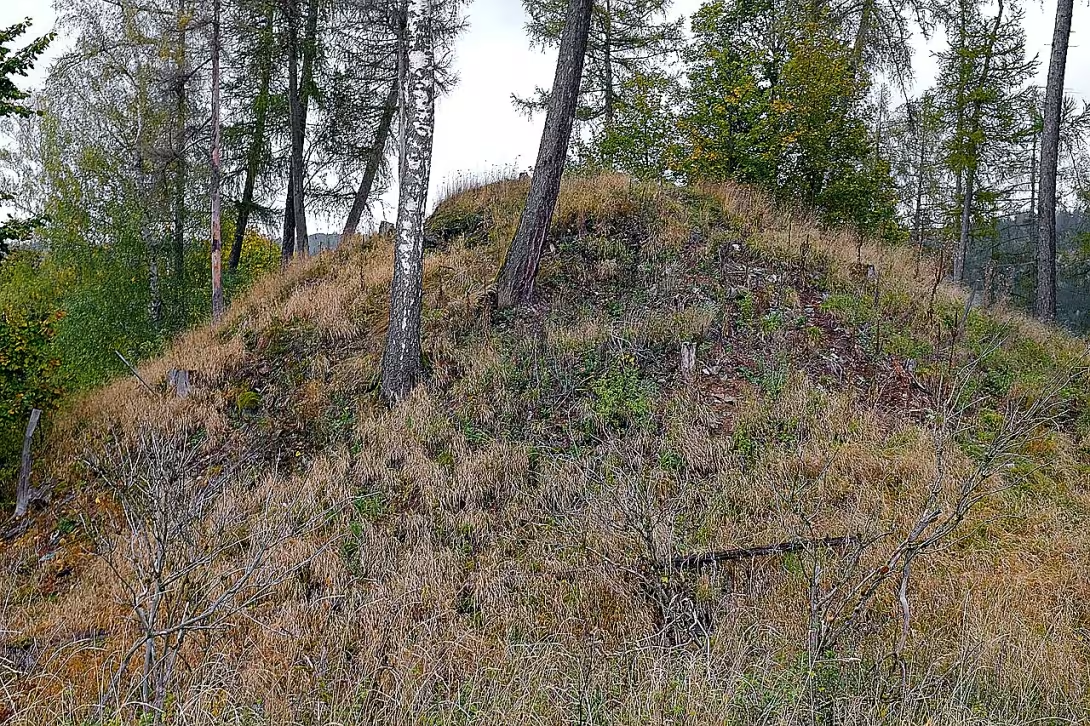
Lazurová hora, also known as Mikhaljejík, is a extinct castle from the 13th century in Tachov district. It lies at an altitude of 620 metres on the northern tip of Lazur Hill above the confluence of Kosi and Jilm creek. Since 2007, the building has been protected as a cultural monument.
There are no written reports of the castle's oldest history. But archaeological findings date back to the 13th century. At that time in the Czech countries Expanded a network of castles and colonization of the border, which accompanied the consolidation of the power of noble families within the royal administration. The castle was founded during this period, but it soon disappeared.
From the point of view of architecture, the object was one of the castles of the bergfrit type. The south side was protected by a ditch. Above it was probably a round bergfrit, from which today only a destructive cone remained. In the safest northern part there was a small palace, while the eastern and western sides fortified the walls.
The castle was located in the cadastrum of the village Vysokov and in the 13th century it was owned by the Monečková from Vyškov. In particular, in 1237-1251, the brothers Vyšemir and the brothers of the castle were masters. The ruins on Lazur Hill are the remains of the castle Vysov, according to which the name of this noble family was named.
Interesting is the name Michaljejk, which was given to the castle by German country scientists. They derived it from the mining settlement Michaelsberg, the predecessor of Michaelsberg Mountain. This settlement was created only when the castle was already falling apart. The construction shows a similar time of origin and ground plan as the castle of Volfštejn. This correlates with the same wolves on the coats of arms of family from Vyškov and from Volfštejn.
Today, the remains of the castle are freely accessible, even if the marked path does not lead to them. The monument is located in the territory of the Lazure Hill Nature Reserve.
Lazurová hora represents a valuable specimen of early medieval fortification in the border. Visiting this extinct castle offers the opportunity to study the remains of bergfrit architecture in natural terrain.
Then and now
Drag the slider to compare how the landmark may have looked when it was built with the view today.
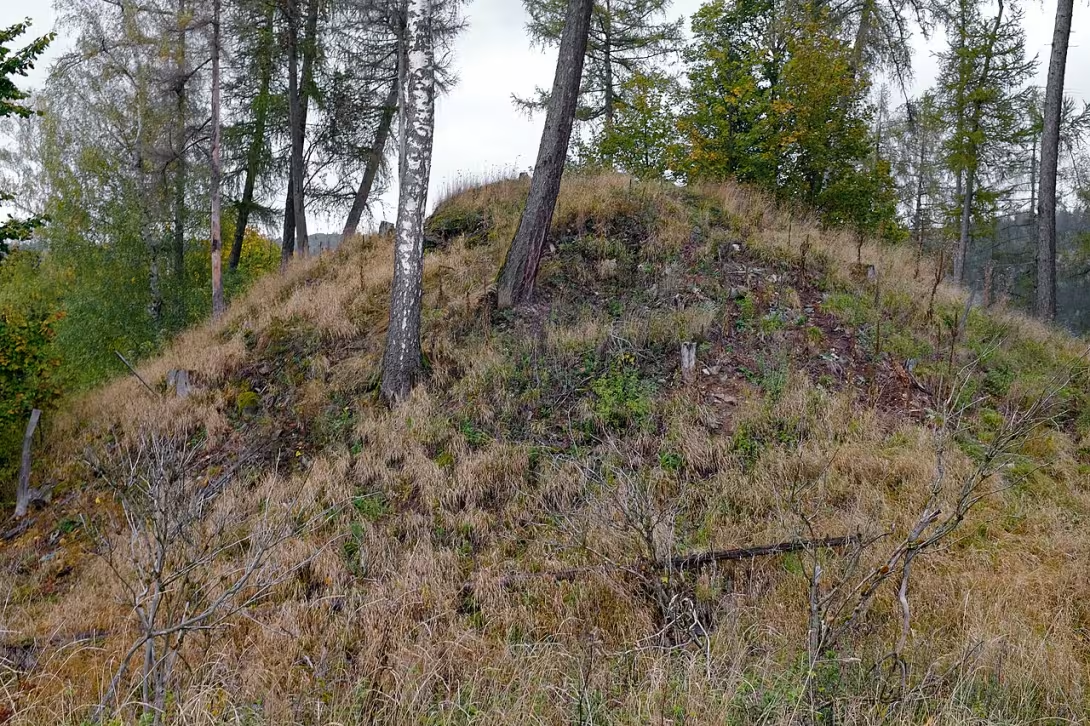
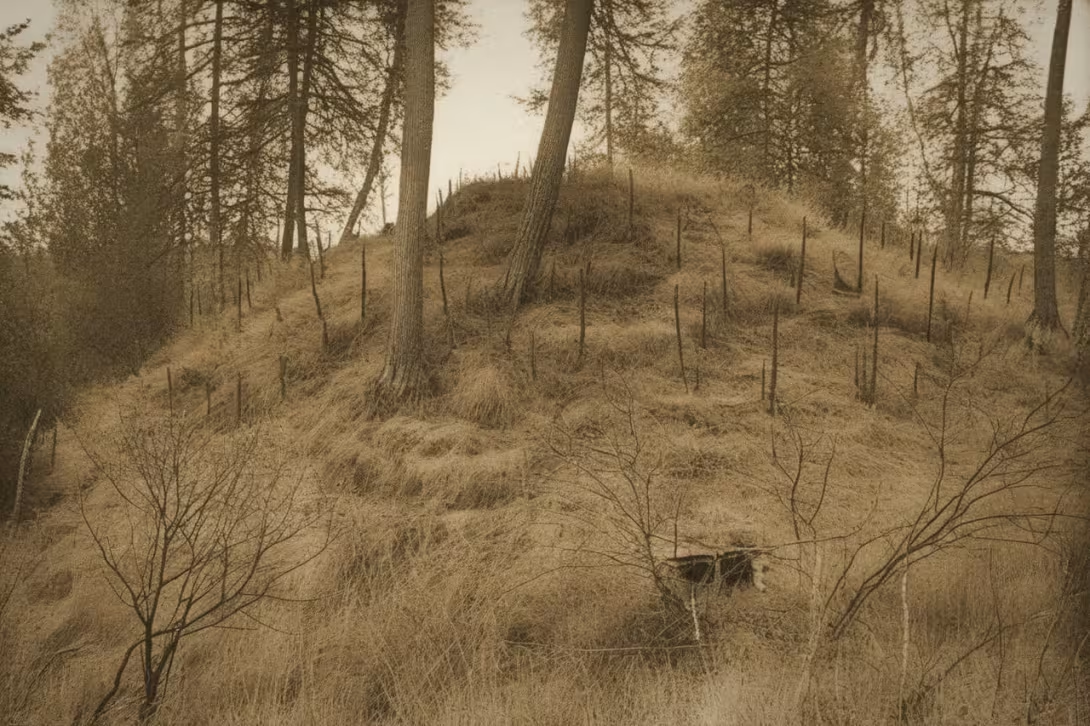
The historical appearance on the left is an AI-generated visualisation and serves as inspiration only.
Historical milestones
- 1237
- Owning the castle in the hands of the brothers Heights and Vyšemír from Vyškov
- 1251
- End of the period of ownership of the castle by the brothers High and Vyšemir
- 1300
- Period of gradual demise and collapse of the wall
- 2007
- The building is officially protected as a cultural monument
Architectural development
The castle had a bergfrit type with a round bergfrit, which is now preserved as a destructive cone. The northern part was a small palace, while the eastern and western sides were fortified by walls. The south side was protected by the neck moat.
Historical events
1237-1251: period when the lords of the castle were the brothers Heights and Vyšemír z Výškova.
Owners
13th century: Monthly from Vyškov (specifically brothers Vyšek and Vyšemír in 1237-1251).
Points of interest
- The 13th century castle is also known as Michaljejk. - He was one of the buildings of the bergfrit type and the south side was protected by the neck ditch. - In 1237-1251 the lords of the castle were the brothers Vyšemir and the brothers Vyšemír of the House of the Moon from Vyškov. - The construction has a similar time of origin and ground plan as the castle of the Volfstejn, as confirmed by the same wolves on the coats of arms of the family. The remains of the castle are freely accessible even if there is no marked path.
Guide
This guide is narrated by a synthetic voice generated by artificial intelligence.
Show guide text
This text was created by artificial intelligence and has not been editorially reviewed. It may contain inaccuracies.
Welcome to Chode Plana. Right now you're standing in a place that once formed a proud symbol of power and protection in this country. The remains of the castle, bearing the poetic name Lazurová hora, are spread out in front of you, but you will also see it in historical records under the name Michaljreik. Now, if you look around you, you may not see the tall walls or the noble gates we know from fairy tales, but that's where the special magic of this place lies. You stand at an altitude of 600 20 meters, where the wind brings the smell of the surrounding forests and the silence that tells stories of ancient times. In front of you lies the fallen castle, which with gradual time became a part of nature, but still carries a print of human work and ambition from the thirteenth century. Let us now move together in time far back, to the time when medieval nobles ruled here. This castle was founded in the thirteenth century, when the landscape was filled with similar fortified settlements. It wasn't just an ordinary house, it was a strategic point in space. At that time, the people here built their homes to be safe and clear. Lazurová hora served as the seat of the nobility of the House of Monthly from Vyškov. Imagine this area eight centuries ago, when the voices of the guards in the grave silence today sounded, the hoof of of horses was beating to the ground, and the air was carrying the smell of smoke from the fires. But this castle, unlike many others who survived centuries, died relatively soon after its creation. It's a fascinating image of how quickly the meaning of one place can be forgotten if political or social circumstances change. Now pay attention to the very form of this place. Even though the walls are long gone, archaeological findings tell us what the castle looked like. Lazurová hora was one of the buildings of the so-called tower type, where the main tower served as the last refuge and observation. Notice the terrain around you. If you look towards the south side, remember that this is where the trench of the neck was located. It was a deep line in the country that was supposed to make it impossible for enemies to access the walls easily. This element was key to defending the castle and creating a natural obstacle that every visitor and attacker had to overcome. Try to figure out in your mind how deep this ditch must have been and what role it played in the overall layout of the building. It is interesting that the floor plan of this castle shows similarities with another building, the Volfštejn Castle, which suggests that at that time there were certain standards of construction that the architects followed. Speaking of people who lived here, we can't ignore the specific names that are associated with this place. In the year one thousand two thirty-seven the castle was owned by brothers named Heights and Vyšemír z Výškova. These two men of the House of the Moon were masters of this estate until the year one thousand two fifty. Imagine them as rulers of this altitude, who managed their vłości here and supervised their subjects. Their era here was relatively short, but it left a trail that brought us to this place today. It's fascinating to think about what kind of conversations these brothers had, what plans they made for their future here, and what made them choose this place for their home. Now we stop at the part that may be the most mysterious. While the beginnings of the castle are clear, its end is rather a gradual appearance. Around the year a thousand three hundred began the period of extinction. The walls began to crumble, people stopped living here, and the construction slowly gave up the power of time and nature. Why did the castle die so soon? Whether there were economic problems, a change in the strategic importance of the region, or other personal circumstances of the families, remains a question that accompanies everyone who stands here. This emptiness you perceive today is basically a monument to time. For centuries the castle was forgotten, until finally it was rediscovered and recognized for its historical value. Since the year two thousand seven, this object has been officially protected as a cultural monument, which means the state has acknowledged the importance of these ruins for our common history. When you look around for the first time from a different angle, you realize that you're standing in a place where three worlds meet. The world of medieval power, the world of oblivion and decay, and finally the world of today's care and protection. Lazurová hora, or Mikhaljejic, is not just a pile of rocks in the woods. It is a reminder that nothing is eternal, but that even what has gone away can be of value if we take care of it and ask the truth about the past. I now ask you to go through the surrounding area in silence. Feel the atmosphere of this place, try to imagine the wind in the walls that are no longer there, and think about the fates of Height and Vyšemír. Explore the surroundings within the marked paths and let your imagination guide you. I hope this short trip to history has helped you better understand the spirit of Lazure Mountain. We thank you for your attention and wish you a pleasant rest of the day when exploring the beauty of our landscape. Goodbye.
Tips for visitors
The best time to visit is spring and autumn months, when nature is blooming or dyeing around the castle, which underlines the atmosphere of the ruins. Transport to Chodová Planá is possible by car and by public connections; Check the specific routes and connections in the maps. Take firm shoes suitable for the forest and plenty of water, because the way to the castle leads through nature. For the best photos I recommend to come in the morning or late afternoon light, which will illuminate beautifully the remnants of the walls and surrounding confluence of the streams.
Frequently asked questions
Can the monument be visited?
This is a ruin. Such sites are often freely accessible, but some can only be visited with a guide or are closed for safety reasons. We have not verified the current situation – take care and respect any restrictions.
Where is the monument?
Location: Chodová Planá. The map on this page shows the exact spot.
Why is the monument protected?
It is listed in the Central List of Cultural Monuments of the Czech Republic as a cultural monument (register no. 1007759107).
Businesses nearby
Do you run a restaurant, accommodation, shop, museum, rental, wellness or other visitor service near this monument? Show yourself directly to the people heading to it — this is how they will see you in the app and on the web:
Nearby
🏰 Historic sites (88)
- Schartlův mlýn 0.8 km
- Pochod Smrti 1.2 km
- zříc. Kühnhackel mühle 2.8 km
- Bývalá pěchotní střelnice 3.2 km
- Pivovarské muzeum 4.3 km
- zámek Chodová Planá 4.5 km
- Zaniklá ves Domaslavičky 4.6 km
- Býv. Caltov 5.0 km
- Morový sloup 6.0 km
- Zámek Berchembogen 6.2 km
- Hornické muzeum 6.2 km Sadová 816 web
- Podhorní kavárna 6.2 km
- bývalý Jirglův mlýn 7.5 km
- Hamrnický zámeček 7.7 km
- Václav Bečkovský - pomník letecké havárie - 8.0 km web
- Goethovo odpočívadlo 8.0 km
- Na paměť Mariánskolázeňských židovských občanů a synagogy 8.1 km
- Zbytky opevnění z bitvy u Třebele 8.3 km web
- sv. Jan Nepomucký 8.3 km
- Chopinův pomník 8.3 km
🍽️ Restaurants and dining (131)
- BEZBAB 3.6 km
- Slunce 4.2 km +420 374 794 232
- Stará sladovna 4.2 km
- Ve Skále 4.4 km Pivovarská 107 +420 374 794 181 web
- Restaurace Stanowitz 4.7 km
- Kavárna Republika 5.4 km
- Mes-Amis 5.9 km Dukelských hrdinů 105 web
- Rud's Pizza 6.0 km web
- Na Namesti 6.0 km +420 374 798 862 web
- Bavaria 6.1 km
- Pizzerie Capri 6.2 km
- U kovárny 6.3 km
- Lidová kantýna 6.8 km
- Hospůdka pod tribunou 6.8 km web
- Hospoda 6.9 km
- U Pejska a Kocicky 7.0 km
- Pivo Limo Párky 7.0 km
- Holiday 7.1 km Plzeňská 98/4 +420 354 623 194 web
- Kronl 7.1 km web
- Villa Berolina 7.1 km web
🏨 Accommodation (104)
- Skautská základna Sruby pístov 1.1 km web
- Fara Michalovy hory 2.1 km web
- Apartmán Rainmühle 2.6 km web
- Penzion Ovesné Kladruby 18 4.1 km web
- Wellness Hotel U Sládka 4.2 km Pivovarská 107 +420 374 617 100 web
- Kemp Stanowitz 4.7 km +420 354 624 673 web
- Tábořiště na Kosím potoce 4.9 km web
- Daniela 6.1 km
- Bavaria 6.1 km
- Guest House Razka 1 6.6 km
- Marion 6.7 km Palackého 360/39 +420 606 463 789 web
- TJ Lokomotiva Ubytování 6.8 km web
- TJ Lokomotiva 6.8 km +420 724 315 342 web
- Na Vodách 6.9 km
- Hotel Goethe 7.1 km web
- Betlem 7.1 km
- George pension 7.2 km web
- Parkhotel Golf Mariánské Lázně 7.2 km
- Golf Hotel Morris 7.2 km
- Hotel SwissHouse 7.3 km
🚲 Rentals and sport (6)
- Sport Bílek 7.6 km web
- Denk 7.8 km
- Sportisimo 7.8 km web
- Michal Kandráč 9.2 km
- Motokrosový areál Cech 9.9 km
- Bazén 14.3 km web
🥾 Hiking and nature (178)
- Puklina LV 5A 0.1 km
- Mramorová jáma 0.3 km
- Lazurový mlýn 0.6 km
- Čiperka 0.7 km
- Pístovská kyselka 1.2 km
- Rybářská kyselka 1.3 km
- Kyselka u Pístovského mlýna 1.3 km
- Vyhlídkový altán 1.6 km
- Illsano 1.7 km
- Stopa Járy Cimrmana 1.8 km
- Pramen Hubertka 2.7 km
- Horka 2.9 km
- Býv. keramická továrna Jana Miloty 3.2 km
- Koňská kyselka 3.3 km
- Koňský pramen 3.3 km
- Milhostovské mofety 3.9 km
- Homole 4.2 km web
- Dolní Kronův mlýn (zříc.) 4.6 km
- Horní Kronův mlýn (zříc.) 4.6 km
- Kastlův mlýn (zříc.) 4.8 km
Accommodation nearby
Themed route
Here is the design of the cruise route:
1. Horseradish A walk along this stream will accompany you pleasantly through the landscape towards the finish line. 2. Elm stream (water flow) - The place where this stream meets the previous stream creates a picturesque confluence in the valley. 3. Lazure Hill (nature reservation) - The road leads through a protected area with rich nature surrounding the castle top. 4. Lazurová hora (castle) - Top of the trip where you can admire the historical ruins at the top of the hill.
Seasonal recommendations
In spring the surroundings of the castle awaken to life and the ruin is surrounded by fresh greenery. The air is clean and light is fine, which creates a feeling of a new beginning. We recommend moisture-resistant shoes because roads can be muddy after melting snow. The best thing is to set off in the morning when nature is the most fresh.
Summer brings a radiant sun and a castle ruin in full heat seems monumental. There is a dense vegetation around the castle and insects in the area. It is advisable to choose light, breathable clothes and take plenty of water with you. The ideal time for visiting is early morning or evening to avoid the greatest temperatures.
In autumn, the landscape around Lazure Mountain is painted in golden and red shades, which gives the place a melancholy atmosphere. Fogs often roll between rocks, which increases the mystery of this place. Practical is to dress up layers of clothing that protect against cold wind. The best are sunny days in October, when the colour of the leaves is the most distinctive.
Zimą castle ruin works strictly and desolate, especially if the stones are covered with snow. The silence and the freezing air underscore the feeling of abandonment and antiquity. It is necessary to wear warm shoes with anti-slip soles and sufficiently thick winter clothes. We recommend a visit in the morning when the most daylight is.
Visualizations and artistic views


The visualisations are generated by artificial intelligence and serve as inspiration.
Photos from the area
Real photos taken near the monument


Zdroj a licence jsou uvedeny u každého snímku.
Tips from visitors
No tips yet. Be the first!
Log in and add your tip.
Sources and literature
Photos: Lubor Ferenc / CC BY-SA 4.0 — Wikimedia Commons. The author and licence also appear when you hover over the image.
Faktickým podkladem tohoto textu byl článek na Wikipedii, jehož autory jsou přispěvatelé Wikipedie. Článek je dostupný pod licencí CC BY-SA 4.0.
Location on the map
More monuments – Chodová Planá
Show all in the municipality


Příběhy a pověsti
Legendy, pověsti a příběhy spjaté s touto památkou
Fotografie návštěvníků
Přidat fotografiiZatím žádné fotografie. Buďte první, kdo přidá fotografii z návštěvy!
Máte k místu vzpomínku nebo zajímavý příběh?
Log in a přidejte svou fotografii nebo hodnoťte.
Za ověřenou návštěvu v aplikaci získáte víc bodů — poznáme podle GPS, že jste na místě.
Reviews and comments