



pomník bitvy roku 1813 (Stradov) Monument
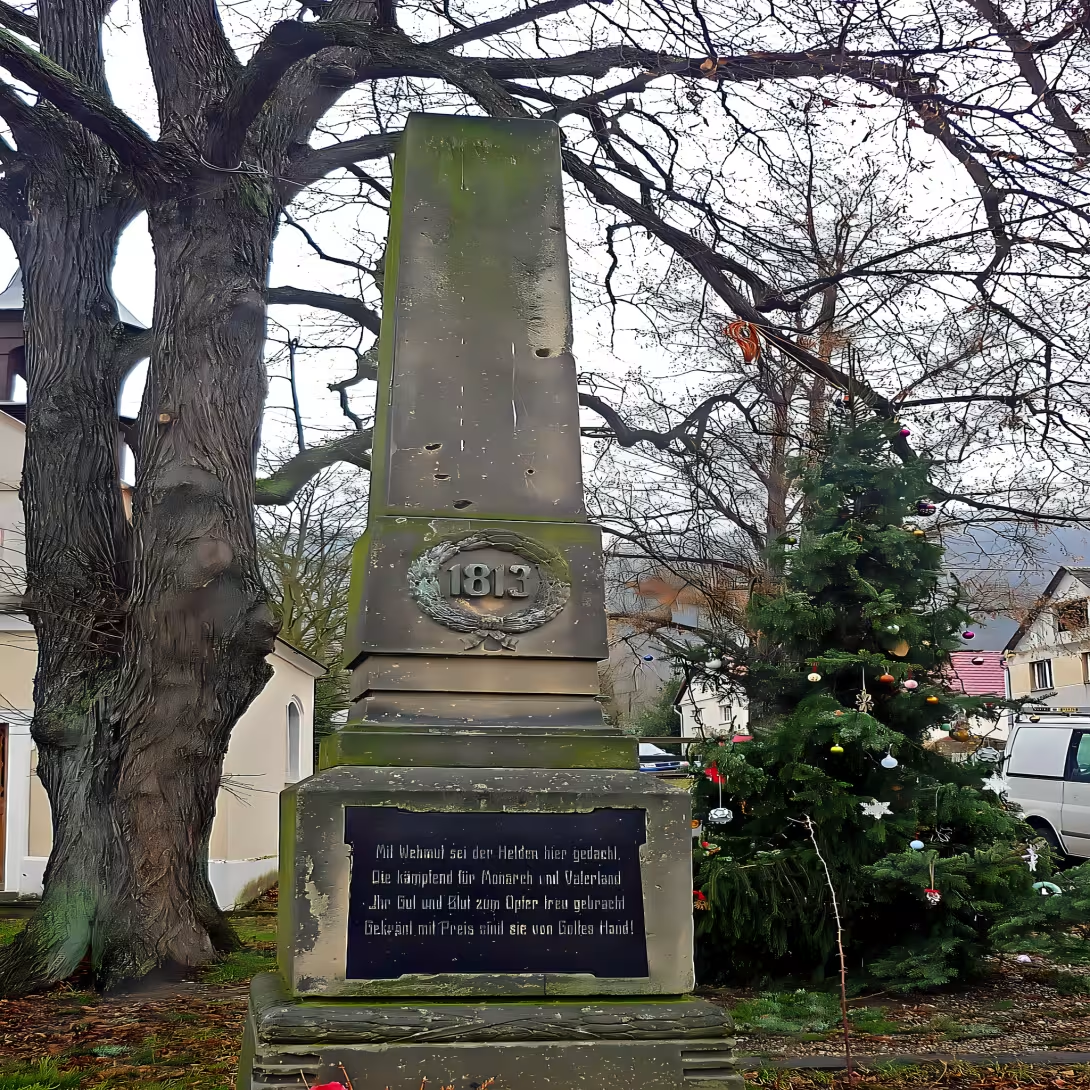
The memorial of the battle of 1813, located in the village of Stradov, is a war monument and instead of respect important for its role during the intense clash at Chlumce and Prestana. This monument stands in front of the chapel of the Virgin Mary and is unique by its inception by the local municipal government, which distinguishes the Stradov memorial from other great monuments in the battlefield. The Monument takes the form of a slender, chamallow needle mounted on a prism plinth and is decorated with a black granite inscription that resembles fallen heroes of fighting in 1813.
Stradov played a key role as a back point in Russian defense during the battle. On 29 and 30 August 1813, intense clashes took place between Russian troops under the leadership of General Alexander Ivanovich Ostermann-Tolstoy and the French Corps of General Dominik Vandamm. Stradov has repeatedly been conquered by both sides, leading to considerable loss of life and almost total destruction of the village.
The memorial was created on the occasion of the 100th anniversary of the Battle of 1913, a period of massive monumentalisation of the battlefield. This process reflected the period of political and national interests of the winning powers. The Stradov monument is the first one on the site, which was initiated by the local government, which underlines its community importance. The author of the design and realization was probably the local sculptor Kohlschütter from Krupka.
Architecturally, the monument is built as a 3.8 meter high sandstone obelisk with a prism plate and a black granite inscription. Its location on the Stradov baits was chosen not only because of the geographical center of the then battlefield, but also because of the symbolic relationship to the neighbouring chapel of the Virgin Mary, which survived the war rage.
The ceremonial discovery and consecration of the memorial took place on 4 August 1913 with the participation of local royalties and the general public, highlighting its importance as a monument to liberation from foreign yoke.
Today, the monument is lost in an unpreserved crop after World War II, but it still represents an important historical monument. His visit offers a view of the region's rich history and his important role in the war events of the 19th century.
The 1813 Memorial of the Battle is not only a monument to historical events, but also a testament to the local sense of community and shared memory. His visit offers a valuable insight into the past and recalls the importance of historical care for the preservation of historical sites.
Historical milestones
- 1813
- The Battle of Chlumce and Prestana, during which the village Stradov was repeatedly conquered and almost completely destroyed.
- 1913
- Building a monument to the 100th anniversary of the battle.
Architectural development
The building is built as a 3.8m high chamber needle mounted on a prism plinth. On the front side there is a inscription plate made of black granite.
Historical events
29 and 30 August 1813: The fierce struggle at the site Stradova, which served as a supporting point of Russian defence.
Points of interest
- Pomník bitvy z roku 1813 se nachází ve vsi Stradov a je válečný památník s důležitou roli během střetnutí u Chlumce a Přestanova. - Tento pomník byl iniciován místní obecní samosprávou, což jej odlišuje od ostatních památek na bojištním území. - Stradovský pomník je prvním na areálu, jehož vznik iniciovala místní samospráva, zdůrazňující jeho komunitní význam. - Pomník byl odhalen 4. srpna 1913 s účastí místní honorace a široké veřejnosti, což zdůrazňuje jeho význam jako památníku osvobození. - Dnes je pomník ztracený v neudržovaném porostu po druhé světové válce, ale stále představuje důležitou historickou památku.
Guide
Show guide text
This text was created by artificial intelligence and has not been editorially reviewed. It may contain inaccuracies.
Welcome to the quiet and calm heart of the village Stradov. Right now, when you listen to these words, you are standing in a place that is deeply and irreversibly linked to the stormy history of this entire region. Look around you. You are on the baits, in the space that is now surrounded by the calm of the present, but which, under its superficial silence, hides the memories of very difficult and fateful times. In front of your eyes is this thin, chamallow needle, which with its presence reminds of all the weight of the events that took place here. Notice how this object floats in space right in front of the Virgin Mary Chapel. It is a place where faith and historical memory meet, where time has stopped to allow us to remember those who were before us. This monument is not just a piece of stone, it is a silent witness who tells us the story of fighting, destruction and the subsequent rise.
To really understand why this object is standing right here and why it is so important to this community, we need to go back deep into the past together. Imagine the year one thousand eight hundred and thirteen. It wasn't just an ordinary year in the calendar. It was a time of great chaos, great armies and relentless war clashes. The battles at Chlumce and Prestana, which are being discussed here, have been absolutely devastating to this area. Stradov was not just a passive observer of these events, he was right at the center of the event. The village was repeatedly conquered, its houses destroyed and the people who lived here had to face incredible suffering. The almost complete destruction of the entire village was a reality that we can hardly imagine today. Every stone in this surrounding country could tell the story of the time when the peaceful villages became a battlefield where many people's lives were decided. The pain and the destruction were so deep that they became part of the identity of this place.
And yet, after 100 years, something extraordinary happened. In the year one thousand nine hundred thirteen, exactly a hundred years after the horrors, people decided that memory must not be lost in the dust of time. It wasn't just a reminder of the old battle. The creation of this monument had a much deeper and stronger meaning. It was a symbol of liberation from a foreign yoke, an expression of a deep desire for freedom and dignity. At that time, people needed to remember that even after the greatest darkness came light and that their existence had value. This monument was therefore built as a sign of hope and as a permanent proof that even from debris can be raised.
Now pay attention to the very form of this monument that you are now observing. Notice its shape. It's a thin, chamallow needle. This geometry does not seem cumbersome or overwhelming, but rather noble and upward, as if trying to combine earthly suffering with celestial calm. There's a black granite label on his body. The black color of the stone gives the whole seriousness and dignity that is absolutely necessary for such a war monument. The black granite acts as a solid foundation that can withstand both time and weather. The architect who designed this whole was called Kohlschütter. His work here embodies a combination of simplicity and strong expression. You can look at the details of this granite plate as a permanent witness to what happened here. The overall resemblance of the monument is such that it makes a man think and the silent honours of the past.
Speaking of these fighting events and the people who played key roles in them, we cannot forget the names that appear in these historical contexts. Names like Alexandr Ivanovič Ostermann-Tolstoj or Dominik Vandamm are very important in this history. Even though their names may seem distant or foreign today, their decisions and actions directly affected the fate of the people in this area and the very fate of this village. They were the faces of that time, when the fates of nations were broken in these fields and in these paths. Their presence in the history of this place is inseparable from the very struggle that took place here.
And now I'm going to tell you something that makes this monument really special and that completely distinguishes it from all the other monuments that you can find on the battlefield around here. Most of these structures were founded by state, large armies or government institutions. But not here. This monument was initiated and financed directly by the local municipal authorities. Imagine the great will and the power of the local people. They were not just soldiers or remote government officials, but the people themselves who decided that their history deserved to be preserved in their own way. That is the true importance of this place. It's a monument created by humans for people, expressing the pride of the local community on its roots. That's a fact that radiates from this place and that makes it more valuable than just a rock.
This monument is the first in this whole complex, which reminds us so clearly and strongly of the past. It's the beginning of a journey through history that you can explore and discover in this area. We hope that this brief moment at the memorial has helped you better understand the meaning of this place and its depth. Continue to walk, look around you, perceive the atmosphere of this place and let yourself be carried away by its story. Thank you for stopping by and paying attention to this important symbol. Goodbye.
Tips for visitors
The best time to visit is in the spring or autumn season when vegetation and landscape are in their most beautiful glow. This time of year also offers lighter weather for long walks in the surrounding countryside.
For those travelling by public transport, it is advisable to check the current schedule of buses or trams for connections from nearby cities.
When visiting, bring protective clothes and shoes suitable for walking as the terrain around the monument is often unbalanced. Don't forget to also bring an umbrella, especially in the summer months.
For photography it is best to come at the beginning of the morning or when the sun sets. These days offer best for dazzling light and long shadows that can highlight the historical architecture of the monument.
It is possible to visit the Chapel of the Virgin Mary and explore the landscape monument zone of the battlefield. These places offer interesting information about the history of the battle and are suitable places for families with children looking for educational and recreational activities.
Frequently asked questions
Can the monument be visited?
This is a structure in a public space that can usually be seen from outside free of charge. We have not verified that this particular one is freely accessible.
Where is the monument?
Location: Stradov, Ústecký kraj. The map on this page shows the exact spot.
Why is the monument protected?
It is listed in the Central List of Cultural Monuments of the Czech Republic as a cultural monument (register no. 1000154678).
Businesses nearby
Do you run a restaurant, accommodation, shop, museum, rental, wellness or other visitor service near this monument? Show yourself directly to the people heading to it — this is how they will see you in the app and on the web:
Nearby
Kaple Panny Marie, krajinná památková zóna bojiště, pomníky ve Varvažově, Přestanově a Chlumci.
Accommodation nearby
Trips and activities nearby
Guided tours, tickets and activities nearby from GetYourGuide
Affiliate link: if you buy from the partner, we may receive a commission. The price for you does not change.
Search tours and activities →Themed route
Thematic cruise route from the village Stradov
1. Memorial of the Battle of 1813 (Stradov) - historical monument This monument is our main destination and serves as a memory of an important historical moment. It is a place where you can remember the events of 1813 and appreciate the importance of this battle for the region.
2. Chapel of the Virgin Mary - religious monument After visiting the memorial we move to a nearby chapel, which is famous for its architecture and peaceful environment. The Chapel of Our Lady offers beautiful facilities for relaxation and reflections after looking at the historical monument.
3. Landscape monument zone battlefield - natural monument This area is an ideal place for those who want to understand history in the context of nature. The landscape monument zone of the battlefield offers views of places that witnessed important events, and it is a great way to learn more about the history of the region.
4. Monuments in Varvajov - historical monuments The following aim is to visit monuments in the village of Varvájov. These monuments are important for understanding the broader context of the battle of 1813 and offer another view of the historical events that shaped the region.
5. Monuments in Prestana - historical monuments The final point of the route is a visit of monuments in the village of Prestanov. These monuments close our path to history and offer another opportunity to learn more about the past of the region.
This route offers a comprehensive view of historical events associated with the battle in 1813, using only selected monuments and zones listed in the requirements.
Seasonal recommendations
Spring: In the spring season the atmosphere in Stradov is beautiful due to peaceful lighting and the beginning of the green trees around the monument to the battle of 1813. This is the time when nature leaves its winter clothes, creating views full of life and new beginnings. Since spring is not a period of great crowds of tourists, it is an ideal time for a peaceful visit. Clothes suitable for mild temperatures and the possibility of snow or wet weather are recommended. The best time to visit is in the morning when the water in the natural park is calm and the air is clear.
Summer: Summer brings long days full of sunlight, which increases the attractiveness of Stradova for visitors. High temperatures and full growth of trees create a pleasant atmosphere, but they also cause large crowds of tourists, especially in the high summer season. To ensure comfort, it is recommended to visit the monument quickly in the afternoon and wear light clothes suitable for warm weather, including sun protection. Don't forget to take the drink with you and be prepared for the possibility of circumvention or waiting for large crowds.
Autumn: In autumn the Stradov offers a beautiful view of the coloured leaves of trees, creating a unique atmosphere full of calm and mild temperatures. This time is ideal for visiting because the crowd period is already coming to an end. Comfortable clothes suitable for colder weather and the possibility of solar intervals is recommended. The best time to visit is in the afternoon when temperatures are mild and nature offers its most beautiful veil.
Winter: Winter in Stradov brings peaceful and quiet visits because the monument is less visited. The atmosphere is characterized by cold temperatures and snow cover, creating a unique winter landscape around the monument. It is important to wear warm clothes and suitable shoes to avoid cold and possible snow conditions.
Visualizations and artistic views


The visualisations are generated by artificial intelligence and serve as inspiration.
Photos from the area
Real photos taken near the monument


Zdroj a licence jsou uvedeny u každého snímku.
Tips from visitors
No tips yet. Be the first!
Log in and add your tip.
Sources and literature
Photos: SchiDD / CC BY-SA 4.0, rozlišení zvýšeno umělou inteligencí — Wikimedia Commons. The author and licence also appear when you hover over the image.
Faktickým podkladem tohoto textu byl článek na Wikipedii, jehož autory jsou přispěvatelé Wikipedie. Článek je dostupný pod licencí CC BY-SA 4.0.
Location on the map
More monuments – Stradov
Show all in the municipality
Příběhy a pověsti
Legendy, pověsti a příběhy spjaté s touto památkou
Fotografie návštěvníků
Zatím žádné fotografie. Buďte první, kdo přidá fotografii z návštěvy!
Log in a přidejte svou fotografii nebo hodnoťte.
Za ověřenou návštěvu v aplikaci získáte víc bodů — poznáme podle GPS, že jste na místě.
Reviews and comments