



Pomník Jindřicha Šimona Baara Memorial
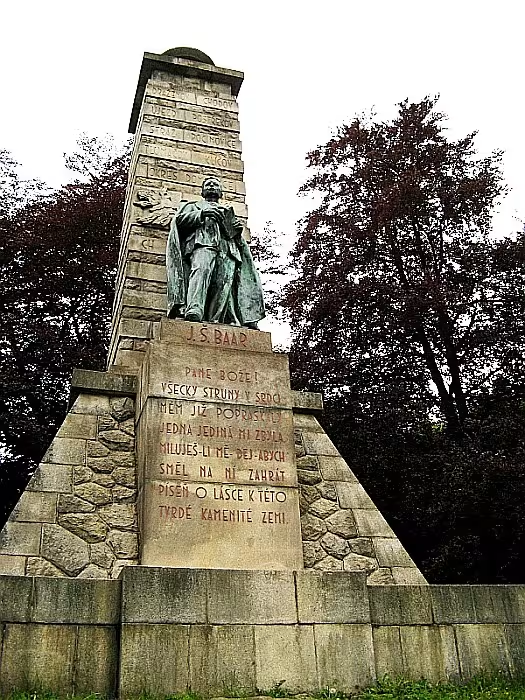
Pomník Jindřicha Šimona Baara on Previews in the Klenčí pod Čerchov village is a fourteen meters tall historical monument. On top of it is a three-metre bronze statue of a writer, a poet, a collector of fairy tales and a Catholic priest. This work of sculptor Ladislav Šaloun and architect František Kuželka has been included in the list of cultural monuments of the Czech Republic since 3 May 1958. From the location it offers views of the whole of Chodsko, including the town of Domazlice.
The creation of the monument is linked to the early 1930s. At that time Czechoslovakia faced the consequences of the economic crisis and rising tensions in the border. The ceremonial unveiling was carried out on July 5, 1933 by the composer and the native of the Chode Jindřich Jindřich.
The architectural solution consists of a pedestal made of stone blocks, which donated to the pedestrian villages and associations. It is mounted on a mound in the shape of a chamallow needle on top of which lies a bronze statue of a writer.
The dramatic fates of the memorial marked the occupation during World War II. In August 1940, the Nazis wiped out a stone pedestal and took its parts away. However, the Chodůvá showed their determination and secretly delivered the bronze statue to Chodská Castle in Domazlice, where it remained hidden throughout the war. The post-1945 period dedicated to restoring damaged national monuments and honoring the victims of the occupation. The second ceremonial revelation of the renewed work took place on 5 July 1947. A pedestal of burnt Lidice was inserted into the new pedestal.
Key events define the following years: 1933 with the first discovery, 1940 with the destruction of the pedestal and the hiding of the statue, 1947 with the second discovery, and finally summer 2023 when the monument underwent reconstruction.
Today, the Monument on the Outlook is an accessible place. In its vicinity are also monuments of fallen American soldiers and five Red Armyans. The site is worth visiting thanks to its cultural value, linked to the legacy of the important personality of the Chode region, and a distant view of the landscape.
Historical milestones
- 1933
- The ceremonial unveiling of the monument by music composer Henry Henry Henry.
- 1940
- The Nazis swept up a stone pedestal and the statue was hidden in Chode Castle in Domazlice.
- 1947
- The second festive revelation of a monument with a new pedestal containing a stone from Lidice.
- 2023
- There was a reconstruction of the memorial.
Architectural development
The base of the monument consists of stone blocks donated by the pedestrian municipalities and associations, which are located on a mound in the shape of a chamber needle. The top of the work is a bronze statue. A stone from Lidice was inserted into the pedestal in the reconstruction after World War II.
Historical events
In 1933 the monument was first festively revealed. In 1940, the Nazis were destroyed and the statue was taken to Chode Castle. The opening of the renewed monument took place in 1947. In the summer of 2023 the monument was renovated.
Points of interest
- He's 14 meters tall and has a three-meter bronze statue on top. - The work was created by sculptor Ladislav Šaloun and architect František Kuželka. - During the war, the Nazis destroyed the pedestal, but the statue was hidden in Chode Castle. - On the second discovery in 1947, a stone from Lidice was inserted into the pedestal. In the summer of 2023, the monument was renovated.
Guide
Show guide text
This text was created by artificial intelligence and has not been editorially reviewed. It may contain inaccuracies.
Welcome to this high-rise place where history combines itself with the widest horizons you can see in this part of the country. You're standing in front of a monumental piece that dominates the whole neighborhood. Before we go into his story, let yourself stand for a moment and perceive the atmosphere of this place. Look up, really high. In front of you is a 14-metre monument that connects the earth's soil to the sky as a fixed point. Feel the height, the weight, and the presence this place emits. If you look around now, you'll see why this place is chosen for that very purpose. You are on the Previews in the Klenčí nad Čerchov village and this view, which you have in front of you, is one of the most beautiful in all of Chodsko. Your eyes can now slide on hills, forests and villages, all the way to the Domazlice itself, which are looming in the distance. It's a look that must consume you.
Now, however, pay attention to the memorial itself, which stands right in front of you. What you see is not just a piece of stone and metal, but a living chronicle of human spirit, faith and suffering. This monument is dedicated to Henry Simon Baar. You may not remember his name, but for this territory and for the Czech people, this man was of great importance. He was not only a spiritual father, a priest, but also a respected writer whose words had weight and strength. This monument was created as an expression of respect for his character and his work. The whole process of its creation was carefully planned to match the size of the person it reminds of.
Let's see how this work was made. Notice the precision with which everything is connected. At the top of this 14-metre construction, you will see the most important - three-meter bronze statue of Henry Simon Baar himself. Watch as the light is reflected from this dark, shiny metal. The statue looks noble and human at the same time. Two great masters of their field were behind all this visual. The sculptor Ladislav Šaloun, who breathed in the bronze life and movement, and architect František Kuželka, who designed this whole monumental structure and ensured that it fit perfectly into this place and acted harmoniously with the surrounding landscape. When you look at the statue, try to perceive her face, her attitude as a priest and a writer looking into the world. It is a work that required not only technical art, but a deep understanding of the human soul.
But the history of this place is not just a story of fame and artistic success. It's also a story about fighting, about destruction and an incredible return to life. The first solemn revelation of this monument ended in 1933. It was a moment of joy and national pride that also accompanied the music of composer Henry Henry. People gathered to honor the memory of a man who meant so much to them. But the peaceful times weren't supposed to last forever.
Now we must return in time to the dark years when the weight of occupation prevails over our country. In 1940 the Nazis came, who tried to destroy everything that was important to Czech humanity. It wasn't just people who wanted to take over the territory, but also people who wanted to erase our memory and our identity. In this attack, the stone base on which the statue stood was brutally smashed. The monument was damaged, its foundation destroyed, and this place seemed to be ruined forever. But people didn't get broken. There was a time of incredible courage at that time. To prevent the statue from disappearing and completely destroyed, it was hidden in secret and in the greatest danger. They hid her in Chode Castle in Domazlice so the enemy wouldn't find her. Imagine the tension, the courage of people who risked their own lives to save this symbol.
After the war, when the clouds of darkness broke over the ground again, the time of recovery came. In 1947, the second solemn revelation took place. But it was different than the first. The monument no longer had its original appearance, but it gained a new pedestal. And it is in this new pedestal that there is something that gives him enormous spiritual weight. A stone from Lidice was placed in the stone. This stone is not just an ordinary stone from the soil. It is a symbol of pain, sacrifice and at the same time the immense power of survival. The presence of this stone here, at the feet of a statue of a priest and a writer, creates a bond between the fate of this place and the tragedy that the world had to experience.
Even in modern times, this monument is constantly changing and strengthening. In 2023, a thorough reconstruction took place, thanks to which we can stand here today and perceive this monument in its present, repaired and dignified form. It is proof that the memory of important people and of our common history must be kept constantly carefully for future generations.
If you want to better understand the size of this place, I suggest you now take a few steps around the monument. Notice how the view of the statue changes depending on the angle you're looking at. Feel the contrast between rock hardness and bronze smooth. And then, when you've had enough, look up to the horizon again. Let yourself be consumed by the wide view of Chodsko. It is precisely this combination of monumental art and infinite beauty of nature that makes this place special.
Thank you for spending this moment with us and for being interested in the story that is engraved in stone and bronze. We hope that this view and these words have enriched you. Continue to explore the surroundings now, explore other paths and enjoy the beauty of this landscape. Goodbye.
Tips for visitors
For best experiences we recommend a visit during late afternoon or morning. In these hours, the location offers the best views of the whole of Chodsko and the city of Domazlice and the light is ideal for photography.
You can reach the place by car or use public transport; Please check the current connection in the search engine.
To visit with families and children we recommend to take comfortable shoes and plenty of drinking water as you move in open terrain. It is advisable to prepare for a nature walk.
For the best photos take a look towards the town of Domazlice, where the bronze statue excels beautifully. In the vicinity you can also visit the memorial of fallen American soldiers or the monument of five fallen Red Armyans.
Frequently asked questions
Can the monument be visited?
This is a structure in a public space that can usually be seen from outside free of charge. We have not verified that this particular one is freely accessible.
Where is the monument?
Location: Plzeňský kraj. The map on this page shows the exact spot.
Why is the monument protected?
It is listed in the Central List of Cultural Monuments of the Czech Republic as a cultural monument (register no. 1000149835).
Businesses nearby
Do you run a restaurant, accommodation, shop, museum, rental, wellness or other visitor service near this monument? Show yourself directly to the people heading to it — this is how they will see you in the app and on the web:
Nearby
Památník se nachází na Výhledech v katastru obce Klenčí pod Čerchovem a poskytuje výhled na celé Chodsko a město Domažlice. V jeho blízkosti stojí památník padlých amerických vojáků a památník pěti padlých rudoarmějců.
Accommodation nearby
Themed route
1. Memorial of five fallen Red Armyans (type: memorial) - This object resembles fallen soldiers. 2. Memorial of fallen American soldiers (type: memorial) - Here you will honor the memory of the soldiers of the American forces. 3. Pomník Jindřicha Šimona Baara (type: memorial) - The main goal of your journey, dedicated to an important figure. 4. View of Chodsko and Domazlice (type: view) - From this place you can observe the whole area and the city.
Seasonal recommendations
Spring: In the spring season, the atmosphere around Henry Simon Baar's memorial is full of newly growing green and flowering shrubs, adding an impression of life and renewal. Sun rays illuminate the statue with fine shadows that change with the daily course. It is advisable for visitors to come in the early afternoon when temperatures are pleasant and the crowd is less than the level of sunlight. It is recommended to wear light clothes with the possibility to add a layer for cooler moments.
Summer: Summer offers long and sunny days that illuminate the monument with bright and sharply defined shadows. Flowers in the surroundings are at their peak and add a colorful palette to the landscape. This time is most visited, so it is recommended to arrive early in the morning or later in the afternoon to avoid large crowds. Wearing light and light clothes with sun protection is crucial for comfort.
Autumn: In the autumn, a gray touch comes to the surroundings of the monument, but trees and shrubs are characterized by a colour palette of gold and red shades. The sunlight is less intense, giving the statue mild and quiet lighting. This season usually has less traffic than in summer, so it offers an opportunity for a quieter walk. It is recommended to wear layered clothes that allow you to adapt to cold morning and noon.
Winter: Winter's freezing atmosphere surrounds the monument with a fine snow blanket or ice shapes that add a mystical feeling. The sunlight is weaker and creates soft shading, giving the statue a quiet and peaceful look. Wearing warm clothes with protection against cold and wind is essential for comfort during the visit.
Visualizations and artistic views


The visualisations are generated by artificial intelligence and serve as inspiration.
Photos from the area
Real photos taken near the monument


Zdroj a licence jsou uvedeny u každého snímku.
Tips from visitors
No tips yet. Be the first!
Log in and add your tip.
Sources and literature
Photos: Sovicka169 / CC BY-SA 3.0 — Wikimedia Commons. The author and licence also appear when you hover over the image.
Faktickým podkladem tohoto textu byl článek na Wikipedii, jehož autory jsou přispěvatelé Wikipedie. Článek je dostupný pod licencí CC BY-SA 4.0.
Location on the map
More monuments – Plzeňský kraj
Show all in the region

Příběhy a pověsti
Legendy, pověsti a příběhy spjaté s touto památkou
Fotografie návštěvníků
Zatím žádné fotografie. Buďte první, kdo přidá fotografii z návštěvy!
Log in a přidejte svou fotografii nebo hodnoťte.
Za ověřenou návštěvu v aplikaci získáte víc bodů — poznáme podle GPS, že jste na místě.
Reviews and comments