



přečerpávací stanice Bruska Building
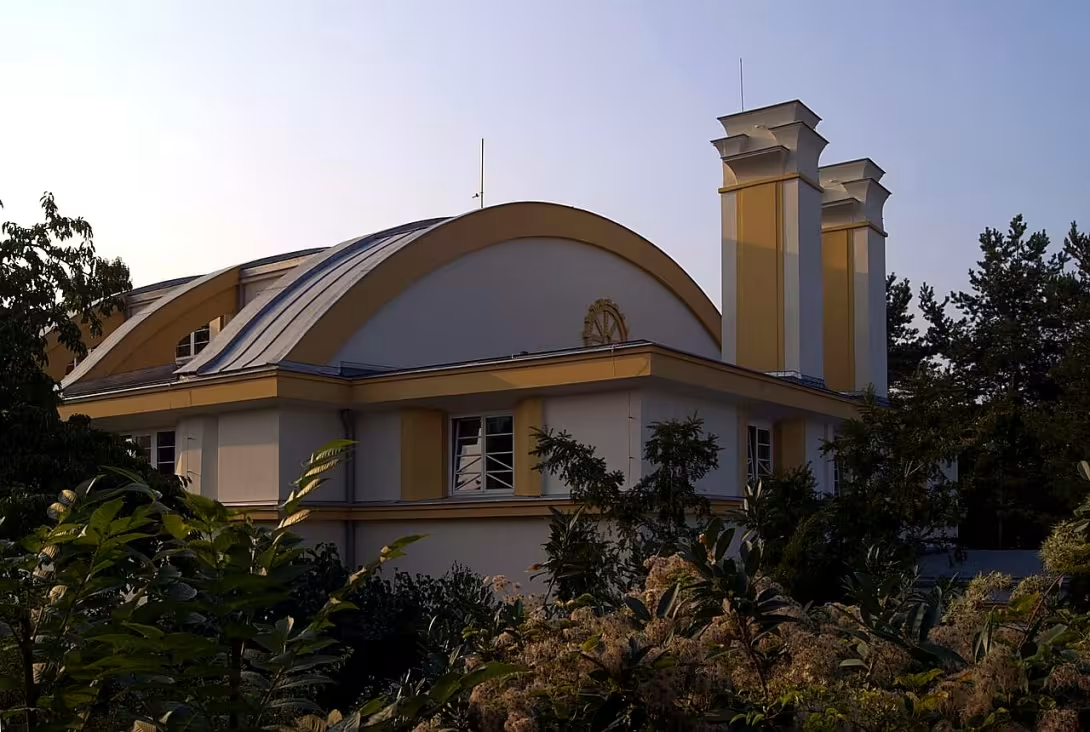
Bruska's pumping station is a unique water object in Prague Rošovice, which provides water supply to the districts of Hradčany and Letná. This historical complex is one of the oldest service stations in the territory of Prague and is important thanks to the preservation of original technology and continuous operation since its foundation.
The construction was built as an emergency solution for critical water scarcity in Prague. After the First World War, namely in 1919, construction works financed as an emergency measure started. The project, planned before the war, was intended to address water shortages for military-occupied Hradčany and Letná. The design authors are probably Jaroslav Žofka, Luděk Řehák and Josef Němec, while the construction company Ing. B. Hollmann carried out the implementation between 1920-1930. The basic works were completed in 1924, and the technology equipment was then installed by Daněk together with the electrical plants František Křižík a.s. Praha Karlín.
The building of the station has a rectangular floor plan, it is double-storey, underglued and covered with a segmental roof. The engine room with dimensions 19,70 x 25.85 meters is covered with an arc reinforced concrete structure with a height of 6,8 metres and an arc lift of 4,8 metres. Arch beams are connected by beams and around the perimeter with armoured plates with steel windows. The construction rests on iron concrete pillars and brick walls. The interwindow pillars are stored on a horizontal frame, which serves as a base for the ride-on crane. On the ground floor there is a guard and apartments for the water and machinery man.
There are two leveling waters west of the building. The first, Bruska 1, comes from the same period as the station, while the second, Gruska 2, is younger and serves for the treatment technology in the water tower. The waters have a floor plan of 47 x 32.9 metres, a water height of 4 metres and a volume of around 5 881 to 5 895 m ³. The bottom is reinforced concrete thickness 30 cm and a reinforced concrete layer with a 15 cm thick cross armour. The vertical walls of a height of 4.9 meters are formed by arches inverted. The Hennebique ceiling is 80 cm thick and is slightly overslept for drainage. Each watercourse is lit by four skylights with ventilation vents.
The capital of Prague is the owner of this building, which was declared a cultural monument on 28 April 2011 due to its historical value and continuous operation.
Bruska's pumping station is a rare technical unit that combines industrial architecture with functional water works. It is a place worthy of visiting everyone interested in the technical development of Prague and preserved technology from the beginning of the twentieth century.
Historical milestones
- 1919
- Design of construction in the framework of emergency work for water provision for Hradčany and Letná.
- 1924
- Completion of basic construction work on the building.
- 1930
- Implementation of the petrol station technology by Daněk and electrical plants František Křižík.
- 2011
- Announcement of an object for a cultural monument.
Architectural development
The building has a rectangular plan and is covered with a segmental roof. The construction of the machinery room uses arc reinforced concrete beams and pillars. Water is built from reinforced concrete vaults using the Hennebique ceiling.
Historical events
1919: Design of the project in the context of emergency work; 1924: Completion of basic construction work; 1930: Installation of petrol station technology; 2011: Announcement for cultural monument.
Owners
Prague City
Points of interest
- Gruska pumping station is a unique water object in Prague Rošovice. - This historical complex is one of the oldest petrol stations in the territory of Prague and is important thanks to the preservation of original technology and continuous operation since its establishment. - The construction was built as an emergency solution for critical water scarcity in Prague after World War I, namely in 1919. - The capital of Prague is the owner of this building, which was declared a cultural monument on 28 April 2011 due to its historical value and continuous operation. - Bruska pumping station is a rare technical unit that combines industrial architecture with functional water works.
Guide
Show guide text
This text was created by artificial intelligence and has not been editorially reviewed. It may contain inaccuracies.
Welcome to Prague Rostovice. You're standing in front of one of the most interesting, though perhaps less well-known technical works in our city. The přečerpávací stanice Bruska stands before you. The first impression of this place may be moderate, but behind these walls is a fascinating story about how the city cared for its most basic need, which is drinking water. Feel the atmosphere of this place, which combines industrial functionality with deep historical value. It's a place where the need to survive with engineering art meets.
Let us now think together about how this building was built and in what context it was built. Imagine Prague after World War I. It was a period of great change, uncertainty and often need. It was in the year nine hundred and nineteen that this work was designed as part of urgent work. Why was this building so important? The answer lies in a more political and military situation. During the time of military occupation of the city there was a serious lack of water, which was a critical situation for the whole of Prague. It was essential to ensure a reliable and stable water supply for strategically important districts, namely Hradčany and Letná. The Brussels station was thus created as an emergency measure to save these areas from a shortage of fluid. The basic works on the building were subsequently completed in the year nine hundred twenty-four.
Now pay attention to the architecture itself and to what you see before you. Look at the overall appearance of the object. The main element that forms the core of this station is the engine room. Note that it is built using an extensive reinforced concrete structure. At that time, it was a very modern material that made it possible to build solid, durable and stable buildings capable of bearing the enormous load that heavy pumping machines and vibrations of their operation carry. In addition to the machinery room itself, this complex includes two balancing water jams. These tanks were key to the proper functioning of the whole system because they helped maintain stable pressure and water levels, which were then pumped into the heights of Hradčan and Letná. The whole project was the work of three architects, which were Jaroslav Žofka, Luděk Řehák and Josef Němec. When looking at the construction, notice how the whole concept is focused primarily on its purpose. There is a sense of functionality and practicality, which is typical of the technical structures of the time, while maintaining a certain dignity and order.
Speaking of this station, we can't ignore the people and companies who gave her life through their technology. The construction of the walls itself was just the beginning. The real magic began in the year nine hundred thirty, when the pumping technology itself was installed into the building. The company Daněk and very important electrical plants František Křižík worked on this challenging task. The name František Křižík is synonymous with innovation and brilliance in electrical engineering in Czech history. The fact that his races left a mark here only underlines the high importance of this place. Imagine the noise of machines, the smell of ozone and the energy that began to flow here, so that water could overcome the height differences of the terrain and reach into homes and offices in the upper parts of the city. Even though we may not see the machines from the outside today, their presence in the building still defines the character of the whole place.
Now invite you to realize one very interesting fact that makes Grinder a real one. This pumping station is not only a unique water object within Střešovice, but is one of the oldest service stations in the whole territory of Prague. But what is truly incredible is a combination of two things. First, the station has, to an extraordinary extent, maintained its original technology. Nowadays, when everything changes in the order of several years, it is such a rare thing to preserve. On the right, since its foundation, the station has been in continuous operation. This means that, from the time of the Interwar Republic to this day, this building is still in office. He is a silent but hardworking witness to the transformation of Prague, which carries a trace of emergency solutions from the beginning of the century as well as precise engineering. It was this combination of history, functionality and continuity that led to the building being officially declared a cultural monument in the year two thousand eleven. It is a recognition that even a purely technical object can have great cultural and historical value.
Stop for a moment and feel the silence of the surroundings that contrasts with the constant movement of water inside these walls. It is fascinating to think that even though the world around us has changed, technology in this building still serves its purpose, for which it was designed almost a century ago. Grinder reminds us that the basic needs of people remain the same and that the quality work of architects and engineers can go back decades.
I hope you are interested in this short trip to the Prague water industry world and that you are now seeing more than just a simple technical object in this building. Bruska's pumping station is proof that even functional buildings can have their souls and tell fascinating stories about the survival, development and technical progress of our city. I will now invite you to explore further the surroundings of Rošovice, where you will find many other hidden corners and architectural pearls waiting for their discovery. Thank you for your attention, I wish you a pleasant continuation of Prague and enjoy the beauty of this city. We'll say goodbye to this monument, but you carry on carrying her story. Goodbye.
Tips for visitors
This time of year also offers a beautiful green landscape nearby.
The current connection can easily be found using an online search engine or mobile applications for traffic information.
It is also good to have a protective umbrella or umbrella with you depending on the weather.
The best time for photos is in the early afternoon when the light is soft and not too strong.
Visit also Hradčany with their view of Prague or Letná for its green square and historical monuments.
Frequently asked questions
Can the monument be visited?
The building is in use (offices, a school, shops and the like). The interior is generally accessible only during operating hours and tours are not usually offered; we have not verified the details. You can see the exterior from the street.
Where is the monument?
Location: Střešovice. The map on this page shows the exact spot.
Why is the monument protected?
It is listed in the Central List of Cultural Monuments of the Czech Republic as a cultural monument (register no. 1461820844).
Businesses nearby
Do you run a restaurant, accommodation, shop, museum, rental, wellness or other visitor service near this monument? Show yourself directly to the people heading to it — this is how they will see you in the app and on the web:
Events nearby

Zdroj akcí: otevřená data měst a obcí ČR (Národní katalog otevřených dat) a kalendář akcí Národního památkového ústavu.
Nearby
Praha 6 – Střešovice, Hradčany, Letná.
Accommodation nearby
Trips and activities nearby
Guided tours, tickets and activities nearby from GetYourGuide
Affiliate link: if you buy from the partner, we may receive a commission. The price for you does not change.
Search tours and activities →Themed route
Thematic cruise route: Water work and historical surroundings of Prague 6
1. Bruska pumping station (water works) The main objective of our route is a fascinating water work that was built to control the water flow from Vltava. It is a technical monument that is worth exploring for its architectural and historical value. The station is not only an important part of local water management, but also a beautiful example of engineering solutions from the past.
2. Flight sets (park) After visiting the water works, we will look at the Letenské orchards which lie nearby and offer a peaceful opportunity for relaxation. The park is famous for its beautiful gardens, water tanks and historical summer theatre. It is an ideal place to relax in technical terms of the pumping station.
3. Hunting (sports equipment) We continue towards Štvance, which is a historic swimming stadium in Prague. The construction is architecturally interesting and has a rich history dating back to the 20th century. It is a place where you can explore the sports heritage and also enjoy the view of the Vltava.
4. Střešovice cemetery (cemetery) The next point is the Střešovice cemetery, known for its history and architecturally significant burial. It is a place of peace and respect for the past with many monuments on the tombs of prominent figures. The cemetery is also a beautifully wooded area offering views of the surrounding landscape.
5. Old Town Hall (historical monument) Although it is a place outside the direct surroundings of Střešovice, the visit to the Old Town Council in Hradčany will close our routes by looking at the history and architecture of Prague. This monument is a symbolic centre of a city with a rich history that goes back to the Middle Ages.
This route offers a combination of technical works, nature and history, which allows you to see different aspects of life in Prague.
Seasonal recommendations
Spring: May and March bring fresh green and awakening nature to the Střešovice district. The light is fine and does not shine during this period, which is ideal for observing small parts of the historical building from the outside. I recommend visiting the morning when the air is the cleanest. Dress well, because the morning cold can still feel when the sun is starting to warm.
Summer: In the hot months, the water works are surrounded by greenery and shady corners offer a pleasant refuge. The sun shines high and creates sharp shadows on the wall of the building. The best time for a walk is an early evening when the temperature is more pleasant and the colors are warmer.
Autumn: Leaf turns colors into gold and brown, which gives the surroundings a memory mood. It is advisable to wear a waterproof jacket and firmer shoes because the road can be wet. The best place to visit is when the sun is low, so it highlights the surface of old walls.
Winter: In the winter months, the monument is in a rough, rough, leaves-free environment. If snow falls, the white colour looks very strongly next to the dark parts of the building. The light is weak and gray, so it is good to come in the morning when the most light is. Dress very warm, use your coat, scarf and gloves so that the cool wind doesn't unleash you from observation.
Visualizations and artistic views

The visualisations are generated by artificial intelligence and serve as inspiration.
Photos from the area
Real photos taken near the monument

Zdroj a licence jsou uvedeny u každého snímku.
Tips from visitors
No tips yet. Be the first!
Log in and add your tip.
Sources and literature
Photos: Tpeltan / CC BY-SA 3.0 — Wikimedia Commons. The author and licence also appear when you hover over the image.
Faktickým podkladem tohoto textu byl článek na Wikipedii, jehož autory jsou přispěvatelé Wikipedie. Článek je dostupný pod licencí CC BY-SA 4.0.
Location on the map
Příběhy a pověsti
Legendy, pověsti a příběhy spjaté s touto památkou

Fotografie návštěvníků
Zatím žádné fotografie. Buďte první, kdo přidá fotografii z návštěvy!
Log in a přidejte svou fotografii nebo hodnoťte.
Za ověřenou návštěvu v aplikaci získáte víc bodů — poznáme podle GPS, že jste na místě.
Reviews and comments