






Areál Výzkumného ústavu cukrovarnického Střešovice Building
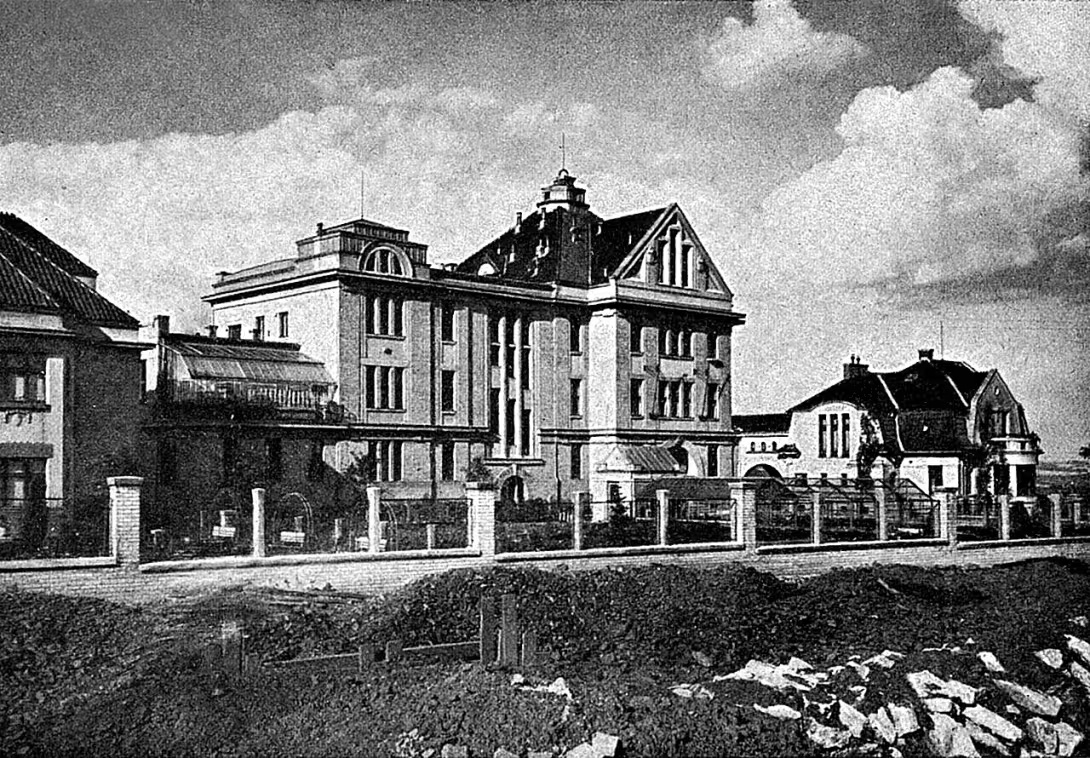
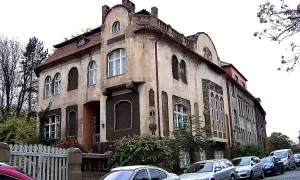
The Areál Výzkumného ústavu cukrovarnického Střešovice is a complex of seven buildings constructed between 1920 and 1922 in the district of Střešovice. Situated on Ořechovka, it features a sloping terrain with an architectural blend of historicism and geometric Art Nouveau. Originally serving as a center for sugar industry research, it now houses a physics institute.
Architect Josef Záruba-Pfeffermann designed the complex. His firm also built the State Agricultural Research Institute in Prague and a power plant in Prostějov. A prominent public figure, Záruba-Pfeffermann participated in the first resistance and worked as a political publicist. From 1910 to 1914, he was part of Masaryk's Realistic Party's executive committee.
The site includes four original and three modern buildings. The main research institute is a three-story rectangular structure with a large attic. Its interior boasts a main vestibule with a three-armed staircase and an organically rounded stone handrail, along with an entrance vestibule featuring a yellow-green coffered stucco ceiling. On the second floor, a representative library contains built-in cabinets, a stucco ceiling, wooden paneling, and brass fittings. A covered access corridor links the main building to the director's villa, a two-story structure with an irregular floor plan and a mansard roof. The complex also includes a larger villa for officials and a smaller building that housed laboratories, employee accommodation, and representative spaces. The grounds feature two gardens, two wooden gazebos, and a well-preserved original fence.
Stylistically, the complex combines historicism with geometric Art Nouveau and early architectural modernism. Interiors incorporate national style motifs and rondocubist details. From its completion until 1950, it was operated by the Sugar Research Institute. In 1950, the premises were acquired by the Central Institute of Physics, established through the reorganization of Škoda Works' Physical Research under J. Bačkovský's leadership. Since 1990, it has been home to the Institute of Physics of the Czech Academy of Sciences.
A specific detail of the entrance vestibule is its pastel yellow-green color, referencing the building's original purpose as a sugar research facility. The site's transition from agricultural research to high-level physics marks a significant shift in its functional history.
In 2010, the complex was proposed for designation as a cultural monument. It remains a significant example of architectural transition in Prague during the early 20th century.
The Areál Výzkumného ústavu cukrovarnického Střešovice represents a unique intersection of industrial science and early modern architecture, attracting those interested in the stylistic evolution of the first Czechoslovak Republic.
Historical milestones
- 1920
- Beginning of the construction of the research institute complex.
- 1922
- Completion of the original buildings.
- 1950
- The complex was acquired by the newly formed Central Institute of Physics.
- 2010
- The area was proposed for designation as a cultural monument.
Architectural development
The complex blends historicism with geometric Art Nouveau and modern elements, featuring interiors with national style motifs and rondocubist details. The main building is a three-story structure with a representative library and a unique three-armed staircase. The site also includes a director's villa with a mansard roof and perfectly preserved original fencing.
Historical events
1920–1922: Construction of the original complex. 1950: Establishment of the Central Institute of Physics in the premises. 2010: Nomination as a cultural monument.
Owners
Sugar Research Institute (1920–1950), Central Institute of Physics (1950–1990), Institute of Physics of the Czech Academy of Sciences (since 1990)
Points of interest
– The complex consists of seven buildings constructed between 1920 and 1922, featuring an architectural blend of historicism, geometric Art Nouveau, and early architectural modernism. – Designed by Josef Záruba-Pfeffermann, the site includes a main research institute with a vestibule featuring a three-armed staircase and an organically rounded stone handrail. – The entrance vestibule features a pastel yellow-green coffered stucco ceiling, which references the building's original purpose as a sugar research facility. – The site's functional history transitioned from agricultural research to high-level physics when the premises were acquired by the Central Institute of Physics in 1950. – Since 1990, the complex has been home to the Institute of Physics of the Czech Academy of Sciences.
Guide
Show guide text
This text was created by artificial intelligence and has not been editorially reviewed. It may contain inaccuracies.
Welcome to Střešovice. Please, take a moment to settle in, adjust your headphones, and simply look around you. You are standing before the remarkable complex of the Výzkumný ústav cukrovarnický, the Sugar Research Institute. As you take in your first impression of the site, notice how the buildings seem to follow the natural flow of the land. This isn't a flat, rigid urban block; instead, the entire complex is thoughtfully integrated into the sloping terrain of this beautiful part of Prague. There is a certain quiet dignity to the atmosphere here, a sense of intellectual pursuit that has lingered in the air for over a century.
Let us step back in time to the beginning of the 1920s. Imagine the world just after the Great War, a time of immense change and a renewed drive for scientific progress. It was in 1920 that the construction of this research complex began. At the time, the sugar industry was a vital pillar of the economy, and there was a pressing need for a dedicated space where research and innovation could flourish. For two years, the site was a hive of activity, with workers and engineers shaping the landscape and raising the walls of what would become a center of excellence. By 1922, the original buildings were completed, marking the birth of a facility that would serve as a beacon of industrial science.
Now, I invite you to turn your attention to the architecture. As you look at the facades before you, you are actually witnessing a fascinating crossroads of design history. The man responsible for this vision was the architect Josef Záruba-Pfeffermann. He didn't stick to just one style; instead, he created a charming and sophisticated blend. If you look closely at the lines and proportions, you can see the influence of historicism, which looks back to the grandeur of the past to provide a sense of stability and prestige. But then, notice the shift toward something more rhythmic and stylized. This is the geometric Art Nouveau, a version of the style that moved away from flowing organic curves and toward cleaner, more structured patterns. And finally, you can sense the breath of the future in the early architectural modernism that permeates the site. It is this specific combination—the old, the decorative, and the functional—that gives the complex its unique and timeless character.
As you explore the area, keep in mind that you are not looking at a single monolith, but a carefully planned ensemble of seven different buildings. This includes the main research institute, which stands as the heart of the complex, and several accompanying villas. These villas weren't just residential spaces; they were part of a holistic environment where living and working were intertwined, fostering a community of scholars and researchers. If you can see the entrance to the main institute, imagine stepping into the vestibule. This space was designed to be the transition point between the outside world and the focused, silent world of the laboratory.
The history of this place is inextricably linked to the people who shaped it. Beyond the architectural genius of Josef Záruba-Pfeffermann, the name J. Bačkovský is also closely associated with the legacy of this site. These men were not just building offices and labs; they were creating a temple to science. They understood that the environment in which a scientist works can influence the quality of their discoveries. By placing the institute here in Střešovice, away from the chaotic noise of the city center but still within its reach, they ensured that the researchers had the peace and inspiration necessary for their complex work.
However, as the decades passed, the purpose of these buildings shifted, reflecting the broader political and scientific changes in Czechoslovakia. For nearly thirty years, the halls echoed with the study of sugar and chemistry. But in 1950, a significant transition occurred. The complex was acquired by the newly formed Central Institute of Physics. Think about the irony and the evolution of that change: a place built to study the sweetness of sugar became a place to study the fundamental laws of the universe and the mysteries of physics. The transition from chemistry to physics mirrored the global shift toward nuclear research and high-energy physics during the mid-century. The buildings remained the same, but the conversations inside changed from the molecular structure of sucrose to the behavior of atoms and particles.
There is something almost mysterious about this transition. When you look at the buildings now, you are seeing a shell that has housed two entirely different scientific worlds. It makes one wonder about the ghosts of ideas that still haunt these corridors—the forgotten formulas of the sugar researchers and the complex equations of the physicists. This layering of history is what makes the site so compelling. It is a physical record of how human curiosity evolves.
For a long time, the architectural value of this site was a quiet secret, known mostly to those who lived in the neighborhood or worked within its walls. But as our appreciation for early 20th-century modernism grew, so did the recognition of this complex. In 2010, the area was officially proposed for designation as a cultural monument. This proposal was a recognition that the work of Josef Záruba-Pfeffermann was not just functional, but an artistic contribution to the fabric of Prague. It acknowledged that the way these seven buildings interact with the slope of the hill and with each other is a masterclass in urban planning and aesthetic balance.
As you stand here now, I encourage you to take a slow walk around the perimeter. Notice how the light hits the facades and how the geometric details of the Art Nouveau elements emerge as you change your angle of view. Feel the slope of the ground beneath your feet and imagine the architects in 1920 sketching these plans, figuring out how to make the stone and mortar harmonize with the earth.
The Výzkumný ústav cukrovarnický is more than just a collection of old offices; it is a testament to a time when science, art, and architecture were seen as partners in the quest for progress. Whether it was the pursuit of a better sugar refining process or the exploration of the physical laws of nature, this site has always been about looking forward.
Thank you for joining me on this brief journey through the history of Střešovice. I invite you now to wander through the grounds at your own pace. Let the silence of the complex speak to you, and perhaps you will feel a spark of that same curiosity that drove the researchers who once walked these paths. Enjoy your exploration, and we will see you at the next stop.
Tips for visitors
To capture the best architectural details of the Areál Výzkumného ústavu cukrovarnického Střešovice, plan your visit during the early morning or late afternoon. The soft light during these hours beautifully highlights the seven buildings and their unique integration into the sloping terrain, making it an ideal time for photography.
The site is accessible by both car and public transport. If you are driving, please note that the complex is located on Ořechovka street. For those using public transit, it is recommended to check current connections and schedules in a transit search engine to ensure a smooth journey.
Because the complex was constructed on a slope, visitors are advised to wear comfortable, sturdy walking shoes. This will make navigating the different levels and the terrain of the research institute much more pleasant.
Families visiting the area can enjoy exploring the surrounding Střešovice district. The unique industrial character of the buildings provides an interesting backdrop for a walk through this residential area.
Businesses nearby
Events nearby

Zdroj akcí: otevřená data měst a obcí ČR (Národní katalog otevřených dat) a kalendář akcí Národního památkového ústavu.
Nearby
The complex is located in the Střešovice district of Prague on Ořechovka street, situated within a sloping residential area.
Accommodation nearby
Trips and activities nearby
Guided tours, tickets and activities nearby from GetYourGuide
Affiliate link: if you buy from the partner, we may receive a commission. The price for you does not change.
Search tours and activities →Themed route
Welcome to this thematic walking tour starting at the Areál Výzkumného ústavu cukrovarnického Střešovice in the charming district of Střešovice, Prague.
1. Ořechovka Street: Begin your journey on Ořechovka street, where you'll find yourself amidst a picturesque sloping residential area. This street offers a glimpse into local life and architecture, making it an excellent starting point to immerse in the neighborhood's unique atmosphere.
2. Střešovický Park: A short walk from the research institute will lead you to Střešovický Park. This park is perfect for relaxing and enjoying some greenery amidst your exploration of the area. It offers a serene environment with walking paths and benches, ideal for taking a moment to reflect on the beauty surrounding you.
3. Local Cafés: As you continue exploring Ořechovka street, take time to visit one of the local cafés. These spots are perfect for enjoying a coffee or a light meal while soaking in the vibrant community spirit of Střešovice. They provide an excellent opportunity to interact with locals and experience authentic Czech hospitality.
4. Residential Architecture: While walking through the residential area, take note of the unique architectural styles that characterize this part of Prague. The charming houses and buildings reflect a blend of historical influences and modern design, offering visual delight for architecture enthusiasts.
5. Return to Areál Výzkumného ústavu cukrovarnického Střešovice: Conclude your tour by returning to the research institute's area. Reflect on your journey through this unique district, appreciating its blend of history, culture, and community life.
Enjoy your exploration of Střešovice!
Seasonal recommendations
Spring brings a sense of rebirth to the Areál Výzkumného ústavu cukrovarnického Střešovice. The surrounding greenery begins to bloom, and the soft, gentle sunlight highlights the intricate architectural details of the site. It is a peaceful time to explore the grounds as the weather stabilizes. Visitors should prepare for unpredictable temperatures by wearing layers. Arriving in the mid-morning is ideal to enjoy the freshness of the day before the midday sun becomes too bright.
During the summer months, the area is bathed in intense sunlight and surrounded by vibrant, lush foliage. The atmosphere is lively and warm, making it a popular time for sightseeing. Because this is the peak season, crowds can be more frequent, so it is highly recommended to arrive early in the morning to experience the site more quietly. Wear light, breathable clothing and remember to bring sun protection and water to stay comfortable during your walk through the complex.
Autumn transforms the landscape into a palette of gold and amber. The changing leaves and the crisp, cool air create a nostalgic and tranquil atmosphere that is perfect for photography. The lighting during the afternoon is particularly stunning as it filters through the thinning canopy. To make the most of your visit, wear comfortable walking shoes and bring a medium-weight jacket to protect against the cooling breeze.
In winter, the Areál Výzkumného ústavu cukrovarnického Střešovice takes on a quiet, contemplative character. The air is sharp and cold, and the site often feels much more secluded and calm than in other months. Since daylight hours are much shorter, plan your visit for the middle of the day to ensure you have enough light to see the historical structures. It is essential to dress in heavy, warm layers and wear sturdy footwear to navigate the grounds comfortably in the chilly weather.
Visualizations and artistic views


The visualisations are generated by artificial intelligence and serve as inspiration.
Photos from the area
Real photos taken near the monument

Zdroj a licence jsou uvedeny u každého snímku.
Tips from visitors
No tips yet. Be the first!
Log in and add your tip.
Sources and literature
Fotografie: AnonymousUnknown author / Public domain — Wikimedia Commons. The author and licence also appear when you hover over the image.
Faktickým podkladem tohoto textu byl článek na Wikipedii, jehož autory jsou přispěvatelé Wikipedie. Článek je dostupný pod licencí CC BY-SA 4.0.
Location on the map

Příběhy a pověsti
Legendy, pověsti a příběhy spjaté s touto památkou
Fotografie návštěvníků
Zatím žádné fotografie. Buďte první, kdo přidá fotografii z návštěvy!
Přihlaste se a přidejte svou fotografii nebo hodnoťte.
Za ověřenou návštěvu v aplikaci získáte víc bodů — poznáme podle GPS, že jste na místě.
Reviews and comments