



Proškův mlýn Water mill
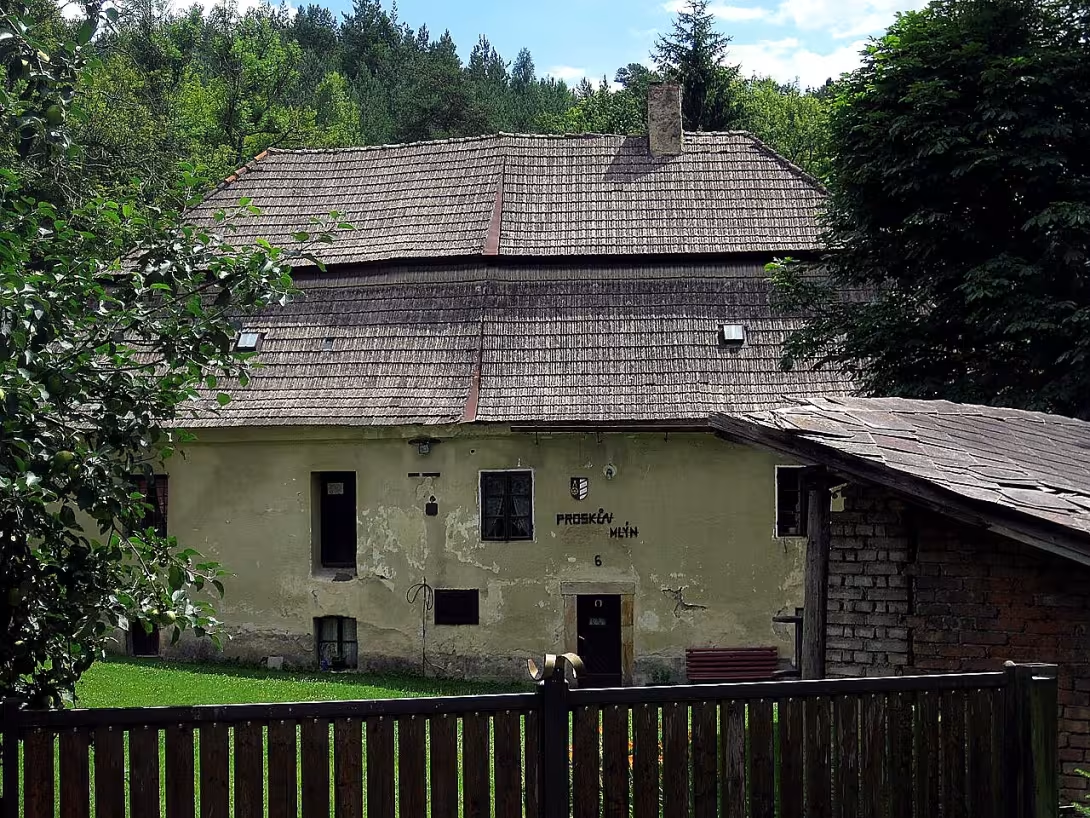
Proškův mlýn is a historic water mill located in the middle of Pohříí, a local part of the village of Malá Kyšice in the Central Bohemia region of the Czech Republic. This monument is listed in the Central List of Cultural Monuments and represents an important part of local history. The mill, which was operated until the beginning of World War II, is today protected as a cultural monument and attracts attention to its architecture and historical significance.
The history of Proškov Mill dates back to the 15th century when the first written mention of it appears. Originally, the territory was royal property and belonged to the royal castle Křivoklát. The oldest specific mention dates back to 1548, when it was inherited by Vladislav Bezdružický from Kolovrat. In the following years the mill had different owners and tenants, including the prelates of the church of Prague and Ferdinand Kustoš from Zubří. After the abrogation of the Voršilek monastery he went into possession of the Religious Fund and was sold to Antonín Vítek from Salzberg in 1787.
The architecture of Proškov Mill reflects his long history. The mill is equipped with a black kitchen with a oven and a smoker from the 17th century, indicating its ancient origin. There is also a millstone and stool in the mill, which still resembles the time of operation. The machinery dates back to the second half of the 19th century, indicating continued modernisation and maintenance of the building.
Owners and administrators Over the years, Prošek's mill has changed frequently. After Vladislav Bezdružický from Kolovrat he was transferred to the prelates of the church of Prague, followed by various owners such as Ferdinand Kustoš from Zubří and Antonín Vítko from Salzberk. In the 19th century, the owners of the mill were Whitefeller and Čechman, then the mill became owned by Max Kirschberg and Rudolf Kalousova from Nové Scahořice. In 1892 he was sold to Jana and Anezka Konvalinková, who bequeathed him to their daughter Anna and her husband Josef Prošek of Chyňava. Josef Prošek became mayor of Chyňava and Upper Bezděkov and under his leadership part of the garden was rebuilt into a building plot where a future inn was built. After the death of Josef Prošek, the milling tradition continued with his son Karl, who married Rozena Franclová and founded a swimming pool in 1933.
Key events in history Prošek's mill includes its gradual transitions between different owners as well as changes in the function and maintenance of the object. For example, in 1630, he ran a miller named Kaspar Votavou, who became a traveller in Unhost. After the 30-year war, the mill burned down and was restored by the same miller. Another important event was the building of the inn in 1902, which now serves as a restaurant "U Bat.".
Today Proškův mlýn is a protected cultural monument and attracts attention with its historical value. The mill is partly equipped with ancient furniture and equipment, allowing visitors to feel like in the past. Next to the mill there is a restaurant "U Báběra," which offers an opportunity to see the building and enjoy the local culinary.
Proškův mlýn is not only a monument to architecture, but also a witness to the rich history of the region. Its long-term use and transitions between different owners reflect changes in the way of life and management in the area. For visitors this monument is not only an interesting historical location, but also an opportunity to explore local culture and traditions. Visit Proškův mlýn means time travel and discover hidden pearls of Central Bohemia region.
Historical milestones
- 15th Century
- First written mention of the mill
- 1548
- Vladislav Bezdružický from Kolovrat won the mill into the heritage
- 17th Century
- Black kitchen with oven and smoker
- 1630
- A miller called Kaspar Votava
- 1787
- Sale of the mill to Antonín Vítek from Salzberg
- 1902
- Status of the inn building
Historical events
- 1630
- The miller and traveler in Unhost was Kaspar Votava.
- 1669
- The new tenant of the mill became Matìj Svášek, also an unhošt traveller.
Owners
The first specific mention of the mill dates back to 1548. In the following years he had various owners, including Vladislav Bezdružický from Kolovrat (1566), prelates of the church of Prague (1573) and Ferdinand Kustoš from Zubří (1744). After the abrogation of the Voršilek monastery, he went into possession of the Religious Fund, and was then sold to Antonín Vítek of Salzberg in 1787.
Points of interest
- Proškův mlýn is a historic water mill located in the middle of Pohříí, a local part of the village Malá Kyšice in the Central Bohemian region of the Czech Republic. - This monument is listed in the Central List of Cultural Monuments and represents an important part of local history. - The history of Proškov Mill dates back to the 15th century when the first written mention of it appears. The oldest specific mention dates back to 1548. - The mill is equipped with a black kitchen with an oven and a seventeenth-century smoker, indicating its ancient origin. - Machinery comes from the second half of the 19th century, which shows continued modernisation and maintenance of the building.
Guide
Show guide text
This text was created by artificial intelligence and has not been editorially reviewed. It may contain inaccuracies.
Welcome to Prošek's Mill. You are standing right in the heart of the Hostile, in the part of the village of Mala Kyšice, and you have just stopped at one of the most important symbols of this place. Before you go any further, I suggest you stop for a moment, soak up the atmosphere of this neighborhood and realize that right now you're moving through the fabric of history that is felt every step of the way. In front of you is a building that is not just a simple building, but a living witness of centuries, which stands here in the middle of the landscape and reminds us of a time when people's lives were more closely connected to the rhythm of flowing water and relentless work in fields and in mill spaces.
Let's go back deep into the past together so we can understand what you're watching. The story of this mill is not short and its roots go much further than it might seem. The first written references to the existence of this place appear in our chronicles in the 15th century. Imagine that time when the landscape around it looked completely different, when there was much denser vegetation and people were moving on paths that may not exist anymore. The mill was at that time a key point for the whole community, a place where the needs of farmers met with the power of nature.
Over the next centuries, the mill was becoming part of various families and owners, which shows us how important it was. In the year fifteen hundred forty eight the mill became part of the legacy of a great nobleman, who was Vladislav Bezdružický of Kolovrat. This is an important moment, because it shows that Proškův mlýn was already perceived as a valuable and strategic object in the early days of the New Testament, which also had its weight in the broader political and economic context.
Now please look around you and pay attention to the architecture and the overall effect of these structures. Although time changes and technology develops, the relationship between the mill building and its immediate surroundings remains fascinating. Notice how the mill is integrated into this space. Right next to it is the building of the inn, which was built only at the beginning of the twentieth century, namely in nineteen hundred and two. This building gives the whole place the character of a social centre, a place where people could stop, relax and change newspapers after demanding work in the mill or fields. It's an interesting contrast between the ancient core of the mill and the structure that came a little later to serve the social needs of the community.
If you look at the inn itself now, you can realize how the space functions change over time. This building has undergone a significant transformation in the year two thousand twenty and today it serves as a restaurant under the name U Bat. It is a fascinating example of how historical heritage can adapt to modern times and still remain useful for visitors and locals without losing its original character.
Every old house has its own stories and people who breathe into it. But in order to understand them, we must imagine everyday life in these areas. In the seventeenth century, there was a specific atmosphere, which was composed of, for example, a black kitchen with an oven and a smokehouse. Imagine the smell of wood, the heat of the furnace and the constant movement of people preparing food for the miller and their family. It was the heart of every such house where the heat of fire was combined with the constant movement of work.
In the year sixteen hundred and thirty, the miller Kaspar Votava was housed here. Who was that? How were his days? The miller was a figure at the time that had to have not only strength but also deep knowledge of nature and mechanics. He must have understood the flow of water, the strength of stones and the rhythm of seasons. Every sound that sounded in the mill must have been a clear signal to him about the state of his work. Another important figure in the history of this place was Antonín Vítek from Salzberg, who purchased the mill in Seventy-eight years. These names are not just rows in historical documents, they are people who have built their fates here, who have experienced joy and hard times here and who have kept this mill going for generations to come.
But now I want to take you further into consideration the importance of this place. You may be asking why this mill is so important today. The answer is in his status. Proškův mlýn is included in the Central List of Cultural Monuments of the Czech Republic. It's not just a formal entry. It means that this place is considered an indispensable part of our national heritage. It is a protection for the future so that this historical fragment is kept constantly and that even people in a few hundred years can stand exactly where you stand and feel the same respect for history.
There's something mysterious about it when you realize how many generations of people have gone through these roads and watched the same view of this mill. Although owners were changing, new centuries were coming and technology was changing, Proškův mlýn is still here. It is one of those pillars of local history that holds together the identity of the entire region of Little Kyšice and the Thermal. It's a symbol of endurance and continuity.
When you look at the buildings again, notice their overall integrity. Although these are not monumental palaces with towers or statues, its beauty lies in its authenticity and how naturally it fits into this landscape paradise. Feel the harmony between human activity and the natural environment that the mill has used forever.
I hope this short journey has pleased you over time and has helped you to see more in these buildings than just simple structures made of stones and wood. Proškův mlýn is a living story that is still written. Do not be taken away from the mill itself, but continue to walk and perceive the beauty of this neighborhood, which is so closely linked to this history. Explore the surrounding roads, look at the flow of water and remember people like Kaspar Votava or Vladislav Bezdružický from Kolovrat who left their trail.
Thank you for your visit and for your interest in our common heritage. Read this view of history again before you go on your journey. We wish you a beautiful rest of the day and many other experiences in discovering the beauty of our landscapes. Goodbye.
Tips for visitors
Best time to visit Proška's mill is spring or early autumn, when the surrounding nature is the most lively and suasaná. For lovers of photography are the best moments during the morning or evening light, especially at the mill wheel or at the water flow, when the natural elements are reflected.
The mill can be reached by car and through public transport.
Visitors should wear comfortable shoes suitable for walking in nature and their own drinking regime. For families with children the area of the mill is a pleasant place for a quiet walk in the natural environment near the water.
In the context of the information provided there are no other specific monuments in the area, so it is recommended to pay all attention to the architecture itself and the history of this water mill.
Frequently asked questions
Can the monument be visited?
This is a technical monument. Some are open as exhibitions, others are out of use or on private land. We have not verified whether this one is accessible.
What are the opening hours and admission?
We have not verified the opening hours or admission. Current information is published by the operator.
Where is the monument?
Location: Středočeský kraj. The map on this page shows the exact spot.
Why is the monument protected?
It is listed in the Central List of Cultural Monuments of the Czech Republic as a cultural monument (register no. 1000138097).
Businesses nearby
Do you run a restaurant, accommodation, shop, museum, rental, wellness or other visitor service near this monument? Show yourself directly to the people heading to it — this is how they will see you in the app and on the web:
Nearby
🏰 Historic sites (147)
- Bocka Mill 0.0 km
- Loretské displaced 1.2 km
- Mohyla Jana Palacha 1.2 km
- Mostecký mln 2.5 km
- _ 4.2 km
- Melichar Museum 4.4 km
- Sv Václav 4.5 km
- Jan Hus 4.6 km
- Adolf Kajpr 4.6 km
- Saint Jan Nepomucký 5.1 km
- mohyl burial ground Hora 5.8 km
- monument to archaeological research 5.8 km
- Tomb of the maid 6.2 km
- Muzeum Arcade hry 6.3 km U Fan 280 web
- Skanzen 6.3 km
- Red Ústí 6.4 km U Fan 280 web
- Glass smelter 7.1 km
- ruin Jenčeč 7.3 km web
- Saint Norbert 7.8 km
- Saint Benedict 7.8 km
🍽️ Restaurants and dining (370)
- U Bat 0.0 km + 420 312 525 506
- Guesthouse Lika 1.1 km Liberation 135
- U Goat - Hostinec 1.1 km Peace 21
- Tak Na Hatich 1.8 km
- Pension Livanec 1.9 km Main 40 + 420 725 26 02 web
- Tyrol pubs 2.2 km
- BBQ Bouda 2.3 km
- Restaurant Srub 3.2 km
- Under Stars 3.6 km web
- Refreshments Na compostu 3.7 km
- Guesthouse in adhesive 4.2 km
- N & A Kebab 4.3 km web
- Stop Caffe 4.3 km web
- U Chalupó 4.4 km Dukel 51 + 420312247035 web
- Stop Caffe 4.4 km web
- KFC 4.5 km
- McDonald 's 4.5 km
- Sun Services Center All 4.6 km
- _ 5.1 km
- Asian Wok 5.2 km
🏨 Accommodation (51)
- Area Botanika 1.6 km
- U Sajdl 4.3 km
- Sport Hotel Sletiště 7.7 km + 420 312 249 465 web
- Hostel U Konvalinků 7.9 km
- Hostel On the bell 8.0 km
- Golden selenium 8.1 km
- Guesthouse Villa Sítna 8.1 km
- Valek 8.1 km
- Hotel Kladno 8.1 km
- Hostel Racanda 8.1 km
- Guesthouse Tonichka 8.2 km
- _ 8.5 km web
- Astra 8.5 km
- Guesthouse Iris 8.6 km
- Hotel Merkur 8.7 km
- Tourist hostel Centrum 9.0 km Váňova 322 + 420603816906 web
- Autocamp Plešivec 9.0 km
- Ponte 9.1 km
- Hoffmann 9.4 km
- Guesthouse 68 9.4 km
🚲 Rentals and sport (62)
- Cycloservice in barn 1.2 km Main 41 774 963 184 web
- Adventure Golf Upper Unthanks 2.2 km
- Staj Tara 4.1 km
- Stáj u Wild Leny 4.3 km
- Intersport 7.4 km
- Decathlon 7.5 km American 3252 web
- Horse sports grounds 7.6 km
- Kladno 7.6 km
- Lane park 7.7 km
- City Stadium Slevests 7.7 km
- Vavřinec, Beach club Kladno 7.8 km web
- Tennis DLI Silečl 7.8 km
- TJ Slovan Kladno 7.8 km
- Fitcentrum 7.8 km
- Kladen sports hala 7.8 km
- LTC Slovan Kladno 7.9 km
- Sport hall BIOS 7.9 km
- TJ New Town Kladno 7.9 km
- KOLO & KAVA 7.9 km web
- SK Kladno 8.1 km
🥾 Hiking and nature (237)
- High above 1.3 km
- High above 1.3 km
- Žlábek 1.9 km
- Jurkova jáma 2.1 km
- Tuchonín 2.3 km
- Sets Legionaries 4.2 km
- Horka 4.5 km
- Veselov 4.5 km
- Málková podikás 4.7 km
- Kouty 5.0 km
- Karabinské vr 5.3 km
- Kožová hora 5.6 km web
- Kožová hora 5.6 km
- Stone 5.6 km
- Lite Top 5.8 km
- Hora 5.8 km
- carpenter 6.2 km
- König 6.3 km
- LEGO train stop 6.6 km
- Radotín porok 6.8 km
Accommodation nearby
Trips and activities nearby
Guided tours, tickets and activities nearby from GetYourGuide
Affiliate link: if you buy from the partner, we may receive a commission. The price for you does not change.
Search tours and activities →Themed route
1. Proškův mlýn - exposition , museum exhibition. Here you will learn the history of grinding and see the original technical equipment. 2. Tadvoří mlně, area of the building. This space allows you to see the architecture and atmosphere of the historic water mill. 3. Instantaneous and Reality , outdoor space. Here you can see the water elements and the surroundings that form an integral part of the complex.
Seasonal recommendations
Spring: In the spring season, Proškův mlýn is particularly attractive because of the emerging life of nature, when the first flowers appear along the stream and the trees begin to sprout. Lighting is mild and sunny, which creates an ideal atmosphere for relaxation and sightseeing. In this season, it is recommended to visit the memory at the beginning of the day when crowds are less burdened than in later hours. It is advisable to prepare light clothes, but also something warmer for possible cooling winds.
Summer: Summer is a time when Proškův mlýn offers the most beautiful experience with full beauty of nature. High solstities and warm days create a lively atmosphere that is ideal for outdoor activities such as a picnic or just for a moment relaxing under the shadow of old trees. High numbers are expected in the main summer season, therefore it is recommended to visit the memory early in the morning or later in the evening. Don't forget to bring a sunflower and enough drinking.
Autumn: In the autumn period Proškův mlýn turns into a postcard pearl when tree leaves pick up fireworks. This season is ideal for lovers of photography and relaxation in the air full of pleasant cold. The lighting is mild, which creates a calm atmosphere. Visiting a memorial at the beginning or end of the day can be especially pleasant because you can avoid the middle hot hours and also more visitors. It is advisable to take your clothes to a variable temperature.
Winter: Winter brings Proškův mlýn to a different light, where the atmosphere and traffic are less intense. If autumn rains turn into snow, you can enjoy a view of the mill covered with white rain, which adds romantic breaths. In the winter months it is recommended to visit the monument at noon, when the lighting is the best and durability of snow allows even short walks around the creek.
Visualizations and artistic views


The visualisations are generated by artificial intelligence and serve as inspiration.
Photos from the area
Real photos taken near the monument


Zdroj a licence jsou uvedeny u každého snímku.
Tips from visitors
No tips yet. Be the first!
Log in and add your tip.
Sources and literature
Photos: MartinVeselka / CC BY-SA 4.0 — Wikimedia Commons. The author and licence also appear when you hover over the image.
Faktickým podkladem tohoto textu byl článek na Wikipedii, jehož autory jsou přispěvatelé Wikipedie. Článek je dostupný pod licencí CC BY-SA 4.0.
Location on the map





Příběhy a pověsti
Legendy, pověsti a příběhy spjaté s touto památkou
Fotografie návštěvníků
Zatím žádné fotografie. Buďte první, kdo přidá fotografii z návštěvy!
Log in a přidejte svou fotografii nebo hodnoťte.
Za ověřenou návštěvu v aplikaci získáte víc bodů — poznáme podle GPS, že jste na místě.
Reviews and comments