



Psané skály Other
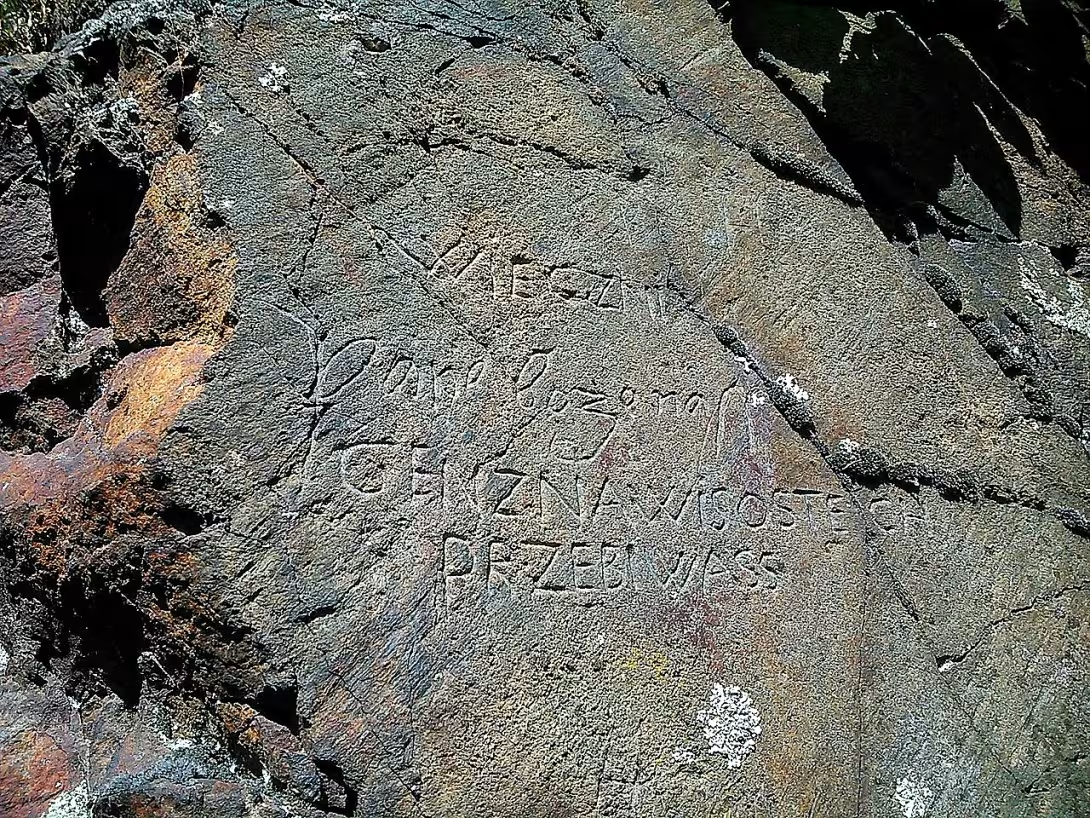
Psané skály are a renaissance rock formation and an important cultural monument in Benešovsk, located near the village Poličany above the bay where the Mast stream flows into the water tank of Slapa. The place is remarkable with carved inscriptions of religious character in Czech, German and Latin along with reliefs of sun and stars, to which leads a steep cliff with stone steps.
This object represents a rock wall with cut stone steps, inscriptions and reliefs. Historical modifications include the installation of a commemorative plate in the 20th century. The historical context of the site falls within the period of the sixteenth and seventeenth centuries, when strong religious disputes and persecution of non-Catholic groups took place in the Czech countries after the Hussite wars and before the post-white mountain reCatholics.
The inscriptions are probably from the sixteenth or seventeenth century, and their authors are probably Mikuláš, who are the followers of Mikuláš Vlasenický invited also the Mikulášenský brothers, or members of another branch of the Czech brothers. These groups were hiding here from persecution. In this context, it is specifically mentioned that the chivalrous vicar Matěj Poličanský, who left his church in 1612 and was at the head of the political Mikulash for several years.
Key documented events include the year 1612, when Matěj Poličanský was at the head of the political Mikulášovci. Around 1925, there was a commemorative plaque with the relief of the chalice and the inscription "Truth wins. This is where our ancestors tarried for the faith persecuted." In 1965 this site was declared a cultural monument of the Czech Republic.
The surrounding landscape includes the village Poličany, the stream Mast and the water tanks Slapy in Benesovsk. In the written rocks, the yellow tourist brand of the Club of Czech tourists begins with the 6038 route, which leads through Nahoruba, Blažim, Jablonna and Nedvozí to Teletín.
This monument bears witness to the difficult times of religious difficulties and the hiding of persecuted ancestors in Czech countries. Visiting this place above the water tank of Slapa offers a direct view of the traces left here in the stone by the history of the 16th and 17th centuries.
Historical milestones
- 1965
- The location has become a cultural monument.
- 1925
- Planting a commemorative plate with the relief of chalice and inscription.
- 1612
- The chivalrous vicar Matěj Poličanský left his church and led the political Mikulash.
Architectural development
The unit consists of a rock wall with cut stone steps, inscriptions and reliefs. Historical modifications include the installation of a commemorative plate in the 20th century.
Historical events
In 1612, the Polish Mikuláš priest Matěj Poličanský led the Polish Mikuláš. In 1965, this site was declared a cultural monument. Around 1925 there was a commemorative plate with the relief of the chalice.
Points of interest
- It's a Renaissance rock formation and a significant cultural monument in Benesovsk. - The site has carved religious inscriptions in Czech, German and Latin along with reliefs of sun and stars. In the sixteenth and seventeenth centuries, members of religious groups were hiding here from persecution. - Around 1925 there was a commemorative plate with the relief of the chalice. - In 1965 this site was declared a cultural monument of the Czech Republic.
Guide
Show guide text
This text was created by artificial intelligence and has not been editorially reviewed. It may contain inaccuracies.
Welcome to this remarkable and deeply impressive place. You are standing right in front of the Pied Rocks, which stand in nature near the village Poličany above the picturesque bay, in places where the Mast stream flows into the water tank of Slapa. If you look in front of each other, you'll see a steep cliff and stone steps rising up to hidden treasures on a rock. You are in Benesovsk and in front of you is a Renaissance rock formation, which is an important cultural monument and a place with an extraordinary atmosphere. Take a deep breath and let the calm of the surrounding nature take hold of the secrets of our ancestors for centuries.
Let us dive together into the time of origin and into the historical context of this place. In the sixteenth and seventeenth centuries, there were people who faced severe trials. The site served as a safe haven, where members of religious groups hid from persecution. It was a moving time of spiritual search and struggle for your own faith. When you climb the stone steps into a steep cliff, you find yourself in places where these people have left deep traces. The unknown authors here carved inscriptions of religious character in stone as well as captivating reliefs of the sun and stars. These messages are made in several languages, namely Czech, German and Latin. Imagine what those moments were like when people came here under cover of darkness or in silent contemplation to impart their thoughts and hopes into hard stone.
Now pay attention to the architecture itself and the details you have right in front of you. Look closely at the walls of the rock formation. Note carefully carved inscriptions that resisted the tooth of time. Each letter and each stroke of chisel bears witness to the craftsmanship and inner determination of the creators. In addition to texts in different languages, you can also see carved reliefs of sun and stars. These symbols were not selected randomly. For people in the past, light was in darkness, hope and divine protection. Let your view slowly cross over the rock wall and perceive the special harmony between the raw natural stone and the human hand, which embedded the spiritual message into it.
There is also a very strong and specific story about this place, in which a significant historical figure is present. He's the life-saving college priest, Matěj Poličanský. In the year six hundred and twelve, he took a major step in his life. He left his church so far and became the leader of the political Mikulash. Imagine this man walking in the same places as you, leading his faithful and seeking their safety and spiritual freedom. Matěj Poličanský embodies the courage to stand up to the order at that time and follow its conscience. His name is forever linked to the fate of these rocks and gives the whole place a deeply human dimension.
Let us now look at other attractions and milestones that have shaped the new history of this memorable place. You'll find that care for this inheritance has a long tradition. Around the year twenty-five were mounted on the rock a commemorative plate with the relief of the chalice and a inscription that resembles the local moved history and refers to the drinking tradition. Decades later, namely in nineteen hundred and sixty-five, this whole site officially became a protected cultural monument. This recognised its enormous value for Czech history and culture in order to preserve it for future generations.
In conclusion, we'd like to invite you to explore the area further. When you have a quiet look at all the inscriptions and reliefs, take a walk around the surrounding nature and see the landscape around the water tank Slapa, where the Mast stream flows. Thank you for listening to our audio guide, we hope you enjoyed your visit to the Written Rocks, and wish you a beautiful rest of the day on your next trips. Goodbye.
Tips for visitors
To visit the rock body above the water surface, it is best to choose the morning hours when the sunlight optimally illuminates the steep cliff and historical inscriptions on the rocks. A passenger car or local public transport connections can be used to transport to the site, the current timetables of which can be verified in the respective connection search engine. Take with you fixed shoes suitable for walking on uneven terrain and stone stairs, plenty of drinking water and a camera. Photography offers the best results from the observation points above the bay, where the stream flows into the tank, with the best light for pictures of details in the cliffs in the morning. In the vicinity within 30 minutes you can admire the picturesque landscape including the village Poličany, the flow of the stream Mastník and the extensive water tank Slapy in the district of Benešov. A trip to this natural location with stone steps leading to rocks is suitable for families with children who can move in the natural terrain and climb the slope.
Frequently asked questions
Can the monument be visited?
We have not verified whether this monument is accessible. Please ask the owner or operator, or the local municipal office.
Where is the monument?
Location: Poličany. The map on this page shows the exact spot.
Why is the monument protected?
It is listed in the Central List of Cultural Monuments of the Czech Republic as a cultural monument (register no. 1000129381).
Businesses nearby
Do you run a restaurant, accommodation, shop, museum, rental, wellness or other visitor service near this monument? Show yourself directly to the people heading to it — this is how they will see you in the app and on the web:
Nearby
Okolní krajina zahrnuje vesnici Poličany, potok Mastník a vodní nádrž Slapy na Benešovsku.
Accommodation nearby
Themed route
1. Poličany - Municipality. The entry point of the trip where you can start walking through the landscape. 2. Grease - The brook. The path along the water stream offers pleasant movement in nature towards the destination. 3. Psané skály - Natural landmark. The main destination of the journey with remarkable rock formations. 4. Water tank Slappy - Water surface. Ideal place to relax near the water at the end of the route.
Seasonal recommendations
The spring moons awaken the surrounding nature to a new life, when the forest undergrowth around the rocks turns green, and the snow cover slowly retreats to the sunlight. The light penetrating through so far not entirely squid trees creates a fine shadow game on the stone surface and promotes the creation of ubiquitous moisture that highlights the natural structure of the stone. For the spring trip, put on firm and waterproof shoes, because forest roads are very muddy and slippery after tidal and spring rains. The best time to visit is the morning hours, when the morning mist gives the place a mysterious touch and in nature there is total peace without a lot of curious visitors.
During the summer, the whole area is covered with thick and fully developed green leafy trees, creating pleasant cool and shade right at the rock walls and in their immediate surroundings. Sun rays rarely penetrate the earth through thick curtain vegetation, which ensures stable temperature and protection from afternoon heat. In view of the warmer days, it is worth choosing to explore the terrain in light breathable clothing, but do not forget the effective repellent against ticks and mosquitoes who are very active in the forest environment this time of year. The best lighting conditions for possible photography of rock detail occur in the late afternoon, when the horizontal rays of the sun penetrate through the sides of the forest.
Autumn time brings a colorful palette of shades from yellow to orange to deep red to the surroundings, which together with the dark surface of the rock creates a stunning visual contrast. The falling leaves cover the surrounding terrain and the morning fog often cloaked the whole area in a melancholic grove that amplifies the historic atmosphere of this mysterious place. The ideal time for visiting is around noon, when daylight reaches its maximum intensity and can at least for a moment thaw a dense fog hanging over the landscape.
The winter season turns the landscape into a quiet and freezing fairy tale, where rocks often cover sparkly icicles and layers of pure snow reflecting frosted sunlight. The atmosphere is quite different from the rest of the year, as the deep silence of the forest does not disturb any sounds and the surrounding nature rests under the snow blanket. It is essential for the winter expedition to wear high-quality thermo-insulating layers, winter non-slip shoes with a deep sample and warm lined gloves, as low temperatures and frozen terrain require great caution when moving. The most suitable part of the day for a short winter walk is an early afternoon, when the sun is at the highest above the horizon and provides at least a slight heat and light for safe return before dark.
Visualizations and artistic views

The visualisations are generated by artificial intelligence and serve as inspiration.
Tips from visitors
No tips yet. Be the first!
Log in and add your tip.
Sources and literature
Photos: Joker Island / CC0 — Wikimedia Commons. The author and licence also appear when you hover over the image.
Faktickým podkladem tohoto textu byl článek na Wikipedii, jehož autory jsou přispěvatelé Wikipedie. Článek je dostupný pod licencí CC BY-SA 4.0.
Location on the map






Příběhy a pověsti
Legendy, pověsti a příběhy spjaté s touto památkou
Fotografie návštěvníků
Zatím žádné fotografie. Buďte první, kdo přidá fotografii z návštěvy!
Log in a přidejte svou fotografii nebo hodnoťte.
Za ověřenou návštěvu v aplikaci získáte víc bodů — poznáme podle GPS, že jste na místě.
Reviews and comments