



Pulčín Castle ruin
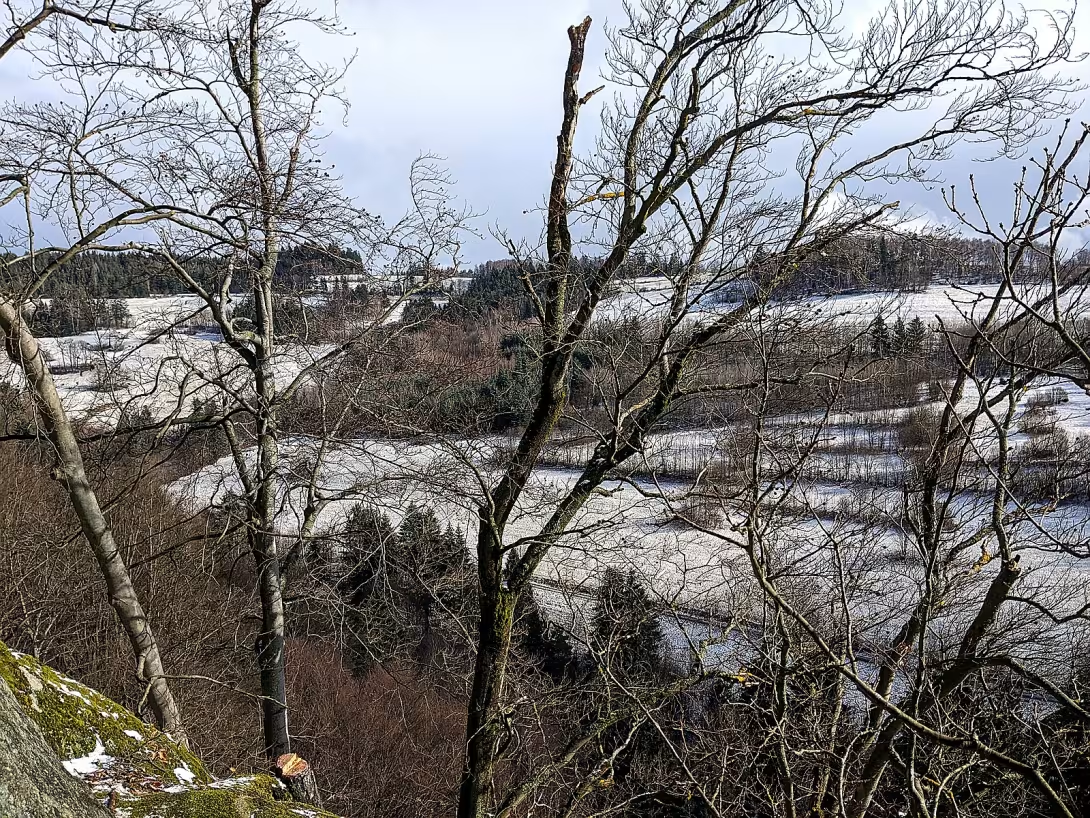
Pulčín is a ruin of a medieval rock castle in the district of Vsetín lying in the position of the Castle on the ridge of Pulčín rocks. The monument was probably created at the turn of the 14th and 15th centuries as a centre of the estate and a strategic point for the protection of the Shooter Pass. Only tiny remnants of the tower and traces carved into sandstone rocks have been preserved from the fort today.
The mansion is likely to have grown in connection with the development of manmade nobles linked to the Royal Castle of Brumov. Although the archaeological findings from 1987 demonstrated the presence of fortifications in the area of the chateau as early as the end of the 13th century, the predominance of the ceramics found from the 15th century suggests that the main construction period is at the turn of the 14th and 15th centuries. The area served as the administrative centre of the estate, which included the villages Pulčín, the Upper People, Lhota, Seninka and the now extinct village Zubřovka.
The construction design was determined by a natural sandstone rock suk with dimensions of approximately 18 × 15 meters with artificially modified upper platform. Access to the top was provided by a natural but modified crack on the southwest side, followed by carved steps. The upper plateau has preserved pockets and grooves for the introduction of beams of wooden structures. Along the southwest and northwest foothills, the perimeter wall was unveiled within 1.5 metres. This wall connected with sand mortar probably formed the basis of a massive tower building whose upper part had a grafted character.
The main rock tower was adjacent to the castle courtyard with dimensions of approx. 20 × 15 metres, which was six metres below. The tank closed a rock block from the north and east with holes for beams and simple wall walls. From the surrounding terrain towards the top of Hradisko separated the moat space over seven metres deep and twelve metres wide, through which he led the bridge.
The first written mention of the monument dates back to 1426, when it belonged to King Zikmund of Luxembourg. The name Miroslav of Cimburka is later associated with this place. This fearsome thieving knight is mentioned here in 1437. Miroslav z Cimburka participated in disputes over the years 1447 and 1448 about the village of Bz and the return of the artillery from Castle Brumova. In 1446 he faced a lawsuit for a robbery committed by his people on the road against Oldřich Štosa of Branice and Woodhouse.
The fortress was demolished around 1470 during the Czech-Hungarian wars. At the end of the 15th century it was already in ruins and in the years 1517, 1518 and 1520 it was listed as a deserted Pulina castle. In 1493, the original farmhouse belonged again to the castle of Brum.
Among the attractions are the inclusion of this monument in the category of rock castles, although it lacks typical elements such as cut-out lights. In addition to medieval artifacts, archaeological research from 1987 also brought findings from prehistoric times, namely from a younger degree of culture of lužické garbage fields. People's tradition may have placed their seat at the highest peak in Hradisko, but research has refuted this claim and confirmed the correctness of the position on the Castle.
There are rumours about a man named Púčina or Pílčina who built the yard here in exchange for a collection of honey, yarn, cumin and fox skins. Other versions tell of his expulsion as punishment. There have also been reports of a great treasure hidden in a deep basement beneath the castle to be guarded by evil spirits.
Today the remains of the building are protected as a cultural monument of the Czech Republic and are located on the southern edge of the natural reserve Pulčín - Hradisko. Visitors can observe carved steps and beams in the sandstone.
The ruins of castle Pulčín represent an important proof of medieval settlement and fortification in the area of Pulčín rocks. It's a place where the history of brigands knights is linked to the natural value of the reservation. Visiting this forgotten mansion offers insight into the strategic arrangement of border areas in the 15th century.
Historical milestones
- 1426
- First written mention of Castle Pulčín as goods of King Zikmund of Luxembourg.
- 1437
- Miroslav z Cimburka is mentioned in connection with its registered office in Pulčín.
- 1470
- The castle was torn down during the Czech-Hungarian wars.
- 1987
- Archaeological research has been carried out, bringing back ancient and medieval artifacts.
Architectural development
The castle's own core was a distinctive sandstone rock suk with approximately rectangular ground plan and an artificially modified upper platform. Access was provided by a natural but artificially modified crack on the southwest side, followed by carved steps on the top platform. Until today, only tiny remnants of the living tower have been preserved and carved pockets and grooves in the rock after the beams of wooden structures have been dropped.
Historical events
1426: First written mention of the castle held by King Zikmund of Luxembourg. 1437: The castle is listed in connection with the fearsome thieving knight Miroslav of Cimburk. 1446: Miroslav z Cimburka has been sued for the robbery of his people. Around 1470: The castle was torn down for Czech-Hungarian wars.
Owners
royal Crown (Zikmund Lucemburský), Miroslav z Cimburka
Points of interest
- The monument is categorized as rock castles, although it lacks typical elements such as cut-out lights. - In addition to medieval artifacts, the archaeological research from 1987 also brought findings from prehistoric times, namely from a younger degree of culture of the Lužice dumpster fields. - People's tradition may have placed their seat at the highest peak in Hradisko, but research disproved this claim and confirmed the correctness of the position on the Castle.
Guide
Show guide text
This text was created by artificial intelligence and has not been editorially reviewed. It may contain inaccuracies.
Welcome to the ruins of Castle Pulčín. Stop for a moment, take a breath and feel the peace and quiet of this place. You're standing right now at the highest point of the ridge of the Front Rocks, in a position that bears the fitting name of the Castle. If you look around you, you will see that the castle is no longer a monumental building that we may be used to imagining from fairy tales. In front of you are modest remnants that are inserted into the rough beauty of the northeast part of the bars Pulčín. It may surprise you at first glance how little of the original mansion remains, but it is in this stealth that lies the secret and attraction of this place.
Now let's go back a few centuries together to understand why a castle was built here. Pulčín was probably created at the turn of the 14th and 15th centuries. It wasn't a castle for a king or a magnificent court ball, but rather a strategic mansion. Its creation was closely linked to the development of the settlements of the so-called Manic nobility, which was tied to the castle Brumov. Imagine the landscape at that time, dense forests and rocky formations where every high point was key to controlling the surrounding area. Pulčín had one very important function, and that was the protection of the Shooting Pass. The passes at that time were the living arteries of the landscape, the paths that merchants, soldiers and messengers traveled. Whoever controlled the pass controlled the movement in the region and could effectively manage his estate. Pulčín served as a centre of administration and at the same time as an inaccessible guard fort.
Now pay attention to what you see right in front of you. Since the castle is a ruin today, we will not seek high towers or decorated gates. Instead, focus on the position itself and the way the remains lean on the rock ground. Feel the atmosphere of this place and try to imagine how there must have been smoke from fires in ancient times and hear the voices of the guards. Although the remains are modest, their location on the ridge of the Front Rock tells us how important the defensive position was. Look at the surrounding terrain and realize how difficult access would be for anyone who tries to break in without a warrant. It was precisely this natural rock opacity that was the best ally of the castle's inhabitants.
Speaking of Pulčín, we can't ignore the people associated with him. The first written mention of this castle dates back to 1426. At that time the castle was registered as the goods of King Zikmund of Luxembourg. It is fascinating to think that this small, remote place was linked in the records to such an important figure as the Luxembourg monarch. A little later, in 1437, the name Miroslav of Cimburka appears in connection with the residence at Pulčín. These men, whether they were powerful kings or local nobles, were here at a similar time looking for security, power, or a way to effectively control their subjects.
Unfortunately, history Pulčína is not only a story of building and administration, but also a story of extinction. The castle did not fall due to oblivion or slow decomposition. His end was violent and violent. In 1470, during the bloody Czech-Hungarian wars, the castle was torn down. Introduce yourself here at that moment. The noise of fighting, the flames and the subsequent fall of walls to protect the pass. After this year, Pulčín became a silent witness to history, a ruin that slowly began to return to the arms of nature.
Now I want to impress you with one special feature that makes Pulčín different from many other similar monuments in our region. If you are interested in castle typology, you will find that Pulčín is categorized as rock castles. But that's a little paradoxical. Typical rock castles are known for their cut-out lights, rooms carved directly into hard rock, which served as warehouses or residential spaces. However, Pulčín lacks these typical elements. It is therefore a rock castle because of its strategic location on the rock cliff and the way in which the construction was connected to the terrain, rather than because of the actual carving of the space into the stone.
But the secrets of this place do not extend only to the Middle Ages. In 1987 there was extensive archaeological research which revealed that people perceived the value of this place much before the castle was built here. Because the archaeologists found ancient artifacts. In particular, these were findings from a younger degree of the culture of the Lužice Dumpster Fields. It's incredible when you realize that in this very place where you stand today and you see the remains of the medieval castle, people have lived and worked in the deep prehistoric world. So Pulčín is not just a monument to one epoch, but to the layers of time that overlap here. From ancient settlements to medieval fortress to today's silent ruin.
People's tradition has tried to interpret this place itself, but science and archeology allow us to see Pulčín for what it really was. It's a place that teaches us humility before time. It teaches us that even the strongest walls can be torn apart and that nature will eventually take back everything we lent her for a while.
Now that you know the story of Pulčín, I suggest you look around in peace. Walk around the ridge of the Front Rock, perceive the texture of the stones and try to reconstruct the castle image that once guarded the Shots Pass. Let the atmosphere of this forgotten mountain guard fill you. Pulčín may no longer speak loudly, but for those who can listen, it still has much to tell.
Thank you for accompanying me on this short journey through history. I wish you a pleasant further survey of Pulčín rocks, and I hope that this place with its quiet beauty and dramatic ending interests you. See you at the next historical monument.
Tips for visitors
To visit the ruins of castle Pulčín choose ideally spring or autumn season when there is less traffic in nature and surrounding rocks offer a unique atmosphere without summer crowds. Take with you fixed and fixed shoes suitable for uneven rock terrain, plenty of drinking water and snacks, because there are no refreshments stands on the very top or in the immediate vicinity. Photography of the rocks and modest remains of the castle at Castle Castle is best early morning or late afternoon, when the side light beautifully highlights the structure of sandstone rock blocks and ridge of the Front. The trip to this area is also suitable for families with children, but due to the steep and rocky terrain in the final part leading to the ruin it is necessary to keep smaller children under constant supervision and choose a backpack instead of a deep pram.
Frequently asked questions
Can the monument be visited?
This is a ruin. Such sites are often freely accessible, but some can only be visited with a guide or are closed for safety reasons. We have not verified the current situation – take care and respect any restrictions.
Where is the monument?
Location: Zlínský kraj. The map on this page shows the exact spot.
Why is the monument protected?
It is listed in the Central List of Cultural Monuments of the Czech Republic as a cultural monument (register no. 1000140712).
Businesses nearby
Do you run a restaurant, accommodation, shop, museum, rental, wellness or other visitor service near this monument? Show yourself directly to the people heading to it — this is how they will see you in the app and on the web:
Nearby
Pulčín rocks, nature reserves Pulčín - Hradisko, Hradisko peak, Francova Lhota, Lomenské gorges and valley Seninka stream.
Accommodation nearby
Themed route
1. Pulčín Rocks Type: Natural Reservations Why is it worth a visit: This vast rock labyrinth offers fascinating rock walls, cracks and prospects to a deep valley. It is the largest sandstone rock town in Moravian Carpathians.
2. Pulčín (ruin) Type: Historical monument Why is it worth a visit: The main destination of the trip is the remains of the highest laid castle in Moravia, from where there is a wonderful view of the surrounding countryside. The ruin breathes through history and the mysterious atmosphere of ancient times.
3. Příchol Hradisko Type: Natural view Why is worth a visit: The very vertex in the nature reserve Pulčín - Hradisko provides a unique space for relaxing in the middle of untouched nature. It is an ideal place for contemplation with a view of wooded ridges.
4. Lomen Grid and Valley of the SeninkaXZ stream Type: Natural interest Why is it worth a visit: The picturesque valley of the creek attracts to a peaceful walk along the water. Lomen competition illustrates the wild and romantic character of the whole area.
5. Franco Lhotax Type: Village location Why is it worth a visit: This stormy village in the foothills closes the cruise route. It offers a demonstration of traditional Valachian architecture and deep forests.
Seasonal recommendations
Spring in Pulčín brings awakening nature, when the sandstone rocks begin to shine through the so far thin forest crowns and the spring sun creates sharp shadows ideal for dramatic shooting ruins. Due to the melting snow and spring rains, the forest tracks are very wet and slippery, so solid waterproof footwear is necessary. Visitors will meet only a minimum of tourists here during this period, so they will enjoy the ruin in complete peace, with the best time for climbing in the morning before warming and the soil will become even more dilapidated.
Summer at Pulčín covers the rest of the walls in thick, rich green foliage and deep shade of trees provide welcome relief from the sudden noon heat, while the morning mist wrapped between the rocks gives the place a mysterious atmosphere. Light breathable clothes, headgear and plenty of drinking water in the bag will be sufficient for a relaxing tour, because you will not find any snacks on the ruin itself.
Autumn turns the surrounding forests into a colorful mosaic of red and yellow shades, which, combined with dark rock blocks, create a melancholy and romantic atmosphere ideal for peaceful contemplation. The frequent mists and mornings reduce visibility, but at the same time they provide a ruin of a fairy tale, which stands out especially around noon when the sun's rays lean into the fallen leaves. On the autumn hike, it is convenient to dress in several layers of onion, put on a windbreaker, and assume that the melting leaves on the stones and roots can slide unexpectedly.
Winter turns Pulčín into an ice kingdom, where rock formations cover glitter icicles and the ruins under the snow cover seem completely inaccessible and wildly, while early dimming throws a blue twilight on the landscape. In this period it is necessary to have quality winter clothes, hat, gloves and because of the icy trails also non-sacks or fixed shoes with deep pattern. Because the days are very short and temperatures are falling far below freezing, it is best to start around noon when the sun has at least a small force and provides the best lighting conditions for a short visit.
Visualizations and artistic views


The visualisations are generated by artificial intelligence and serve as inspiration.
Photos from the area
Real photos taken near the monument


Zdroj a licence jsou uvedeny u každého snímku.
Tips from visitors
No tips yet. Be the first!
Log in and add your tip.
Sources and literature
Photos: Ben Skála / CC BY-SA 3.0 — Wikimedia Commons. The author and licence also appear when you hover over the image.
Faktickým podkladem tohoto textu byl článek na Wikipedii, jehož autory jsou přispěvatelé Wikipedie. Článek je dostupný pod licencí CC BY-SA 4.0.
Location on the map
More monuments – Zlínský kraj
Show all in the region
Příběhy a pověsti
Legendy, pověsti a příběhy spjaté s touto památkou
Fotografie návštěvníků
Zatím žádné fotografie. Buďte první, kdo přidá fotografii z návštěvy!
Log in a přidejte svou fotografii nebo hodnoťte.
Za ověřenou návštěvu v aplikaci získáte víc bodů — poznáme podle GPS, že jste na místě.
Reviews and comments