



Pustý zámek (tvrz) Motte
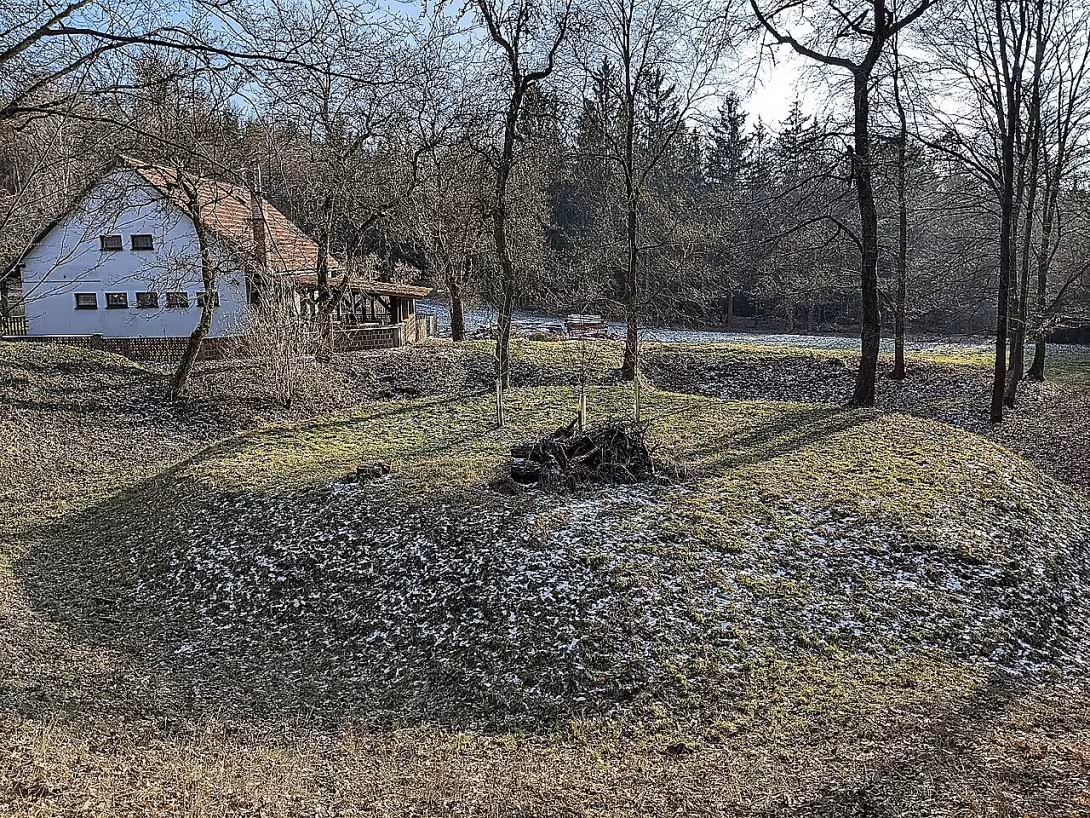
Objekt se nedochoval — na místě dnes nestojí. Následující text popisuje jeho historii, ne současnou návštěvu.
The barren castle, also called Doubravice or Doubravka, is a extinct medieval fortress located near the Beroun district in Central Bohemia. The construction from the beginning of the 15th century has now been preserved as a circular fortress and has cultural heritage status.
The fortress was part of the village Doubravka, which has been written about since 1230. The existence of the fortifications themselves is only documented in 1400, when Hašek z Doubravice was based here. The creation of such smaller harbours at that time was a common way of ensuring local administration and defence in Czech countries.
From an architectural point of view, a round fortress surrounded by a moat and a boulder was preserved. According to Augustus Sedláček's records, the tower was originally built here. However, its masonry was not preserved because it was dismantled in the 18th century and used as building material for the construction of a local pub.
In 1405, the castle belonged to Michael Chabca of Doubravic. He and his brother Václav undertook to pay the tithe in the amount of nine cords of grain to the Cervical rectory. At the same time, vicar Henry of Libědic, Zdeněk of Chajna and Otek of Lesky owned a cruise in Doubravice. In 1407 they sold it to Jan Domashin.
During the 15th century the villages and the fort were desolate. The name Doubravice was subsequently related to the surrounding forest under the estate of Valdek Castle. The last mention of the desert village dates back to 1547 or 1574, when Šebestián Pešík z Komárova sold it to Jiří Zajci from Hazmburk.
The monument is located approximately one kilometre west of the village Újezd near Doubravka grove. Here you can visit the remains of fortifications in the form of wallows and ditches.
The empty castle represents a silent testimony of the extinct medieval settlement and its administrative function. For those interested in history, this site is a valuable place to explore within the region of Beroun.
Historical milestones
- 1230
- First written mention of the village Doubravka
- 1400
- First evidence of the existence of the fortress on which Hašek z Doubravice lived
- 1405
- The fort belonged to Michal Chabca of Doubravic
- 1574
- Last mention of the desert village Doubravice
Architectural development
The fortress took the form of a round fortress with a surrounding moat and a wall. According to August Sedláček, there was a tower on the ground. Its masonry was dismantled and used in the construction of the pub in the 18th century.
Historical events
1400: First evidence of the existence of the fort; 15th century: The desolation of the village and the fortress; 1574 (or 1547): Last mention of the desolate village when selling Jiří Zají z Hazmburk.
Owners
Hašek z Doubravice (about 1400), Michal and Václav Chabec from Doubravic (1405), Šebestián Pešík z Komárova, Jiří Záješ from Hazmburk (1574 / 1547).
Points of interest
- The monument is also called Doubravice or Doubravka. - The masonry of the original tower was dismantled in the 18th century and used as building material for the construction of the local pub. - Architecturally preserved a round fortress surrounded by a moat and a boulder. - In 1405 Michal Chabc of Doubravic and his brother undertook to pay the tithe of nine cords of grain to the Cervical rectory. During the 15th century, the village and the fort were desolate.
Guide
Show guide text
This text was created by artificial intelligence and has not been editorially reviewed. It may contain inaccuracies.
Welcome to the place where time stopped and where nature gradually, but relentlessly, takes back what once belonged to man. You are standing right in front of the Hollow Castle, a place that is now quiet, modest and at first glance almost unnoticeable to the inexperienced eye. You may now seem to be standing in the middle of a green landscape, but please pay attention to what you see under your feet and around you. This quiet included in the earth shapes are not the work of chance. What you are now observing is the last, persistent proof that there once stood a significant fortress, the center of the village, and the seat of powerful generations. Feel this atmosphere of peace and emptiness, which gives that mysterious name the Hollow Castle such profound meaning.
Let's look together at what this country is hiding. This site, also known as Doubravice or Doubravka, is not just an ordinary hill. If you look around, you'll notice the round shape of the fortress, which is clearly surrounded by a moat and a bead. It's these shapes, these artificial lines in the field, that allow us to understand what this place looked like hundreds of years ago. Even if you no longer see tall walls or roofs here today, this geometry still tells us the story of defence and security. This circular structure was designed to provide shelter and protection, and even after centuries of oblivion, it still shows us clearly where exactly the center of this former mansion was located.
To understand why this place was created, we have to go back deep into the past until the 13th century. This is the period when the first mention of the village of Doubravka appears in our written records. Imagine life then - there was not the silence you feel now, but the noise of working people, the sound of cattle and the constant movement in this settlement. The fortress we see today as a remnant of the earth was the heart of this desolate village. Over time, the importance of this place deepened. The first clear confirmation of the existence of the fortress itself is from 1400. At that time, it was no longer just a village, but a fortified place that served as a home for noble generations. This fortress was also part of a wider estate, which was later controlled by Valdek Castle, which shows how closely the site was connected to the region's power structure.
Now please pay close attention to how this architecture is manifested in the landscape. Even though the buildings are long gone, the fortress plan itself has been preserved. Notice how the moat wedges into the ground and how the wall creates an elevated edge. This circular shape is not random; It's an architectural signature of the medieval need to create an impenetrable circle. If you look at the very shapes of the waves, you can imagine in your mind how the walls that supplemented these lines once stood here. Even if you see only soil and grass today, this structure is still very strong and clearly defines the space that was once heavily guarded. It is a fascinating example of how architecture can survive without the building materials themselves, if its basic plan is firmly engraved into the very essence of the site.
But looking at this wasteland, we cannot forget the people who once lived here, made decisions and built them. The empty castle was not just an empty place, it was a home for specific personalities whose names still ring in our chronicles. In the history of this place, names like Hašek z Doubravice appear, which lived here at the turn of the 14th and 15th centuries. Later, in 1405, the fort became the property of Michal Chabcova of Doubravic. These people were not just residents, they were gentlemen of this place, who had their power and their duties here. Other important people, such as Václav Chabeč z Doubravic or Šebestián Pešík z Komárova, were following in their footsteps. In history, Jiří Zají from Hazmburk has also been deeply involved. Each of these names represents a chapter in the history of this place, a chapter full of political excitement, family ties and efforts to maintain control over this territory. Now when you look at this calm wall, try to realize that this is where the fate of these people and their families was once decided.
But there is also one special, almost melancholic interest that gives this place a sense of loss. You may be asking what happened to all the stones and masonry that once formed the tower and walls of this fortress. The answer is simple and fascinating. In the eighteenth century, something happened that may seem relentless today, but it was quite common then. The wall of the original tower has been dismantled. But it didn't just disappear in the dust of time. These stones, which were once used to defend and protect the nobles, were used as building material for the construction of a local pub. It is a fascinating idea - stones from the power center, from a fortress that once aroused respect, became part of an ordinary cottage where people gathered to eat and rest. This transformation from a military and noble object into material for ordinary human needs illustrates the cycle of life and decay that took place at this place.
The story of Doubravka is a story of extinction. The village, which was mentioned in the 13th century, gradually disappeared from the maps. The last mention of this desolate village dates back to 1574. Since then, it has left only this round remnant in the landscape we now call the Hollow Castle. It's a place that teaches us humility before time.
Now that you've become acquainted with the history and fates that shaped this place, I'm going to make a sound for further examination. Let the atmosphere of this place drift. Walk along the edge of the trench, feel the silence and try to complete the missing walls and towers in your imagination. Look at the surrounding landscape and realize how deeply this place is involved in the history of the entire region. Thank you for spending this moment with us and for trying to look into the past of the Hollow Castle. I wish you the pleasant rest of your walk around this historic landscape.
Businesses nearby
Do you run a restaurant, accommodation, shop, museum, rental, wellness or other visitor service near this monument? Show yourself directly to the people heading to it — this is how they will see you in the app and on the web:
Events nearby
Zdroj akcí: otevřená data měst a obcí ČR (Národní katalog otevřených dat) a kalendář akcí Národního památkového ústavu.
Nearby
Hájna Doubravka, village Újezce, castle Valdek.
Visualizations and artistic views


The visualisations are generated by artificial intelligence and serve as inspiration.
Photos from the area
Real photos taken near the monument


Zdroj a licence jsou uvedeny u každého snímku.
Tips from visitors
No tips yet. Be the first!
Log in and add your tip.
Sources and literature
Photos: MartinVeselka / CC BY-SA 4.0 — Wikimedia Commons. The author and licence also appear when you hover over the image.
Faktickým podkladem tohoto textu byl článek na Wikipedii, jehož autory jsou přispěvatelé Wikipedie. Článek je dostupný pod licencí CC BY-SA 4.0.
Location on the map
More monuments – Plzeňský kraj
Show all in the region


Příběhy a pověsti
Legendy, pověsti a příběhy spjaté s touto památkou
Fotografie návštěvníků
Zatím žádné fotografie. Buďte první, kdo přidá fotografii z návštěvy!
Log in a přidejte svou fotografii nebo hodnoťte.
Za ověřenou návštěvu v aplikaci získáte víc bodů — poznáme podle GPS, že jste na místě.
Reviews and comments