



Rácov Castle ruin
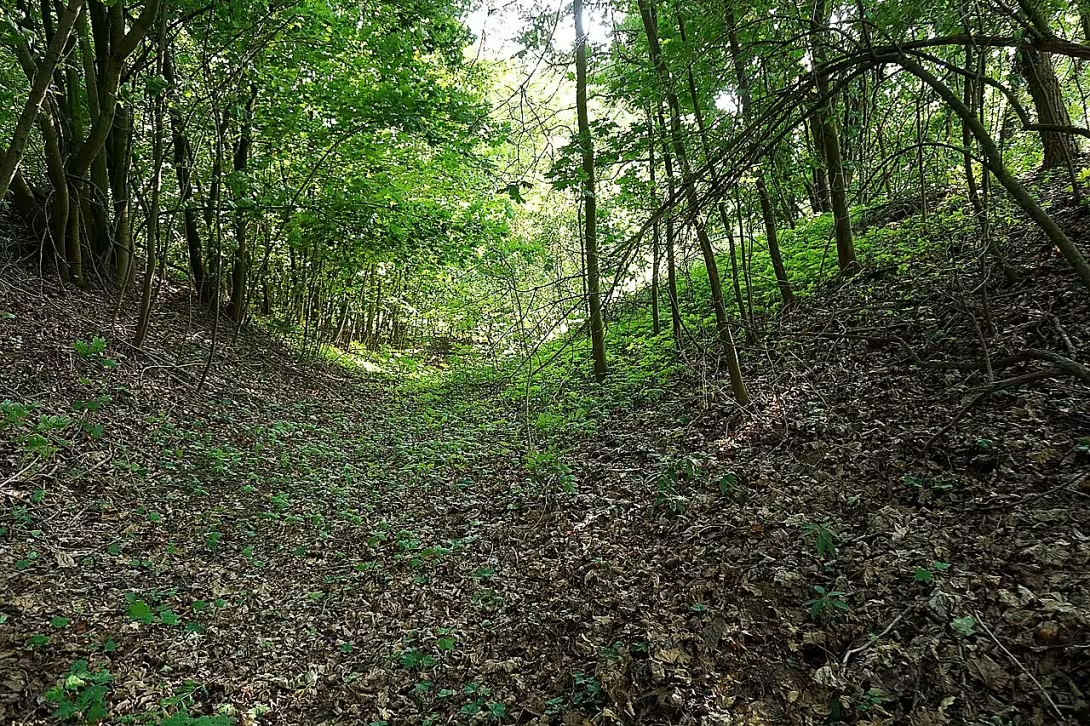
Rácov is an extinct castle on the hill above the castle Neuberk in Čejetky near Mladá Byslav. The object of its size stands on the border of the fortress and castle. It comes from the period between the 13th and 15th centuries and is today protected as a cultural monument.
The oldest history of the mansion has been preserved only a few written reports. Historical sources suggest that it existed in the period of the High Middle Ages, when noble mansions were formed in Czech countries. The first indirect mention of the castle, also known as Rachev, Drácov or Dráčov, dates back to 1380. That's when Václav's houses from Rácova, the Boyslav Archyahen, and Jakub from Rácova, who was a priest.
The construction site became a low island over the left side of Jizera. The defensive system consisted of an external neck fortification, consisting of an insignificant ditch, a wall and another ditch with a preserved depth of about four metres. Behind this fortification there was a small foothold, separated from the core by another moat. The wallets were also built on declining optics. Due to later disassembly of the masonry, terrain relics have been preserved to date.
The castle was part of the Boyslav estate. It is already mentioned as desolate in sources from 1576 and 1580. The fundamental change of location occurred in 1738, when the masonry was dismantled and secondary to the construction of the neighbouring Neuberk Castle.
The remains of the castle are currently freely accessible, although there is no tourist route. The locality represents an interesting proof of medieval settlement and the typological transition between the fortress and the castle. The visit to the site offers the possibility of viewing history through preserved terrain remains, which are a silent witness to the extinct medieval architecture.
Historical milestones
- 1380
- The first indirect written mention in the admissions of Václav and Jakub from Rácova.
- 1576
- The first written report of the castle as desolate.
- 1738
- The wall of the castle was dismantled and used in the construction of the castle Neuberk.
Architectural development
The castle was protected by an outer neck fortification formed by moats and walls. The area consisted of a small foothold and a castle core, while the fortifications were also found on falling optics. Due to the dismantling of masonry in the eighteenth century, terrain relics have been preserved to date.
Historical events
The first indirect written mention of the castle dates back to 1380. In 1576 and 1580 the castle is already mentioned as desolate. In 1738 the masonry was dismantled for the construction of Neuberk Castle.
Points of interest
- The object of its size stands on the edge of the fortress and castle. - The castle is also known as Rachev, Drácov or Dráčov. - The masonry of the castle was dismantled in 1738 and second used in the construction of the neighbouring castle Neuberk. - The defense system consisted of an outer neck fortification with a moat, the depth of which survived about four meters. - The remains of the castle are freely accessible, although there is no tourist route.
Guide
Show guide text
This text was created by artificial intelligence and has not been editorially reviewed. It may contain inaccuracies.
Welcome to a place where history meets silence and where the country seems to whisper stories that no one listens to anymore. You are standing in front of the ruins of castle Rácov. Before we go into deeper secrets, stop for a moment and perceive what is surrounding you. Look around you. You are on a platform that looks strategically over the Neuberk castle near Čejetice. Feel this atmosphere. Can you feel the gentle breeze rolling over the left side of the Jizera? This river, which flows in the foothills, has been an integral part of the life of this place for centuries. Even if you see only traces of past glory today, imagine how this view of the landscape must have affected people who lived here many generations ago. This elevated position was not chosen by chance. It was a choice between security and danger, between power and vulnerability.
Now let's move forward in time together and understand how this object came into being. To understand the essence of Rácov, we must return to the 14th century. The first relentless clues that history has left us about this place appear in documents from the second half of the year a thousand three hundred eighty. The names that were firmly associated with this place - Václav z Rácova and Jakub z Rácova - appear in the then houses. This clearly tells us that it was not just a random fortification, but the seat of the family nobility, which had left its mark and which considered this place to be its home. Imagine these men building up their power at the time and becoming synonymous with this particular design.
Now pay attention to the very form of this place, even though its face is so variable today. Rácov is fascinating by its size and character standing exactly on the border between two types of buildings. It's not just a small fortress, it's not a huge, impenetrable fortress. It's something in between, a unique hybrid that matched the needs of the time. Notice how the castle is using natural terrain geometry. It was built on a low sharpness that provided it with natural protection. Even though the wall of the castle no longer exists in its original form, you can imagine its defensive system through the landscape shape. It was formed by an outer neck fortification, supplemented by a moat. Even though the depth of this ditch is now a memory, its existence clearly tells us that this place was prepared to face the enemy. When you look at the slope of the terrain, try to see the lines that once formed impenetrable barriers.
When you look at this landscape, try to recall the personalities that used to live here and that we have to thank for the fact that we still know about them today. Václav and Jakub z Rácova. These are the people whose existence is the only bridge to the beginnings of this place. Imagine their life at a time when power was linked to the ownership of the country and control of strategic points, such as this one above Jizera. It was the people who made decisions about fate here, who managed their estate here, and who built the foundations of something that would last forever. Even though their names are now just a short line in ancient records, without them Rácov would remain a completely forgotten place without a name.
And now I want to invite you to think about what happened to what you see here. Rácov has many faces and many names, which is the first hint of its mysterious nature. There was a lot of talk about this place at different times. Some called him Rachev, others called him Dracov or Drachev. Why did his name change? Why have these different forms appeared in people's memories and in written reports? This remains one of the tiny but fascinating mysteries surrounding this place. But the greatest mystery and tragedy of this place is its gradual demise.
Rácov was not a castle that fell in a great siege or was destroyed by war. His end was much quieter, yet equally irreversible. By the year 15-72, the castle was referred to as desolate. It means that people left him, that there was no fire in his walls and no voice in his halls. The castle became an empty box, which was slowly subject to the will of time. And then it was 17, 38. In that year something happened that definitely ended the existence of the castle as a separate object. The wall of the castle has been completely dismantled. But it didn't disappear completely, nor did it fall to dust. He's become something else. The stones that once formed the defence and home of the nobles of Rácova were used in the construction of the nearby Neuberk Castle. It's a fascinating idea that if you look at the walls of the nearby castle, you can see a piece of the history of this castle. So Rácov didn't disappear, he just turned, became part of something else.
Even if you are standing in front of a place today that is basically just a shadow of its past glory, believe me, its presence in the landscape is still very strong. Every stone, every change in the field, and every view of the river carries the echo of those who were before us. Rácov is a reminder of how fleeting human works are, but at the same time how permanent their inheritance can be if someone is interested in it.
Thank you for choosing to devote this moment to this very place and for taking this short journey with us in time. Even though there is little to see here today, I believe you have perceived the invisible power of history that still radiates here. Continue to walk, feel the calm of this hill and look at the surrounding landscape with respect for all the layers of time that lie beneath your steps. We wish you a wonderful continuation in discovering this beautiful area and we hope that this view of the forgotten Rácov has brought you something interesting. Goodbye.
Tips for visitors
The best time to visit is spring or autumn, when vegetation is thinner and ruin is more accessible and transparent. In the summer months the site may be overgrown, making it difficult to move in the field.
The location is also available by public transport, the current connection to Mladá Bloslav and the subsequent pedestrian transfer can be verified in the connection search engine.
We recommend fixed shoes for the field and long pants because you move in ruins and natural vegetation. Don't forget the repellent and plenty of fluids, there are no services on the premises.
The best light to capture the remains of the masonry on the sharpness is during the golden watch when the sun shines through the trees. Focus on the details of the masonry in contrast to the surrounding greenery over the Jizera River.
You can visit the castle nearby Neuberk or take a walk along the Jizera River. For families with children the location is suitable as a short trip to history, but due to the terrain is not accessible with a pram and requires increased caution in children.
Frequently asked questions
Can the monument be visited?
This is a ruin. Such sites are often freely accessible, but some can only be visited with a guide or are closed for safety reasons. We have not verified the current situation – take care and respect any restrictions.
Where is the monument?
Location: Mladá Boleslav, Středočeský kraj. The map on this page shows the exact spot.
Why is the monument protected?
It is listed in the Central List of Cultural Monuments of the Czech Republic as a cultural monument (register no. 1000132709).
Businesses nearby
Do you run a restaurant, accommodation, shop, museum, rental, wellness or other visitor service near this monument? Show yourself directly to the people heading to it — this is how they will see you in the app and on the web:
Nearby
Zámek Neuberk, řeka Jizera, město Mladá Boleslav.
Accommodation nearby
Themed route
city Mladá Boleslav, city: Start your journey in this historic center. 2. River Jizera, River: Walk along the shore and enjoy a quiet landscape. 3. Castle Neuberk, Castle: Admire the architecture of this important object. 4. Rácov (ruin) , ruin: Visit the main destination of the trip and explore the remains of the old castle.
Seasonal recommendations
Spring: Rácov, a ruin in Mladá Bloslav, offers a unique view of the reviving nature in spring. Flowers and trees are beginning to bloom, giving the ruins a romantic atmosphere with a hint of old rumours. The sun illuminates the stones in a mild light that emphasizes their history and beauty. Although some people may appear at the beginning of spring looking for the first sun day, it is a period favourable to quieter walks. We recommend wearing clothes suitable for mild temperatures and have some protection against rain because spring weather can be variable.
Summer: In summer, Rácov is a popular destination for tourists seeking escape into history and nature. Sunshine days illuminate ruins in full light, allowing detailed inspections of their architecture. Summer is also an ideal time for photography with bright and vivid colours of beds that surround the memory. Due to high attendance, it is recommended to arrive at the beginning of the day or later in the evening so that visitors enjoy less people. Do not forget the boxes of drinking and sun protection, because temperatures may be high.
Autumn: In the autumn period Rácov is gaining special melancholy atmosphere. November leaves form a living carpet around ruins, creating an impressive landscape suitable for romantic walks or inspiring photography. The sun illuminates the memory with long rays that emphasize its structure and history. Although the traffic is decreasing at this time, it is advisable to wear warmer clothes for colder evenings. A quick reduction of the day also means a shorter visit time.
Winter: Winter Rácov offers a completely different view when ruins appear in the soft light of glaciers and snow. The atmosphere is calm and quiet, which allows the use of the monument without fear of the crowd. Sun rays illuminating rocks in an icy atmosphere give visitors a sense of mystery and peace. Due to cold temperatures, it is necessary to wear warm clothes, including fur and shoe socks. Days are also short, which means that the visit should be planned for the brightest time of the day.
Visualizations and artistic views


The visualisations are generated by artificial intelligence and serve as inspiration.
Photos from the area
Real photos taken near the monument

Zdroj a licence jsou uvedeny u každého snímku.
Tips from visitors
No tips yet. Be the first!
Log in and add your tip.
Sources and literature
Photos: MartinVeselka / CC BY-SA 4.0 — Wikimedia Commons. The author and licence also appear when you hover over the image.
Faktickým podkladem tohoto textu byl článek na Wikipedii, jehož autory jsou přispěvatelé Wikipedie. Článek je dostupný pod licencí CC BY-SA 4.0.
Location on the map




Příběhy a pověsti
Legendy, pověsti a příběhy spjaté s touto památkou
Fotografie návštěvníků
Zatím žádné fotografie. Buďte první, kdo přidá fotografii z návštěvy!
Log in a přidejte svou fotografii nebo hodnoťte.
Za ověřenou návštěvu v aplikaci získáte víc bodů — poznáme podle GPS, že jste na místě.
Reviews and comments