



Radnice (Frenštát pod Radhoštěm) Town hall
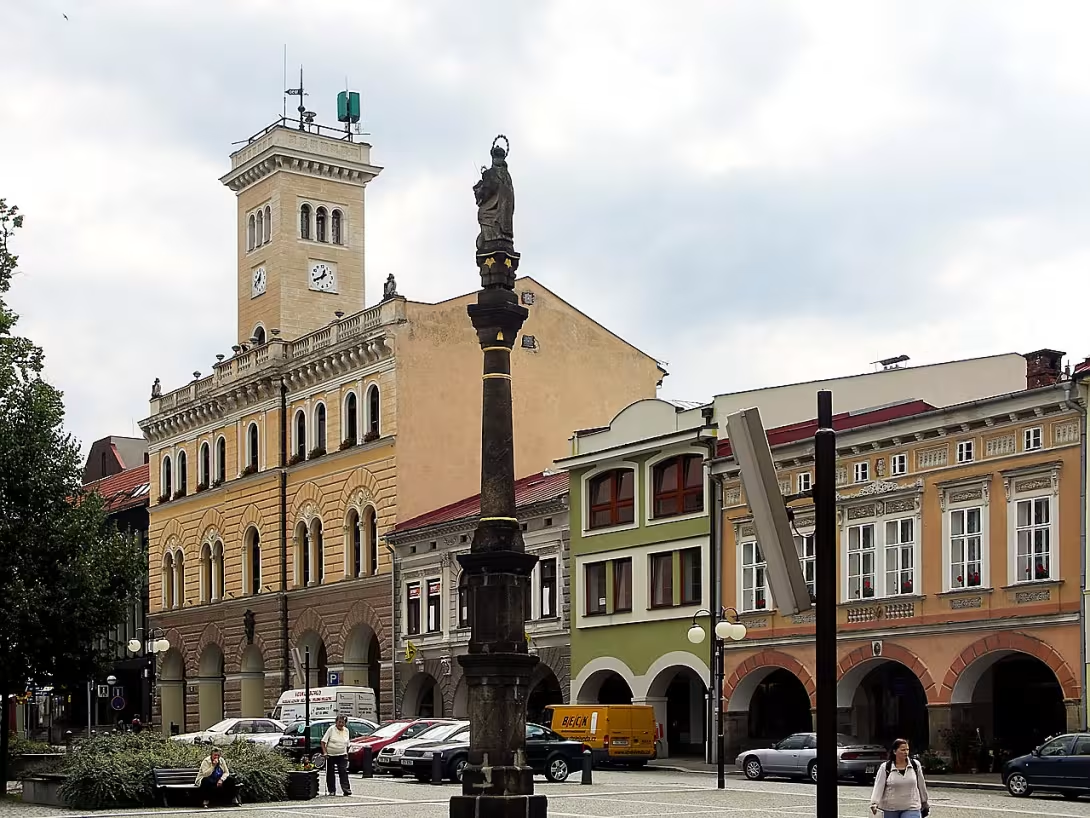
Frenstát Town Hall is a representative Neo-Renaissance building on the Square of Peace in Frenštát, under Radhoště. The building was built between 1889 and 1890 and serves as a seat of the municipal office. Since 1993 it has been listed on the list of cultural monuments of the Czech Republic. The construction excels with its architecture and preserved stucco decoration. The original statue of God Radegast by sculptor Albino Polášek is also located in the lobby.
The history of the city administration in Frenštáta dates back to the 14th century. As early as 1382, it is reminded of the heritable speed and fojt Biersack. The original photography, which performed administrative functions, was redeemed by the city in 1584. The first mention of the town hall dates back to 1614, but there is little information about its form or location. In 1788 City Hall purchased house No. 25 in the square. The classical building grew in its place between 1789 and 1797. This building served its purpose until the end of the 1880s, when it was demolished because of the construction of the new building.
The current town hall was established between 1889 and 1890 according to the design of the Brno builder Antonín Tebich. The implementation of the construction was ensured by Antonín Staněk from Valašské Meziríčí and the cost was 80 000 gold. The two-storey building in the Italian Neo-Renaissance style is complemented by an oblong and high prism tower. The facade is decorated with circular medals with stucco reliefs of personalities: Jan Amos Komensky, Franz Palacký, Josef Jungmann and Bohdan Jablonski. There is a cartouche above the main entrance with the sandstone sign of St. Martin, patron of the city.
During the 20th century, the interior had undergone numerous modifications, yet the original stucco decoration was preserved in the entrance hall. The building in the past has not only served the city administration. Until 1927 there was a general school and between 1959 and 2002 the premises were used by the city museum. Today in the building there is a town hall and there is a Cultural and Information Centre on the ground floor.
The key moment was the housewarming and ceremonial consecration, which was performed in May 1891 by the Frenstát priest Josef Fusek. The original statue of God Radegast by Albino Polášek is an important element of the interior. At the top of Mount Radhosti, visitors can only see a copy of it. The Town Hall Tower offers views of the Beskyd panorama and is open to the public in the tourist season.
The city hall of Frenštětská represents a valuable proof of the history and ambition of the city administration at the end of the 19th century. Visiting the building offers a view of the architecture linked to the national revival and the possibility to see a significant work of art in an authentic environment.
Historical milestones
- 1889
- Construction of the new town hall building.
- 1891
- Collation and ceremonial consecration of the town hall.
- 1993
- Writing the building to the list of cultural monuments.
Architectural development
The building was built in an italizing Neo-Renaissance style as a two-storey object with an arch. The facade is decorated with circular medallions with relief of prominent personalities and the sandstone sign of St. Martin. The interiors have undergone numerous modifications during the 20th century, yet the original stucco decoration of the lobby has been preserved.
Historical events
1584 redemption of heritable photography by the city, 1889 demolishing the old town hall, 1891 housewarming and consecration of the new town hall, 1993 entry to the list of cultural monuments.
Owners
City of Frenštát pod Radhoštěm
Points of interest
- The building has been listed on the list of cultural monuments of the Czech Republic since 1993. - There is an original statue of God Radegast from sculptor Albino Polášek in the lobby of the town hall, while there is only a copy on Mount Radhosti. - The facade is decorated with circular medallions with stucco reliefs of personalities such as Jan Amos Komenský, František Palacký, Josef Jungmann and Bohdan Jablonský. - There is a cartouche above the main entrance with the sandstone sign of St. Martin, the patron saint of the city. - Town Hall Tower offers views of the Beskyd panorama and is open to the public in the tourist season.
Guide
Show guide text
This text was created by artificial intelligence and has not been editorially reviewed. It may contain inaccuracies.
Welcome to Frenštát under Radhošt. Stop for a moment, take a breath and look around you. You are standing in the very heart of the city in Peace Square, and right in front of you is one of the most important local buildings. It's a building that, both in size and appearance, emits dignity and authority. Look at her carefully. It is the city hall of Frenštět, a place where for many decades the fate of the city is decided and where the city office still resides.
When you look at her facade like that, you see the spirit of the late nineteenth century. This representative building in the Neo-Renaissance style was built between 1889 and 1890. To understand why it looks like this, we have to go back in time for a while. Before the creation of this building there was another town hall, which was performed in a classical style. But it was no longer sufficient at the time, perhaps already old or simply not in line with the growing ambitions and needs of the emerging city. That's why it decided to build a new, much more representative mansion.
The whole construction process began in 1889 and was led by two architects, which were Antonín Tebich and Antonín Staněk. These creators wanted to create an object that would not only be a practical office, but also an aesthetic jewel square. Their work was successful and in 1891 the town hall was officially co-ordinated and ceremoniously consecrated. Since then, it serves as an administrative centre and its appearance defines the character of the whole area.
Now, I want to ask you to pay attention to the specific details that you see right in front of you. Look up first. The dominant feature of the whole building is the high prism tower, which reminds the susceptible observer of the traditional city hall towers of old European cities. It's a symbol of power, but it's a landmark for everyone who comes into town.
Then move your view below, on the very facade of the building. Notice the rich stucco decoration of the facade. The stucco, the fine plastic decoration, gives the building depth and elegance. If you approach or look very closely, you will see circular medallions on the facade. They're stucco reliefs that make the faces of prominent personalities uneasy. One of them is Jan Amos Komenský, who reminds us of the connection of the city with great Czech education and spiritual tradition. These details are not just an ornament, but they tell a story about the values that the city had at the time of construction.
Now let's think about moving a little further to the very entrance to the building. Even though you may be out there right now, I know you'll be interested in what's inside. As soon as you enter the entrance vestibule, your attention will immediately attract one extraordinary thing. It is here that the statue of the god Radegast is permanently placed. It's the work of the famous sculptor Albino Polášek.
Here we come to one of the greatest attractions of this place. Many people who visit the area will go to Mount Radhosti to look at the statue of Radegasta, which stands there as a symbol of pagan roots and nature. But know that the statue on the mountain is just a copy. The real original, the real, original statue from the hands of Albino Polášek, is located right here, safe in the lobby of the Frenstát Town Hall. It is a fascinating contrast that the god of mountains and forests has its real resting place in the administrative building of the city.
When we think about people who were connected to this building, apart from the architects Tebich and Staňek and sculptor Polášek, we must not forget other personalities such as Josef Fusek. All these people have contributed to the fact that the City Hall is not just a pile of stone and mortar, but a living testament to history.
It is important to realise the value of this building for the whole Republic. In 1993 the town hall was officially listed on the list of cultural monuments of the Czech Republic. This entry is not only a formal confirmation, but a recognition that the architecture and history of this place are unique and must be protected for future generations. This is proof that the Neo-Renaissance style, which was modern and representative at the time of construction, is now seen as a valuable historical legacy.
Now try to revisit the entire building from the distance. Feel its symmetry, stability and the way it controls the space of the Square of Peace. Imagine how many generations of people went through them, how many important papers were signed here and how many festivities were held outside her door. This town hall is like a silent witness who saw cars coming, regime changes, and the daily life of thousands of people.
It's fascinating how one building can combine such distinct elements. On the one hand, we have the strict administrative function of the city office, on the other hand, the neo-Renaissance aesthetics with its medallions and towers, and at the heart of everything, the mysterious god Radegast, who guards the entrance to the building. It's a combination of order, art and myth.
Now that you know the story of this building, its architectural details and its secrets hidden in the lobby, I suggest you go around the city hall once more. Notice how the impact of light changes on stucco decorating depending on the side of the building. Look again at that tall tower and try to imagine what view of the city and the surrounding hills must be.
Thank you for accompanying me in this brief introduction to the town hall in Frenštáta under Radhošt. I hope you're interested in this building and that you now see more than just an official building in it. It's a piece of history that still lives and breathes. Now I invite you to continue to explore the beauty of this city and its surroundings. Perhaps now you'll be lured to Radhosti to compare a copy of the statue with the original you just visited in your mind. I wish you a pleasant rest of the day and a wonderful experience on your next discovery. Goodbye.
Tips for visitors
The best time to visit is in the morning when the sun illuminates the facade of the building on the Square of Peace. In the summer months the square is lively and offers a pleasant atmosphere for observing historical architecture.
Use the road network or public transport to reach the city. In the center of the city, move on foot, allowing you to better understand the details of the Neo-Renaissance facade of the town hall.
For photography we recommend to use the wide-angle lens from the opposite side of the square, from where the whole building stands out. The best light for pictures of details and decorative elements is during bright days when shadows in architecture stand out.
In the vicinity of Frenštát pod Radhoštěm you can visit Mount Radhosti, which offers beautiful views of the landscape, or take a walk along the Lubiny River. The whole area of Beskyd is ideal for nature lovers.
We recommend to families with children a walk along the square where children can see historical houses. In the vicinity there is plenty of space for rest and easy trips to the surrounding nature of Beskyd.
Frequently asked questions
Can the monument be visited?
Some buildings of this kind are open for guided tours, others serve another purpose or are privately owned. We have not verified whether and when this monument is open – please ask the operator.
What are the opening hours and admission?
We have not verified the opening hours or admission. Current information is published by the operator.
Where is the monument?
Location: Frenštát pod Radhoštěm. The map on this page shows the exact spot.
Why is the monument protected?
It is listed in the Central List of Cultural Monuments of the Czech Republic as a cultural monument (register no. 1000120472).
Businesses nearby
Do you run a restaurant, accommodation, shop, museum, rental, wellness or other visitor service near this monument? Show yourself directly to the people heading to it — this is how they will see you in the app and on the web:
Nearby
Hora Radhošť, město Frenštát pod Radhoštěm, řeka Lubina, Beskydy.
Accommodation nearby
Themed route
1. City Frenštát pod Radhoštěm, municipality. Walk through the centre of the village represents the ideal start of the trip. Radnice (Frenštát pod Radhoštěm) City Hall. The main destination of the journey, which will capture its architecture and history. 3. Lubina River, water flow. It offers a peaceful journey along the water and the possibility of relaxing in nature. 4. Mount Radhosti, peak. A place with a beautiful view and an important cultural character. 5. Beskydy, mountains. A wide area with deep forests and paths for motion lovers.
Seasonal recommendations
Spring: In the spring period of the Town Hall in Frenštět pod Radhostí offers visitors a sweet light of the noon hours, which revives the stone facades and increases the colour of the surrounding nature. Flowers on the grass begin to bloom and trees dress up in new leaves, creating a comfortable and lively atmosphere for the tour. It is recommended to visit city hall in the early spring season when there are fewer people, and to wear a light suit with an umbrella or helmet to protect against sudden rain.
Summer: In the summer period Town Hall in Frenštět pod Radhoště celebrates long sunny days and warm air, which are ideal for visiting outdoor monuments. The sun illuminates historic buildings in full shine, allowing you to catch beautiful photos. It is advisable to bring sunglasses and a protective silicon cream for UV protection this season. Visitors should also plan early mornings or late afternoons to avoid hot and busy hours.
Autumn: In the autumn of Town Hall offers unique experiences thanks to the color change of tree leaves around the monument. The sunny afternoons create a magical atmosphere where the colored leaves are reflected on the stone facades of the building. This time of year is ideal for a relaxed tour without fear of heat or rain. It is recommended to visit in autumn days with a warm suit and hat that protects against cold winds.
Winter: In the winter months of the Town Hall in Frenštět pod Radhostí offers a quiet atmosphere with a snow blanket which adds a romantic touch. The sunny light lights up on the white surfaces and the celebrated buildings create views full of peace. Visitors should accept a warm suit, clip or shoes on a snow mat and protective ocular aids against cold winds. This time of year is perfect for quiet walks, where the comfort of a historic environment without noise can be enjoyed.
Visualizations and artistic views

The visualisations are generated by artificial intelligence and serve as inspiration.
Photos from the area
Real photos taken near the monument

Zdroj a licence jsou uvedeny u každého snímku.
Tips from visitors
No tips yet. Be the first!
Log in and add your tip.
Sources and literature
Photos: David Paloch (Caroig) / CC BY-SA 2.5 — Wikimedia Commons. The author and licence also appear when you hover over the image.
Faktickým podkladem tohoto textu byl článek na Wikipedii, jehož autory jsou přispěvatelé Wikipedie. Článek je dostupný pod licencí CC BY-SA 4.0.
Location on the map

Příběhy a pověsti
Legendy, pověsti a příběhy spjaté s touto památkou
Fotografie návštěvníků
Zatím žádné fotografie. Buďte první, kdo přidá fotografii z návštěvy!
Log in a přidejte svou fotografii nebo hodnoťte.
Za ověřenou návštěvu v aplikaci získáte víc bodů — poznáme podle GPS, že jste na místě.
Reviews and comments