






Radnice (Město) Town hall
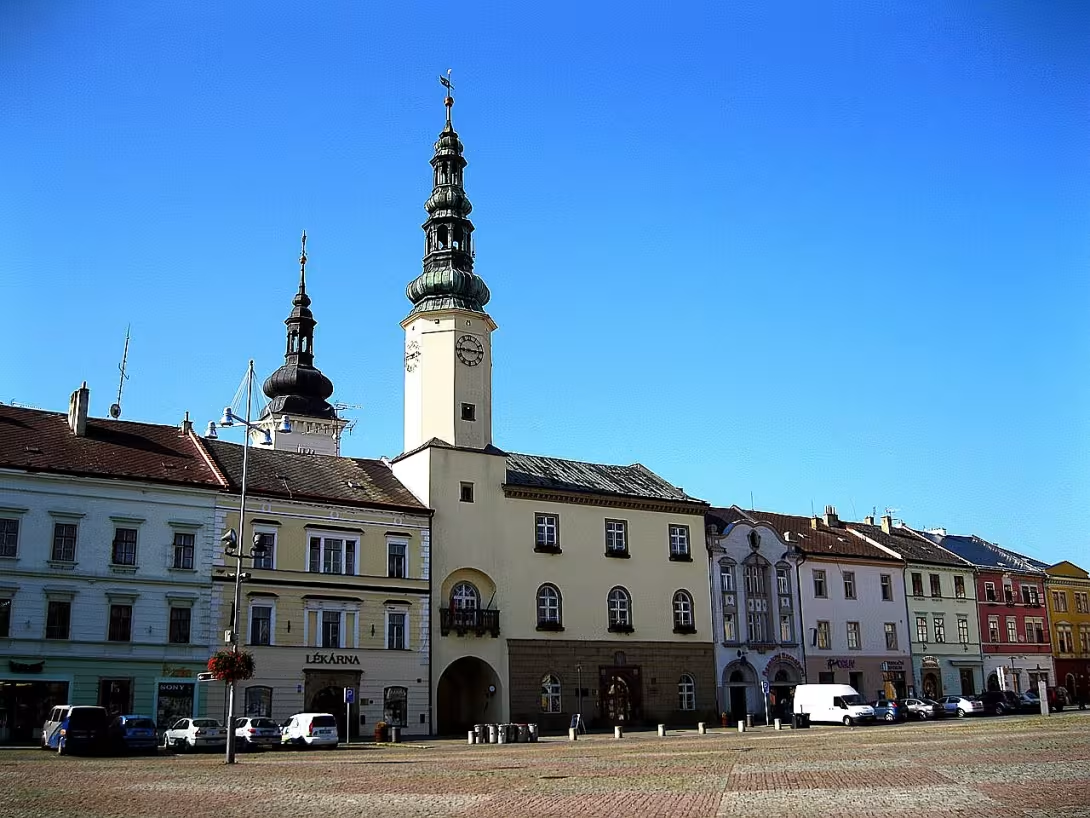
Town Hall in Moravian Třebová is originally a late Gothic building started by Hieronym Dubenský in 1521. After the fire, the building was expanded and restored by architect Andreas Pfoff in the 16th century. The meeting hall of the Consels was located here, which underlines its administrative role. This town hall is not only a historical monument, but also a witness to the development of urban buildings during the period of Renaissance art and architecture in Moravia.
This town hall can be dated to 1521 when Hieronym Dubenský started building it. It was originally built as a substitute for former photography and served the local administration. After the second devastating fire, the architect Andreas Pfoff participated in the town hall, which not only restored it, but also expanded it in the 1960s. His work involved increasing the tower and adding new building elements such as nail vaults in the mazhauz.
The town hall is characterized by late Gothic style with elements of Renaissance art. The original building from 1521 contained the first ground floor tract with mazhauz, a glass polygonal pillar carrying four fields of cross vaults and a small hall where the Moravian eagle symbol was preserved. After the fire, the tower was increased and part of the building restored by Andreas Pfoff, which also expanded the city hall. Its work is the crest vaults in the mazhauz.
The history of administration and ownership of this town hall is closely linked to its architectural development. After the initial construction works of Hieronym Dubenski came to the scene Andreas Pfoff, which not only restored but also expanded the building. His work left a permanent trail in City Hall architecture.
Key events and attractions include a symbol of Moravian eagle, which has been preserved in the walls of the building. The ceiling is decorated with plant motifs of vines, vine leaves and pomegranates. On the facades are the years of testimonies about the progress of construction modifications.
Today, the town hall in Moravian Trebova is not only a historical monument, but also a place to visit. Its architectural wealth and historical importance make it an interesting destination for tourists and historians. Visiting this town hall offers an opportunity to become acquainted with the history of local administration and architecture.
Town Hall in Moravian The Třebob is not only a monument, but also a witness to history and culture. Her visit offers a unique view of the past and recalls the importance of the local administration for the development of the city.
Historical milestones
- 1521
- The beginning of the city hall building by Hieronym Dubensky.
- 16th century
- Restoration and extension of City Hall by architect Andreas Pfoff after the fire.
Architectural development
The original building from 1521 contained the first ground floor with mazhauz. After the fire, the tower was increased and part of the building restored by Andreas Pfoff, which also expanded the city hall. Its work is the crest vaults in the mazhauz.
Historical events
- 1521
- The beginning of the city hall building by Hieronym Dubensky.
- 1960s 16th century
- The extension and renewal of the building by architect Andreas Pfoff.
Points of interest
- Town Hall in Moravian Třebová is originally a late Gothic building started by Hieronym Dubenský in 1521. - After the fire, the building was expanded and restored by architect Andreas Pfoff in the 16th century. - The meeting hall of the Consels was located here, which highlights its administrative role. The Moravian eagle symbol was preserved in the walls of the building. - The ceiling is decorated with plant motifs of vines, vine leaves and pomegranates.
Guide
Show guide text
This text was created by artificial intelligence and has not been editorially reviewed. It may contain inaccuracies.
Welcome to the beautiful town of Moravian Trebova. Right now, you're facing one of the most important buildings in the city, a building that has served for centuries as a centre of administration and a symbol of urban self-esteem. There's a town hall in front of you. Stop for a moment, take a breath and feel the atmosphere of this place. Imagine how people walked through these roads in times when the city was warming up with a completely different rhythm, when the sounds of artisanal workshops sounded out of the surrounding alleys, and in the square, the residents gathered to learn the news from the surroundings. This building, which now welcomes you, is not just an ordinary house, but a silent witness to the history that has survived fires, changes in regimes and the rotation of generations.
Now let's look together at how this building came into being and what its origin is. In order to understand its essence, we need to move deep into the past in our minds, namely five hundred twenty-one in the year. It was this year that the foundation of the town hall was laid. A man named Hieronym Dubenský started the construction. At that time, the town hall was carried out in a late Gothic style. At that time, goth was a period of emphasis on vertical, grandeur and spiritual dimension, which was reflected in the architecture of public buildings. Hieronym Dubenský wanted to create a space that clearly marked the city's power and stability. When you look at the building today, you realize that its basic skeleton and its original intention go back to this very period when the Middle Ages slowly began to change into a new age.
History, however, seldom works in complete peace. City Hall building had to face trials, the most terrible of which was the fire. The fire that posed a huge threat to the cities at the time left traces at City Hall. However, it is this tragedy that has become an impulse for further development. In the 16th century, the time for renewal and enlargement came. Architect Andreas Pfoff entered the game. His job was not only to repair what destroyed the flame, but to improve the building to meet new needs and contemporary taste. Thanks to his work, the town hall has changed and gained its expanded form, which we see today as a basis. Andreas Pfoff added its experience to the building and helped the city hall get up again from the ashes, thereby ensuring that the building can continue to fulfil its important role in the life of the city.
Now pay attention to the architecture itself. Look at the facade and see the overall composition of the construction. Even though the building was changing over the years, we still feel the original Gothic spirit in it, which was later supplemented by elements from the sixteenth century. Notice how the building dominates the space around it. It's an architecture that was meant to inspire respect. The passage of time became a harmonious element of the urban landscape. I suggest you now slowly go around the building and see how its shapes change depending on the point of view. Watch the facade details and think about how many hands have touched these walls and how many eyes have looked at them in the last 500 years.
When we think about what was going on in these walls, we can't ignore the inner spaces, and specifically the meeting hall of the Consels. The Conshels were at that time important personalities, city managers who decided on the laws, taxes, trade rules and the security of all citizens. It was in this hall that there were key debates, disputes and plans for the future of Moravian Třebova. This room was not just an administrative office, but a real center of power. Imagine the tense discussions, the sound of wood bursting in the fireplace and the serious faces of men holding the fate of thousands of people in their hands. The administrative role of the city hall was therefore absolutely crucial, it was a heart that pumped life into the entire organism of the city.
In addition to administration, there is also one very powerful symbol attached to the city hall that you should not miss. It's a symbol of a Moravian eagle. The eagle is a representative of pride, strength and regional identity. His presence at City Hall reminded everyone who came here that the city was part of a wider Moravian entity and that it was linked to the history of this country. The eagle is not just an ornament, it's an expression of jurisdiction and legitimacy. When you see him, remember how important it was in the past to have a clear symbol that unites people and gives them a sense of security and stability under a common flag.
Perhaps now you can think of the secret this building still holds. Every old town hall has its invisible layers. Who knows how many documents or old keys left in her walls? Who knows what secret agreements were made in the corners of a meeting hall of consoles that were never written in chronicles? It is this ignorance that gives the city hall certain charm. It's a place where history meets secrets and where every stone can tell its own unique story if we're just being attentive enough.
Now that you know the basic history of this building, from the beginnings of Hieronym Dubenski to the restoration of Andreas Pfoff to the symbolism of the Moravian eagle, I suggest you observe the city hall in silence for a while. Try to connect all this information into one image. You see not only a stone and mortar structure, but a living organism that survived the century.
Thank you for walking together through the history of this beautiful town hall. I hope you were interested in her story and that you felt a connection with the people who lived here before us. Now invited to explore the magic of Moravian Třebová. Go through the surrounding alleys, discover other hidden corners and be guided by curiosity. I wish you a pleasant rest of the day and many new, fascinating discoveries in our city. Goodbye.
Tips for visitors
Best time to visit the town hall in Moravska Třebová is an early spring or late autumn period when there are not too many people and the atmosphere is calm. Sunshine days are ideal for exploring historical architecture.
Parking is limited around the town hall, therefore we recommend the use of public transport or parking lots on the outskirts of the city. Current information on availability of parking spaces and public transport connections can be found online.
When visiting City Hall, bring sunglasses, shoes suitable for walking on stone corridors and perhaps even water. Also remember the camera or mobile phone with sufficient memory capacity.
The best place for photography is the elevated position, from which the view of the overall construction is opened. The best light for photography is usually in the early morning or evening when the sun is not directly above your head.
In the vicinity of the town hall you can visit the historical church and visitors interested in cultural heritage can take a tour at the local museum. These places are available on foot or by short journeys.
Businesses nearby
Do you run a restaurant, accommodation, shop, museum, rental, wellness or other visitor service near this monument? Show yourself directly to the people heading to it — this is how they will see you in the app and on the web:
Nearby
🏰 Historic sites (99)
- sv. Šebestián 0.1 km
- sv. Roch 0.1 km
- Panna Maria Immaculata 0.1 km
- sv. Josef 0.1 km
- sv. František Borgia 0.1 km
- sv. Karel Boromejský 0.1 km
- sv. Antonín Paduánský 0.1 km
- sv. Jan Nepomucký 0.1 km
- sv. Petr 0.1 km
- Morový sloup 0.1 km
- Brána času 0.2 km
- Zámek Moravská Třebová 0.2 km Zámecké nám. 185/1 web
- Brána času 0.2 km
- Josefína Lamm 0.4 km
- Alfred Lamm 0.4 km
- Oskar Holzman 0.4 km
- Městské muzeum Moravská Třebová 0.4 km Svitavská 315/18
- Kalvárie 0.8 km
- Třebovské Hradisko 1.8 km
- Pomník obětem 1. světové války 2.2 km
🍽️ Restaurants and dining (82)
- Big Pizza & Burger 0.1 km
- HOTEL - Třebovská restaurace 0.1 km
- Na kovárně 0.1 km
- Caffé Na knížecí louce 0.1 km
- Jaha 0.1 km
- Bar-Bar 0.1 km
- Knížecí pivovar 0.1 km web
- Pizza Burgr Caffé 0.1 km
- Restaurace Excalibur 0.2 km +420 777 662 662
- Pivnice U Stupků 0.2 km
- Morava 0.3 km Svitavská 304/2 web
- Laskavárna 0.4 km +420 733 741 415 web
- U Matouše 0.5 km
- Na růžku 0.5 km
- U kavky 0.5 km
- U štiky 0.7 km
- Bistro na cestě 0.9 km web
- U Kalvarie 1.0 km +420731655566 web
- Na hladince 1.0 km +420 774 301 933 web
- Restaurace U Nádraží 1.1 km +420 461 312 189
🏨 Accommodation (19)
- Best 0.3 km Brněnská 14/10 +420 605 515 256 web
- V podzámčí 0.3 km
- Penzion U Cyrila 0.5 km Olomoucká 37 +420 777 242 118 web
- Trnavský grunt 6.8 km +420604316913
- Ubytovna Na rychtě 8.1 km
- Rekreační areál Motýlek 8.4 km web
- Klášter sv. Alfonze z Liguori 8.9 km web
- Penzion Oáza 13.4 km
- PadmaFarma 13.5 km +420 737 550 156 web
- Eden 13.6 km
- Vermon 13.6 km Česká 6/1 +420 603 109 648 web
- Pension Fontána Svitavy 13.8 km U stadionu 708/6 +420 605 404 860 web
- Tělovýchovná jednota Jevíčko, z.s. 13.9 km +420 777 081 531
- U apoštola 14.2 km
- Hotel & Gallery Kopacka 14.3 km +420 775 912 912 web
- Old Mill Glamp 14.3 km Kozov 8 +46722244244 web
- Old Mill Glamp 14.3 km Kozov 8 +46722244244 web
- Hotel Morava 14.4 km
- Kemp Opatovec 15.0 km web
🚲 Rentals and sport (6)
- Jízdní Kola - Jelínek 0.3 km
- Cyklo Němčík 0.5 km Gorazdova 8 +420 608 861 453
- Sportisimo 13.3 km web
- Tělocvična 14.0 km
- Koupaliště Svitavy 14.4 km
- Sportovní střelnice 14.8 km
🥾 Hiking and nature (149)
- Luční lázně 0.4 km
- Křížový vrch 0.8 km
- Nad Boršovem 1.2 km
- Pastýřka 1.2 km
- Hradisko 1.8 km
- V Pekle 1.8 km
- Peklo 1.9 km
- Třebovské hradisko 1.9 km
- Strážný 2.0 km
- Dubina 2.4 km
- Ostrý 2.7 km
- Kamenitý kopec 3.3 km
- Zlatník 3.4 km
- Černý vrch 3.4 km
- Horka 3.6 km
- Liška 4.0 km
- Nad rybníčkem 4.1 km
- U pomníku letců 4.6 km
- Gravitační anomálie (optický klam) 4.8 km
- Spálený vrch 4.9 km
Accommodation nearby
Themed route
Thematic cruise route "Historical Heart Cities"
1. Radnice (Město) - historical monument, administrative building City Hall is the center of urban life and history. Its architecture resembles the history of the village and provides visitors with a view of the important events that took place here.
2. City square - public space You go from the town hall to the town square, where there are various statues and monuments. It is a place for meeting residents and tourists, which offers a quiet atmosphere and beautiful views of the surrounding buildings.
3. City Library - Cultural Institution The town library is about 5 minutes' walk from the square, which is not only a source of education but also a host of various cultural events. It is the ideal place for those who want to learn more about local history and literature.
4. City park - green oasis Shortly from the library there is a city park where visitors can enjoy quiet moments in nature. The park offers a beautiful space for relaxation and views of historical buildings in the background.
5. City Gallery - Art Institute At the end of the route, approximately 10 minutes' walk from the park, there is a city gallery. It is a place for displaying works of local and national artists and provides a view of contemporary cultural trends.
This route offers a comprehensive view of the history, culture and nature of the village Město.
Seasonal recommendations
Spring: In the spring, the town hall in town is charming mainly because of its new living environment. Trees and shrubs are starting to frown, which gives the historic buildings a finely green shade. The sun illuminates the architectural elements of the town hall in a mild light which is ideal for photography. This time of year is suitable for visiting due to usually lower crowds compared to winter and summer periods. It is recommended to wear mild clothes that will be warm at noon but also provide protection against cold wounds.
Summer: Summer is the time when City Hall offers the biggest attraction. The sunny days and warm atmosphere create ideal conditions for long walks along the urban streets around the historical monument. However, due to the popularity of this period, high visitor numbers must be expected. It is recommended to come earlier in the afternoon to avoid the largest crowds while enjoying the lights falling on the facades in a quiet environment. Remember to wear light clothes, sunglasses and plenty of drinking.
Autumn: In autumn, the town hall turns into a beautiful golden color for leafy trees. Mild temperature and often bright sunny day provide ideal conditions for visiting when crowds have not yet increased to winter level. The atmosphere is calm and friendly, allowing relaxed walks on the city streets. It is advisable to wear top clothes that will be warm at noon but also provide protection against cold evenings.
Winter: Winter visit to City Hall offers a completely different atmosphere. Město is covered with snow and light falls on buildings in soft winter light, giving historical elements a unique touch. Due to cold temperatures, opening times are usually shorter and traffic rates are lower than in other seasons. It is important to prepare for snow conditions and wear warm clothes that will include isolated top and wind protection. Before visiting, it is good to learn about possible changes in traffic due to winter conditions.
Visualizations and artistic views

The visualisations are generated by artificial intelligence and serve as inspiration.
Photos from the area
Real photos taken near the monument


Zdroj a licence jsou uvedeny u každého snímku.
Tips from visitors
No tips yet. Be the first!
Log in and add your tip.
Sources and literature
Photos: Lehotsky / CC BY-SA 3.0 — Wikimedia Commons. The author and licence also appear when you hover over the image.
Faktickým podkladem tohoto textu byl článek na Wikipedii, jehož autory jsou přispěvatelé Wikipedie. Článek je dostupný pod licencí CC BY-SA 4.0.
Location on the map


Příběhy a pověsti
Legendy, pověsti a příběhy spjaté s touto památkou
Fotografie návštěvníků
Zatím žádné fotografie. Buďte první, kdo přidá fotografii z návštěvy!
Log in a přidejte svou fotografii nebo hodnoťte.
Za ověřenou návštěvu v aplikaci získáte víc bodů — poznáme podle GPS, že jste na místě.
Reviews and comments