



Radnice (Napajedla) Town hall
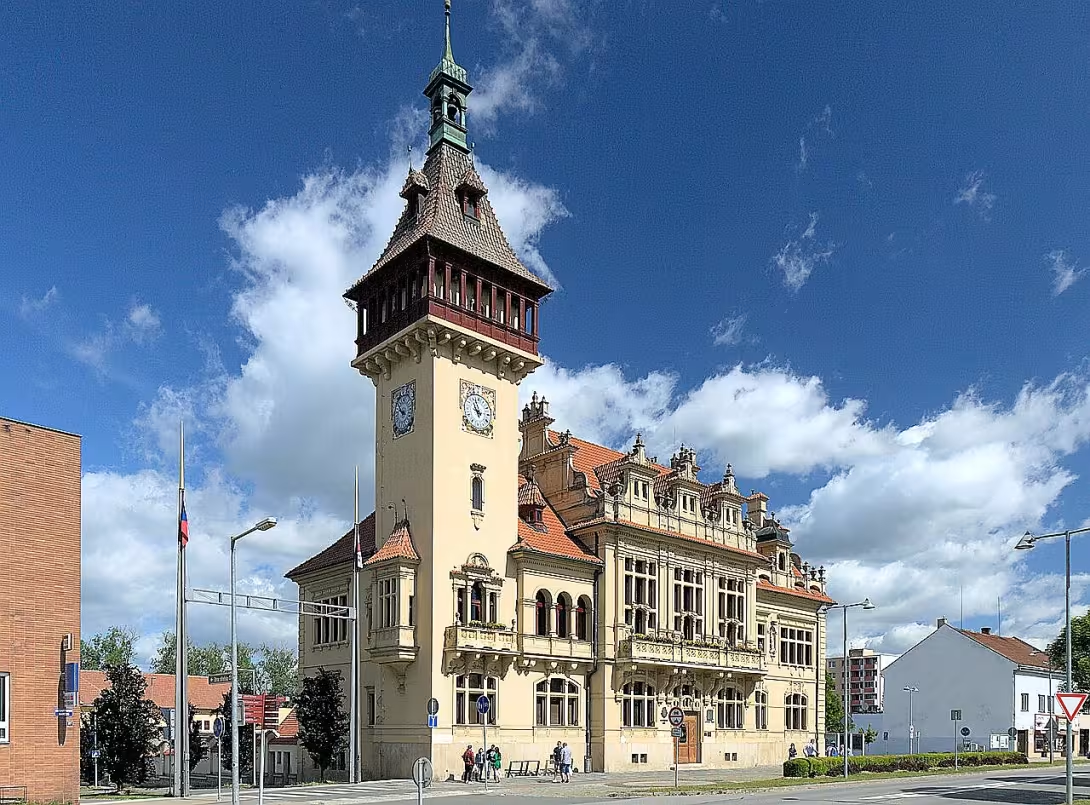
The town hall in Napajedlé is a representative Neo-Renaissance building with Art Nouveau elements located on Masaryk Square. The building was built between 1903 and 1904 according to the design of architect Dominik Fey. Since 1963 it has been protected as a cultural monument of the Czech Republic.
The need for a new town hall arose after the old building burned down in 1662. The subsequently used municipal house stopped meeting the needs of administration at the end of the 19th century. The main impetus for the construction became the promotion of Napajedel to the city, which took place on 14th November 1898 by decision of emperor Franz Joseph I. Architect and local native Jan Sedláček assessed five designs and eventually selected the project Dominik Fey. The construction was carried out by the builder Henry Schleps. On 3 March 1903 he started demolition of original buildings and subsequent construction. Gross construction including roofing was completed in the same year.
The architectural object is characterized by a neo-Renaissance style with distinctive Art Nouveau elements. The main facade of a single-storey building is oriented towards the southeast and the central part of it is moved forward in front of the side wings. There is a main entrance above which is located a balcony and three large windows of the main hall. There's a clock tower on the left. Her two dials decorate the mosaics of glazed ceramics 505 times 505 centimeters. They were made by RAKO according to the design of academic painter Jan Kohler. On the first floor there is a sandstone statue of St. George from the sculptor Franta Uprka. The saint is the patron saint of the city and is depicted on the city emblem.
The interiors are complemented by wall paintings by František Zahrádky in the ceremonial hall, where the characters of Moravian cities are depicted. The stained glass in the windows of the ceremonial hall, showing the characteristics of the Czech Kingdom, was made by the Brno glass master Benedict Škard. He is also the author of the stained glass with the sign of the Napadedel on the main staircase and the stained glass with Saint George in armor in the mayor's office. Part of the original furniture in the offices of the mayor, the secretary and the meeting room, designed directly by the architect Dominik Fey, has survived to the present day.
The ceremonial opening of the town hall took place on 14 August 1904 under the leadership of the historian and national promoter of Vincent Prasko. The celebrations included a weekly national exhibition of Czech and Moravian cities. It was visited by prominent personalities such as Leoš Janáček or František Bartoš. The building had long lacked electric lighting and in 1955 it underwent reconstruction of the outdoor facade.
The building is currently owned by the city Napajedla and continues to serve its original administrative purpose. For visitors, it is an important architectural element of Masaryk Square, which shows an effort for representative construction of city offices in the period of growing national awareness in the early 20th century. Visiting this monument offers the opportunity to see a good example of contemporary craft and art decoration, which is closely linked to the history and identity of the city.
Then and now
Drag the slider to compare how the landmark may have looked when it was built with the view today.
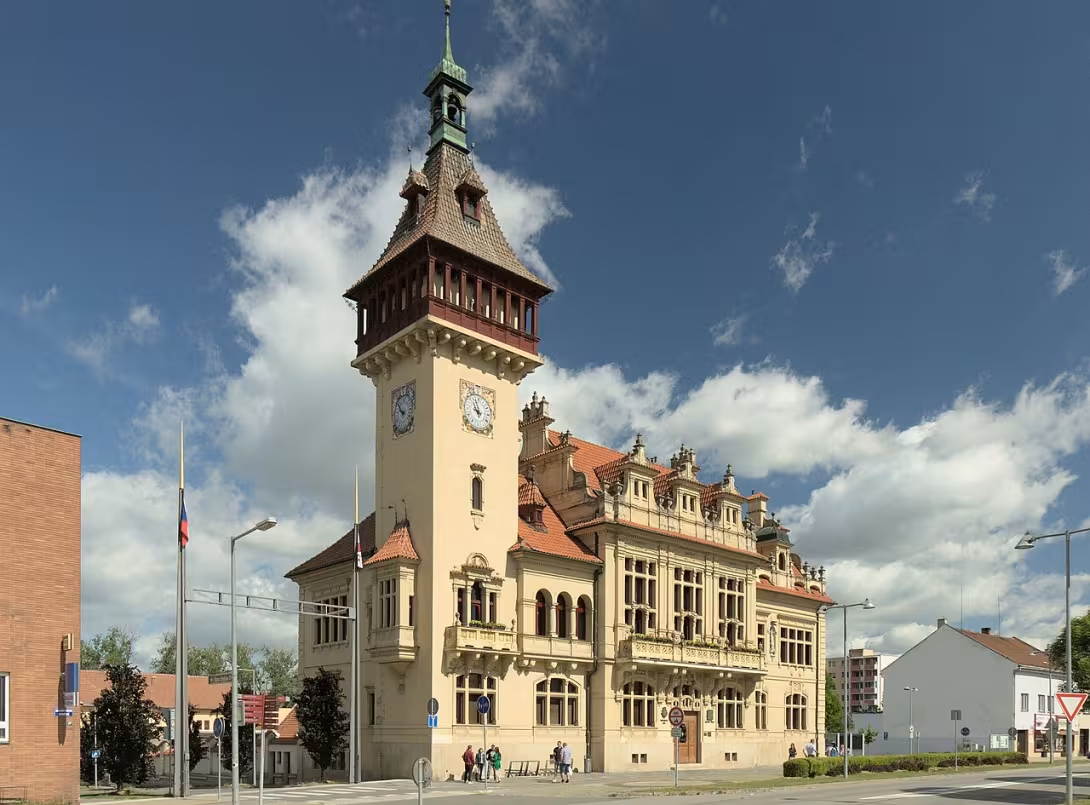
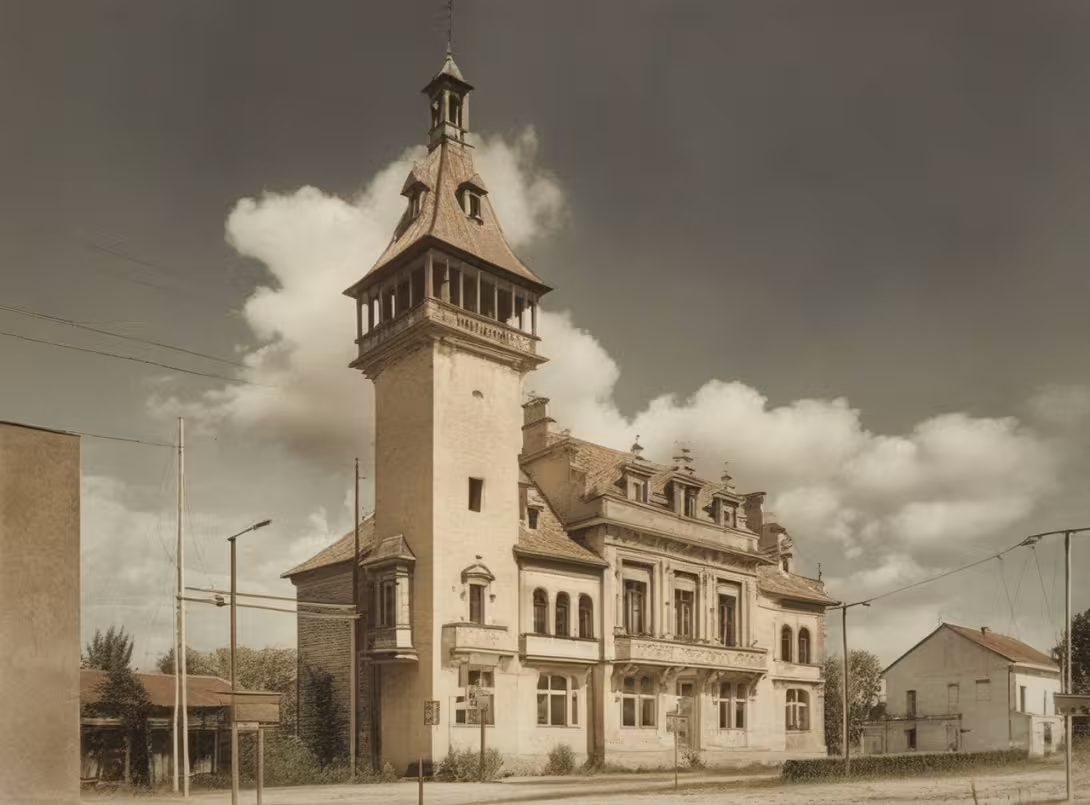
The historical appearance on the left is an AI-generated visualisation and serves as inspiration only.
Historical milestones
- 1898
- The promotion of Napadedel to the city by Emperor Franz Joseph I.
- 1903
- Opening of construction of the new town hall on 3 March.
- 1904
- The opening ceremony of the City Hall on 14 August.
- 1963
- The building is declared a cultural monument of the Czech Republic.
Architectural development
The construction was carried out on the site of the original municipal buildings which were insufficient for the needs of the city. The architecture combines a neo-Renaissance facade with distinctive Art Nouveau elements. A reconstruction of the outdoor mantle of the building took place in 1955.
Historical events
1898: Promotion of Napajedel on the city by Emperor Franz Joseph I. 1903: Opening of the building of the new town hall by builder Henry Schleps. 1904: Ceremonial opening of the building associated with the national exhibition.
Owners
City of Napajedla
Points of interest
- Construction was built in the years of a thousand nine hundred and three to a thousand nine hundred and four according to the design of architect Dominik Fey. Since the year one thousand nine hundred sixty-three, it has been protected as a cultural monument. - The main impetus for construction was the promotion of Napajedel to the city, which took place on the 14th November, a thousand eight hundred ninety-eight years by decision of Emperor Franz Joseph first. - The clock tower has two figures decorated with glazed ceramic mosaics five hundred five times five hundred five centimeters. These mosaics were made by RAKO according to the design of the painter Jan Kohler. - On the first floor there is a sandstone statue of St. George, which is the patron saint of the city and is depicted on the city emblem. - The ceremonial opening of the town hall took place on the 14th of August a thousand and nine hundred and four, and part of the celebrations was a weekly national exhibition, which was visited for example by Leoš Janáček or František Bartoš.
Guide
Show guide text
This text was created by artificial intelligence and has not been editorially reviewed. It may contain inaccuracies.
Welcome to the Napajedles. You are standing in front of one of the most important and beautiful building units in this city. In front of your eyes is the town hall, which immediately captures everyone who passes by with its potency and majesty. Feel this atmosphere where history meets the daily life of the city. This building is not just an ordinary office, it is a symbol of the rise, pride and new era that the city entered over a century ago. It's a place that tells a story about how a small village has become a full city with its own ambition and dignity.
Let us now return together to the time when everything began to change and when today's character of this place was formed. More than a hundred and twenty years ago, Napajedla was at a crucial moment in its existence. In the year one thousand eight hundred ninety-eight there was an event that fundamentally changed the fate of this region. Emperor Franz Joseph First awarded the city status to Napajedles. This promotion was not just a formal act, but a huge leap forward for all citizens. This new position required a new, representative settlement for the city administration, a building which would correspond to the new importance of the city. That's why they started planning and building. The work on this important construction began on the third March of the year a thousand nine hundred and three. The whole construction was very secular and effective, lasted less than two years. The opening ceremony took place on the 14th of August in the year a thousand nine hundred and four. Since then, the town hall has served the people and has become an eternal witness to the many advances, changes and historical moments that have passed through the city.
Now, pay attention to the very construction you are observing. Look at her face and how harmonically she connects different artistic directions. The town hall is built in a representative Neo-Renaissance style, which includes also fine and very decorative elements of Art Nouveau. This style gives the building elegance, lightness and at the same time looks very noble. Notice how the building dominates the entire surrounding space. Your eyes should aim primarily at the tower, which is the most important point of the entire facade. It is equipped with clocks that have been determining the rhythm of life in this city for many decades and remind people of the passage of time. Also look at the sandstone statue of St. George. This work of art was created by famous artist Franta Úprka. The statue gives the building a spiritual dimension and its sandstone material perfectly matches the overall texture of the facade. While you are out now, keep in mind that inside there is a real treasure that is so fascinating to visitors. The interiors are decorated with beautiful wall paintings created by František Zahrádek, as well as light-shining stained glass by an artist named Ben. This whole space has been designed to create wonder and respect for anyone who enters it.
This building is very closely connected with many important personalities that shaped not only this city, but also the whole time the town hall was established. Architect Dominik Fey was the one who inhaled this building's specific shape and character. He also worked with Jan Sedláček to ensure that the construction was not only functional, but also artistic. Let us not forget, however, that Emperor Franz Joseph first was behind the rise of the city, whose decision allowed the construction to begin at all. There are also other big names in the history of this place that have shaped culture and life in this region. We can mention here, for example, the musician Leoš Janaček or Vincent Pig. Although each of these names may not be directly related to every stone in this building, their presence in the history of the city is inseparable from the atmosphere this town hall creates. They are the people who formed the soul of this region, just as the creators of this building form its external form.
It is very interesting to realize how much this building is valued and how much it has value for future generations. Since the year one thousand nine hundred sixty-three, this town hall has been declared a cultural monument to the Czech Republic. That's not just a label. It means that its beauty, its architecture and its historical importance are protected from oblivion and unwanted change. It is a clear proof that even after more than a century people appreciate this work and its importance for the identity of the city. City Hall is not just a geçmişlite, it is a living proof of continuity and stability.
I hope you enjoyed this view of the history of the town hall in Napajedlé and that thanks to it you have better imagined the importance of this place. But this town hall is just the beginning of a journey you can take in this city. Continue to walk and perceive the beauty of this city, which is constantly told and expanded through such structures. Look at the other parts of the square and look around you with wonder like you just did. I wish you a pleasant further discovery of all the secrets Napajedla can offer you. Goodbye.
Tips for visitors
The best time to visit is during the morning when the sun lights up the front facade of the town hall and highlights its neo-Renaissance details. In the afternoon, the building is in the shade of the surrounding building, which can make it difficult to get sharp images.
For outdoor photography we recommend to use the space in front of the building from where the whole architecture can be captured including Art Nouveau elements. The best light for detailed pictures of the decoration can be obtained in clear weather when plastic elements on the plaster stand out.
When you visit, bring comfortable shoes that allow you to go through the entire historic city centre. Since the building is in normal operation, we recommend that you explore its exterior appearance in peace and without rush so that you can see the artistic processing of the building.
In the immediate vicinity of the town hall there is a river Morava, which offers a pleasant environment for walks. You can also visit the nearby church of St. Bartholomew or the monastery chapel, which complement the historical nature of this part of town.
The surroundings of the town hall are suitable for families with children thanks to the proximity of the river Moravia, where nature can be observed. The walk between city hall, church and chapel is easy and suitable for smaller children who can discover historical details on the facades of buildings.
Frequently asked questions
Can the monument be visited?
The building is in use (offices, a school, shops and the like). The interior is generally accessible only during operating hours and tours are not usually offered; we have not verified the details. You can see the exterior from the street.
Where is the monument?
Location: Napajedla. The map on this page shows the exact spot.
Why is the monument protected?
It is listed in the Central List of Cultural Monuments of the Czech Republic as a cultural monument (register no. 1000137514).
Businesses nearby
Do you run a restaurant, accommodation, shop, museum, rental, wellness or other visitor service near this monument? Show yourself directly to the people heading to it — this is how they will see you in the app and on the web:
Nearby
Kostel svatého Bartoloměje, klášterní kaple, řeka Morava.
Accommodation nearby
Trips and activities nearby
Guided tours, tickets and activities nearby from GetYourGuide
Affiliate link: if you buy from the partner, we may receive a commission. The price for you does not change.
Search tours and activities →Themed route
1. Morava River - water flow. Ideal place to start walking and relaxing in nature. 2. Monastic chapel - sacral construction. It offers space for reflection and a view of old masonry. 3. Church of St. Bartholomew - Temple. An impressive building that forms the spiritual center of the village. 4. Town Hall - Municipal Office. The main destination of the trip, which will capture its architecture in the city centre.
Seasonal recommendations
Spring in Napajedlé brings about the awakening nature surrounding the town hall building. The surrounding trees and shrubs are in full bloom, creating a fresh and lively atmosphere. The daylight is gradually extended so you have more time to walk around. The weather is variable, so wear a light jacket on your back and umbrella, as spring rains are common. The morning clock is ideal for a quiet walk where fewer people and the air is fresh. Clothes should be laminated so that you can easily adjust to temperature fluctuations.
Leto offers the longest days and the hottest weather, which is ideal for a longer stay outside. The town hall often becomes a place where people meet in summer, and the surrounding area is full of green. The sun shines strongly, so it is important to protect yourself from sunburn using a hat and sunglasses. We recommend visiting the place either early in the morning or late in the afternoon when heat is more tolerable and shadows are longer. Clothes should be light and breathable, made of moisture-removing material. In the evening you can use the extended light to observe the architectural details of the building, which are sometimes less visible on a sunny day.
Autumn brings golden and red leaves to Napajedel, creating a picturesque contrast with the city hall facade. The air is colder and cleaner, which is nice for walking. The light is softer and warmer, which gives the whole neighborhood a romantic touch. It is advisable to wear a warmer sweater and long pants as temperatures fall. The morning mist can be a common phenomenon, which gives the place a mysterious touch. The best time to visit is usually the morning when the weather is most stable. Don't forget to wear comfortable shoes because the soil can be slippery due to falling leaves and moisture.
The winter in Napajedlé is cold and often snowy, which will wrap the town hall in a white coat. Short days mean that light is precious and valuable, so it is ideal to visit a place around noon when it is warmer and brightest. The atmosphere is calm and quiet, often interrupted only by the noise of snow. Clothes must be very warm, including winter jacket, gloves, scarf and hat. Watch out for slippery pavements, so choose shoes with good slip-proof soles. In the evening, when the street lamps light up, the building receives a special spell that is irreplaceable in the summer months.
Visualizations and artistic views


The visualisations are generated by artificial intelligence and serve as inspiration.
Photos from the area
Real photos taken near the monument


Zdroj a licence jsou uvedeny u každého snímku.
Tips from visitors
No tips yet. Be the first!
Log in and add your tip.
Sources and literature
Photos: Petr Kadlec / CC BY-SA 4.0 — Wikimedia Commons. The author and licence also appear when you hover over the image.
Faktickým podkladem tohoto textu byl článek na Wikipedii, jehož autory jsou přispěvatelé Wikipedie. Článek je dostupný pod licencí CC BY-SA 4.0.
Location on the map

Příběhy a pověsti
Legendy, pověsti a příběhy spjaté s touto památkou
Fotografie návštěvníků
Zatím žádné fotografie. Buďte první, kdo přidá fotografii z návštěvy!
Log in a přidejte svou fotografii nebo hodnoťte.
Za ověřenou návštěvu v aplikaci získáte víc bodů — poznáme podle GPS, že jste na místě.
Reviews and comments