



Radnice (Strakonice I) Town hall
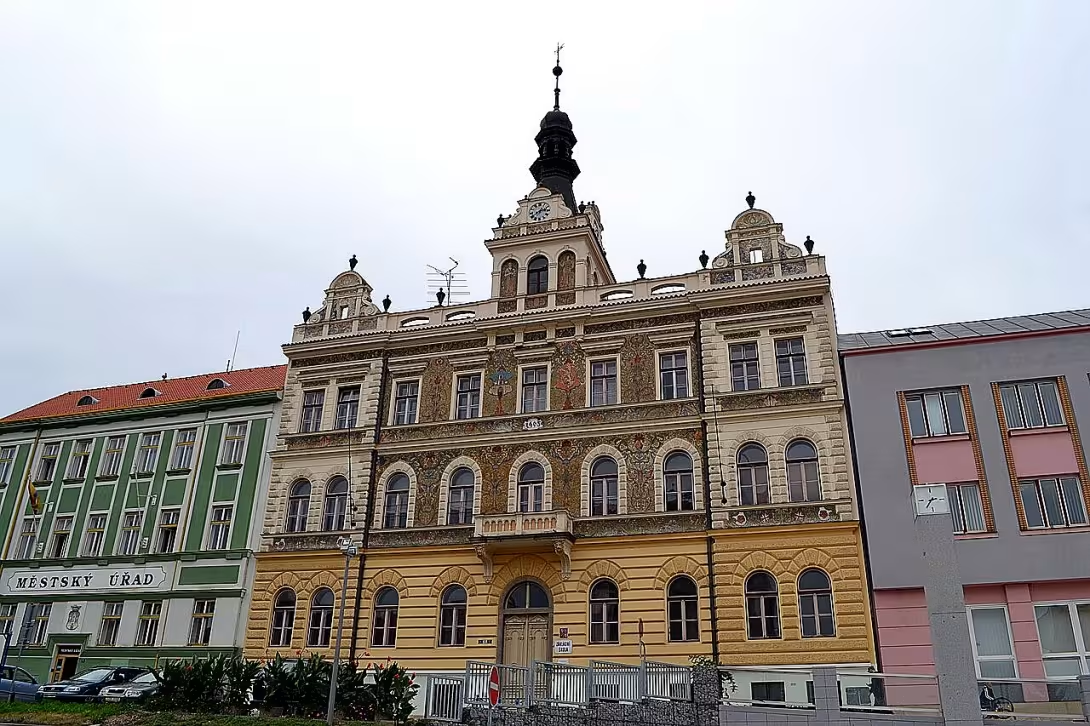
The building of the former town hall, registered under the number descriptive 1, is a protected building on the Grand Square in Strakonice, South Bohemia. This representative Neo-Renaissance building from 1902 to 1903 was replaced by an older Empire office and is today an important element of the historic city centre.
The history of the town hall building dates back to 1488, when the original town hall was established. It burned down in 1588 and subsequently had its own cargo restored by Jan ze Švamberka, master of the priory of the Maltese Order in Strakonice. After another fire in 1626, the Empire City Hall with an hourly tower was built in the same place. However, in 1882 the construction ceased to comply with technical condition and capacity and was therefore demolished.
The current form of the town hall is the result of the work of the Strakonic builder Antonín Albert, who worked out the design of the building while the tower implemented Jindřich Rudolf from Pilsen. The building is two-storey and nine-axis, with a saddle roof and a facade divided by rustic and distinctive ledge. From the first floor of the facade is decorated with a bossy, decorative label with atics, three windows and a balustrade with three vases. The entrance consists of a high semi-circular portal above which is a balcony with balustrade on the first floor. The windows on the ground floor and on the first floor are semi-circular, on the second floor is equal to the mantelpiece.
The decoration of the facade consists of a color sgraffite designed by Mikolash Alš, the author of which is Josef Bosáček. These works of art underwent professional restoration in 1992 and 2016. The dominance of the building is the prism tower with clock, ending with a lantern and spiking with two poppies. On the tower there are statues of Justice and Self-government, between the windows of the second floor there is a city sign and a Czech lion. The inner spaces have a rich ornamental decoration, a massive staircase with a cluster ceiling and a vaulted basement. A small courtyard with three wings is adjacent to the building.
The building served as a city office until 1920. In the following period, namely between 1921 and 1957, there was a real high school; During World War II, the object was occupied by the German army. From 1957 to 2022, the premises were used by the primary school. Currently, the town of Strakonice is negotiating with the South Bohemia Region for further use of the building for the basic art school, while the city office is located in the next house number descriptive 2.
This building is a testament to the flowering of national culture and architecture in the early 20th century, when the Neo-Renaissance style expressed urban self-government and national pride. Visiting the Grand Square in Strakonice offers an opportunity to explore this valuable architecture in close proximity to the Strakonice Castle and the Otava River. The building remains an important witness to the changes of the city administration and education in the region.
Historical milestones
- 1488
- Built by the original town hall.
- 1903
- Construction of the current Neo-Renaissance building is completed.
- 1921
- The building became a real high school.
- 1957
- The building became the seat of the primary school.
Architectural development
The current building is a Neo-Renaissance building with a two-story nine-axis front and a saddle roof. The facade is broken down by rustic, barefoot and distinctive ledge, with a rich ornamental decoration and arched basement. The tower is finished fighting with lantern and spiked with two poppies.
Historical events
1588: original town hall fire; 1626: further fire and subsequent construction of the empire city hall; 1882: demolition of the old town hall; 1902-1903: construction of a contemporary neo-renaissance building.
Owners
City of Strakonice
Points of interest
- The original town hall was founded in 1488, burned down in 1588 and subsequently had it restored by Jan ze Švamberka. - The current Neo-Renaissance building was built between 1902 and 1903 according to the design of builder Antonín Albert. - The decoration of the facade consists of a color sgraffiti that designed Mikoláš Aleš and created Josef Bosáček. - There are statues of Justice and Self-Administration on the tower, between the windows of the second floor there is a city sign and a Czech lion. - A real gymnasium was housed in the building between 1921 and 1957 and was occupied by troops during World War II.
Guide
Show guide text
This text was created by artificial intelligence and has not been editorially reviewed. It may contain inaccuracies.
Welcome to the Grand Square in Strakonice, where you are standing in front of one of the most important monuments of the city - the Neo-Renaissance Town Hall. This building will undoubtedly address you with its elegance and historical layers.
Let's dive into her origins. The original town hall was built here in 1488, but the tragedy came in 1588 when the building burned down. Undisappointed Jan ze Švamberka took the initiative and had it restored. However, time did not stop beating and the older Empire City Hall was eventually demolished because of its unsatisfactory condition. However, a new building appeared in its place in 1902- 1903, designed by architect Antonín Albert. This Neo-Renaissance Town Hall was completed in 1903 and immediately began to serve as a real gymnasium.
Look up at the facade of the buildings that will undoubtedly address you. Note the rich sgraffiti that makes up her visual crown. This colour decoration is the work of Mikolas Alš and was realized by Josef Bosáček. Their artistic talent brings to life historical scenes that will have their own meaning for each visitor.
The dominance of the building is the prism tower with clock and statues of Justice and Self-government. These elements not only decorate the building, but also symbolize the historical values that the Strakonice respected.
The building became a place where many interesting stories took place. In 1921 a real high school began to work here and later, in 1957, it became the seat of the primary school. As a child or a student, many people went through these halls and halls.
The interesting thing is that the building has witnessed many changes in urban life. Although her function was changing, she remained the center of community and culture.
Now that you've seen her architecture and history, I invite you to explore Strakonice again. The city has many hidden stories and beautiful places waiting for your visit.
Thank you for your attention, and I hope Strakonice approached you as much as she did us. Be happy in your next exploration!
Tips for visitors
The building of the town hall in the Grand Square is best visited during the morning hours when the sun illuminates its neo-Renaissance facade and highlights rich architectural details. For photography it is ideal to use a wide area of the square, which allows to capture the entire building in its historical context without disturbing elements. In the vicinity of the building there is a picturesque historical center of the city, which encourages you to walk. If you plan a trip with children, you will appreciate the proximity of the river Otava, where you can observe the water level and enjoy the quieter pace of the city. In the immediate vicinity of the town hall there is also a significant Strakonice Castle, which is a great goal for further exploring the history of the region.
Frequently asked questions
Can the monument be visited?
The building is in use (offices, a school, shops and the like). The interior is generally accessible only during operating hours and tours are not usually offered; we have not verified the details. You can see the exterior from the street.
Where is the monument?
Location: Strakonice I. The map on this page shows the exact spot.
Why is the monument protected?
It is listed in the Central List of Cultural Monuments of the Czech Republic as a cultural monument (register no. 1000152919).
Businesses nearby
Do you run a restaurant, accommodation, shop, museum, rental, wellness or other visitor service near this monument? Show yourself directly to the people heading to it — this is how they will see you in the app and on the web:
Nearby
Strakonický hrad, řeka Otava, historické centrum města Strakonice.
Accommodation nearby
Themed route
Thematic cruise route in Strakonice
1. Radnice (Strakonice I) - historical monument Type: historical building Why is it worth a visit: Town Hall is an icon of Strakonice, whose gothic appearance attracts attention. It is not only an administrative centre, but also a testimony about the rich history of the village.
2. Strakonice castle - historical fortress Type: castle Why is it worth visiting: Strakonice Castle, built on a high rock cliff above the Otava River, offers not only historical monuments but also impressive views of the surrounding countryside. His towers and walls tell stories of past times.
3. Otava River - natural element Type: River Why is worth a visit: Otava is a living element of the city that gives Strakonice peace and beauty. It is an ideal place to relax and explore the natural environment along its shores.
4. Historical Centre of Strakonice - architectural landscape Type: historical area Why is it worth a visit: When walking through the historical centre you will enjoy a view of ancient houses and alleys that preserve the spirit of past times. It's a place full of atmosphere and magic that brings you to another time.
This route will offer visitors the opportunity to explore not only the main memory of the city, but also other attractions that are part of Strakonice.
Seasonal recommendations
Spring: In spring, the surroundings of the town hall in Strakonice turn into a bright flower, when trees and bushes dress up in their first green coat. The sun rays illuminate the architectural beauty of the building in the most comfortable light, which contributes to a wonderful atmosphere. It is advisable to visit this monument at noon when the sun is at the highest level and provides ideal lighting for photos. Due to the falling temperatures, you should bring light clothes, but also something to cover, because morning and evening can be colder.
Summer: In the summer, the surroundings of the town hall are full of life when flowers and trees are developed in the gardens and provide shelter from sunlight. The days are long and warm, allowing a long walk on the streets of Strakonice. The best time to visit is in the early afternoon or in the evening when temperatures are tempered and trees offer natural shadows. We recommend wearing light clothes and a protective sun helmet as well as enough drinking cloth.
Autumn: The surroundings of the town hall in Strakonice become melancholic beauty in autumn. Tree leaves are golden and red, which adds a romantic atmosphere to the architecture of the building. The sun's rays are shorter, but their darker colors illuminate city hall stones in a unique light. The best time to visit is at noon, when the sun still provides enough light for detailed monitoring of architecture. Due to decreasing temperatures, you should take with you clothes suitable for colder weather such as long gloves and hat.
Winter: During winter, the surroundings of the town hall are covered with snow or a freezing surface, adding a romantic atmosphere. The sun rays reflect on the ice surfaces and illuminate the building's stones in a special light. The best time to visit is in the morning or in the evening when the temperature is lighter and fewer people are moving on the streets. We recommend wearing warm clothes, including fur and shoes with helmets to enjoy a visit without losing heat.
Visualizations and artistic views

The visualisations are generated by artificial intelligence and serve as inspiration.
Photos from the area
Real photos taken near the monument


Zdroj a licence jsou uvedeny u každého snímku.
Tips from visitors
No tips yet. Be the first!
Log in and add your tip.
Sources and literature
Photos: Martin Kozák / CC BY-SA 3.0 — Wikimedia Commons. The author and licence also appear when you hover over the image.
Faktickým podkladem tohoto textu byl článek na Wikipedii, jehož autory jsou přispěvatelé Wikipedie. Článek je dostupný pod licencí CC BY-SA 4.0.
Location on the map




Příběhy a pověsti
Legendy, pověsti a příběhy spjaté s touto památkou
Fotografie návštěvníků
Zatím žádné fotografie. Buďte první, kdo přidá fotografii z návštěvy!
Log in a přidejte svou fotografii nebo hodnoťte.
Za ověřenou návštěvu v aplikaci získáte víc bodů — poznáme podle GPS, že jste na místě.
Reviews and comments