



Řesanice Granary
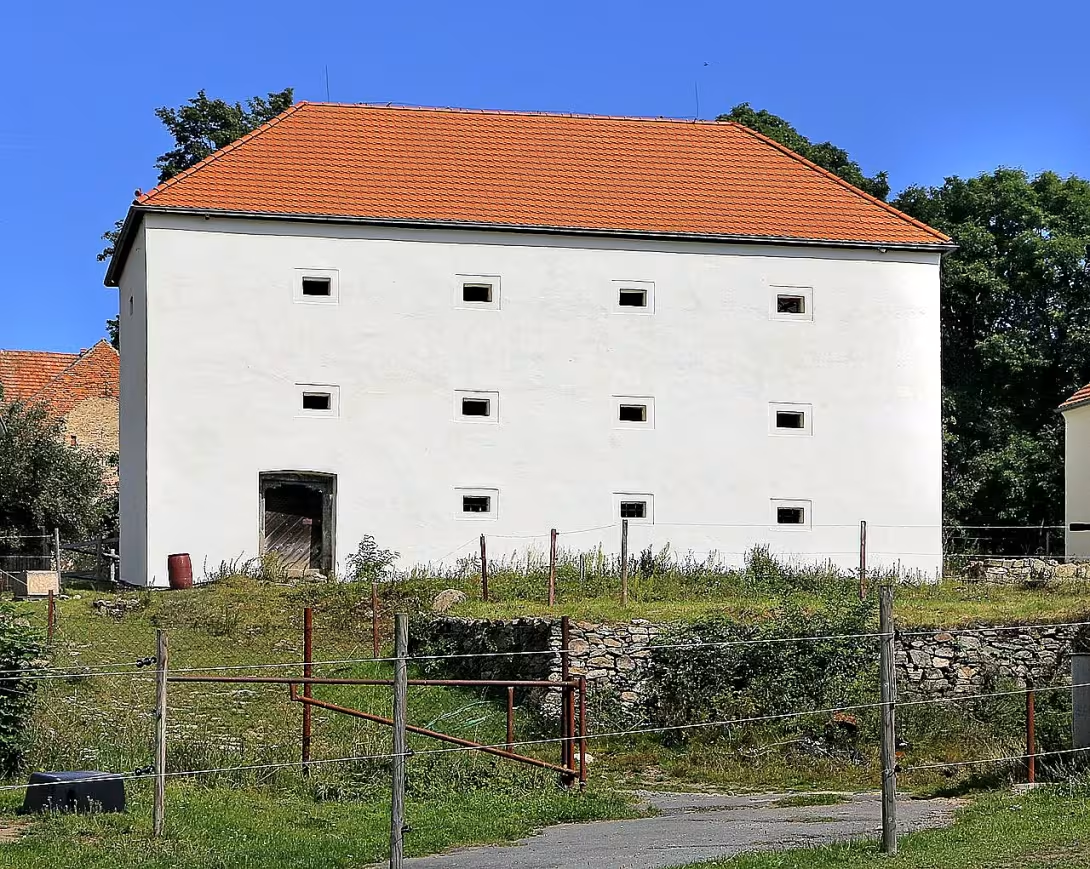
Riesantic fortress - medieval mansion and baroque granary near Kasejovice
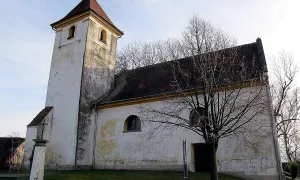
In the 18th century it was converted into a Baroque granary. It is located in the village Řesanice in the surroundings of Kasejovice, where it served originally as a seat of the local Vladic family since the 14th century. Its most important rest is a three-space palace from the Gothic period, which was adapted to the economic area and finally to the granary, retaining preserved elements of medieval cuisine and vaults. The monument is proof of the development of the superstructure from the highest Gothic to the Renaissance to the Baroque reconstruction, which reflects cultural and economic changes in the Czech countries in the 17th and 18th centuries.
The foundation of the fort is connected to the creation of the village Řesanice, which is first mentioned in the written sources only in 1357, when they were mentioned by Probe and Wilhelm of Řeanice as the patron saint of the Church of All Saints. Originally belonged to the family of Nábíky from Řesanice, who held it until the 16th century. In 1454, the fort is remembered as the property of Kadov and Řesanice, who inherited it after his father's death and lived here until 1517. At this time, the fort was part of a large estate that included neighbouring villages. In the 16th century it was inherited by Strojeticky from Strojetic, who held it until the third quarter of the 17th century. Their owners, such as Bořivoj Strojettika, divided the wealth among their sons, and the fort belonged to his son Bořivoj, who acquired it together with parts of other villages in 1543.
In the 17th century the fortress belonged to the Strojetic family, who sold it in 1680 to Jáchy Zdeněk Čejka from Olbramovice. In the following decades the fort was gradually sold and in 1700 it was bought by Jiří Adalbert Janovský of Janovice, who joined her to the estate of Oselce. In 1770 the fort had already lost its seat function and in the 18th century it was converted into a baroque granary. This reconstruction included the abolition of vaults and the replacement is a beam ceiling, which is evidenced by the adaptation of the original Gothic palace to economic purposes.
Architecturally, the fortress is represented by a three-space palace that was built directly on the rock floor. The perimeter walls are 1.2 meters thick and 8.5 meters high, which is typical of Gothic forts. The interior has been preserved fragments of late Gothic paintings and Renaissance decorations, which show a rich history of the building. The Baroque reconstruction also included the reconstruction of the entrance, which was lined with a stone frame from parts of original Gothic portals. In the neighbourhood of the fortress there is a medieval black kitchen, which is underlaid and has a stone-plated vaulted vault with wooden formwork. This kitchen is a typical example of a medieval economic facility that served to prepare food in a cold cellar.
Today the castle is protected as a cultural monument and represents an interesting example of the development of the superstructure from Gothic to Renaissance to Baroque reconstruction. In the vicinity there is the Church of All Saints, whose patron was the original owners of Řeanice, and the natural landscape with forests and fields. For the visit, the fort is accessible and offers interesting insights about the history of the superseded settlements in Pilsen.
The Editorial Fortress is proof of how the medieval residence adapted to changes in the economy and culture. Its Baroque rebuilding into a granary reflects the economic needs of the agricultural estate in the 18th century and thus retains valuable historical monuments worth visiting.
Historical milestones
- 1357
- First written mention of Řešanice and their family
- 1543
- Distribution of Řeanice among the sons of Jan Strojectik from Strojetic
- 1680
- Sale of the fortress Jáchym Zdeněk Čejk from Olbramovice
- 1770
- She lost her residence function, converted into a baroque granary
Architectural development
The fortress was established in the 14th century as a superseded residence. In the 16th century it belonged to the Strojetic family, who converted it into an economic area. In the 18th century it was converted into a baroque granary, keeping medieval parts such as black cuisine, made of stone and bricks.
Historical events
- 1357
- 1412
- 1543
- 1680
Owners
- Henry Petr Strojectic
- Jáchym Zdeněk Čejka z Olbramovice
Points of interest
- It is located in the village, which is first mentioned in the written documents only in 1357.
- Originally it served as a residence for a local nobleman who held it until the 16th century.
- In the 17th century the fortress was sold and in the 18th century it was converted into an economic building where the elements of medieval cuisine were preserved.
- The interior is preserved fragments of late Gothic paintings and Renaissance decorations.
- There is a church nearby whose founders were the original owners of the village.
Guide
Show guide text
This text was created by artificial intelligence and has not been editorially reviewed. It may contain inaccuracies.
Welcome to the Riesan Castle - one of those places that reminds you of how history is written between the walls of old buildings. You are standing in front of a building that has experienced centuries of power change, war storms and peaceful rural life. You see before you a simple but strong structure, which once belonged to the royal family, later became the seat of the nobility of the Strojetic family and eventually turned into an economic object. And it's this variability that makes her so interesting.
Let us return to a time when Řesanice was not only a village but a seat of local nobles. The first written mention of this place dates back to 13 hundred and fifty-seven, when the Vladic family, who held the estate here for centuries, settled here. The people who lived here were more local masters than great magnates - their power reached only the surroundings, but their influence on the village was profound. When the fortress reached the hands of the Strojetic family in the 16th century, it began to change. They later, in the eighteenth century, converted it into a baroque granary, as was often the case when nobles lost their original meaning and buildings served economic purposes rather than representation.
Now look at the facade of this building. Even though it may seem simple to you, it hides traces of different times. There were traces of medieval architecture - for example, the black kitchen that was part of the original area. It was a room where they cooked for the whole fort, where they cooked food for the masters and their servants. You can't see the fires here today, but imagine how smoke once burst here and how it cooked for the people who decided the fate of this country. Note also the economic buildings that are part of the entire complex. These simple wall walls and wooden structures tell us how they lived here in everyday life - not only in festive halls, but also in working areas.
Now pay attention to some of the personalities involved. One of them was the Probe of Řeanice, who lived at the turn of the 14th and 15th centuries. He was a man who made his way through a time when the Czech countries were going through the stormy times of Hussite wars. His name ties to the first written mention of the Řešanice, and although we do not know much about him, his existence proves that this place was once the center of power. Later, there was also a Kadov and Řeanice Probe who became famous as a warrior and diplomat. And then there was Jan Strojetic from Strojetic, who in the sixteenth century divided Řesanice among his sons - a decision that had far-reaching consequences for the future fate of the fortress.
But let's do something that might surprise you. Although Řesanice first appeared in written sources only in 13 hundred and fifty-seven, it is likely that people lived here much earlier. The village that stretches around this fortress was once a small settlement, but over time it became part of the wider history of Czech countries. And it is this fortress that served as a seat, later an economic object, that is a book you can read. Every stone, every beam tells you a story about the people who lived here, worked and made decisions.
Take another look before leaving. You see the black kitchen, the economic buildings, maybe the remains of the old walls that tell us about the past. This fortress is not only a monument to the nobleman's mansion, but also to the everyday life of the people who worked here. And that is her spell - that it is not only about the rich masters, but about all who lived here, suffered, but also made history.
Thank you for taking the time to stop by. If you're wondering what else is hiding in these places, you can look at the surrounding fields where the fields and meadows that used to be hard property were decomposed. And when you leave, remember, every old building has a story, and the Manor of the Isle just told you one of them. Good trip, and when you come back, you might find something new they haven't told you yet.
Tips for visitors
Visit The cutlery is most suitable between May and September when the weather is pleasant and nature is in full force. In summer it is also ideal for families with children because it is warmer and the opportunity to spend time outside is greater. In winter, the fort is less visited, but suitable for lovers of history who want a quiet atmosphere.
The location is available by car and by public transport.
Always bring suitable clothes according to the weather - in summer light clothes and sunglasses, in winter warm clothes. It is also good to bring water, refreshments and a small snow object to enroll in the monument book. It is advisable to have a high-quality camera or smartphone with a good visual field, because some places can be in narrow corridors or with limited light.
The best places to photograph the fort are mainly the entrance gate, baroque granary with its characteristic elements and surrounding terraces. It is recommended to photograph in the morning or afternoon hours when light is more pleasant and less shadows. Due to the historical nature of the site, it is advisable to respect the rules of photography - do not look in the interiors without the consent of the employees and do not forget the ethics of photography in historical areas. '} {' what to visit in the surroundings (within 30 minutes walking or travelling by car): ':
The Church of All Saints is an interesting cultural monument. There is a possibility to see its interior equipment and historical details. The church is well accessible and offers a quiet environment for relaxation.
The surrounding natural landscape is a great place for walks and relaxation. In the woods you will find various species of plants and animals that are typical of this region. The fields are suitable for families with children who can play or just relax. It is recommended to visit these places during the period when nature is most diverse, i.e. summer or spring.
The village of Kasejovice offers the opportunity to know local culture and traditions. You can look at old houses that are typical of regional architecture. It is possible to visit local farms in the surroundings of the village and to observe the cultivation of agricultural crops.
Old Smovice is another interesting village nearby. There is an opportunity to look at old churches and historical buildings that are typical of local traditions. The surrounding landscape is rich in forests and fields that are suitable for families with children.
For families with children is the best visit during the summer holidays when the weather is pleasant and children have more free time. On the fort you can see interesting historical objects and tell children about the history of the place. There are many natural places around where children can play and explore nature. It is also recommended to visit the Church of All Saints, where children can see beautiful decorations and historical objects. It is always good to find out in advance which parts of the fort are accessible to children and what activities are suitable for their age group.
Frequently asked questions
Can the monument be visited?
This is a residential or farm building, not a museum with opening hours. Please view it from public space and respect the owners' privacy. We have no information about access to the interior.
Where is the monument?
Location: Řesanice, Plzeňský kraj. The map on this page shows the exact spot.
Why is the monument protected?
It is listed in the Central List of Cultural Monuments of the Czech Republic as a cultural monument (register no. 1000136823).
Businesses nearby
Do you run a restaurant, accommodation, shop, museum, rental, wellness or other visitor service near this monument? Show yourself directly to the people heading to it — this is how they will see you in the app and on the web:
Nearby
V okolí (do 5 km) se nachází kostel Všech svatých, který je chráněn jako kulturní památka, a přírodní krajina s lesy a políčky. Blízko se nachází také vesnice Kasejovice a Staré Smolivce.
Accommodation nearby
Themed route
Thematic cruise route: Řesanice and its surroundings
1. Fortress Řesanice Type: Historical construction Medieval fortress, which stands on a mild surface and offers a view of the surrounding landscape. Its origin dates back to the 14th century and still maintains a typical residential tower with economic buildings. It is especially interesting for visitors with its period plan and the atmosphere of the rural fortress.
2. The Church of All Saints Type: Protected cultural monument A small Baroque church from the 18th century, which served as a spiritual centre for surrounding villages. Its interior is simple, but valuable statues and paintings have been preserved here, which refer to the tradition of local religious life. The surrounding cemetery provides a peaceful and historic atmosphere.
3. Kasejovice village Type: Traditional rural development A picturesque village with typical estates and field paths that shows what life in this landscape looked like centuries ago. Walk through its alleys reveals old houses with wooden elements and economic buildings that are typical of South Bohemian countryside.
4. Old Smokers Type: Historical village Another village in the surroundings that boasts preserved folk buildings and natural surroundings. Its location in the woods and fields reminds us of how people lived here in close ties to nature. A walk around the settlements and field paths offers peace and authentic rural character.
The route leads along the local field and forest paths which connect all four points in logical order.
Seasonal recommendations
Spring In the spring there is a calm but lively atmosphere where nature wakes up from winter sleep and the fortress is surrounded in green and golden tones. The light of the sun, which extends, creates soft shadows on the old walls, while apple orchards flourish in the surroundings and meadows glow with blue and yellow flowers. The air is fresh, but still cold, and there are bird songs in the area. I recommend visiting early in the morning when the air is purest and the crowds are minimal. Put on layered clothes - it may be cold in the morning, but after noon the sun will welcome warm. Comfortable shoes are suitable because after the rains the roads are muddy. If you choose to search inside, don't forget the light sweater because the old wall keeps the cold.
Summer In the summer months, Řesanice will turn into a living place full of sunshine and warm air, which waves over the field roads. The warm days and long evenings attract walking around, where you can stop by the shade of old trees or relax on benches. In the main summer season, the fort is visited by more tourists, so it is best to come early in the morning or late in the afternoon to avoid the biggest crowds. I recommend light but protective clothing - hat and sunglasses are essential as well as comfortable shoes to walk on uneven terrain. Water is always available, but don't forget to bring a bottle, because on hot days it is important to moisturize.
Autumn Autumn in Řesanice brings a unique atmosphere where nature dresses in red, orange and brown shades and the air is full of the smell of fallen leaves. The sun shines lower, creating dramatic shadows on the harnesses and the surrounding areas, while the evenings cool and the rain begins to visit the landscape more often. This time is ideal for those who appreciate calm and picturesque views because tourists are much less than in summer. I recommend visiting in the morning when the light is the most beautiful and wet still not too strong. Dress up in warm but comfortable layers - autumn weather is variable, and rain can come anytime. The waterproof shoes are also suitable because after the rain the roads are slippery.
Winter Winter Řesanice offers a mysterious and peaceful atmosphere where the fortress and its surroundings are dressed in white snow coats and frost creates ice patterns on the old walls. Short days and long evenings give the place a special charm, while the sun, which is difficult to get over the horizon, illuminates the memory of a soft, cold light. I recommend visiting on bright, sunny days when the snow cover is the most beautiful and clear. Dress up in warm but comfortable layers - warm jackets, gloves and hats are essential because frost can be intense. If you choose to walk around, don't forget the solid shoes because snow and ice can be slippery.
Visualizations and artistic views


The visualisations are generated by artificial intelligence and serve as inspiration.
Photos from the area
Real photos taken near the monument


Zdroj a licence jsou uvedeny u každého snímku.
Tips from visitors
No tips yet. Be the first!
Log in and add your tip.
Sources and literature
Photos: Pavel Hrdlička (Czech Wikipedia user Packa) / CC BY-SA 4.0 — Wikimedia Commons. The author and licence also appear when you hover over the image.
Faktickým podkladem tohoto textu byl článek na Wikipedii, jehož autory jsou přispěvatelé Wikipedie. Článek je dostupný pod licencí CC BY-SA 4.0.
Location on the map


Příběhy a pověsti
Legendy, pověsti a příběhy spjaté s touto památkou
Fotografie návštěvníků
Zatím žádné fotografie. Buďte první, kdo přidá fotografii z návštěvy!
Log in a přidejte svou fotografii nebo hodnoťte.
Za ověřenou návštěvu v aplikaci získáte víc bodů — poznáme podle GPS, že jste na místě.
Reviews and comments