



Římský most Bridge
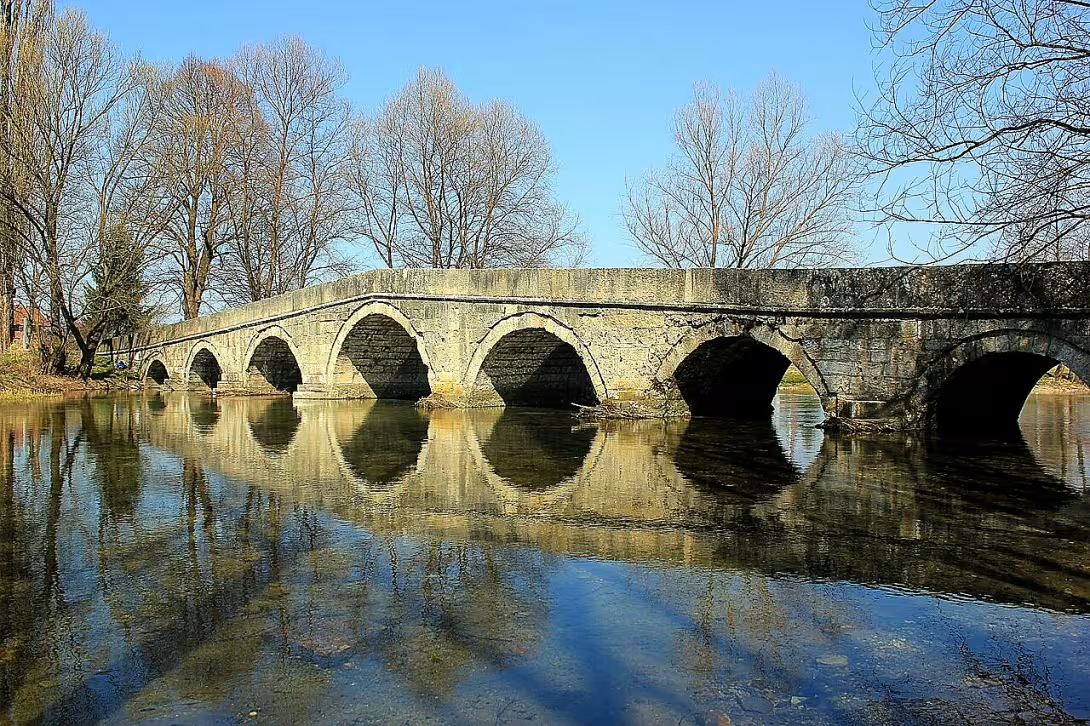
The Římský most is a historical stone bridge in Dolní Pěna, spanning the Pěnenský potok. Constructed in the 18th century, it features either a single or double arch design and has undergone significant changes over time. Its historical significance is underscored by documentation from the Heritage Institute in 1891 and further detailed descriptions provided by Mičán in 1976. Despite likely burial during land reclamation efforts in the 1970s, the bridge remains an important cultural landmark.
Built when Bohemia was part of the Habsburg Monarchy, the Římský most reflects the era's Baroque-influenced architectural development and increased infrastructure projects aimed at improving European transportation. Although specific construction details are scarce, it is assumed that the bridge served as a vital link in the local transport network.
Architecturally, the bridge was originally constructed with large flat stones and featured a vaulted arch design. Historical records describe variations in its structure, noting either a single or double arch configuration. The two half-circular arches had spans of about one meter each. Over time, it underwent modifications, including partial filling to level the roadway crown and reinforcement with concrete during repairs in 1963.
Ownership and administration details are sparse, but historical records indicate its significance through documentation by the Heritage Institute in 1891 and Mičán's description in 1976. These records highlight the bridge's importance as a heritage site, despite discrepancies in its exact location and design over time.
Key events associated with the Římský most include its repair in 1963, which involved concrete reinforcement to ensure structural integrity. Historical sources suggest that during land reclamation efforts in the 1970s, the bridge was likely buried, rendering its current existence unverifiable. Nearby, a chapel dedicated to Saint John of Nepomuk adds cultural significance to the area, further enhancing the site's heritage value.
Today, the exact state and accessibility of the Římský most are uncertain due to its probable burial in the 1970s. However, its historical context and architectural features make it a noteworthy site for those interested in exploring the region's cultural heritage. Visitors can appreciate the broader historical landscape by visiting the nearby chapel with a niche dedicated to Saint John of Nepomuk.
The Římský most stands as a testament to the rich history and architectural ingenuity of its time, offering insights into past infrastructure developments within Bohemia. Its legacy continues to intrigue historians and tourists alike, inviting exploration of Dolní Pěna's historical treasures.
Historical milestones
- 18th century
- Construction of the Římský most in Dolní Pěna.
- 1891
- Documentation by the Heritage Institute highlighting its historical significance.
- 1963
- Concrete reinforcement and repairs to ensure structural integrity.
- 1970s
- Likely burial during land reclamation efforts, affecting accessibility.
- 1976
- Detailed description provided by Mičán, emphasizing its cultural importance.
Architectural development
Originally constructed with large flat stones, the Římský most featured a vaulted arch design. Over time, it was partially filled in to level the roadway crown and reinforced with concrete during repairs in 1963. The bridge's structure included two half-circular arches with spans of about one meter each.
Historical events
The bridge was documented by the Heritage Institute in 1891 and again in 1976, indicating its historical significance.
In 1963, the bridge underwent repairs that included concrete reinforcement.
Points of interest
- The Římský most was likely buried during land reclamation efforts in the 1970s, which makes its current existence uncertain and adds a layer of mystery to this historical site.
- Despite being constructed with Baroque influences typical of the Habsburg Monarchy era, specific details about the bridge's original design are scarce, leaving room for speculation about its initial architectural features.
- The bridge underwent significant modifications in 1963, including reinforcement with concrete, highlighting ongoing efforts to preserve it despite changing times and technologies.
- Historical records from the Heritage Institute in 1891 and Mičán’s description in 1976 provide insights into the Římský most's significance, yet discrepancies in its exact location and design over time add intrigue to its history.
- Nearby, a chapel dedicated to Saint John of Nepomuk enhances the cultural significance of the area, offering visitors additional historical context and enriching their exploration of Dolní Pěna’s heritage.
Guide
This guide is narrated by a synthetic voice generated by artificial intelligence.
Show guide text
This text was created by artificial intelligence and has not been editorially reviewed. It may contain inaccuracies.
The Roman Bridge was a stone bridge in the village of Dolní Pěna in the Jindřichův Hradec district. It spanned the Pěnenský Stream. Its story is unusual. Today it cannot be verified whether the bridge even existed, and the preserved records do not even agree on what it looked like and where exactly it stood.
The Monument Institute preserves two inventory sheets for the bridge with the same registration number 1891. One is neither signed nor dated, the other was signed by Mičán in 1976. Both bear the designation Roman Bridge and both place the origin of the bridge probably in the 18th century. However, the description of the structure and its location differs between them.
According to the unsigned sheet, the bridge stood on the edge of a forest below a pond, on the original path that connected Dolní Pěna with Jindřichův Hradec. It was a barrel vault arch made of flat, thick stones. It was partly supplemented with rubble stone and partly filled up to the level of the road surface. In the vault soffit, a concrete patch remained after repairs, and the arch on the upstream side was partly bricked up. In 1963 the bridge was repaired and completed.
The 1976 sheet describes a small bridge near house number 36, to which the name Čáplovi is given. According to this record, the small bridge was made of stone and had two arches. Both semicircular arches had a span of about one meter. The roadway had no parapet walls. Instead, stone slabs lay there, and otherwise a path of trodden earth led across the bridge. The bridge was 3 meters wide, the masonry and vaults were pointed and painted. About a quarter of the right arch had collapsed. The bridge led across the original streambed. The flow had been diverted and a new concrete bridge leads across the new streambed.
The Monument Catalog describes a single arch bridge near house number 36. This seems to be a combination of data from both sheets. It is possible that each of them described a different bridge: a two-arch bridge near house number 36 and a single arch bridge about 115 meters higher upstream.
During land amelioration in the 1970s, the bridge was probably buried. About 500 meters upstream along the stream stands a bridge with a niche chapel of Saint John of Nepomuk, which is also protected as a monument.
Tips for visitors
The best time to visit the Římský most is during late spring or early autumn when the weather is pleasant, making it ideal for exploring the surrounding rural landscape. These seasons offer comfortable temperatures and fewer crowds, allowing you to appreciate the historical charm of the area without distractions. Additionally, visiting during these times provides opportunities to witness local flora in bloom and enjoy the serene ambiance.
The combination of these options ensures that both private vehicle owners and public transit users can easily access the Římský most.
When planning your visit, consider bringing comfortable walking shoes as there may be some uneven paths around the site. A camera is recommended for capturing the picturesque views, especially at sunrise or sunset when the lighting enhances the historical structures' beauty. Additionally, carrying a light jacket can be useful due to variable weather conditions in the region.
For photography enthusiasts, the best spots are near the bridge itself and the chapel with Saint John of Nepomuk's niche located upstream. Early morning or late afternoon provides the most favorable natural lighting, casting soft shadows that accentuate the architectural details. These times also tend to have fewer visitors, allowing for more tranquil photo opportunities.
Nearby attractions within a 30-minute drive include other historical sites and rural landscapes in the Jihočeský kraj region. The chapel with Saint John of Nepomuk's niche is particularly noteworthy for its religious significance and scenic setting. Families can enjoy exploring this area, which offers both cultural insights and natural beauty, making it an enriching experience for all ages.
Frequently asked questions
Can the monument be visited?
This is a structure in a public space that can usually be seen from outside free of charge. We have not verified that this particular one is freely accessible. According to the heritage register the structure is in poor condition – do not enter it and take care nearby.
Where is the monument?
Location: Dolní Pěna, Jihočeský kraj. The map on this page shows the exact spot.
Why is the monument protected?
It is listed in the Central List of Cultural Monuments of the Czech Republic as a cultural monument (register no. 18061/3-1891).
Businesses nearby
Do you run a restaurant, accommodation, shop, museum, rental, wellness or other visitor service near this monument? Show yourself directly to the people heading to it — this is how they will see you in the app and on the web:
Events nearby
Zdroj akcí: otevřená data měst a obcí ČR (Národní katalog otevřených dat) a kalendář akcí Národního památkového ústavu.
Nearby
The surrounding landscape includes a chapel with a niche dedicated to Saint John of Nepomuk, located approximately 500 meters upstream. The area is characterized by its rural setting and historical structures.
Accommodation nearby
Themed route
Thematic Walking Tour: Římský Most and Surroundings
1. Římský Most (Roman Bridge) - Type: Historical Structure - Why Visit: This ancient Roman bridge, located in the village of Dolní Pěna, is a testament to early engineering prowess. Its well-preserved arches offer insight into historical transportation and trade routes that once connected regions across Europe.
2. Chapel with Saint John of Nepomuk Niche - Type: Religious Site - Why Visit: Situated approximately 500 meters upstream from the Roman Bridge, this chapel features a niche dedicated to Saint John of Nepomuk. The site is steeped in local folklore and religious history, providing a serene spot for reflection amidst its rural charm.
3. Village Center of Dolní Pěna - Type: Historical Village - Why Visit: Explore the quaint village center with its traditional architecture and peaceful atmosphere. Walking through Dolní Pěna offers a glimpse into rural life in the Jihočeský region, enriched by historical structures that have stood the test of time.
This tour provides an immersive experience into the history and culture surrounding the Římský Most, highlighting significant local landmarks within its immediate vicinity.
Seasonal recommendations
Jaro: During the spring season, visiting the Roman Bridge in Dolní Peň offers a special vibrancy with blooming shrubs and trees enveloping the space in lively colors. Sunny days transform into warm evenings filled with long shadows, providing a unique atmosphere for strolls across the bridge under clear lighting. Visitors can expect moderate crowd levels as it is before the main summer season. It's recommended to wear comfortable clothing suitable for both warm and cool weather, such as tops with jackets or sweaters that can be easily added or removed. The best time to visit is in the early afternoons when the sun illuminates the bridge and surrounding landscape but before the weekly crowd surge begins.
Léto: During the summer season, the Roman Bridge in Dolní Peň offers an exciting combination of historical and natural beauty. Sunny days illuminate ancient stone structures while the water beneath the bridge becomes a tranquil oasis for relaxation. Summer visits often attract more tourists due to ideal weather conditions, so it's advisable to visit early in the morning or later in the evening to avoid peak crowds. Humid warm days mean that tourists should wear light clothing and not forget sun protection sunglasses, insect repellent, and plenty of water. Additionally, bringing a compact umbrella is recommended for unexpected heavy showers common in Central European summers.
Podzim: In autumn, the Roman Bridge in Dolní Peň offers a unique atmosphere with leaves changing to gold and red hues. Sunny days illuminate the bridge under warm light, creating a romantic ambiance perfect for a leisurely walk or photography. Visitor numbers increase during weekends but overall crowd levels are typically lower compared to summer. Tourists should wear outerwear and warmer clothing for cooler days and higher chances of rainy conditions, while short gloves are useful for protection against chilly mornings. The best time to visit is in the early afternoons when lighting is ideal and before weekly crowds begin.
Zima: During winter, the Roman Bridge in Dolní Peň offers a peaceful and subdued environment, covered with snow or chilled air depending on current conditions. Sunny illumination creates dramatic shadows on the bridge while cold weather makes visits more serene and intense. Tourists should wear warm clothing, including coats and hats, to protect against the cold and possible rain or snow. The best time to visit is typically around midday when lighting is optimal for photography and overall experiences, avoiding almost closures on Friday afternoons.
Visualizations and artistic views


The visualisations are generated by artificial intelligence and serve as inspiration.
Photos from the area
Real photos taken near the monument


Zdroj a licence jsou uvedeny u každého snímku.
Tips from visitors
No tips yet. Be the first!
Log in and add your tip.
Sources and literature
Faktickým podkladem tohoto textu byl článek na Wikipedii, jehož autory jsou přispěvatelé Wikipedie. Článek je dostupný pod licencí CC BY-SA 4.0.
Location on the map

Příběhy a pověsti
Legendy, pověsti a příběhy spjaté s touto památkou

Fotografie návštěvníků
Zatím žádné fotografie. Buďte první, kdo přidá fotografii z návštěvy!
Log in a přidejte svou fotografii nebo hodnoťte.
Za ověřenou návštěvu v aplikaci získáte víc bodů — poznáme podle GPS, že jste na místě.
Reviews and comments