






Minoritský klášter v Českém Krumlově Monastery
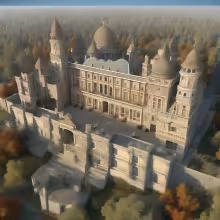
On Krumlov Latrán, at Monastery No. 50, there is a complex called the Three Monasteries: a former Minorite monastery with the Church of the Body of God and the Virgin Mary, a monastery of clarisks and a monastery of bekens. This concentration of three Greek and semi-secular communities in a single area is quite exceptional. Today, the object is in the administration of the Knight's Order of Cruisers with a red star and serves as one of the significant cultural centers of the city with permanent exhibitions and seasonal exhibitions.
In 1350, Kateřina of Rožmberk, born from Vartenberk, became the founder of the monastery, the widow of the highest butler of the Czech Kingdom Petro of Rožmberk. The construction was not going too fast - the first minorites came to the monastery in 1357 and the convention was consecrated by the Bishop Albert of Sarajevo. The monastery church was dedicated to the body of God and the Virgin Mary. Four years later, in 1361, the first clarisky entered the neighboring female monastery. In 1375, a third community was added: the convention was occupied by heres, devout lay sisters. The Rožmberk area was generously supported by gifts and proceeds from villages and courtyards.
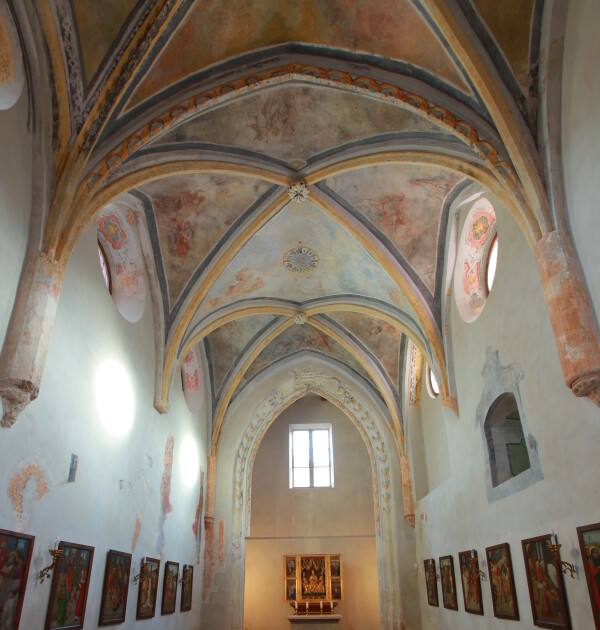
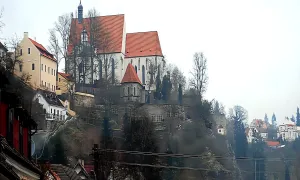
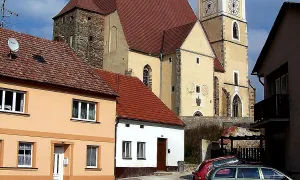
The construction development included late Gothic modifications between 1490 and 1500, of which roof roofs were preserved to this day. During the 17th and 18th centuries the monastery went through reconstruction in Baroque style, which imprinted its present form. The Convention of Clarisks was abolished in 1782 as part of the Yosefin reforms for emperor Joseph II. The Minorite monastery survived for more than half a century until it was violently abolished in 1950, when the Communist regime carried out its plan K.
After the cancellation, the buildings served various worldly purposes: as a military school, accommodation for officials of the court, warehouse and social apartments, until the 1990s. Parts of interiors and exteriors have become desolate. The situation was only changed by the extensive reconstruction launched in May 2014; the repaired monastery was reopened to the public on 28 November 2015. The total cost of revitalization was almost CZK 327 million and part of the building was adapted to the accommodation.
The monastery gardens have also been restored. On the Tramín are planted woods of a sad nature resembling the historical cemetery; the routes were restored in the original layout. In the courtyard there are signs of the foundations of St. Anne's Cemetery Chapel from 1555, which he had built Vilém z Rožmberka for his third wife Anna Maria Baden - the chapel was demolished in the second half of the 19th century. The main garden, the years used as a garden colony, is terratically divided and includes a part of both useful and ornamental with vineyards, hops and vegetable beds and colour plants. Behind the church of the body of God, a stone Lourdes cave with a niche for the statue of the Virgin Mary was preserved in the former kitchen garden. The area also includes an herb garden with preserved original goals, fruit orchards and renovated conical building.
In one place, the visitor will connect the medieval history of the Rozberg benefactor, the drama of the Josefini interference of monasteries and the fate of the object during the communist era - all in a carefully restored environment with open exposures and live gardens.
Then and now
Drag the slider to compare how the landmark may have looked when it was built with the view today.
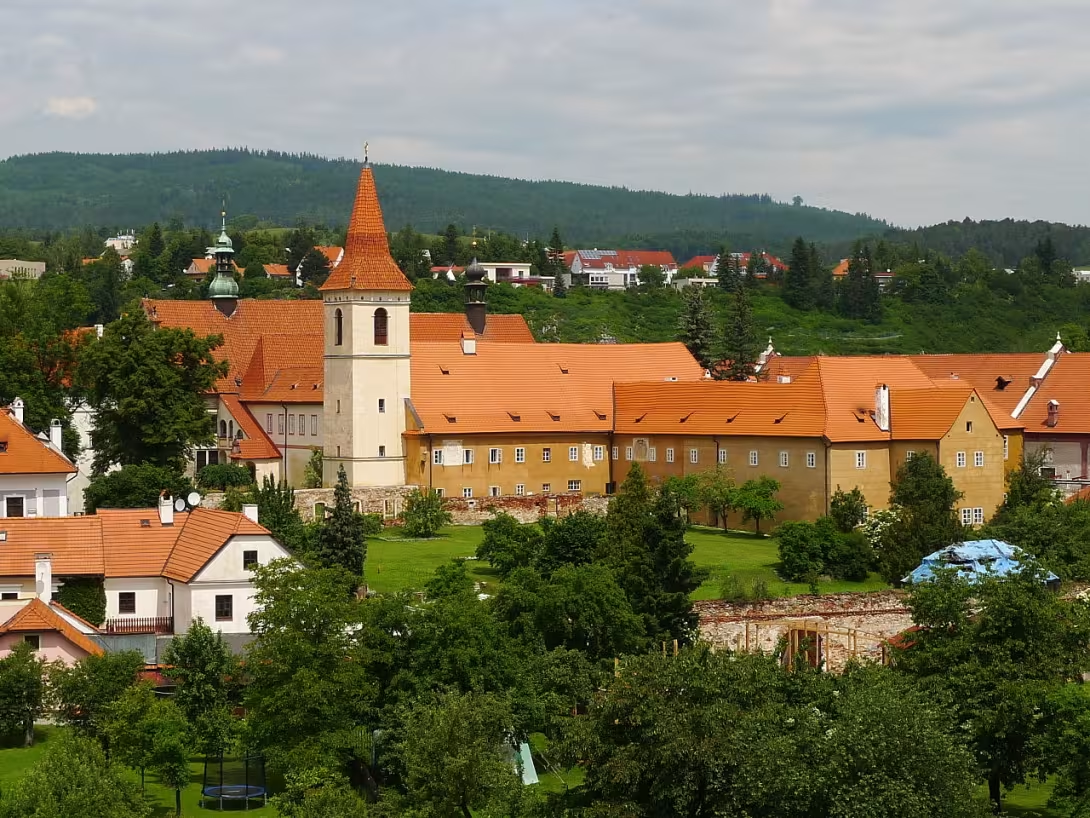
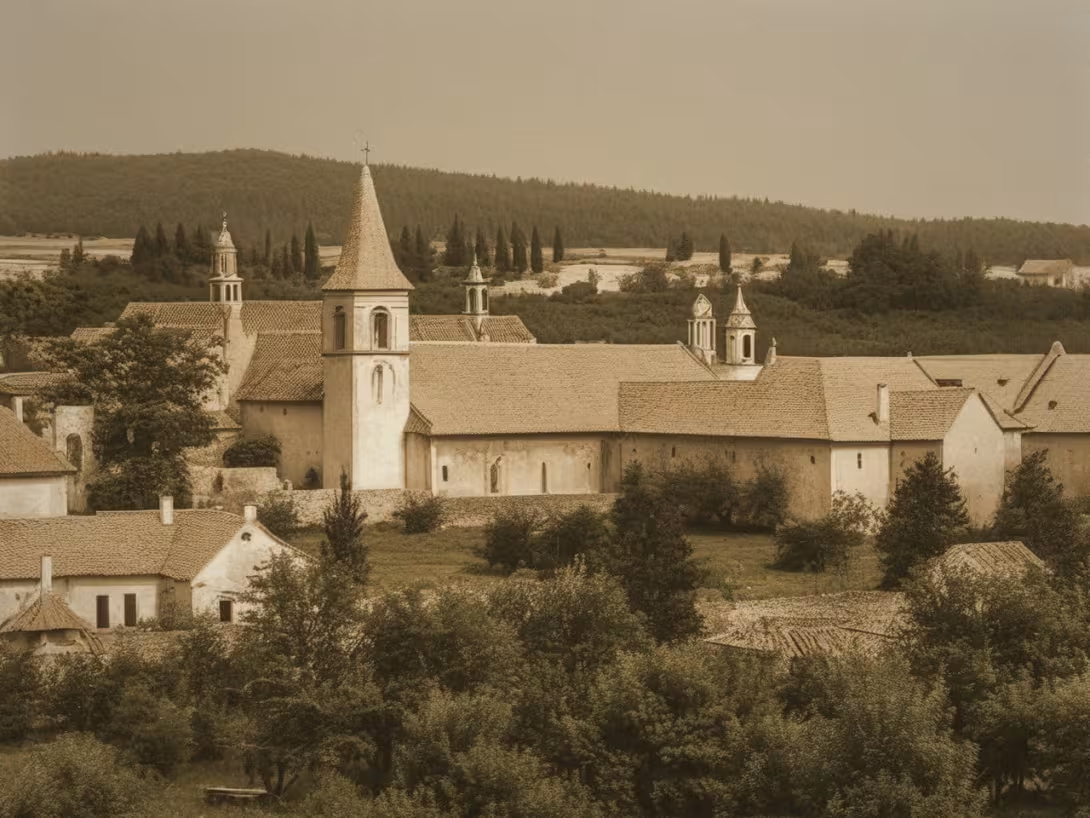
The historical appearance on the left is an AI-generated visualisation and serves as inspiration only.
Historical milestones
- 1350
- The establishment of a monastery of minorities by order of Catherine of Rožmberk.
- 1361
- The establishment of the Clariske monastery.
- 1375
- The establishment of a monastery by a beanie in the neighborhood.
- 1490
- Gothic building modifications of the monastery (documented by roof roofs).
- 1782
- The abrogation of the Clarisque monastery by Emperor Joseph II.
- 1950
- The abolition of the Minority Monastery
Architectural development
The original Gothic complex was gradually modified in the 15th century (roof roofs from late Gothic). In the 17th and 18th centuries he went through Baroque reconstruction, which gave him the present form. The area includes the church of God's body, monastery buildings and gardens with historical elements such as the cemetery foundations and the chapel of St. Anne. The reconstruction of the 21st century preserved the original structure with modern accessories.
Historical events
- 1357
- The arrival of the first minorities and the consecration of the monastery by the Bishop Albert of Sarajevo.
- 1782
- The abrogation of the Clarisque monastery by Emperor Joseph II as part of the Yosefin reforms.
- 1950
- The violent abolition of the minority monastery by the Communist regime.
- 2015
- Opening the monastery after reconstruction for the public.
Points of interest
- The Three Monasteries on Latrán is an exceptional focus of three Greek communities - minorities, clarisks and beets - in a single area.
- The monastery was founded in 1350 by Kateřina of Rožmberk, widow of Petra of Rožmberk, the highest butler of the Czech Kingdom.
The first minorites came to the monastery in 1357, the convention was consecrated by the Bishop Albert of Sarajevo.
- The Convention of Clarisks was abolished in 1782 as part of the Josephine reforms, the Minorite monastery survived until 1950.
Guide
This guide is narrated by a synthetic voice generated by artificial intelligence.
Show guide text
This text was created by artificial intelligence and has not been editorially reviewed. It may contain inaccuracies.
Welcome to Latrán, one of the most beautiful parts of Český Krumlov. Please stop for a moment and feel the atmosphere of this place. Right now, you're standing in front of the Minorite monastery, a complex that retains hundreds of years of history, faith and human destiny. Look at the buildings in front of you. Even though they act today as a harmonious whole, there is actually a fascinating story behind them about the three monasteries, which is a very special matter in our parts.
Let's go back more than 600 years together, back to the mid-14th century. At that time, this space was mainly made up of ambition and deep piety of the Rosberg masters who ruled here with unshakable power. The first stone of this spiritual centre was laid in 1350 by Kateřina of Rožmberk, who was the widow of Petra of Rožmberk, then the highest butler of the Czech Kingdom. Imagine Catherine as a strong woman of her age, who wanted to leave a mark in the form of a place dedicated to prayer and to help others. It was her initiative that began the creation of a minority monastery.
What's interesting, however, is that the Minorites themselves, the members of the Order of St. Francis, did not come into these spaces immediately. The first brothers settled here only in 1357. This year, the monastery was officially consecrated by Bishop Albrecht of Sarajevo. Imagine the hustle and bustle at the time, the sounds of Latin prayers and expectations that accompanied the creation of this centre in the heart of South Bohemia. But Catherine and her family didn't quit. In the coming decades, the site began to expand at an incredible rate. In 1361 the Clariske monastery was founded, which was the female branch of the Minorites, and 15 years later, in 1375, in the immediate neighbourhood even the pimples were added.
Now, when you look at the facades and the overall scope of the complex, you realize how unusual it was to have three different religious communities in one single complex. The Minorites, the Clarisks and the Beaners shared space, but each lived his own, strictly separate life. It was a spiritual town in a small town that served as an important cultural and religious centre of the whole region.
Attention now to architecture. Even though the buildings now appear to be united, centuries of different styles are layered in them. If you look at the total available, you see the basic Gothic nucleus. One of the most valuable details, which is not visible from the outside at first glance, but are documented in the history of buildings, are roof roofs. These structures come from 1490 and are a living testament to the Gothic building modifications that took place at the turn of the century. Later they were joined by baroque adjustments that gave the buildings their present, finer and more representative appearance. Look at the facade and see how these two epochs intersect. Gothic rigour meets baroque elegance here.
This area was closely associated with the family name Rožmberk. In addition to Catherine, Vilém z Rožmberka left its trail. For these noble generations, the monasteries were not only places of prayer, but also symbols of their power, wealth and care for the salvation of the soul. The monastery was a place where high politics met with deep spirituality.
However, history is not only about ups and downs, but also about deep falls. The monastery went through a period of severe injuries. The first big break came in 1782, when Emperor Josef II, known for his radical reforms and the abolition of orders which he did not consider useful for society, cancelled the monastery of clarisky. This disrupted the balance of the three monasteries. Another much more painful blow came in 1950. The communist regime, which saw the enemy in religion, also abolished the monastery of minorities.
Imagine what it means for buildings when suddenly people who have taken care of them with love and respect for centuries disappear. The monastery began to decay. The walls burst, the roofs flowed, and the silence that used to be the silence of prayer turned into the silence of abandonment. This unique complex seemed to be slowly disappearing from the map of Český Krumlov.
But the story of the Minorite monastery ends happily. A large and precise reconstruction took place between 2014 and 2015. Thanks to her, the site came back to life, but in a new role. It is no longer a closed space for monks and monks, but an open cultural and social centre. Today you can visit various exhibitions and participate in social events. It's a fascinating transformation from an ascetic renunciation to a meeting place with people, culture and education.
Before you go any further, let me give you one interesting thing. Think about how rare this concentration of three communities is in one area. Most monasteries are separate, separate, each community has its own world. Here, however, the minorites, clarisks and pimples were practically neighbors. This closeness to the various ways of living in one complex makes the Krumlov monastery unique, which is unprecedented in our region. It's like three different chapters of one big book on faith were written in one building.
Now I invite you to cross the threshold of this compound and examine it closely. Come in, walk through the spaces that once hosted prayer and now host art. Feel the contrast between the thick historical walls and the modern uses that have been returned to them in recent years. Let yourself be inspired by the peace of Latrán and the history that surrounds you from each side.
Thank you for accompanying me on this short journey through time. Enjoy your next stay in Český Krumlov and let yourself be captivated by the secrets of this wonderful city. Goodbye.
Tips for visitors
{'paragraph': 'The best time to visit the Minorite monastery is in the summer months, especially in June to September, when the outdoor environment of the monastery is the most beautiful and sunlight creates ideal conditions for photography. The morning clock or late afternoon is suitable because there are fewer visitors and the light is softer. In winter, the monastery offers a quiet atmosphere, ideal for walking and observing historical details without crowds.'}
{'paragraph': 'Parking is provided in several places around the monastery, for example in the parking lot near Latrán Square or in the parking lot near the castle Český Krumlov. It is recommended to use public transport as the city centre is available on foot. Local bus connections will bring you right to the monastery. The current connection and availability of parking spaces can be found on the official city website or in the traffic search engine.'}
{'paragraph': 'When visiting the monastery, wear comfortable shoes because the area is extensive and includes staircases and dirt terrain. It is also appropriate to take a map or brochure with a plan of the monastery, which they often provide at entry points. Bring plenty of water in the summer and warm clothes in the winter because it can be cold in the interiors. Do not forget the camera or mobile phone to capture beautiful interiors and exteriors.'}
{'paragraph': 'Photography is allowed in the monastery but with certain limitations. The best places for quality pictures are monastery gardens and exteriors with Gothic architecture, where the light is pleasant and the details are well captured. In interiors photography is often restricted or prohibited, so check the current rules before entering. The ideal time for photography is morning or afternoon when light is not too strong and creates soft shadows.'}
{'paragraph': 'In the vicinity of the monastery there are several other interesting places that are within half an hour of walking distance. For example, you can visit Castle Český Krumlov, which is about 1.5 kilometers away and offers stunning views of the city. Another option is the Church of the Assumption of the Virgin Mary on Krumlov Square, which is about a kilometre away and is known for its Gothic architecture. For nature lovers there is an interesting garden of Rožmberg, located near the chateau and offers picturesque walks between historic terraces.'}
{'paragraph': 'For families with children a visit to the Minorite monastery is a great opportunity to explore history and nature. Children can visit the monastery gardens where it is often possible to see different plants and animals. In the interior of the monastery are often placed information and interpretation panels, which impress children with their stories. It is also recommended to visit the nearby Castle Český Krumlov where children can see medieval weapons and other historical objects. For a longer stay it is advisable to bring something to paint or write so that children can capture their impressions from the visit.'}
Frequently asked questions
Is Minoritský klášter v Českém Krumlově open to the public?
Yes, the Minorite monastery is open to the public. It is open from April to October and visitors can browse through its interiors.
How do I get to the place by car / public transport?
The place can be reached by car or urban transport. The nearest bus stop is near the chateau, from here the monastery is about 5 minutes walk away.
How much is the entrance fee and is it paid on the spot?
The entrance to the Minorite monastery is free.
Is the tour suitable for children and seniors?
Yes, the Minorite monastery is suitable for visiting families with children and seniors. The rooms are well accessible and offer plenty of seating.
How long does the tour take?
The tour of the monastery takes about 30-45 minutes, but you can also extend it according to your interests and needs.
What are the opening times and booking is required?
The Minorite monastery is open from April to October. Admission is free of charge, but we recommend ordering access on the website in advance.
What's interesting in the immediate vicinity?
In the immediate vicinity of the monastery you will find castle Český Krumlov, which is one of the most famous and visited chateaux in the Czech Republic. You can also walk around the historic part of the city.
For kids
Imagine going back 676 years to the Middle Ages. You stand in front of the great chateau in Český Krumlov and hear the bells of the church. But which church? The Minorite monastery! That's where we'd be going today.
How did it look here? The monastery was built as a seat of the Minorite Order, which came to Bohemia in 1227. At that time the Czech Republic was still a small country and monasteries played a huge role in education, health and religious activities.
Businesses nearby
Events nearby
Zdroj akcí: otevřená data měst a obcí ČR (Národní katalog otevřených dat) a kalendář akcí Národního památkového ústavu.
Nearby
{'sights': [{\ 'name': 'Castle Český Krumlov', 'staves': 'Chateau and chateau in the UNESCO area, about 1,5 km from the monastery.'}, {'name': 'Church of the Assumption of the Virgin Mary', 'staves': 'Gothic church on the Krumlov Square, about 1 km from the monastery.'}, 'nature': {'River': 'Vltava (monastery is situated on the northern meandru of the river)', 'park': 'The garden of the monastery with historical elements, about 2 km from the monastery.'}, 'nature': {'River' Vltava '(monastery is situated on the northern meandru of the river)', 'park': 'Gardens of the monastery with the terrace.'
Accommodation nearby
Trips and activities nearby
Guided tours, tickets and activities nearby from GetYourGuide
Affiliate link: if you buy from the partner, we may receive a commission. The price for you does not change.
Search tours and activities →Themed route
Thematic cruise route: Monastery in Latrán and surroundings of Český Krumlov
1. Minorite monastery in Latrán * * This historic monastery of minorities, built in the 13th century, is an example of Gothic architecture with rich decoration. It is a centre of spiritual and cultural tradition in Český Krumlov and offers visitors exposition with art items from the past.
2. Castle Český Krumlov * * The chateau and chateau in the UNESCO area, about 1.5 km away, is a symbol of the medieval power of the family Rožmberk. Its panoramic view over the city and Vltavou is unforgettable, and historical gardens are located on its premises.
3. Church of the Assumption of the Virgin Mary * * The Gothic church on Krumlov Square, about 1 km from the monastery, is an architectural pearl of the city. Its Gothic details and historical frescoes capture the spiritual and cultural development of the region.
4. Castle Rozberg Garden * * The Baroque garden with historical elements, about 2 km from the monastery, is a great place to relax. Its terraces and fountains resemble the luxurious life of the Rozberg estate.
End of route: After visiting the monastery and church it is recommended to walk through Krumlov Square and admire its historic atmosphere. The distance between the points is approximately 1-2 km, so the trip can be done in a day.
Seasonal recommendations
Spring in Český Krumlov brings the first green tones and awakening of nature to the monastery garden, which creates contrast with the calm atmosphere of the historical area. The light is soft and diffuse at this time, ideal for shooting details of Gothic architecture without sharp shadows. For visitors this period is outside the main tourist peaks, so you can explore the monastery without crowd pressure. It is recommended to wear layered clothes because spring weather is usually variable and it may be cold in the morning or evening. The most suitable visit is on Tuesday or Wednesday, when traffic is quietest and staff have more time to answer questions about the history of the order.
The summer is the most busy season in South Bohemia, where the monastery is surrounded by fully blooming vegetation and long days. The sun shines strongly, highlighting the colors of the facades and creating dramatic shadows in the doors. Due to the large number of tourists, it is necessary to come as soon as possible after opening, ideally in the morning to avoid the largest clusters of people. Clothes should be light and breathable, suitable for walking on stone tiles, and remember enough drinking mode. In the main summer season the waiting time for entry may be longer, so it is better to buy tickets in advance or take advantage of the quieter afternoon hours if the program allows you to do so.
Autumn in the Minorite monastery offers a unique atmosphere where leaves on trees turn into golden and red shades, which gives the whole area a romantic and nostalgic touch. The light is warmer and lower, which creates an intimate environment for exploring interiors and chapels. Tourism is gradually decreasing, so it is possible to experience the monastery in peace and without rush. It is recommended to wear a warm jacket, scarf and tight shoes because autumn rains and cold wounds are common. The best time is the late autumn, when nature is rested and the monument acts as a special silence that promotes reflection on the spiritual heritage of the place.
Winter brings silence and often a snow blanket to Český Krumlov, which covers the streets and gives the monastery a fabulous look. Short days and low sun create specific lighting that emphasizes stone structures and historical details. In Advent and Christmas time, the city may be full of visitors, but the monastery itself is less crowded than summer monuments. It is necessary to equip yourself with a high-quality winter jacket, gloves and slippery shoes because the pavement can be slippery from the iceberg. The opening hours are shortened in the winter months, so check your current operating hours in advance and plan your visit so you can get a tour before closing.
Visualizations and artistic views


The visualisations are generated by artificial intelligence and serve as inspiration.
Photos from the area
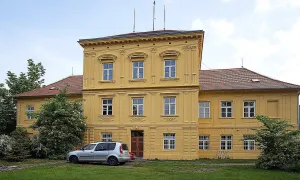
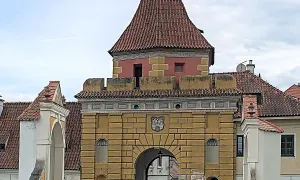
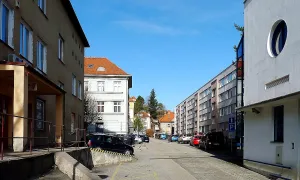
Real photos taken near the monument


Zdroj a licence jsou uvedeny u každého snímku.
View from the area
This animation was generated by artificial intelligence from a real photograph of the surroundings. The motion and details are not real footage of the location.
Atmosphere of the place
This atmospheric visualisation of the place and period was generated by artificial intelligence. It is not real footage of the location.
Tips from visitors
No tips yet. Be the first!
Log in and add your tip.
Sources and literature
Fotografie: H2k4 / CC BY-SA 3.0, rozlišení zvýšeno umělou inteligencí — Wikimedia Commons. The author and licence also appear when you hover over the image.
Faktickým podkladem tohoto textu byl článek na Wikipedii, jehož autory jsou přispěvatelé Wikipedie. Článek je dostupný pod licencí CC BY-SA 4.0.
Location on the map

Příběhy a pověsti
Legendy, pověsti a příběhy spjaté s touto památkou

Fotografie návštěvníků
Zatím žádné fotografie. Buďte první, kdo přidá fotografii z návštěvy!
Přihlaste se a přidejte svou fotografii nebo hodnoťte.
Za ověřenou návštěvu v aplikaci získáte víc bodů — poznáme podle GPS, že jste na místě.
Reviews and comments