






Rotunda svatého Kříže Menšího Church
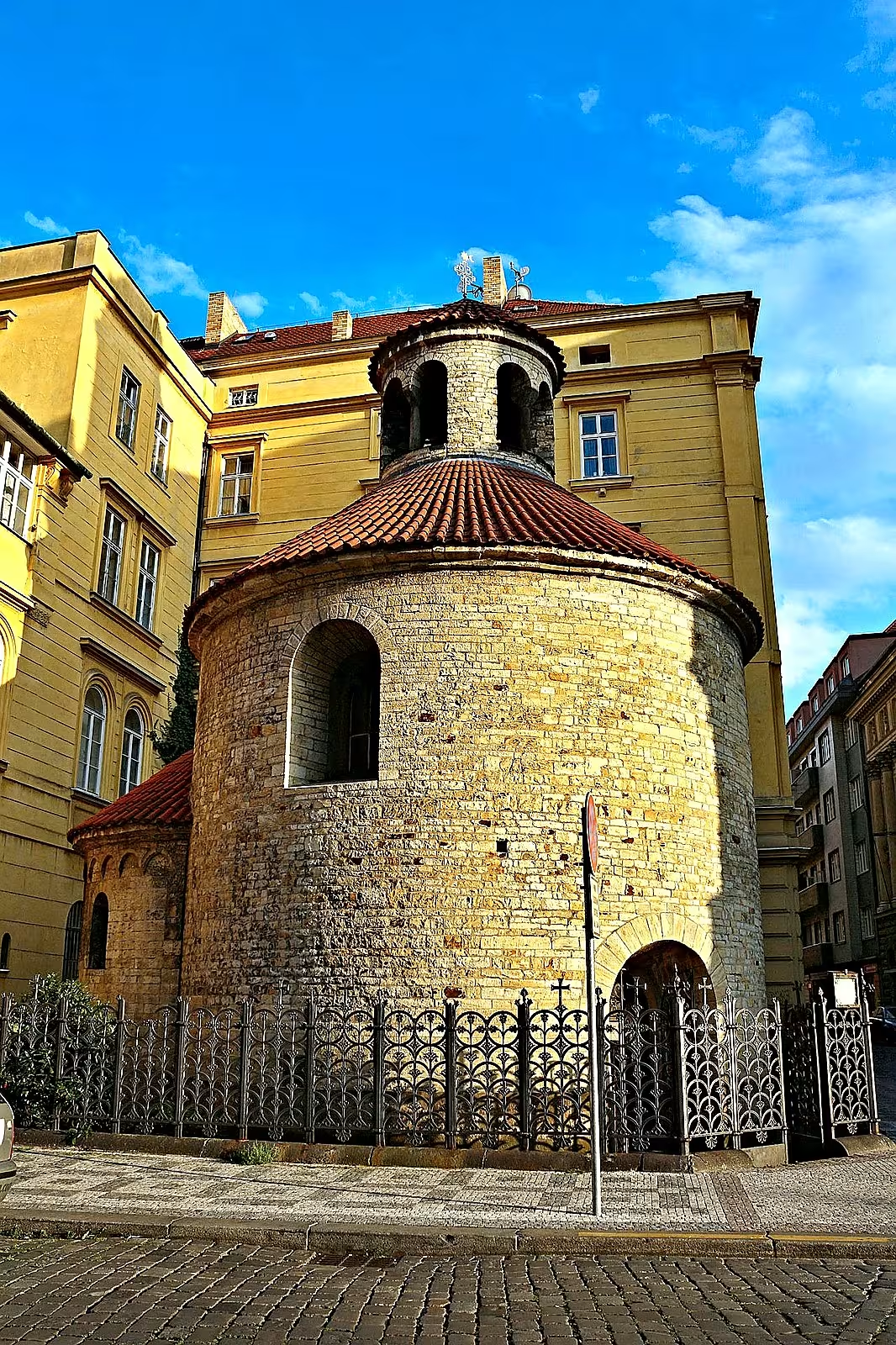
The Rotunda of the Holy Cross, known in Czech Rotunda svatého Kříže Menšího, is a Romanesque Rotunda, located at the crossroads of the streets of Konviktský and Carolina Svoté in Prague's Old Town. This small but historically important monument, built after 11125 years, stands on a significant trade route from Vyšehrad to the crossing of the Vltava. Despite its architectural simplicity, it has a rich history of the parish church since 1365, which makes it a remarkable cultural monument of the Czech Republic.
The origin of Rotunda is related to the Czech period of Romanesque, characterized by religious and architectural development. While specific details of its original construction remain weak, historical sources suggest that it may have served as a private sanctuary for one of the noble courts of Old Town. Its strategic location on the key trading route underlines its importance at this time.
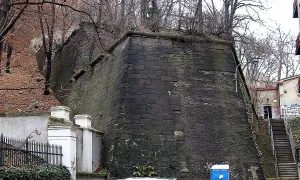
Rotunda has architecturally small ashtray blocks arranged in rows to form a circular boat with copulated roof and semi-circular apps. Part of the construction is arched freeze decorated with apsides and lantern with folded Roman windows, crowned with golden cross, half moon and star. During the 19th century, the original brick floors and fragments of 13th century gravestones were discovered under the floor, led by architect Vojt Ignác Ullmann.
The ownership and administration of the Rotunda have shifted over time. Originally related to the noble court of the Old Town and in 1625 he became part of the Dominican economy of the Old Town Monastery. The sanctuary was later closed because of church reforms under Joseph II in 1784 and was renamed as a warehouse. In 1860, plans to demolish the building were thwarted by Ferdinand Bretislav Mikovc and Josef Mánes, which led to its purchase by the City Council of Private Property. Ullmann's restoration effort preserved this architectural jewel for future generations.
Among the key events in Rotunda's history are his first documented mention of the parish church in 1365 and its acquisition by Dominicans in 1625. The reconstruction at the end of the 19th century, driven by Mikovc and Mánes, meant a crucial moment while preserving its historical integrity. Legends suggest that the place has spiritual meaning, with stories of divine signs appearing there.
Today, Rotunda is actively used by the Old Catholic Church in the Czech Republic and managed by the Prague Old Catholic parish. Regular services are held here and retain their role as a place of religious observance. Its preservation allows visitors to explore a piece of Prague architectural heritage, which offers insights into the period of the Romanesque and historical landscape of Bohemia.
The Rotunda search for the Holy Cross stands as proof of the permanent heritage of medieval architecture and spirituality in Prague. The rich history and architectural beauty make it a mandatory visit for interested people to explore the cultural tapestry of this historic city.
Then and now
Drag the slider to compare how the landmark may have looked when it was built with the view today.
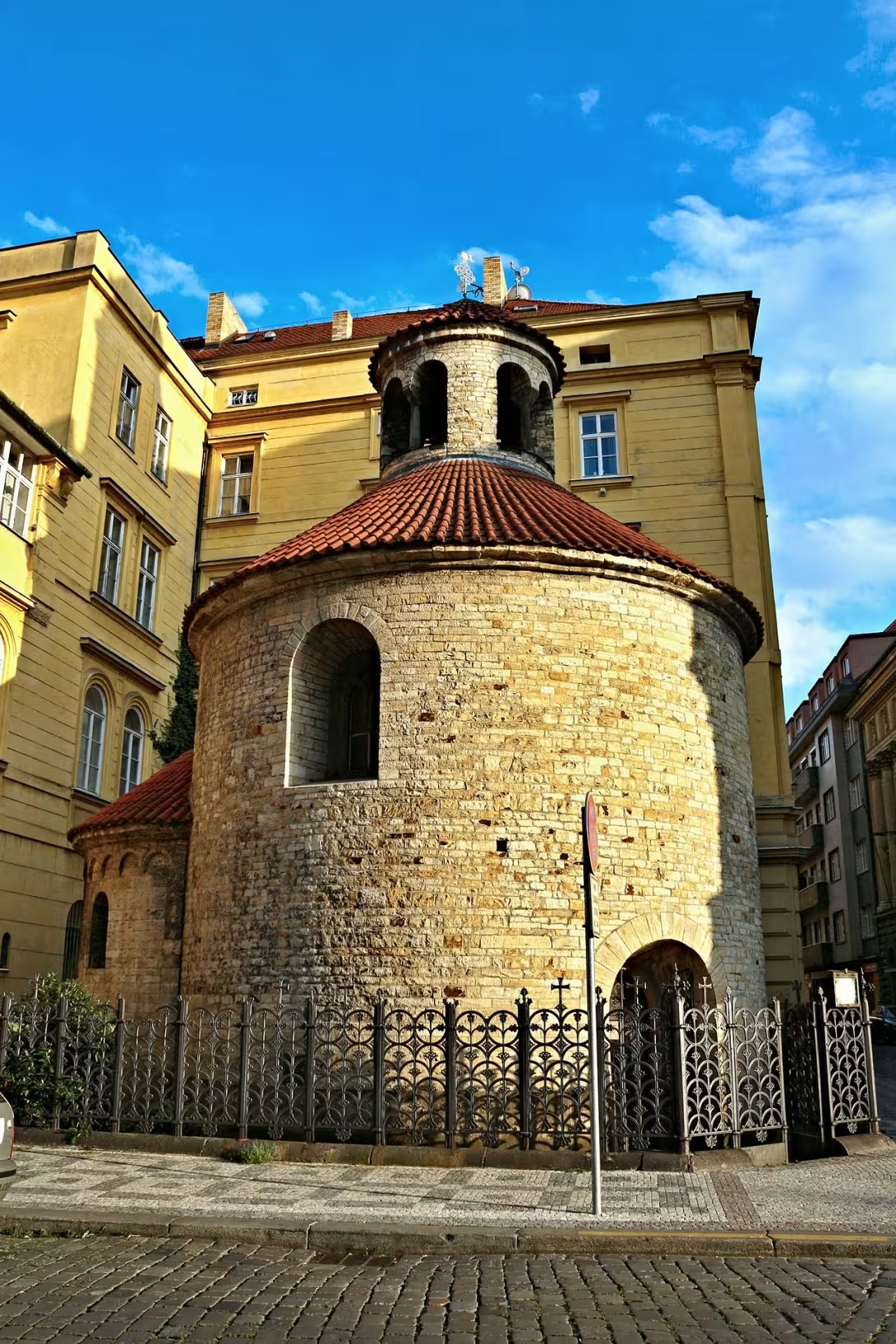
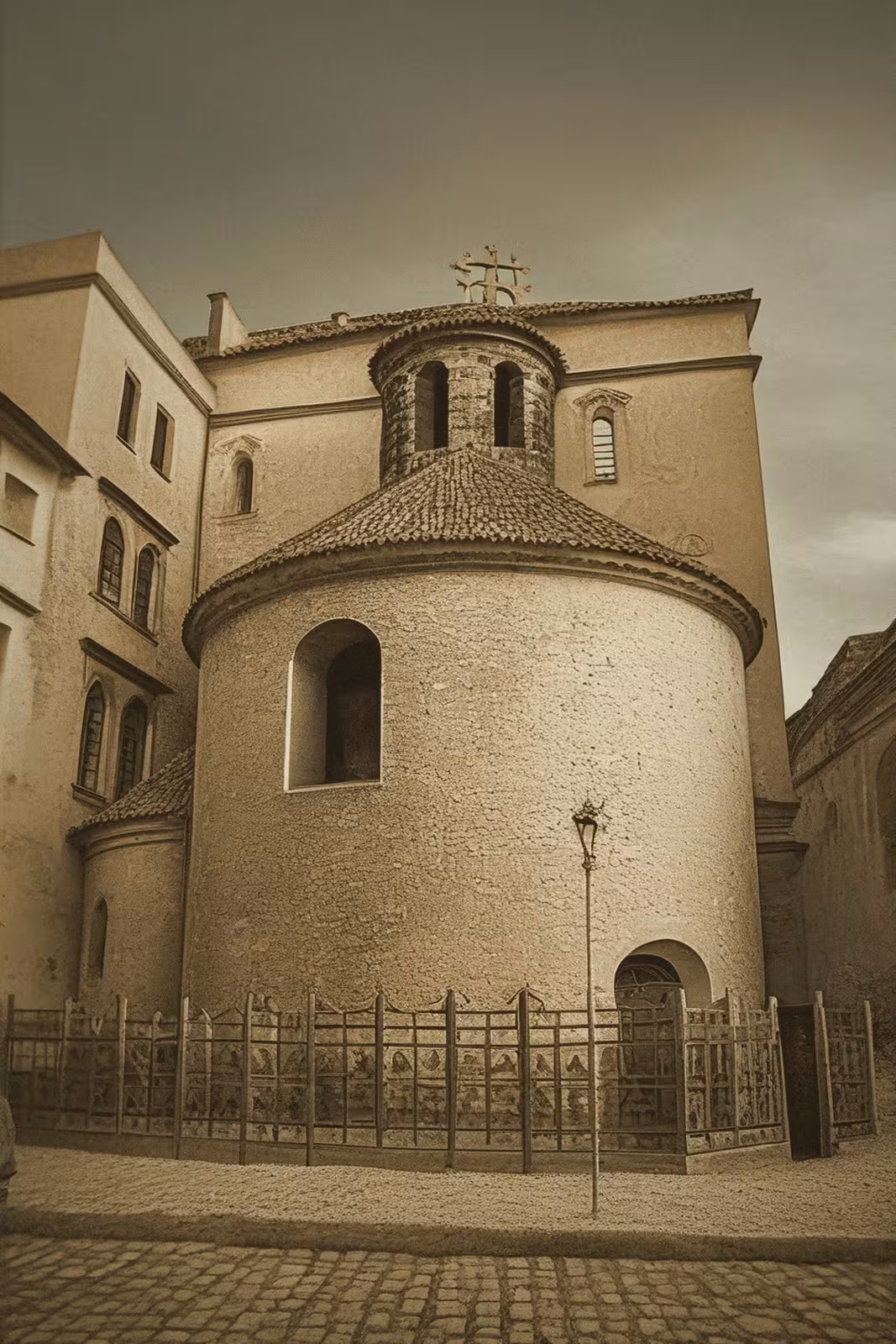
The historical appearance on the left is an AI-generated visualisation and serves as inspiration only.
Historical milestones
- 1365
- The first documented mention of the parish church.
- 1625
- Retrieved Dominicans from the Old Town Monastery.
- 1860
- Efforts to recover have begun to save the memorial.
Architectural development
Rotunda contains small ashrai blocks arranged in rows, forming a circular boat with a bone roof and a semi-circular apside. During the restoration run by Ignác Ullmann, the original brick floors and fragments of 13th century gravestones were discovered under the floor. During the 19th century, when the construction was restored, significant changes were made to prevent demolition.
Historical events
The first documented mention in 1365 as a parish church.
Received by Dominicans in 1625.
Reconstruction started by Ferdinand Břetislav Mikovec and Josef Mánes at the end of the 19th century.
Owners
Probably belonged to one of the Old Town of the Noble Courts
Dominicans from the Old Town Monastery (1625)
City Council after private purchase
Points of interest
- Despite its modest size, the Rotunda of the Holy Cross is one of the oldest surviving buildings in Prague, Old Town, which emphasizes the permanent character of Romanesque architecture.
- Legend has it that divine signs appeared on site, added a layer of mystical attraction to Rotunda, and attracted those who were interested in history and spirituality.
- Rotunda was associated with Dominican people who played an important role in Prague's religious life during the 17th century when it was part of the Old Town Monastery economy.
- The discovery of original brick floors and tombstones of the 13th century during the restoration of Vojt Ignác Ullmann provides valuable knowledge of medieval building techniques and funeral procedures.
- Ferdinand Bretislav Mikovec and Josef Mánes successfully prevented the demolition of Rotunda in 1860, thereby ensuring its survival for future generations.
Guide
This guide is narrated by a synthetic voice generated by artificial intelligence.
Show guide text
This text was created by artificial intelligence and has not been editorially reviewed. It may contain inaccuracies.
The Rotunda of the Finding of the Holy Cross stands in Prague's Old Town, at the intersection of Konviktská street with Karoliny Světlé street. It is traditionally called the Church of the Holy Cross Minor. This name distinguished it from the Church of the Holy Cross Major in the now-vanished monastery of the Cyriacus monks. It emerged probably after 1125 and is today a cultural monument.
The rotunda grew up near an important trade route from Vyšehrad to the crossings over the Vltava river. It may have originally served as a private shrine of one of the Old Town noble courtyards. The first written mention comes from 1365, when it was a parish church. A cemetery stretched around it and nearby stood a rectory, which was destroyed during the Hussite wars.
In 1625 the dominicans acquired the rotunda from the Church of Saint Giles. In 1784, under the reign of Joseph the Second, it was closed as part of church reforms and became a warehouse. In 1860 it was supposed to give way to the construction of a new building. At the urging of Ferdinand Břetislav Mikovce and Josef Mánes, the Artistic Society came to its defense. The rotunda was then purchased by the city council and architect Ignác Ullmann restored its exterior without accepting payment. He also designed an altar, which painter Jan Popelík decorated. During the repairs, remains of the original clay floor and parts of tombstones from the thirteenth century were found under the paving. In the surroundings, a denarius of Prince Jaromír from the year 1012 also appeared.
The building is small and simple, constructed from fine opaline ashlars laid in rows. The round nave is covered by a dome with a lantern and on the east side a semicircular apse adjoins it, decorated with a small arched frieze. The lantern is pierced by paired Romanesque windows and at the apex it bears a gilded cross with a crescent and an eight-pointed star. In 2022, remains of old roofing, probably still Romanesque, were found under the roof covering.
Josef Mánes imagined the walls covered with scenes from the legends of Czech saints. This did not come about. According to his design, however, a neo-Romanesque fence was created with motifs of Czech wild roses, which separates the grounds from the street. Inside are remains of Gothic wall paintings from the fourteenth century, which were restored by František Sequens. Above the presbytery hangs a painting of the Annunciation by Petr Maixner from 1870.
According to legend, the rotunda stands on the site of a pond into which a crucified girl was thrown because against her parents' will she had embraced Christianity. During a night storm, the cross apparently emerged and stood upright above the surface. During the repair of the foundations, a large decayed cross was supposedly actually found.
Today the rotunda is used by the Old Catholic Church and regular services are held in it.
Tips for visitors
The best time to visit Rotund from finding the Holy Cross is late in the morning or early in the afternoon, usually from around 10 am to 14 pm. This timing allows you to enjoy soft natural light, which increases architectural details and inner works of art without hard shadows cast by the midday sun. In addition, visiting these hours often means fewer crowds, providing a calmer experience as you explore this historic place.
Parking near Rotunda can be difficult due to its central location in Prague Old Town. However, there are several parking garages within walking distance that offer comfort for those who travel by car. For public transport users, rotunda is well served by tram and buses that run through the city centre. It is advisable to check the local traffic application or website for the most common routes and plans to ensure a smooth path.
When visiting Rotunda, it is wise to bring comfortable walking shoes as you will probably explore on foot. Due to its location in Prague Old Town, there are many paved streets leading up to the place. In addition, carrying a small umbrella or raincoat can be helpful because of unpredictable changes in the weather. A camera is also recommended to capture the complex Romanesque architecture and all internal details visible during your visit.
Photographed enthusiasts will find several places around Rotunda ideal for capturing its beauty. The best light for photography is usually late in the morning when the sun lights up the facade without throwing deep shadows. Inside, natural window lighting can highlight the interior properties of the rotunda. For family visits, consider bringing with you a little sketch or coloring books to make the children involved in the examination.
For those interested in extending their visit outside of Rotund, Prague Chateau is an excellent attraction in the vicinity of about 30 minutes by public transport. It offers a rich history and an amazing view of the city. Another option within walking distance is Charles Bridge, which provides picturesque scenes and access to other historical monuments on its way.
Frequently asked questions
Can the monument be visited?
Yes. We verified the opening hours or admission on the official website (8. 9. 2026); you will find them in the visitor information on this page. Please double-check with the operator before you travel.
What are the opening hours and admission?
Details verified on the official website (8. 9. 2026) are listed in the visitor information on this page. Official website: https://www.czechmarionettes.com/
Where is the monument?
Location: Konviktská, Karolíny Světlé, Staré Město, Praha, Hlavní město Praha. The map on this page shows the exact spot.
Why is the monument protected?
It is listed in the Central List of Cultural Monuments of the Czech Republic as a cultural monument (register no. 38179/1-18).
Businesses nearby
Do you run a restaurant, accommodation, shop, museum, rental, wellness or other visitor service near this monument? Show yourself directly to the people heading to it — this is how they will see you in the app and on the web:
Events nearby

Zdroj akcí: otevřená data měst a obcí ČR (Národní katalog otevřených dat) a kalendář akcí Národního památkového ústavu.
Nearby
ITEX Show interactive overview of the surroundings - restaurants, accommodation, rentals and other places within a 15 km radius.
Data: OpenStreetMap contributors, 15 km radius.
‡ Historical monuments
- Clam-Gallas Palace in Praze (0.4 km - Husova 156 / 21)
- House U Kohouta (0.6 km)
- Hlavkova railway (0.9 km - Gorazdova 1994 / 9)
- Kolovrat Palace in Waldstein (1.0 km - Waldstein 150 / 4)
- Jaroslav Vrchlický (1.3 km)
- Gorlice (2.0 km)
- Brick gate (2.0 km - In strength 46 / 1)
- Military Historical Institute Praha (2.2 km - U Memorial 1600 / 2)
Restaurant and catering
- McDonald 's (0.7 km - Vodičkova 736 / 15)
- Restaurant River's smokelab (1.2 km - Lidická 2)
- Pizzeria U Penguin (1.2 km - square 14 October 1)
- LegendA (1.5 km)
- Yi Xiang Ge (5.7 km)
- McDonald's (5.8 km)
- Švejk restaurant U Brážek (5.9 km - U Libertariv 18)
- Pizzeria Cerreto (6.0 km)
Accommodation
- The Mozart Prague (0.2 km - Carolina Light 208 / 34)
- Old Prague Hotel (0.3 km - shell 421 / 5)
- Old Town Jewel Apartments (0.9 km - Elishka Beautiful Mountain 10 / 2)
- Hotel AXA (1.7 km - Na Poříčí 40)
- EA Hotel Tosca (2.0 km - Blanická 718 / 10)
- Theatrino (2.7 km - Bořivova 1216 / 53)
- Hotel Olšanka (3.0 km)
- Plaza Prague Hotel (3.8 km)
› Rental and sports
- Kieser Training (1.1 km)
- Free Time Centre Botič (1.6 km)
- Floral expert (1.7 km)
- Velox Sport (2.1 km)
- U Tyrše (2.1 km - Jaselská 464 / 38)
- JUN (2.2 km - Haškova 629 / 7)
- Pavvy Cycles (2.6 km - Chvalova 1577 / 12)
- Virus Sport (2.8 km - Black Sea 235 / 5)
© Tourism and nature
- Information and booking center (0.8 km - Maiselova 38 / 15)
- Petrinka (1.2 km)
- Prague Chateau (1.4 km)
- Masaryk prospect (1.7 km)
- Vyšehrad (2.1 km)
- ÚAMK, a.s. (4.9 km - On the Union 1837 / 9)
- Gabrielka (5.5 km)
- Excursion Emy Destinnova (6.2 km)
Accommodation nearby
Trips and activities nearby
Guided tours, tickets and activities nearby from GetYourGuide
Affiliate link: if you buy from the partner, we may receive a commission. The price for you does not change.
Search tours and activities →Themed route
Thematic cruise route: Rotunda svatého Kříže Menšího and surroundings
1. Rotunda svatého Kříže Menšího (Church) - Type: Historical church - Why is it worth a visit: This baroque church, proportional in the 18th century, is the oldest heir to the company Crožovník with the mentioned event in the Czech Republic. Its unitary architecture and historical links to the Ríd of the Cross for another reason, an unfocused goal for milestones of history and architecture.
2. The Square of the Republic - Type: Square - Stand for filling: It lies close to 500 meters from Rotunda, it is a centralized and lively national Prague. It must be assumed that historical buds such as the National Theatre and the monument to Thama, which offers a rich cultural and architectural history of the city.
3. Church of St. Nicholas - Type: Church - It is worth the effort: This Gothic church, located at the Square of the Republic, is one of the oldest and most famous sacred buildings in Prague. Its history dates back to the 13th century and offers usable interiors with a rich Hungarian declaration.
4. National Theatre - Type: Theatre building - It is worth fulfilling: Located in the Square of the Republic, it is in the iconic place of Czech theatre and music. Its impressionable facade and history as a home for new industrial cultures and premieres that have a key structure.
5. The Thama Memorial - Type: Memorial - Proce stanza za vstavu: This memorial in the Republic Square is celebrated by Czech poet and writer Jaroslav Vrchlický, who under the pseudonym them. It is an important symbol of national identity and artistic decision.
This route offers historical architecture and cultural monuments, which are a mouthful of entrenchment in Prague's life, each point is called into the history of the city.
Seasonal recommendations
Spring: A visit to Rotund Saint Clement in the spring offers a peaceful experience as nature begins to awaken around this historic place. Soft, scattered light filtering through the incoming trees creates an ethereal atmosphere that increases the architectural beauty of the rotunda. While the weather may be unpredictable with occasional rain showers, it is advisable to wear layers and wear an umbrella or waterproof jacket. Spring is usually less crowded compared to summer, so it is a pleasant time for those who prefer a calmer visit.
Summer: Rotunda Saint Clement in Prague September under bright summer sun, cast dramatic shadows that highlight its complex details. This season brings fresh greenery surrounding the site, offering picturesque views and lively atmosphere. Summer is the top tourist season, so expect bigger crowds, especially at noon. Arriving early or late in the day can help avoid the busiest times. Light clothing is recommended due to warm temperatures, along with comfortable shoes for exploring.
Autumn: Autumn in the Rotunda of St. Clemente is characterized by a stunning view of autumn leaves, providing a colorful background that increases its historical charm. Colder weather and softer light create a cozy and pleasant atmosphere, ideal for peaceful exploration. This season sees fewer tourists than summer, offering a more relaxed visit. It is wise to dress in layers as temperatures may vary, and to wear a light jacket is suitable for sharp evenings.
Winter: In winter, Rotunda Saint Clement has a magical quality with snow covered with surroundings and festive lights that illuminate the structure during the holiday season. Short days mean early closure, so plan your visit accordingly to make as many daily hours as possible. Winter can be quite cold, so dressing warmly in layers is necessary, along with hats, gloves, and scarves for comfort. Despite the potential ice conditions, this place remains a beautiful place where you can experience the winter charm of Prague.
Visualizations and artistic views


The visualisations are generated by artificial intelligence and serve as inspiration.
Photos from the area
Real photos taken near the monument

Zdroj a licence jsou uvedeny u každého snímku.
Tips from visitors
No tips yet. Be the first!
Log in and add your tip.
Sources and literature
Photos: VitVit / CC BY-SA 4.0 — Wikimedia Commons. The author and licence also appear when you hover over the image.
Faktickým podkladem tohoto textu byl článek na Wikipedii, jehož autory jsou přispěvatelé Wikipedie. Článek je dostupný pod licencí CC BY-SA 4.0.
Location on the map
Příběhy a pověsti
Legendy, pověsti a příběhy spjaté s touto památkou
Fotografie návštěvníků
Zatím žádné fotografie. Buďte první, kdo přidá fotografii z návštěvy!
Log in a přidejte svou fotografii nebo hodnoťte.
Za ověřenou návštěvu v aplikaci získáte víc bodů — poznáme podle GPS, že jste na místě.
Reviews and comments