



Rovný Motte
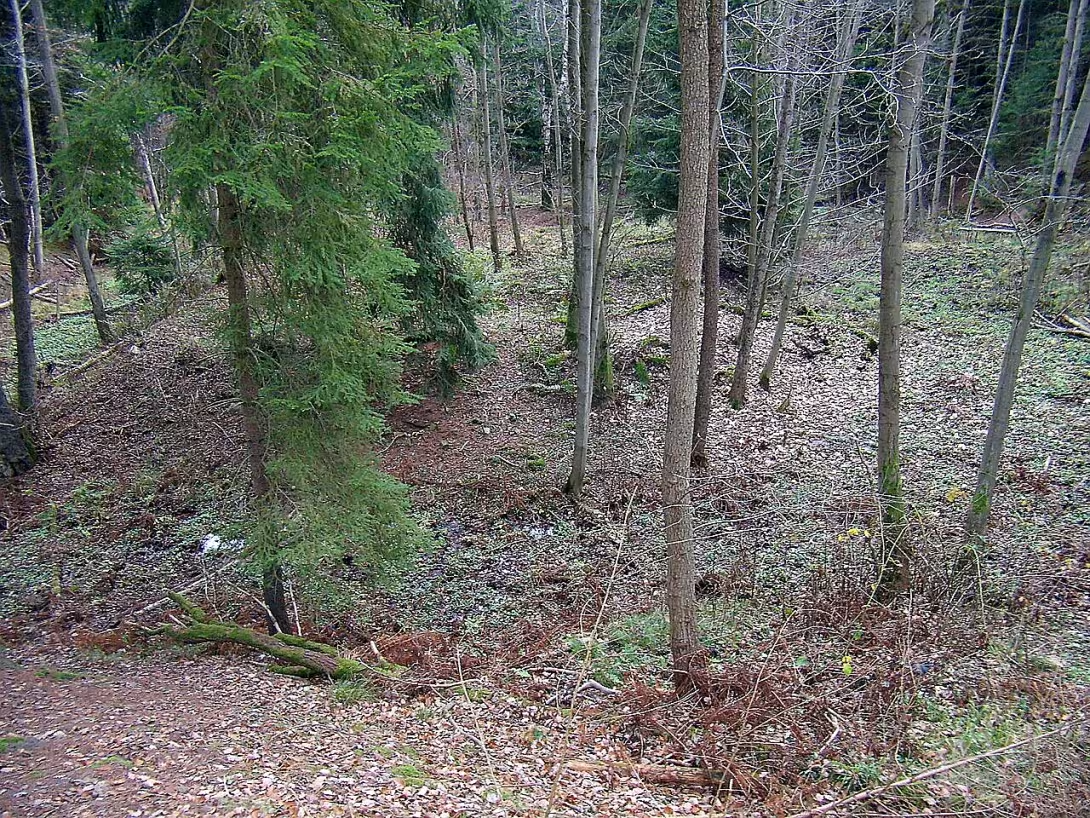
Rovný, also known as Rovensko, is a extinct housing complex involving a village, medieval fortress, farm yard and mills. Located about 3.5 km south of the Drahony Escape in Rokycany district. The whole complex is protected as a cultural monument of the Czech Republic and represents an important example of medieval settlement in the valley of the tavern of Koželuzka.
Little has been preserved about the oldest history; the first written mention of the place dates back to 1367. At the time, the castle here belonged to Nicholas of Equal. The first mention appears during the period of stabilisation of the estate within the Czech Crown.
The settlement was located in the valley of the left tributary of Koželuzka. The village consisted of a series of settlements around the village, approximately 200 × 100 metres across which the stream flowed. On the south side of the village, the remains of medieval chalets were preserved, whose readability is limited by traces of younger mining pits and milestones. Along the north side, there were four younger settlements with three-piece houses on stone sockets with dimensions 9-12 × 20- 31 meters. The complex included a system of four ponds. A fortress 35 × 24 metres tall was situated on the island in the middle of the third pond. Its perimeter was protected by a wall with probably a four-sided tower in the northeast corner and a residential building of 14 × 7 metres. The fort was entered from the farm yard over the moat bridge. In this yard, there were two granary houses, a grafted building heated by a furnace and a long underglazed building. There was a mill under the fort, which was driven by a drive of approximately 200 metres in length.
After Nicholas of the Straight, Martin z Rovného and his son Mikulash ruled, who served as a priest in Lhota under Radče. In 1410 he bought the fortress Vojslav Vlk z Miletic, followed by Oldřich from Vlkov. Since 1418, the estate belonged to Livik from Jivjan. In 1433 he was referred to as the owner of the house in Pilsen, whose defense he participated in the vicinity of the city of Hussite led by Prokol Holým. The last known owner in the 15th century was Václav Gut z Dubňan, listed in historical records in 1486. At the end of the century, Rovný became a part of the LBH estate. In 1540 only the mill remained here. Kryštof of Valdštejna sold the object to Lobkovice of Zbiroho in 1573. The village was restored at the beginning of the 16th century, but it finally disappeared during the Thirty Years' War.
Today the area is accessible to tourists and visitors of history. Around the settlement there is a green marked route from Plískov to Town Hall. There are traces of medieval life in a unique pond environment. This desolate village offers a quiet view of the history of the settlement of this region.
Historical milestones
- 1367
- First written mention of the fort belonging to Nicholas of the Equals
- 1410
- Vojslav Vlk z Miletic bought a fort
- 1418
- Lvík z Jivjan became owner
- 1540
- Only the mill remains in the area
Architectural development
The estate formed a lush with estates on stone suspects. The fortress 35 × 24 meters was protected by a wall with probably a four-sided tower. The complex also included economic buildings, granaries and mill with drive.
Historical events
1367: First written mention of the fort; 1418: Lvík z Jivjan took over the estate; 1540: Only the mill remains on the premises; 16th century: Restoration of the village which subsequently disappeared in the Thirty Years War.
Owners
Mikuláš z Rovného (1367), Martin z Rovného, Mikuláš z Rovného, Vojslav Vlk z Miletic (1410), Lvík z Jivjan (1418), Václav Gut z Dubňan (1486), Lobkovic from Zbiroha (1573).
Points of interest
- Rovný is a extinct residential complex including village, medieval fortress, farm yard and mills. - A fortress 35 × 24 meters across the island in the middle of the third pond. - The castle district was protected by a wall with probably a four-sided tower in the northeast corner and a residential building. - The village was restored at the beginning of the sixteenth century, but it definitely disappeared during the Thirty Years' War. - The first written mention of the place dates back to 1367.
Guide
Show guide text
This text was created by artificial intelligence and has not been editorially reviewed. It may contain inaccuracies.
Welcome to the Rovný monument. Stop for a moment, take a breath and feel the silence of this place. You may feel you're standing in the middle of a plain landscape, but right under your feet and around you is a fascinating story from the days of knights and medieval masters. You're standing in front of a place we now call a extinct settlement complex. This means that even if you can't see the rising walls or the high towers today, life has been throbbing in the past. Imagine going back hundreds of years in time. Here, in the valley of the tavern of Koželuzka near the Drahony Escape, the entire village, the farm yard, the mills, and the fortress was dominant over everything.
Let us now look together at how this place was created and what its original meaning was. The first written mention of Straight dates back to 1367. At that time there was the family of Nicholas of the Equals who was the first documented owner of this fort. In the 14th century such a fortress was the foundation of power and security in the surrounding landscape. It was not just a residence for nobles, but a centre for the management of nearby land and protection for the people who lived and worked here. Rovný was not just a lonely house, but a complex system where the needs of defence, agriculture and craft intertwined.
Now pay attention to the terrain around you. Even though the buildings are gone, we can reconstruct the architecture of this complex in our minds. Imagine you're in a system of ponds that surrounded the entire complex. Water here was not only a source of livelihood, but above all a powerful defense element. The fortress itself had dimensions of 35 times four twenty meters and was very strategically located. Imagine an island in the middle of the third of these ponds. It was on this island that there was a fortress, which made it a very difficult place for any enemy. The perimeter of this island was protected by a wall that probably carried a four-sided tower in the northeast corner. This tower served as a prospect and a last resort. There was a residential building next to her, where the men of Straight lived. Feel this atmosphere of isolation and safety that water and walls provided to their inhabitants.
When we look at the history of this place, we see how its owners changed over the decades, reflecting the troubled times of that time. After Nicholas of Straight, Vojslav Vlk z Miletic settled here in 1410, who bought the fort. Only eight years later, in 1418, the owner became Lvík z Jivjan. Each of these men brought his own history and influence to the Equal. Names like Martin z Rovného or Václav Gut z Dubňan appear among the personalities associated with this place. Each of them saw Rovný as his home or strategic point in the landscape. Imagine how the fate of local peasants was decided in these areas, how trade agreements were held here, and how fire was burning in the fireplace in winter evenings in the residential building, while water was freezing out in the ponds.
We will now stop at one of the greatest mysteries and sad chapters of this place. Rovný was not destroyed by a one-time disaster, but gradually disappeared. The highlight was the period of the Thirty Years' War, which left deep wounds throughout Central Europe. It is during this bloody conflict that the villages have finally ceased to exist. The people left, the houses were burned down or torn down, and once a whistling center began to return to nature. It is fascinating and at the same time freezing to think about how quickly the entire estate that existed for hundreds of years can be erased. Evidence of this decline is a chronological record from 1540, when only the mill remained in the whole area. Everything else, the walls, the tower and the living quarters, became part of the history and layers of the earth.
Now try to imagine the contrast. On the one hand, the medieval blossom, the walls, the ponds and the mighty gentlemen, and on the other hand, the silence that rules here today. Rovný is now a silent witness to the variability of time. What was once a symbol of stability and power is now just a clue in a landscape that can only be deciphered by those who know where to look. It is this invisibility that makes an even place with a certain secret. It's like reading a book with most pages missing, but we're trying to write the whole story out of the remaining pieces.
Imagine the sound of a mill wheel in this valley, the view of a four-sided tower being mirrored in the ponds and the guards moving around the walls. All these details are now part of the country's memory. It is important to remember that even places that are not visible at first sight form the identity of our landscape. Rovný reminds us that history is not only about big cities and famous castles, but also about smaller, local centres that carry the fate of hundreds of ordinary people.
Now that you know what was once in this place, I suggest you go through the neighborhood with a new look. Follow the lines of the terrain, perceive the flow of water in the tributary of the Koželezky and try to draw the contours of the island and the walls in mind. Let your imagination guide you, because in the case of lost monuments, it is the best guide.
Thank you for spending some time with us at the Rovný monument. We hope this trip to the past has helped you better understand the spirit of this place. We now invite you to explore the surroundings and discover other hidden corners of this beautiful landscape. We wish you a pleasant continued journey and many new experiences. Goodbye.
Tips for visitors
The best time to visit is late spring or early autumn, when nature in the valley is the most colorful and vegetation around the ruins does not prevent sight. For photography we recommend morning hours, when the sun gradually lights up the ruins of the fortress and creates interesting shadows in the surrounding terrain.
Since you are in the valley near the creek, we recommend that you bring enough drinking water and shoes suitable for uneven terrain. For families with children it is ideal to walk along the river Koželuzka, which offers an interesting natural scene.
When visiting, you can explore the surrounding village of Drahony Úzce or take a tourist route from Plískov to Town Hall. You can get the best footage from elevated points in the area where you can see the entire area of the former settlement complex.
Frequently asked questions
Can the monument be visited?
This is an archaeological site. Often there is little to see on the ground and the land may be private. We have not verified access.
Where is the monument?
Location: Plzeňský kraj. The map on this page shows the exact spot.
Why is the monument protected?
It is listed in the Central List of Cultural Monuments of the Czech Republic as a cultural monument (register no. 1000125076).
Businesses nearby
Do you run a restaurant, accommodation, shop, museum, rental, wellness or other visitor service near this monument? Show yourself directly to the people heading to it — this is how they will see you in the app and on the web:
Nearby
The village of Drahony Escape, the river Koželuzka, the tourist route from Plískov to Town Hall.
Accommodation nearby
Trips and activities nearby
Guided tours, tickets and activities nearby from GetYourGuide
Affiliate link: if you buy from the partner, we may receive a commission. The price for you does not change.
Search tours and activities →Themed route
1. Tourist route from Plískov to Town Hall (trip route) - A proper start to the path that takes the countryside towards the main destination. 2. Trunky stream (water flow) - A natural element in the surroundings that offers a peaceful walk in nature. 3. Rovný (fortress) (historical monument) - The main destination of the trip where you can admire the remains of the former fortress. 4. Precious Escape (village) - Local village, which serves as a suitable ending of the entire circuit.
Seasonal recommendations
Spring: In the spring season Rovný (fortress) is revived by flowers and new leaves, which adds colored nuances to panoramic views of surrounding landscapes. The sunny days offer ideal conditions for walking around the historic ruins, while the mild wind can bring a cool spring smell. Visitors should be properly dressed for weather changes and come on the early days of the week when the probability of high traffic volumes is lower. This time of year offers a peaceful atmosphere for exploring history and natural beauty.
Summer: In summer, Rovný (fortress) becomes a popular destination for tourists looking for an escape from urban heat. The sunny dawn illuminates the old walls of the fortress and creates dramatic shadows that add a mystical atmosphere. This season it is recommended to visit ruins early in the morning or late in the afternoon to avoid the peaks of traffic and heat. Warm clothes and sun protection are key to a comfortable experience while water should always be available.
Autumn: Autumn visit Straight (fortress) offers a unique atmosphere with coloured leaves and mild temperatures. Sunshine days in this period can be ideal for understanding historical monuments without rain barriers, while cooler afternoons offer a calmer environment. Visitors should be properly dressed for weather changes and bring moisture protection if necessary. This time of year offers a peaceful experience where you can enjoy the peace and beauty of nature.
Winter: In winter, Rovný (fortress) is transformed into a quiet and mystical disturbance where snow covers old stone walls. Sunny days can offer a clear and clean atmosphere for photography and understanding historical details, while colder temperatures require well-dressed, including a warm suit and moisture protection. This time of year offers a peaceful and intimate experience where you can enjoy the calm and beauty of the winter environment.
Visualizations and artistic views


The visualisations are generated by artificial intelligence and serve as inspiration.
Photos from the area
Real photos taken near the monument

Zdroj a licence jsou uvedeny u každého snímku.
Tips from visitors
No tips yet. Be the first!
Log in and add your tip.
Sources and literature
Photos: Krabat77 / CC BY-SA 3.0 — Wikimedia Commons. The author and licence also appear when you hover over the image.
Faktickým podkladem tohoto textu byl článek na Wikipedii, jehož autory jsou přispěvatelé Wikipedie. Článek je dostupný pod licencí CC BY-SA 4.0.
Location on the map
More monuments – Plzeňský kraj
Show all in the region

Příběhy a pověsti
Legendy, pověsti a příběhy spjaté s touto památkou
Fotografie návštěvníků
Zatím žádné fotografie. Buďte první, kdo přidá fotografii z návštěvy!
Log in a přidejte svou fotografii nebo hodnoťte.
Za ověřenou návštěvu v aplikaci získáte víc bodů — poznáme podle GPS, že jste na místě.
Reviews and comments