






Sasko-Lauenburský palác Palace
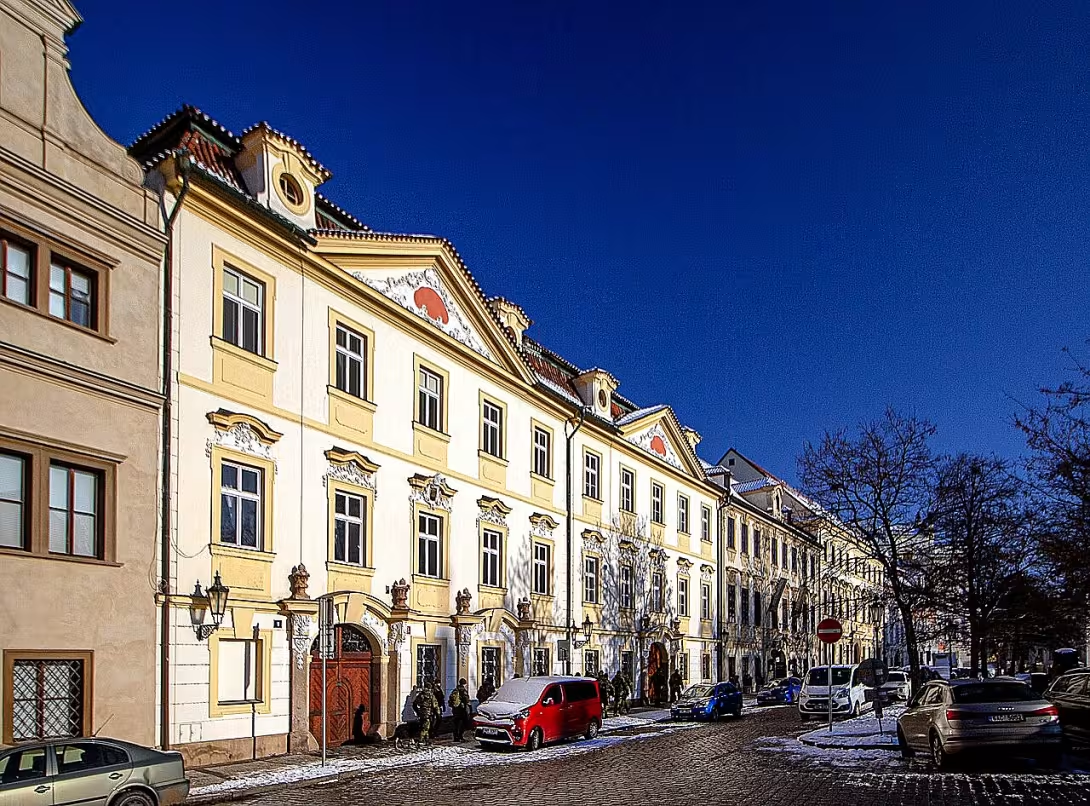
The Sasko-Lauenburský Palace, located on Hradčanské Square in Prague, is a notable historical monument. It comprises two originally Renaissance houses with a unified Baroque façade. These buildings, at addresses čp. 63/9 and čp. 62/10, are recognized as cultural monuments due to their rich history and architectural significance. The site retains only Gothic vaulted cellars from its medieval structures, highlighting the layers of historical transformation it has undergone.
The origins of these palaces trace back to a time when Bohemia was an important cultural hub within the Holy Roman Empire during the Renaissance period. Initially constructed as separate medieval buildings with Gothic vaulted cellars, they were linked after 1552. The left building (čp. 63/9), known by various names such as Rožmberský dům and Kolovratský palác, was rebuilt in Renaissance style by the Rožmberks following a fire in 1451. By the late 16th century, it came under the ownership of the Kolovrat family, who added rich sgraffito decoration to its façade. The right building (čp. 62/10), also known as Kapitulní archiv, was originally Gothic and served as a residence for the renowned architect Petr Parléř from 1372 until his death in 1399.
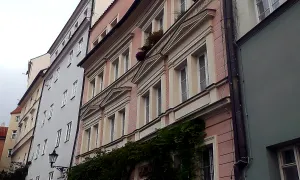
Architecturally, both buildings underwent significant changes over time. A major reconstruction between 1726–1727 unified their façades into a cohesive Baroque style, reflecting the influence of the Habsburgs who ruled the region during this period. This transformation was executed by Prague architect A. V. Spannbrucker in 1737, further enhancing the palaces' aesthetic and historical value.
Ownership of these buildings has seen dramatic shifts throughout history. In 1623, Julius Jindřich Sasko-Lauenburský acquired the property through marriage with Anna Marie Magdalena of Lobkowicz. Later, in 1717, the Prague Metropolitan Chapter purchased the buildings, and they underwent further modifications under Spannbrucker's direction in 1737. The palaces served as residences for the chapter and its canons until their restitution to them in 1991.
Key events associated with these palaces include the significant reconstruction that unified their façades and Julius Jindřich Sasko-Lauenburský's acquisition through marriage, which marked a notable change in ownership. Additionally, Petr Parléř's residence in one of the buildings adds an intriguing layer to its historical narrative.
Today, the Sasko-Lauenburský Palace stands as a testament to Prague's rich architectural and cultural history. Visitors can explore this site, appreciating its blend of Renaissance and Baroque elements while reflecting on its storied past. The palace remains accessible to those interested in delving into the layers of history it embodies, making it a worthwhile destination for anyone keen to experience Prague's historical charm.
Then and now
Drag the slider to compare how the landmark may have looked when it was built with the view today.
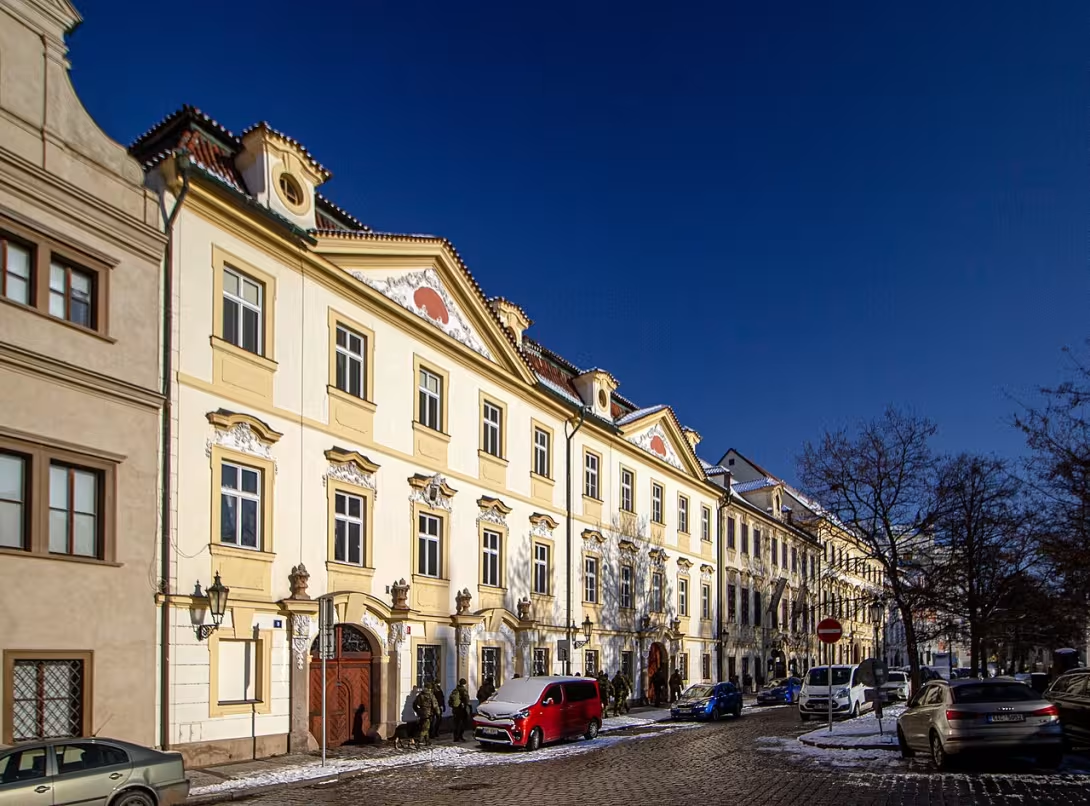

The historical appearance on the left is an AI-generated visualisation and serves as inspiration only.
Historical milestones
- 1451
- The Rožmberks rebuilt the left building in Renaissance style after a fire.
- 1372-1399
- Architect Petr Parléř lived in the right building.
- 1623
- Julius Jindřich Sasko-Lauenburský acquired the property through marriage.
- 1737
- The buildings were modified into Baroque style by A. V. Spannbrucker.
Architectural development
Originally medieval structures with Gothic vaulted cellars, both houses were linked after 1552. The left building was rebuilt in Renaissance style by the Rožmberks post-1451 fire, while the right building housed Petr Parléř in the late 14th century. By the late 16th century, the Kolovrats family owned the left building and added sgraffito decoration. A significant reconstruction between 1726–1727 unified their façades into a Baroque style.
Historical events
Reconstruction between 1726–1727 unified the façades of both buildings.
In 1623, Julius Jindřich Sasko-Lauenburský acquired the property through marriage.
The Prague Metropolitan Chapter purchased and modified the buildings in 1717 and 1737.
Owners
In the 14th century, the building on the left (čp. 63/9) belonged to the Rožmberks, who rebuilt it in Renaissance style after a fire in 1451. By the late 16th century, the Kolovrats family owned it and added rich sgraffito decoration. The right building (čp. 62/10), known as the Kapitulní archiv, was originally Gothic and housed architect Petr Parléř from 1372 to 1399. In 1623, Julius Jindřich Sasko-Lauenburský acquired it through marriage with Anna Marie Magdalena of Lobkowicz. The building was sold to the Prague Metropolitan Chapter in 1717 and underwent Baroque modifications by A. V.
Points of interest
- The Sasko-Lauenburský Palace's Gothic vaulted cellars are remnants of its medieval origins, offering a rare glimpse into the architectural layers that predate its Renaissance and Baroque transformations.
- Petr Parléř, a renowned architect known for his work on St. Vitus Cathedral in Prague Castle, lived in the Kapitulní archiv building from 1372 until his death in 1399, adding significant historical prestige to this location.
- The unification of the two originally separate Renaissance houses into one Baroque façade was a result of a major reconstruction between 1726–1727, reflecting the aesthetic preferences and political influence of the Habsburgs during their rule.
- In an intriguing twist of fate, Julius Jindřich Sasko-Lauenburský acquired the palace not through purchase or inheritance but by marrying Anna Marie Magdalena of Lobkowicz in 1623, marking a notable shift in ownership tied to personal alliances.
- The rich sgraffito decoration added to the left building's façade by the Kolovrat family in the late 16th century showcases an artistic technique that was popular during the Renaissance, highlighting the cultural and aesthetic values of its owners.
Guide
This guide is narrated by a synthetic voice generated by artificial intelligence.
Show guide text
This text was created by artificial intelligence and has not been editorially reviewed. It may contain inaccuracies.
The Saxe-Lauenburg Palace is the name for a pair of originally Renaissance houses on Hradčanské náměstí in Prague. The left house is sometimes called the Rožmberk House, while the right one is called the Chapter Archive. Both are protected as cultural monuments. On the exterior, they are connected by nearly identical façades, which they acquired during a Baroque renovation in the first half of the eighteenth century.
Structurally, both houses were connected after fifteen fifty-two. From the medieval buildings, only Gothic cellars with barrel vaults in the right part of today's plot remain. That area once adjoined the castle wall at the back. A two-story terraced house closes it off to the street today, with multi-story wings extending from it into the courtyard.
The left house, also called the Kolovrat Palace or Canons' House, belonged to the Rožmberks in the fourteenth century. After a fire in fourteen fifty-one, they had it rebuilt. At the end of the sixteenth century, the Kolovrats acquired it, and under them, rich sgraffito decoration was added, which is preserved in the courtyard.
The right house has Gothic foundations. From thirteen seventy-two until his death in thirteen ninety-nine, the builder Petr Parléř lived in it. Around fifteen ninety-six, both houses were rebuilt into a three-story Renaissance palace.
The palace owes its present name to Julius Henry of Saxe-Lauenburg. He acquired the house in sixteen twenty-three through marriage to Anna Maria Magdalena, born Lobkovic, widow of Zbyněk Novohradu of Kolovrat. In seventeen seventeen, the Prague metropolitan chapter purchased the house. Prague builder Spannbrucker then renovated both buildings in the Baroque style and unified their façades. The houses served the chapter and its canons. The Communists took them away, and in restitution in nineteen ninety-one they were returned to the chapter.
Tips for visitors
The best time to visit the Sasko-Lauenburský Palace is during late spring or early autumn when the weather is pleasant, allowing you to comfortably explore both the palace and its surroundings on Hradčanské Square. These seasons offer a balance of good light for photography and fewer crowds compared to peak tourist months, enhancing your experience as you admire the Baroque façade and Renaissance architecture.
The area is well-served by trams and buses that connect to various parts of the city. For those who prefer driving, it's advisable to park at a distance and walk or use local transport options to reach the square. Always check for current routes and schedules using a reliable transit app or website.
When visiting, consider bringing comfortable walking shoes as you'll likely explore more than just the palace itself. A camera is essential if you're interested in capturing the architectural details of the Baroque façade, which are best photographed during the golden hours—early morning or late afternoon when the light is soft and warm. Additionally, a map or guidebook can enhance your understanding of the site's historical context.
Nearby attractions within a 30-minute walk include Prague Castle and the Church of Our Lady before Týn. Both offer rich history and stunning architecture that complement your visit to the palace. For families with children, these sites provide educational opportunities and plenty of space for exploration. Consider planning a picnic in one of the nearby parks if you have time, as it can be a delightful way to relax after exploring.
Frequently asked questions
Can the monument be visited?
Some buildings of this kind are open for guided tours, others serve another purpose or are privately owned. We have not verified whether and when this monument is open – please ask the operator.
What are the opening hours and admission?
We have not verified the opening hours or admission. Current information is published by the operator.
Where is the monument?
Location: Praha, Hlavní město Praha. The map on this page shows the exact spot.
Businesses nearby
Do you run a restaurant, accommodation, shop, museum, rental, wellness or other visitor service near this monument? Show yourself directly to the people heading to it — this is how they will see you in the app and on the web:
Events nearby

Zdroj akcí: otevřená data měst a obcí ČR (Národní katalog otevřených dat) a kalendář akcí Národního památkového ústavu.
Nearby
The palace is situated on Hradčanské Square in Prague, near other historical sites such as Prague Castle and the Church of Our Lady before Týn.
Accommodation nearby
Trips and activities nearby
Guided tours, tickets and activities nearby from GetYourGuide
Affiliate link: if you buy from the partner, we may receive a commission. The price for you does not change.
Search tours and activities →Themed route
Tematická výletní trasa: Historické památky Prahy
1. Sasko-Lauenburský palác - Typ: Palác - Proč stojí za návštěvu: Sasko-Lauenburský palác je klíčovou historickou památkou na Hradčanském náměstí, známý svou architekturou a bohatou historií. Sloužil jako rezidence českých králů a poskytuje pohled do minulosti říše.
2. Prague Castle - Typ: Hrad - Proč stojí za návštěvu: Nacházející se nedaleko Sasko-Lauenburského paláce, je to největší hradový komplex v Evropě. Je známý svou historií a architekturou, která sahá od románských do gotických stylů, což ho činí fascinujícím pro každého zájemce o historii.
3. Church of Our Lady before Týn - Typ: Kostel - Proč stojí za návštěvu: Tento gotický kostel je jedním z nejznámějších a nejvýraznějších kostelů v Praze. Jeho dvojité věže jsou ikonické pro městský horizont, nabízející pohledy na celou Prahu.
Tato trasa umožňuje návštěvníkům prozkoumat historické památky v centru Prahy a ocenit jejich architektonický a kulturní význam.
Seasonal recommendations
Spring: Visiting the Saxe-Lauenburg Palace during spring offers a unique experience as nature begins to awaken around its historic architecture. The blooming gardens and fresh greenery create a picturesque setting, enhanced by softer natural light that beautifully illuminates the palace's intricate details. This is an ideal time for photography enthusiasts who wish to capture the harmonious blend of man-made elegance and natural beauty. However, spring can also bring unpredictable weather, so visitors are advised to dress in layers and carry an umbrella or raincoat. The gardens may attract a moderate number of tourists eager to enjoy the blossoming flora, making it wise to arrive early to avoid larger crowds.
Summer: Summer at the Saxe-Lauenburg Palace is marked by long daylight hours that provide ample time for exploration and leisurely strolls through its expansive grounds. The warm weather invites visitors to relax in the palace gardens or nearby parks, enjoying picnics under the sun. However, this season also sees a higher influx of tourists, particularly during peak holiday periods. To enhance your experience, consider visiting early in the morning or later in the afternoon when the crowds are thinner and temperatures more bearable. Light, breathable clothing is recommended to stay comfortable throughout your visit.
Autumn: Autumn transforms the Saxe-Lauenburg Palace into a serene retreat with its vibrant foliage casting warm hues across the landscape. The cooler weather provides a pleasant atmosphere for walking tours of the palace grounds, while the soft autumn light adds a romantic touch to the historic architecture. This season typically sees fewer visitors compared to summer, allowing for a more relaxed and intimate experience. Visitors should dress warmly in layers to accommodate the crisp air and bring along a jacket or scarf as temperatures can drop, especially later in the day.
Winter: Winter at the Saxe-Lauenburg Palace offers a magical atmosphere with its historic structures often adorned by snow, creating a fairy-tale-like setting. The shorter days mean that visiting earlier is advisable to make the most of daylight hours for exploring both the interior and exterior spaces. Warm clothing is essential, including coats, hats, gloves, and sturdy boots, as temperatures can be quite chilly during this season.
Visualizations and artistic views


The visualisations are generated by artificial intelligence and serve as inspiration.
Photos from the area
Real photos taken near the monument


Zdroj a licence jsou uvedeny u každého snímku.
Tips from visitors
No tips yet. Be the first!
Log in and add your tip.
Sources and literature
Photos: VitVit / CC BY-SA 4.0 — Wikimedia Commons. The author and licence also appear when you hover over the image.
Faktickým podkladem tohoto textu byl článek na Wikipedii, jehož autory jsou přispěvatelé Wikipedie. Článek je dostupný pod licencí CC BY-SA 4.0.
Location on the map
Příběhy a pověsti
Legendy, pověsti a příběhy spjaté s touto památkou
Fotografie návštěvníků
Zatím žádné fotografie. Buďte první, kdo přidá fotografii z návštěvy!
Log in a přidejte svou fotografii nebo hodnoťte.
Za ověřenou návštěvu v aplikaci získáte víc bodů — poznáme podle GPS, že jste na místě.
Reviews and comments