



sbor Dr. Karla Farského (Vysoké nad Jizerou) Church
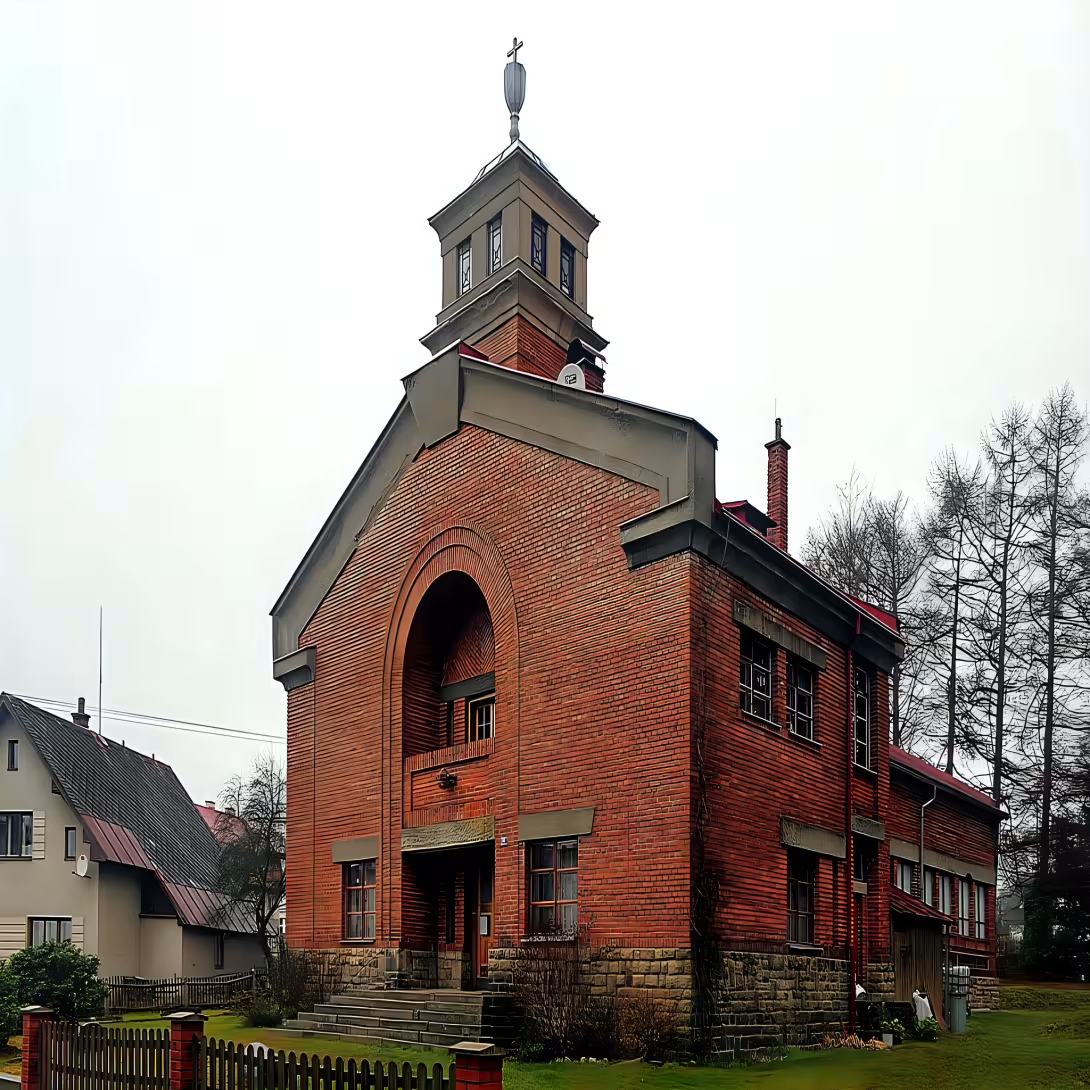
The Dr. Karla Farského Church, located in Vysoké nad Jizerou, Czech Republic, is a remarkable functionalist-style monument with a rich history and architectural significance. Established in 1921, it showcases a unique blend of modern and traditional elements.
The church's origin dates back to the early 20th century when local residents sought a separate religious community. Led by Josef Metelka and František Holec, they aimed to establish an independent congregation. However, ThDr. Karel Farský advocated for caution, encouraging moderation. The church was formally established in 1921 with Oldřich Prajzler as its first president.
Construction began in 1924 under architect Tomáš Šašek's design. The project received financial support from the city council, state subsidies, and public donations. The groundbreaking ceremony took place on July 6, 1925, and the church was officially opened on November 22, 1925.
The Dr. Karla Farského Church is a striking example of functionalist architecture, featuring a distinctive tower with a bell and a single nave with a chancel. The interior boasts a wooden ceiling and classical elements. Its design was influenced by individualistic modernity and functionalism.
Throughout its history, the church has undergone changes. In 1931, the roof collapsed, leading to modifications that included adding a knave and expanding the chancel. In 1944, urns containing executed citizens' remains were placed in the church, but they were later removed and relocated to a nearby cemetery in 1966.
Today, the Dr. Karla Farského Church is an important cultural landmark and a testament to the region's rich history. Visitors can explore its unique architecture and learn about its significance through an on-site exhibition dedicated to ThDr. Karel Farský.
Then and now
Drag the slider to compare how the landmark may have looked when it was built with the view today.
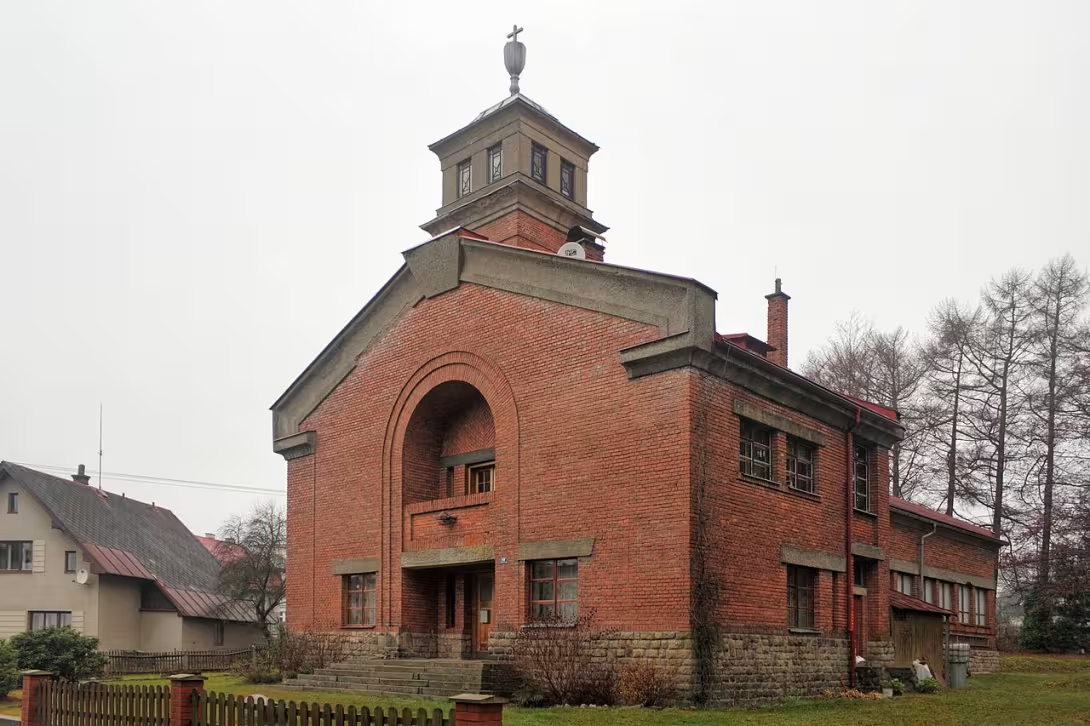

The historical appearance on the left is an AI-generated visualisation and serves as inspiration only.
Historical milestones
- 1921
- The church was formally established.
- 1924
- Construction began under architect Tomáš Šašek's design.
- 1925
- Groundbreaking ceremony took place on July 6 and the church was officially opened on November 22.
- 1931
- The roof collapsed, leading to modifications that included adding a knave and expanding the chancel.
- 1944
- Urn containing executed citizens' remains were placed in the church.
- 1966
- Urn containing executed citizens' remains were removed and relocated to a nearby cemetery.
Architectural development
The church was built using red bricks and features a distinctive tower with a bell. The interior includes a single nave with a chancel and a wooden ceiling.
Historical events
Formal establishment in 1921
Groundbreaking ceremony on July 6, 1925
Opening on November 22, 1925
Points of interest
– The church's unique architecture was influenced by individualistic modernity and functionalism, making it a striking example of functionalist design.
– In 1944, urns containing executed citizens' remains were placed in the church, but they were later removed and relocated to a nearby cemetery in 1966.
– The church has undergone changes throughout its history, including the addition of a knave and expansion of the chancel after the roof collapsed in 1931.
– The Dr. Karla Farského Church is an important cultural landmark and a testament to the region's rich history, with an on-site exhibition dedicated to ThDr. Karel Farský.
– Despite its modern design, the church features classical elements inside, including a wooden ceiling, making it a unique blend of old and new architectural styles.
Guide
This guide is narrated by a synthetic voice generated by artificial intelligence.
Show guide text
This text was created by artificial intelligence and has not been editorially reviewed. It may contain inaccuracies.
The Church of Karel Farský in Vysokém nad Jizerou belongs to the Czechoslovak Hussite Church. The religious community was formally established in 1921 and the church bears the name of the founder and first patriarch of this church.
The number of members of the Czechoslovak Hussite Church was growing in Vysocko and local people wanted to have their own religious community. Karel Farský, however, advised restraint. Nevertheless, he allowed the people of Horní Tříče to elect their own Council of Elders already at Christmas 1920. During his visit to Vysokém on April tenth, 1921, Farský began to arrange the establishment of an independent congregation. The Council of Elders for all of Vysocko was established on May fifth, 1921 and its chairman became the farmer Oldřich Prajzler. The state approved the community only in March 1924. Until then it operated as a branch of the community in Držkov.
The believers first met in an abandoned chapel near the Navarov château and outdoors, most often in the municipal gardens or on the square. The city then lent them the town hall hall free of charge. However, due to the poor floor they had to close it soon. In 1924, architect Jaroslav Kabeš won the competition for the church design. Due to disputes with church leadership he was ultimately rejected and the plan was drawn up by Prague builder and architect Tomáš Šašek. The money came from the city, state subsidies, public collections and a loan from the local savings bank. Karel Kramář also contributed.
The foundation stone was laid on July sixth, 1925 and the church was opened on November twenty-second of the same year, so in less than five months. Bishop Gustav Adolf Procházka accepted an invitation to the ceremony. The bell was donated at Farský's request by the Ministry of Education. After Farský's death in 1927 the congregation took his name.
The rapid construction apparently took its toll. In 1931 the roof collapsed. During repairs the roofing was changed and the hall was extended with a chancel. This was suggested by a high school student at the time and future architect Antonín Vodseďálek. From 1944 urns of executed fellow citizens were stored there. Due to the poor condition of the floor they were moved to the cemetery in 1966. Since 2000 the church has hosted an exhibition about the life of Karel Farský.
The building shows signs of individualistic modernism and tends toward functionalism. It is a single-nave structure made of unplastered red bricks on a stone foundation. It is dominated by a tower topped with a chalice. Inside is the nave with a gallery and a triumphal arch, which separates the chancel. The wooden-clad ceiling is supported by pillars.
Tips for visitors
Best Time to Visit: The Dr. Karla Farského Church is open year-round, making it a great spot to visit regardless of the season. However, if you prefer milder weather, spring and autumn are ideal times to explore the church's unique architecture and surroundings. What to Bring: Wear comfortable shoes for exploring the surrounding area, and consider bringing a camera to capture the church's modern design. Don't forget to bring sunscreen and a hat if you plan to spend time outdoors. Photography: The best spots for photography are around the church's exterior, where you can capture its unique blend of modern and traditional elements. Natural light is ideal during morning or late afternoon hours. What to See Nearby: Within a 30-minute radius, visitors can explore the charming town of Vysoké nad Jizerou, which offers a range of shops, restaurants, and cultural attractions.
Frequently asked questions
Can the monument be visited?
Religious buildings are usually open mainly during services; at other times a visit is normally arranged with the parish or the operator. We have not verified specific times.
Where is the monument?
Location: Dr. Karla Farského 303, Vysoké nad Jizerou, Liberecký kraj. The map on this page shows the exact spot.
Why is the monument protected?
It is listed in the Central List of Cultural Monuments of the Czech Republic as a cultural monument (register no. 107164).
Businesses nearby
Do you run a restaurant, accommodation, shop, museum, rental, wellness or other visitor service near this monument? Show yourself directly to the people heading to it — this is how they will see you in the app and on the web:
Accommodation nearby
Trips and activities nearby
Guided tours, tickets and activities nearby from GetYourGuide
Affiliate link: if you buy from the partner, we may receive a commission. The price for you does not change.
Search tours and activities →Themed route
Tematical Tour Route: Discovering the Sbor Dr. Karla Farského and its surroundings
Stop 1: Vysoké nad Jizerou Town Square Start your journey in the charming town square of Vysoké nad Jizerou, where you can admire the beautiful Baroque architecture and get a feel for the local culture.
Stop 2: Sbor Dr. Karla Farského (Vysoké nad Jizerou) Visit the stunning Sbor Dr. Karla Farského, a unique wooden church built in the early 20th century. Admire its intricate architecture and learn about its history.
Stop 3: Žďár Forest Take a short walk to the nearby Žďár Forest, where you can enjoy a leisurely stroll through the picturesque woods and take in the serene atmosphere.
This thematic route takes you on a journey through the charming town of Vysoké nad Jizerou and its surroundings, showcasing the unique Sbor Dr. Karla Farského and the beautiful Žďár Forest.
Seasonal recommendations
Here is the seasonal recommendation for visiting the Dr. Karel Farský church in Vysoké nad Jizerou:
As you approach the church, you'll notice the vibrant greenery surrounding it, with blooming flowers and fresh leaves on the trees. The atmosphere is filled with the sweet scent of spring. The sunlight casts a warm glow over the historic building, making it an ideal time for photography. To avoid large crowds, consider visiting during weekdays or early mornings. Wear comfortable shoes and layers for changing weather conditions.
(Summer)
The summer season brings warmth and long days to Vysoké nad Jizerou. Be prepared for larger crowds and plan your visit accordingly. Arrive early to beat the heat and take advantage of the morning light. The surrounding nature is lush and green, making it a perfect spot for picnics or relaxation. Don't forget to bring sunscreen, hats, and comfortable clothing.
(Autumn)
As autumn arrives, the church is surrounded by a kaleidoscope of colors – golden leaves, crimson reds, and burnt oranges. The air is crisp and cool, making it an excellent time for a leisurely stroll around the area. Consider visiting during weekdays to avoid peak tourist season. Wear layers for changing weather conditions and comfortable shoes for exploring.
(Winter)
The winter season brings a serene atmosphere to Vysoké nad Jizerou. The church's architecture takes on a mystical quality under the soft, white snow. Dress warmly in layers, including gloves and hats. Consider visiting during weekdays or early mornings to avoid crowds.
Visualizations and artistic views


The visualisations are generated by artificial intelligence and serve as inspiration.
Photos from the area
Real photos taken near the monument


Zdroj a licence jsou uvedeny u každého snímku.
Tips from visitors
No tips yet. Be the first!
Log in and add your tip.
Sources and literature
Photos: Miloslav Rejha / CC BY-SA 4.0, rozlišení zvýšeno umělou inteligencí — Wikimedia Commons. The author and licence also appear when you hover over the image.
Faktickým podkladem tohoto textu byl článek na Wikipedii, jehož autory jsou přispěvatelé Wikipedie. Článek je dostupný pod licencí CC BY-SA 4.0.
Location on the map
More monuments – Vysoké nad Jizerou
Show all in the municipality
Fotografie návštěvníků
Zatím žádné fotografie. Buďte první, kdo přidá fotografii z návštěvy!
Log in a přidejte svou fotografii nebo hodnoťte.
Za ověřenou návštěvu v aplikaci získáte víc bodů — poznáme podle GPS, že jste na místě.
Reviews and comments