



Seberův mlýn Water mill
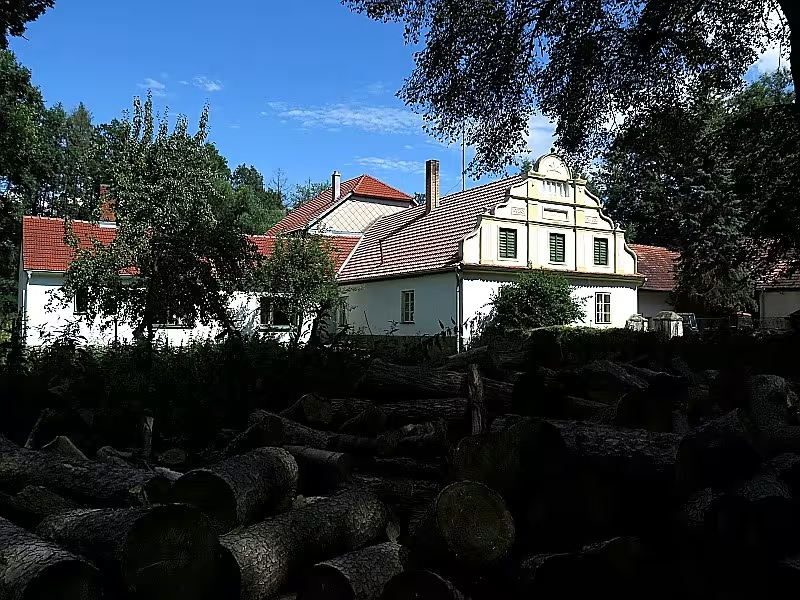
Seberův mlýn in Nišovice in Strakonice district is a water mill on the Volyňka river, protected as a real-estate cultural monument of the Czech Republic. The area includes mill drive, 1856 housing and a complex of farm buildings. The monument is important with its preserved artistic composition and technical details of water management.
The existence of the mill is already documented in the I. Military Survey. The present residential building was built in the middle of the 19th century, at the time of modernization of the Czech countryside, when stone buildings replaced wooden structures. The mills were key technological nodes of local communities at the time.
The area consists of a residential building from 1856 with the inscription "WOGTÍCH - FLIGHT PAN 1856 - MILOTA" on the facade. A storey mill is connected to the house, to which a bakery is attached from the north. The complex also includes granary and farm buildings. In front of the west facade lies a wall surrounded by a front garden with a main gate. On the south side of the yard there is a barn and a shed, while on the east side there are stables. Between the stables and the mill, the gate leads to the drive and the fridge.
The east side of the mill is surrounded by a drive from the Volynka River, which flows along the west side of the complex. On the drive there is a torso fridge. The water led to the water wheel of the drive, and the drain channel went back into the river. In 1930 the mill was equipped with one wheel on the bottom water with an output of 8,3 HP, a drop of 2,1 m and a flow of 0,591 m ³ / s.
After 1919, a bakery and a shed with piglets were built on the premises. In 1930 he owned the František Sebera building. An interesting detail is the stone steeple of the cladiv climb placed at the entrance to the complex.
Seberův mlýn is an important witness to the rural mill and technical development of the region. The whole area, including the drive, is protected by cultural heritage status. Visiting this place offers insight into the architecture and operation of the historic water mill.
Historical milestones
- 1856
- construction of residential housing
- 1919
- construction of bakery and shed with pigsty
- 1930
- ownership of František Sebera
Architectural development
The mill is already documented in the I. Military Survey. In 1856 a residential building was built, followed by a storey mill with a fridge torsion. After 1919, a bakery and a shed were added to the house and the mill.
Historical events
1856: construction of a residential building; after 1919: construction of bakery and shed with pigsty
Owners
František Sebera (1930)
Points of interest
- The building from 1856 has on the facade "WOGTÍCH - FLIGHT PAN 1856 - MILOTA." - In 1930 the mill was equipped with a water supply with an output of 8.3 HP. - At the entrance to the complex there is a stone steeple of hammer steps. - The existence of the mill is documented in the first military mapping. - There's a torso fridge on the drive.
Guide
Show guide text
This text was created by artificial intelligence and has not been editorially reviewed. It may contain inaccuracies.
Welcome to the Sovereign Mill. Right now, you're standing in a place where history meets the constant movement of nourishing water. In front of your eyes is a complex complex that is not just a set of buildings, but a living witness to the past way of life. Feel this atmosphere that is woven through the noise of the Volynka River and the sense of stability these old walls carry. This whole complex, which you are now observing, is now protected as a real-estate cultural monument of the Czech Republic, which tells us that what you see matters not only to the local population, but to our entire country.
Let us now look together at how this place was created and how deep its roots are embedded in time. The existence of this mill is not just a modern finding; His presence was documented in the very first military maps that were created for our country. This means that a long time ago this mill was an important point in the landscape, an indicative sign for travelers and locals. If you now focus on the very core of the complex, you will see a residential building which dates back to 1856. But this is just the beginning of the long history of this place. The area has grown gradually over the years and adapted to the needs of the people who lived and worked here. After 1919, there was a significant expansion when the bakery and other economic buildings, including the knees and piglets, were added to the whole. In this way the mill became not only a place of flour production, but also a centre of everyday livelihood and agricultural life. Another important love in the history of this place is 1930, when the mill became the property of František Sebera, whose name is inextricably linked to this place.
Now pay attention to the architecture and details you have right in front of you. The whole complex has preserved its original artistic composition, which is extremely rare these days. Note how individual parts - mill drive, residential part, mill and economic buildings - are interconnected into one harmonious unit. If you look at the facade of the 1856 residential building, you can see something quite extraordinary. There's an inscription on his surface that works as a time capsule. Read it in spirit: WOGTECH - FLIGHT OF THE LORD 1856 - MILOTA. These words remind us that every wall here has its name and year of birth. They're traces of people building their homes and their future here.
Let us now move on to another interesting detail that you can see at the entrance to the premises. There is a stone object in the middle of the road, which at first sight can act as a simple stone, but in fact it is a stalk of piping. This stone element is a silent witness to the old craft techniques and mechanical processes that once took place here. It's a reminder of when everything was made with the effort of hands and the power of machines driven by nature.
If you're wondering what force was needed to operate this whole thing, we need to look at the water itself. In 1930 the mill was equipped with modern, both at the time, around the bottom water. This mechanism had the power of eight whole three horsepower. Imagine the incredible power flowing through the Volyňka River, which was transformed into work, machine movement and flour, which then traveled into bakeries and then into tables of people all around. The mill drive you see is the key element that brings this water to the mill and ensures the constant movement of life in this area.
Seberův mlýn is a place where history does not only happen in books, but in every stone, in every sign on the facade and in every noise of water in the drive. It's a place that encourages you to slowly observe and see the connections between man and nature. I hope this brief insight into his past has helped you better understand the importance of this place. Please continue the tour, go through the premises, feel the calm and let the atmosphere of this historical unit drift. We thank you for your visit and wish you a pleasant further time in the vicinity of the Sovera Mill.
Tips for visitors
The best time to visit is the spring flowering season or the autumn coloured season, when the surrounding nature is most in tune with the atmosphere of the historic mill. For photography we recommend morning hours when light falls on the water surface and drive at a natural angle, which will highlight the texture of old wooden and stone structures.
The location is also available through public transport; Please check the current connections and timetables in the traffic controller.
For comfortable exploration we recommend to wear comfortable shoes suitable for uneven terrain by water. Families with children can appreciate the closeness of the flow, which offers interesting natural observations, but it is necessary to keep children under constant supervision for water safety.
The best places for pictures are near the mill drive, where you can see the movement of water and historical buildings throughout the conlude. As part of a short walk you can enjoy the nature of the Volynka River, which is a key element of the whole area.
Frequently asked questions
Can the monument be visited?
This is a technical monument. Some are open as exhibitions, others are out of use or on private land. We have not verified whether this one is accessible.
What are the opening hours and admission?
We have not verified the opening hours or admission. Current information is published by the operator.
Where is the monument?
Location: Jihočeský kraj. The map on this page shows the exact spot.
Why is the monument protected?
It is listed in the Central List of Cultural Monuments of the Czech Republic as a cultural monument (register no. 1000131056).
Businesses nearby
Do you run a restaurant, accommodation, shop, museum, rental, wellness or other visitor service near this monument? Show yourself directly to the people heading to it — this is how they will see you in the app and on the web:
Events nearby
Zdroj akcí: otevřená data měst a obcí ČR (Národní katalog otevřených dat) a kalendář akcí Národního památkového ústavu.
Nearby
Volyňka River
Accommodation nearby
Themed route
Seberův mlýn - exterior - historical mill. A perfectly preserved stone building with an original water wheel that provides a unique view of traditional agricultural architecture.
Seberův mlýn - internal exposition - museum exhibition. In the interior are exhibited original mill machines and historical documents that bring everyday life and technology to the past century. (distance from exterior about 200 m)
River Volyňka - shores - natural path. Along the river there is an undemanding route overlooking the water flow, where local flora and fauna can be observed and enjoy the calm atmosphere of the river. (distance from mill about 300 m)
Seasonal recommendations
Spring brings to the surroundings of the Sovereign Mill the awakening of nature, when the surrounding meadows and trees come to life fresh greenery and flowers. The light at this time is soft and scattered, which creates a calm atmosphere ideal for walking and observing the details of the historical building. Practically, the spring season is often less crowded than summer, allowing visitors to experience a place in private. Clothes should be laminated, because temperatures can change rapidly from cold mornings to warmer afternoons. The best time to visit is the late spring, when the weather is already stable and the landscape is fully blooming, while the morning hours offer the most peaceful experience without large groups of tourists.
Summer offers the longest days and brightest lighting that reveals every line and texture of the mill. Nature is in full bloom, surrounding vegetation is dense and green, which gives the whole environment a lively and energetic atmosphere. However, it must be assumed that this is the main season when the traffic is highest and the crowds can be significant. For a comfortable experience it is crucial to come as early as possible in the morning, ideally before nine o'clock, or on the contrary late in the afternoon when the crowd pressures are released. Clothes should be light, breathable and suitable for higher temperatures, sun protection such as a hat or sunglasses is also necessary.
Autumn brings a rich variety of colours to the landscape around the mill, from gold to dark red, creating a wonderful contrast with the stone structure of the monument. Light becomes warmer and lower, which underlines the historical nature and gives the place a romantic and thoughtful character. The atmosphere is calmer and colder, ideal for slow walks and photography. Practical advice includes wearing layered clothes with wind jacket because the wounds and evenings are already cold and may rain. The visit in autumn is less demanding for the time window, as the crowds become significantly thinner, allowing longer stay in place without feeling crowded.
Winter brings a quiet and often snow blanket to the surroundings of the Suri Mill, which turns the landscape into a quiet, white scenery. The lighting is short and gray, creating a dramatic and slightly melancholic atmosphere, different from other seasons. The clothing must be heat-insulated, with emphasis on dry shoes and gloves so that it can be maintained outside even at low temperatures. The most suitable is a visit in the afternoon when there is still plenty of light and temperatures are highest, while winter tranquility allows a unique experience of history.
Visualizations and artistic views


The visualisations are generated by artificial intelligence and serve as inspiration.
Tips from visitors
No tips yet. Be the first!
Log in and add your tip.
Sources and literature
Photos: Sovicka169 / CC BY-SA 4.0 — Wikimedia Commons. The author and licence also appear when you hover over the image.
Faktickým podkladem tohoto textu byl článek na Wikipedii, jehož autory jsou přispěvatelé Wikipedie. Článek je dostupný pod licencí CC BY-SA 4.0.
Location on the map




Příběhy a pověsti
Legendy, pověsti a příběhy spjaté s touto památkou

Fotografie návštěvníků
Zatím žádné fotografie. Buďte první, kdo přidá fotografii z návštěvy!
Log in a přidejte svou fotografii nebo hodnoťte.
Za ověřenou návštěvu v aplikaci získáte víc bodů — poznáme podle GPS, že jste na místě.
Reviews and comments