






Sloup Nejsvětější Trojice v Dubé Holy trinity column
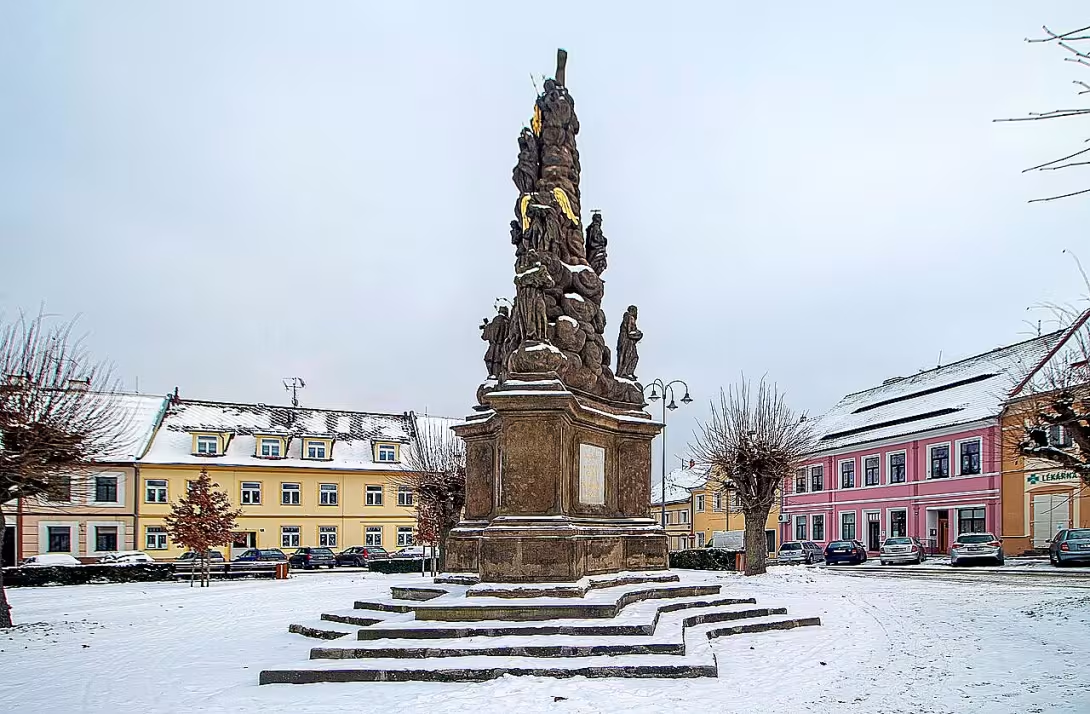
Sloup Nejsvětější Trojice v Dubé is a Baroque building decorated with statues of saints. Located in the middle of Masaryk Square in Dubá. This dominance is listed in the Central List of Real-Estate Cultural Monuments of the Czech Republic and is part of the urban monument zone in the Protected Landscape Region of Kokořín - Máchov Region. The work is remarkable with its historical and artistic value and represents an important part of the local heritage.
The creation of the column is closely linked to the history of the New Berstejn estate and the town Dubá. In 1723, Count František Karel Rudolf Swéerts-Sporck bought the estate, which he took over from the Butler family. This period was often catastrophic for Dubá; The city suffered several major fires and the population was decimated by plague epidemics. In 1726, Countess Anna Kateřina, daughter of Count František Antonín Špork and wife of Franz Karl Rudolf Swéerts- Sporck, had built the column of the Holy Trinity with the Virgin Mary and other saints. The work was probably from the hand of the lithomeric sculptor František Tollinger, which underlines his artistic importance.
The building is made of sandstone and performed in Baroque style. The base has the shape of a polygon with covered corners. It has modern marble plates with Latin and German inscriptions. These replaced the original texts and emphasize the historical context of the work set up by Countess Kateřina Swéerts-Sport in 1726. Above the base is a pillar surrounded by statues of saints and angels, while on top is the group of the Holy Trinity. The column adorns the statues of St. Joseph with Jesus, the archangel Raphael with the boy Tobiya, Saint Judy Tadeaš and three other characters - John Nepomuk, Antonín of Paduan and Ivan. Originally there were also statues of St. Catherine, St. Wenceslas and St. Florian.
The history of the column is associated with several important events. The fires in 1692 and 1711 destroyed many parts of the city, including the original privileges and old chronicles. The monuments have been repaired several times. Bigger reconstruction took place at the turn of the 19th and 20th centuries, namely in 1882 and 1909. At the end of the 20th century, the surface layer of the statues was damaged by erosion, resulting in a total restaurant in 1994. Further corrections followed in 2004 and 2018. In May 2019, the construction office in České Lípa approved the city of Dubé for a new layout of the area around the column, which emphasizes the emphasis on the emphasis of free space.
Today Column The Holy Trinity stands as an important cultural monument in the centre of Dubé. Its historical and artistic value attracts visitors who can enjoy the work itself and the beautiful surroundings in the Protected Landscape Region of Kokořín - Mách Region. The monument is accessible to everyone. Her visit offers a view of rich history and Baroque art in Bohemia. It is an opportunity to appreciate the architectural talent of past generations and to understand more deeply the region's culture.
Sloup Nejsvětější Trojice v Dubé is therefore more than an artistic object; It's a testament to the rich history of the city and its inhabitants. His presence at Masaryk Square remains an important element of public space, which reminds of past events and celebrates the cultural heritage of Dubé. Visiting this place is the way to history and the way to appreciate the beauty of the monuments that make up our collective past.
Historical milestones
- 1726
- Position of the column of the Holy Trinity.
- 1994
- Total restaurant sights.
- 2018
- Bigger pole renewal.
Architectural development
The column was built from sandstone and probably comes from the workshop of sculptor František Tollinger. During the years it underwent several repairs, including restaurants in 1994, 2004 and 2018. In 2019, the intention to modify the space around the column was approved.
Historical events
- 1692
- A fire that destroyed many parts of the city.
- 1711
- Another fire that lost city privileges and old chronicles.
- 1882
- First bigger repair of the pole.
- 1909
- Second bigger repair of the column.
Owners
- 1723
- František Karel Rudolf Swéerts-Sporck
- 1726
- Anna Kateřina Swéerts-Sporcková
Points of interest
- Column of the Holy One The Trinity is listed in the Central List of Real Cultural Monuments of the Czech Republic. - It is part of the urban monument zone in the Protected Landscape Region of Kokořín - Mách region. - The creation of the column is closely linked to the history of the New Berstejn estate and the town Dubá, built in 1726 by Countess Anna Kateřina Swéerts- Sporck. - The work was from the hand of the lithomeric sculptor František Tollinger. - The monument was repaired several times, including reconstruction in 1882, 1909, restaurants in 1994 and other repairs in 2004 and 2018.
Guide
Show guide text
This text was created by artificial intelligence and has not been editorially reviewed. It may contain inaccuracies.
Welcome to Dubé, a place where history is bound to nature and where every stone tells its own story. Right now, you're standing in the heart of the city, on Masaryk Square, and one of the most important local monuments stands before you. Look ahead. The dominance of this space is the Column of the Holy Trinity. It is a monumental baroque work, which, by its height, hangs over the surroundings and immediately attracts the attention of anyone who enters the city centre. Feel its nobility and how naturally it fits into the atmosphere of the square. It's a place that stops time and encourages us to think about how people saw the world centuries ago.
Let us now go back many years together, namely seven hundred twenty-six years. It was this year that the column was set up. To understand why he's standing here, we need to look at the time. The Baroque was not only a period of architecture, but above all a period of strong emotions, deep faith and desire for representation. The column wasn't built randomly. His creation was worthy of a significant figure of the time, Countess Anna Kateřina Swéerts-Sporcková. For her and her surroundings, this pillar was not only an ornament to the square, but above all a profound expression of the faith and a symbol of the culture that she wanted to bring to the region. At that time, such buildings served as a public belief of religious beliefs and as a token of gratitude or a request for protection for the whole town and its inhabitants.
Now pay attention to the very form of the monument. Look up and feel her vertical line heading towards the sky. The column is performed in baroque style, which you can tell by its dynamics and plastic design. Note the statues of the saints who accompany the main body of the pillar. These characters are not only here for beauty, but they have their spiritual meaning and are meant to commemorate the virtues and protection that saints bring to the people. The whole project, as you see it, came from the mind of an architect named František Tollinger. He was the one who was able to combine the religious symbol with the aesthetic value so that the column was harmonious and dominant. Look at the details of the work and see how the light breaks on the surface of the monument. It's fascinating to think that the same shapes and lines were observed by humans three years ago.
When we think about this place, we can't forget the people who were closely connected to it. In addition to the already mentioned Countess Anna Catherine, František Karel Rudolf Swéerts-Sporck plays a crucial role in the history of the estate. At that time, the Sporck family was seen as a bearer of European culture, education and influence. Their activities in and around Dubé have left deep traces. The creation of this pillar is very closely linked to the history of the New Berstejn estate and the very town of Dubá. Imagine then the relations between the nobles and the inhabitants, the influence of the monarchs on the city's appearance and the effort to turn the local space into a place that emits meaning and stability. The column thus serves as a silent witness to power, faith and social order of the old times.
Perhaps you're wondering how the monument has remained in such a state for so many centuries. The answer lies in the care and respect that generations of people have held for it. The column does not exist in isolation, but it is part of a wider context. It is listed in the Central List of Real-Estate Cultural Monuments of the Czech Republic, which means it is recognised as an invaluable piece of our national heritage. In addition, it is located within the urban monument zone Dubá, which is part of the wonderful Protected Landscape Area of Kokořín and Mách Region. This combination of historical architecture and untouched nature creates a unique environment that is highly appreciated in our region.
To make the column look like you see it today, it had to go through some major repairs. In the year one thousand and nine hundred and ninety-four there was an overall restaurant that breathed new life into the memory and stopped the gradual decomposition of the material. But the care wasn't over. Even recently, in the year two thousand and eighteen, a larger recovery took place. Thanks to these interventions, we can say with certainty today that the Baroque beauty of the column remains for future generations. It's a reminder that history isn't just about what happened, it's about how we take care of these tracks in the present.
Stop for a moment and try to imagine the sounds and smells of this square in the year seven hundred twenty-six hovering. The sound of horse hooves on the road, the calls of people in period clothes and the silence that brought prayer to this pillar. There is something mysterious about the fact that this stone survived wars, changes in regimes and stormy weather, and yet still stands as a fixed point in space. It's a symbol of endurance and a link between the ancient past and our present day.
Now that you have learned more about the origin, the creators and the importance of this baroque jewel, I suggest you go around it again from different sides. Notice how the view of the statues of saints changes depending on the position of the sun. Feel how the column organizes the space of the entire Masaryk Square and how it creates a center around which life in Dubé has revolved for hundreds of years.
But your journey through Duba does not end here. Around you are still many places waiting to be discovered. I invite you to continue to explore this beautiful city, to perceive the atmosphere of the monument zone, and to be inspired by the region of Kokorín and Máchov, which surrounds this place. I hope this short trip to history has helped you to understand more what you are seeing right now, and that you are leaving with a sense of admiration for the work and faith that this pillar created centuries ago.
Thank you for your attention and I wish you a pleasant further journey along the corners of our beautiful region. Enjoy your time in Dubé and let her stories catch you. Goodbye.
Tips for visitors
For the best experience we recommend a visit on clear days, ideally during morning hours or late afternoon. In these times, the light is ideal for capturing the details of Baroque statues and highlighting their shape. For photography it is best to stay in Masaryk Square, from where the column is well visible throughout its scale without the need to search for complex angles.
Transport to Dubé is possible by car and public transport; Please check the current connection in the traffic controller. Parking near the square is possible, but it is advisable to count on limited capacity during busier periods.
When visiting, take drinking water and change for possible shopping around. For families with children, the area around the monument is suitable for a short rest and observation of statues, which can be for the smallest interesting part of the city's walk.
The Protected Landscape Region of Kokořín - Máchov Region is located in the area, which is famous for its natural beauty and other historical monuments. We recommend to devote time to exploring this area, located near the city.
Businesses nearby
Do you run a restaurant, accommodation, shop, museum, rental, wellness or other visitor service near this monument? Show yourself directly to the people heading to it — this is how they will see you in the app and on the web:
Nearby
Sloup se nachází v Chráněné krajinné oblasti Kokořínsko – Máchův kraj, což je region známý svou přírodní krásou a historickými památkami.
Accommodation nearby
Themed route
Thematic cruise route: Column of the Holy Trinity and its surroundings
1. Column of the Holy Trinity - Type: Historical landmark - Why is it worth visiting: This column is one of the most famous architectural works of the Baroque period in Bohemia. Its height of 35 meters and rich sculptures are attracted to many visitors who can do here about its history and artistic importance.
2. Protected Landscape Region Kokořín - Máchov Region - Type: Natural landmark - Why is it worth visiting: This area is famous for its beautiful forests, the valley of the river Ohře and the historic castle Kokořín. It is ideal for spa walks and knowledge of the natural and cultural heritage of the region.
3. Bearing - Type: River - Why is it worth a visit: The fence is a key element of the region of Kořín, whose valley offers views of mountain regions and natural beauty. Walking along the banks of the river are ideal for relaxing and enjoying a quiet environment.
4. Castle Kokořín - Type: Historical landmark - Why is worth visiting: The castle is one of the most characteristic and iconic places in the region. Its history dates back to the Middle Ages, and today it attracts visitors with its architecture and view of the surrounding landscape.
5. The forests of Kokořín - Type: Natural space - Why is it worth visiting: Forests in this area are rich in different species of trees and animals. They are an ideal place for nature lovers who want to explore a wide ecosystem and enjoy quiet moments away from urban life.
This route offers a combination of historical and natural experiences that are ideal for a day trip to the region of Kokořín - Máchov region.
Seasonal recommendations
In spring, the pillar surrounds the fresh green and fine light highlights the details of the sculpture. The atmosphere is full of hope and the awakening of nature. We recommend to wear more layers of clothing because the weather is usually variable, and visit the place in the morning.
In the summer months the monument in the bright sun and surrounding trees provide a pleasant shade. It's time for the biggest visit, which is why it's best to come first thing in the morning to avoid the biggest groups of people. Don't forget light summer clothes and sun protection.
Autumn brings golden colors of leaves that form a beautiful contrast with the stone of the pillar. A misty wound gives the place a mysterious and peaceful touch. It is suitable for footwear with fixed soles due to wet surface and visit in the afternoon when the light is softest.
In winter, the column is very sober and majestic, especially if it is covered with snow. There is a deep peace and quiet here. It is necessary to wear very warm clothes and plan your journey so that you are in place before dark, as the days are short.
Visualizations and artistic views

The visualisations are generated by artificial intelligence and serve as inspiration.
Photos from the area
Real photos taken near the monument


Zdroj a licence jsou uvedeny u každého snímku.
Tips from visitors
No tips yet. Be the first!
Log in and add your tip.
Sources and literature
Photos: VitVit / CC BY-SA 4.0 — Wikimedia Commons. The author and licence also appear when you hover over the image.
Faktickým podkladem tohoto textu byl článek na Wikipedii, jehož autory jsou přispěvatelé Wikipedie. Článek je dostupný pod licencí CC BY-SA 4.0.
Location on the map

Příběhy a pověsti
Legendy, pověsti a příběhy spjaté s touto památkou

Fotografie návštěvníků
Zatím žádné fotografie. Buďte první, kdo přidá fotografii z návštěvy!
Log in a přidejte svou fotografii nebo hodnoťte.
Za ověřenou návštěvu v aplikaci získáte víc bodů — poznáme podle GPS, že jste na místě.
Reviews and comments