






stará škola v Dřevčicích School building
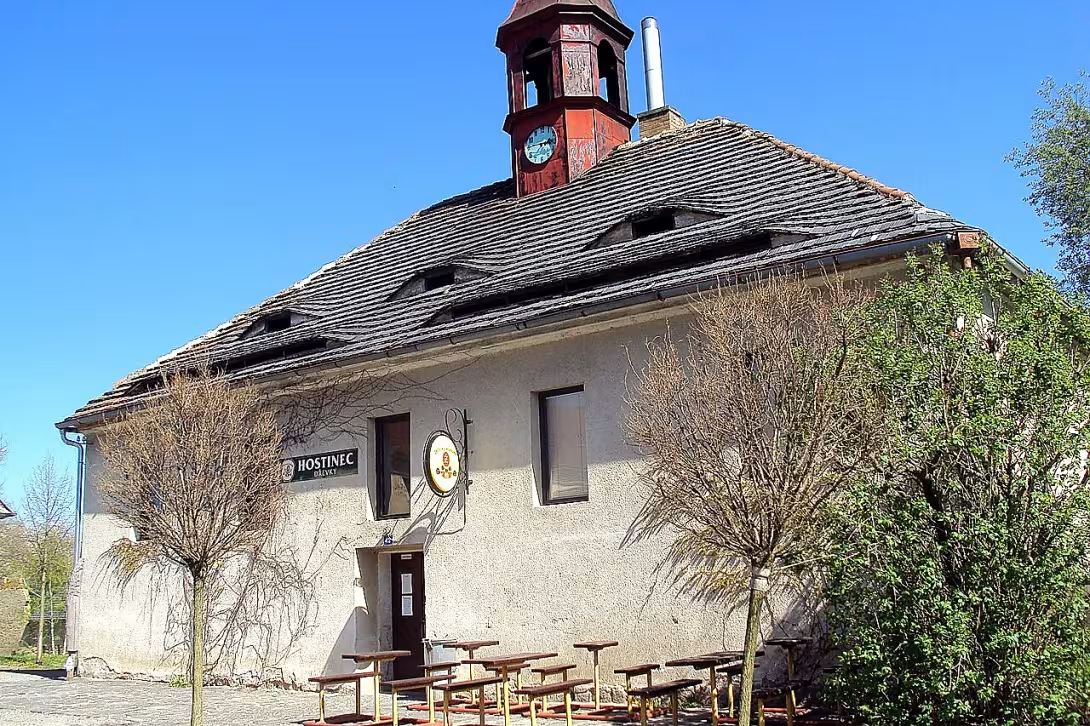
Old school in Woodchica is a cultural monument from 1848. The administration falls under the city Dubá in the district of Česká Lípa in the Liberec Region. The building is remarkable with its architecture with tower and clock; There's a local inn in it today. The building is located near the border of the Protected Landscape Region of Kokořín - Máchov Region and the European significant locations of the Rover Rock.
Villages Wood is recorded as a earthly residence from the second half of the 14th century (namely from 1363- 1373), when it is associated with the name Spolehrda of Woodchica. In the 19th century the village belonged to the Nehozámecký manor Kounice with administrative centre in Zahradky near České Lípa. In 1848 the village was hit by a large fire which destroyed 24 houses, i.e. more than a third of the village. It was this year that the administration of the estate in the centre of the village had a place called Hirtenberg (Shepherd's Hill) built a new school.
The monument with the descriptive number 42 is a brick object with elevated ground floor and partially embedded operating basement. The building is covered by a valb roof, which ends with a metal-plated bell sandtuce with lantern and clock. In the inside of the tower he survived the battleship, part of the original mechanical clock. The longitudinal facade consists of five window axes with a central entrance, while the rooms inside have flat ceilings.
In the 19th century, the building was owned by the Neoplámecký estate Kounice, currently owned by the city of Dubá. The school originally worked as a village unit for more than 70 children from Woodchia and nearby Camomile. Due to the growing number of pupils, a new school was later built on the opposite side of the road, which served until 1977. Since then, children have been commuting to Dubé.
The tower was repaired in 2020, which was in a state of emergency. In the works, a dial, an electronic clock machine and a bell from 1918 were removed. They found a 1921 box in a spherical poppy tree on the tip of the tower. It contained period tender and German-written documents. These included a list of the inhabitants of Woodchic according to the descriptive numbers, the price of basic food and the history of the village.
In the immediate vicinity of the school lies the memorable settlement no. 4. Its fenced wall Friedrich Bernau in the second half of the 19th century marked as the remains of the wooden fortress. The north side of the building is dominated by a protected maple-leaf platinum with a height of 16 metres and a strain perimeter of 335 centimetres. There is also a ruin of the poor castle and a restored section of the Old Goose Road. In 2017, its fruit tree alleys won the first place in the National Ale of the Year competition.
There's a local inn in the old school building tonight. The construction represents a unique combination of educational history and architecture in a naturally valuable environment. Visiting this place offers insight into the history of rural life and the landscape of northern Bohemia.
Historical milestones
- 1848
- Construction of a new school after a big fire Woodchic
- 1921
- Location of the box with historical records to the tower
- 20
- Repair of clock tower in emergency condition
Architectural development
The building was built in 1848 at the site after the fire. It has a walled-up character with a valb roof and a tower with a lantern plate. The tower was renovated in 2020.
Historical events
1848: Construction of the school after the great fire village; 2020: Repair clock tower.
Owners
New castle estate of Kounice (19th century), city Dubá (present)
Points of interest
- Old school in Woodchica is a cultural monument from 1848.
- The building has architecture with tower and clock; There's a local inn in it today.
- In 2020, the tower was repaired, during which the dial was removed, the electronic clock machine and the bell from 1918. On the job, they found a box of period tender and German documents.
- In the vicinity of the school there is a protected maple-leaf platinum 16 metres high and a strain of 335 centimeters.
- The restored section of the Old Goose Road, which won the first place in 2017 in the national competition Ale of the Year.
Guide
Show guide text
This text was created by artificial intelligence and has not been editorially reviewed. It may contain inaccuracies.
Welcome to Woodchica, a small corner of the Czech landscape, where history is written not only in books, but also in stones and bricks of local buildings. You are standing in front of just one of the most distinctive symbols of this village, a walled-up building that has lived through many over the last 200 years. Although there is a local inn in its premises today and you may feel the smell of fresh bread or hear the voices of the guests, your eyes should be open to the facade and roof construction. Look at this building wholeheartedly. It is a walled-up building with an elevated ground floor and a partially embedded basement, which gives it some strength and anchoring in the field. Above the heads is a wall roof, which ends with a characteristic element - a bell-shaped clock. This detail is a sort of orientation point for locals and visitors, a small turret element that matches the overall rural impact while highlighting the more famous history of this place.
To understand why this building is standing where it is, we have to go back more than a hundred years. The year 1848 was a year of major changes and heavy tests for Woodchica. The village was hit by a great tragedy, a great fire that destroyed many houses and infrastructure. At such a time when it is necessary to restore not only housing, but also the basic pillars of social life, the school becomes a priority. It was this year, that is, in 1848, that a new school was built to continue the education of children and that the village could recover from the wound caused by the fire. So this building is not just a functional object, but a symbol of recovery, hope and will to continue life after disaster. It's a walled-up monument that reminds us of how people were building their homes and institutions at the time with regard to the future.
Now pay attention to the architectural details that are right in front of you. Even though architects who designed this building are not known and their names are lost in the sand of time, their work speaks for itself. Notice the proportions of the building. The elevated ground floor protected the inner spaces from moisture and possibly from floods, which was important in the lowlands and flat terrain. The partially embedded basement then provided additional storage spaces and technical facilities. The roof, Valba, is simple, but effective, typical of the rural architecture of the time. And above it, the sandman. It's a little turret that carried a bell and a clock. For a village that didn't have a big church tower or had just a smaller sacral structure, these hours at school could have been an important orientation point for time. The bell then served to call for school lessons or to announce important events. This combination of functionality and symbolism makes this building a unique whole.
If we look deeper into the history of this place, we'll find the name Friedrich Bernau. Although the evidence does not give details of his exact role, his association with this site suggests that it was a personality that had an impact on the development of Woodchic during the period. It could be the founder, the benefactor, or even the teacher who worked here. In such small municipalities, the fate of individuals was often inseparably linked to the fate of the entire community. The name Friedrich Bernau thus remains a silent witness to the time when a new school and a new era of education were born in Woodchice. It's a reminder that every brick wall is behind people, their decisions and their efforts.
Now, about what may be most interesting to you and what gives this monument a little mysterious air. In 1921, after seventy-three years since the school was founded, there was an event that became part of the local legend and history. A box of historical records has been placed in the tower, i.e. in the sandbox. Such containers, often called time capsules, were used to store documents, coins or other objects that were intended to capture the spirit of time for future generations. This box remained there for years, hidden from the eyes, while the building changed its uses and decades passed by it.
It was only in 2020, nearly a hundred years later, that the moment came when this mystery could be parted. The clock tower was in a state of emergency and had to be repaired. During this difficult work, in which the dial was removed, the electronic clock machine and even the bell from 1918, something unexpected happened. It was the box from 1921 that was found during the search of the inside of the tower or during the manipulation of the structure. And what was inside? There were period tender. Imagine the moment when the workers or historians involved in the repair uncovered these coins. It was money that was used at the time, and their discovery was a sort of bridge between the past and the present. This event shows how history can hide in unexpected places, even in such an ordinary building, which today serves as an inn.
Repair of the tower in 2020 was a key moment to preserve this monument. The emergency situation threatened the loss of this architectural element, which is so important to the identity of the building. Removing the old dial and electronic machine allowed access to the inside of the tower where the box was found. The bell from 1918, which was also taken down, has its own story. The bell from this time often carried a sign with the date of casting and sometimes the name of the spreader. His presence in the sandbox recalls that this building was in the past an active center of village life, where time was measured and events announced by sound.
Today, when you're standing in front of this building, you can imagine how the first lessons of children took place here, how the teachers explained reading and writing, how the evenings were extended and how the sound of the bell was carried around the village. Even though beer is being poured and served in the building today, the soul of the place remains. The cultural monument from 1848 is not just a set of walls and roofs, but a living witness to the history of Woodchic. It's a place where the past meets the present, where mysterious findings become part of a normal day and architecture speaks a language that we understand even after centuries.
In front of you, there's an opening for self-examination. Look at the facade from different angles. Notice how light falls on bricks or plaster, how shades change during the day. Feel the atmosphere that exists here. If possible and the building allows it, try to imagine how a child would feel coming to school here in 1848. What kind of shoes, what kind of suit, how
Tips for visitors
For the best experience we recommend a visit in late spring or early autumn times. At these times the surrounding nature is in the best condition and the lighting conditions are ideal for observing the architecture of the building.
You can get to the memory by car or public transport. Please check the current traffic connections and parking options in internet search engines or traffic applications before travelling.
For a walk in this area it is recommended to bring comfortable shoes suitable for uneven terrain, drinking water and possible weather protection. It is the ideal preparation for movement in the surrounding countryside.
If you are interested in photography, the best light for capturing details of the bell tower and wall walls of the school can be found during morning or late afternoon hours. These moments best highlight the structure of the object.
For families with children, a great plan is a walk along the Old Goose Road or a visit to the nearby memorial of the maple tree plateau. In the surroundings you can also explore the ruins of the poor castle or the estate no. 4.
Businesses nearby
Do you run a restaurant, accommodation, shop, museum, rental, wellness or other visitor service near this monument? Show yourself directly to the people heading to it — this is how they will see you in the app and on the web:
Nearby
CHKO Kokořín - Mách's region, the memorable estate no. 4, the ruins of the poor castle, the monument of the maple-leaf platinum and the Old Goose Road.
Accommodation nearby
Themed route
1. stará škola v Dřevčicích (Historical building) - The main destination of the trip, which represents the history of local education. 2. the historic estate No. 4 (Memorial estate) - Worth visiting for its historical value. 3. the ruin of the Poor Castle (Historical ruins) - It offers a view of the ancient ruins within CHKO Kokořín - Mách region. 4. Memorial Maple Platinum (Natural Monument) - A magnificent tree that is worth visiting for its age size. 5. Old Goose Road (Path) - A beautiful route to guide visitors around.
Seasonal recommendations
Spring: In the spring season stará škola v Dřevčicích offers a unique experience when nature wakes up from its winter sleep. Open doors and windows allow sunlight to enter, which joins the interior with its historical elements. Zelenat is the starting garden around the monument added to this picture a lively color and sweet fragrant breath of flowering shrubs. The best time to visit is in the early spring months, when we are still avoiding crowds. It is recommended to wear clothes suitable for mild temperatures and possible sun blindness.
Summer: Summer in Woodchica offers a full experience with a long opening time, which allows you to explore the memory even in the late afternoon. Sunlight illuminates all the details of the old school and the garden becomes a living center with a diverse flora. In the main summer season it is recommended to come early in the morning to enjoy a memory in a quieter atmosphere and avoid large crowds. Hot clothes, sunny okujars and pocket bowls for drinking are essential for a comfortable visit.
Autumn: Autumn offers a nostalgic experience in an atmosphere full of coloured leaves. Sunlight, which is becoming increasingly short, provides a mild and warm oversight that highlights the historical nature of the old school. The garden around the monument offers a view of the golden and red palette of leaves. The best time to visit is in the early autumn months, when we are still avoiding crowds. It is recommended to wear warmer clothes and perhaps an umbrella for possible short springs.
Winter: Winter visit to the old school in Woodchica offers a completely different experience where the monument is illuminated by sunlight, which is becoming increasingly shorter. The garden around seems almost mythical without leaves and with an ice crown on the water tanks. Opening hours are limited due to winter time, so it is recommended to arrive early in the morning. Hot clothes and suitable shoes are essential for a comfortable visit in the cold air. This time of year offers a quiet experience without large crowds, which allows you to think more closely about historical elements of the monument.
Visualizations and artistic views

The visualisations are generated by artificial intelligence and serve as inspiration.
Photos from the area
Real photos taken near the monument

Zdroj a licence jsou uvedeny u každého snímku.
Tips from visitors
No tips yet. Be the first!
Log in and add your tip.
Sources and literature
Fotografie: Zákupák / Public domain — Wikimedia Commons. The author and licence also appear when you hover over the image.
Faktickým podkladem tohoto textu byl článek na Wikipedii, jehož autory jsou přispěvatelé Wikipedie. Článek je dostupný pod licencí CC BY-SA 4.0.
Location on the map
More monuments – Dubá
Show all in the municipality
Příběhy a pověsti
Legendy, pověsti a příběhy spjaté s touto památkou
Fotografie návštěvníků
Zatím žádné fotografie. Buďte první, kdo přidá fotografii z návštěvy!
Přihlaste se a přidejte svou fotografii nebo hodnoťte.
Za ověřenou návštěvu v aplikaci získáte víc bodů — poznáme podle GPS, že jste na místě.
Reviews and comments