



Sloup se sochou Panny Marie a sochami světců Marian column
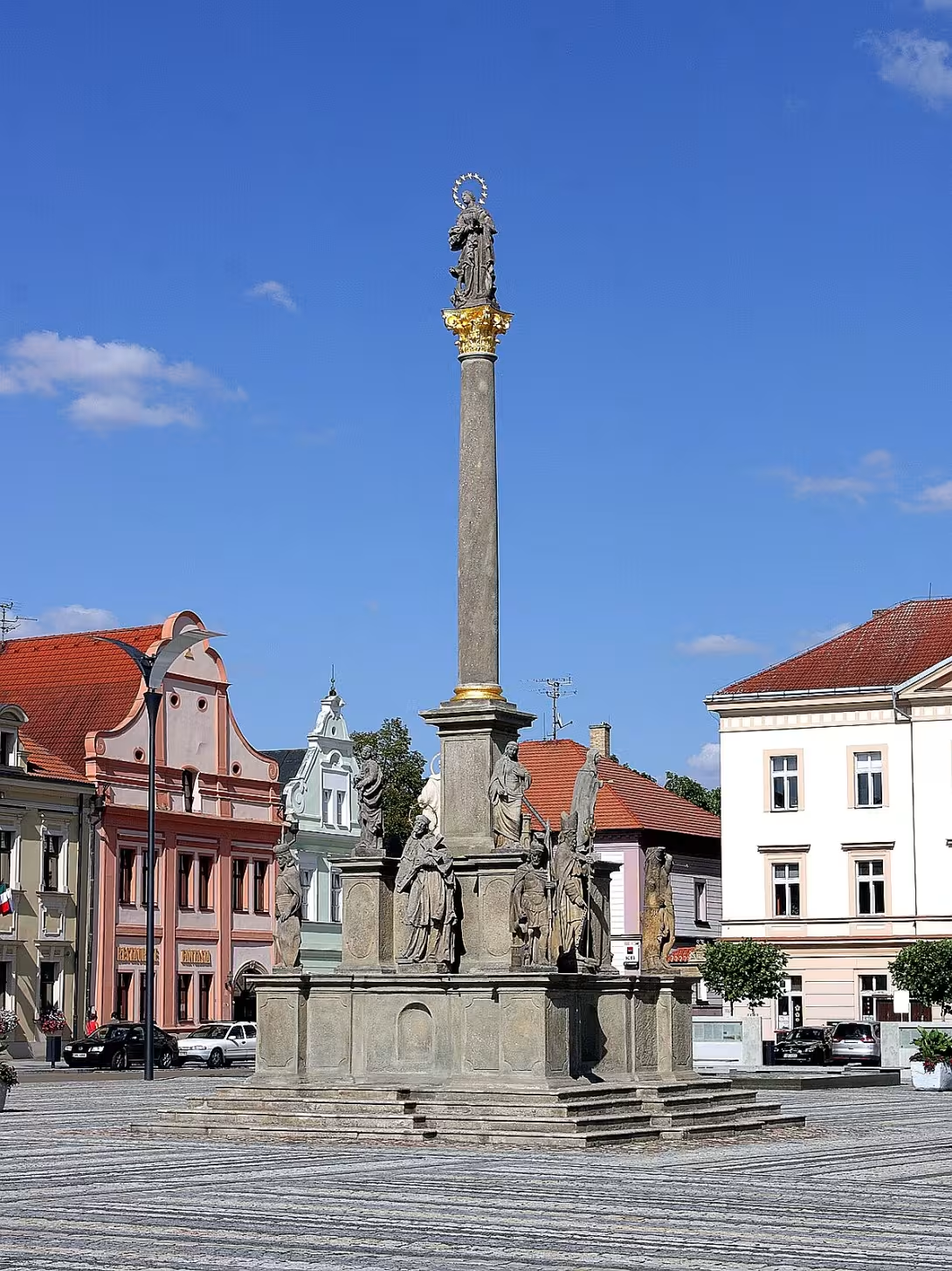
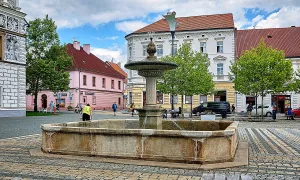
The Marian column on Masaryk Square in Silver is a Baroque monument with thirteen sculptures from the workshop Kristian and Lazarus Widemann. This monument was created as a token of gratitude for the retreat of the plague and represents an important work of Baroque sculpture.
The main impulse for its establishment was a plague wound from 1713. The construction took place gradually and was completed in 1740. In 1762, the column was consecrated by Bishop Ondrej Kayser. There were 17 statues in the monument at that time.
The monument consists of a pillar with a statue of the Virgin Mary, supplemented with other statues placed in two levels. There are eight life-size characters at the bottom. Among them are St. Wenceslas, St. Florian, St. Roch, St. Shebestian, St. John of Nepomuk, St. Francis of Paula, St. Anthony of Padua and St. Prokop. The upper part contains statues of sublife size, such as St. Rosalia Palermo, St. Barbara, St. Mary Magdalene and probably St. Terese of Ávila.
The fate of the monument has been complicated over the centuries. The reconstruction in 1843 was followed by a complete repair in 1868, in which nine stone fences with a stretched chain were newly constructed. A major restoration was carried out in 1894 by Karl Wilfert. In this work were replaced the most damaged statues of Saint Florian, Wenceslas, Shebestian, Rocha, Prokopa and Barbora. Probably at that time, four angels were also removed from the pedestal of the column.
In the first half of the 20th century, the work was in a state of emergency. There was vandalism in 1962, in which three sculptures were torn down. Their fall damaged four other statues and the architecture of the column. Although the statues were set back in 1962 and 1963, the missing parts were no longer completed. For a long time, the overall reconstruction followed between 2011 and 2015. During this process the work was dismantled, the statues restored and gradually reinstalled. Due to their neglected condition, the statue of St. Rosalie was replaced by a sculpture copy while the original was stored in the museum.
The Marian column is an important witness to the Baroque religion and history of Silver. Even today, it fascinates its dynamic form and rich program of statues that attract the eye of every visitor.
Historical milestones
- 1713
- A plague wound that was an impulse to set up a pillar.
- 1740
- Completion of the gradual process of building the column.
- 1762
- The ordination of the column by Bishop Ondrej Kayser.
- 1894
- Essential restoration and replacement of several sculptures with Karl Wilfert's new plastics.
- 2011- 2015
- Total reconstruction, analysis and restoration of statues.
Architectural development
The original Baroque state was supplemented in 1868 with stone fences with a chain. In 1894 there was a major restoration in which Karl Wilfert replaced several damaged statues with new ones. From 2011 to 2015, a complete reconstruction was carried out, including analysis of the work and restoration of the statues.
Historical events
Establishing a pillar in response to the plague in 1713. The consecration of the monument by Bishop Andrew Kayser in 1762.
Points of interest
- The column was created as a token of gratitude for the retreat of the plague. In 1762 there were 17 statues in the monument. - In the reconstruction in 1868, nine stone pylons were newly constructed with a stretched chain. - There was vandalism in 1962, in which three sculptures were torn down. The statue of St. Rosalie was replaced by a sculpture copy while the original was stored in a museum.
Guide
Show guide text
This text was created by artificial intelligence and has not been editorially reviewed. It may contain inaccuracies.
Welcome to Silver. Right now, at this moment, you're standing in the middle of Masaryk Square and your eyes are likely to encounter this noble and important object that carries the entire history of this place. Before you stands a Marian pillar, a baroque monument that is not only a stone piece, but above all a strong expression of human faith, hope and deep gratitude. Look at his figure, how his shapes stand out against the sky and how they attract the attention of everyone who passes by. This column is the heart of the square and a silent witness to many of the events that have taken place here for centuries. Feel the atmosphere that radiates around it, and feel that you are facing something that has survived many generations of people. To understand why this column is standing right here, we need to go back deep with you to a time when the world was much different and people faced forces that they could not control. By the year one thousand seven hundred and thirteen. That was the year the plague hit these countries. It was a disease that brought great fear, pain and uncertainty to every house and every mind. The people of the time, in deep faith and despair, sought a way to avoid this destruction. By promising that if the plague blows stop, they will build a monument to their gratitude, a process that lasted many years. The construction of this column was neither quick nor easy. It took place gradually, as a persistent process of expressing relief, from a thousand seven hundred thirteen to a thousand seven hundred forty. Each year of construction was a reminder that the danger was averted and that people deserved to live in peace. This whole process was extremely important to the entire community because the column became a symbol of the victory of life over death and the invisible enemy. Now please pay attention to the work itself and its architecture. Look at how the column is built and how its entire structure is organized. This whole work came from the workshop where the masters Kristian and Lazar Widemann worked. Their work can be seen in every detail, every movement that statues express. Feel the baroque style that is full of dynamics, emotions and movement. If you look up, you will see the pinnacle of the entire work - the statue of the Virgin Mary. It's her, it's her presence, that dominates the whole thing and heads towards heaven. Below it you will see a number of saints who are placed in two levels. There are 13 baroque plastics, which form a harmonious and rich whole. Feel how these figures are distributed, how each of them rises at different heights and how they create a rich visual structure that forces you to follow the column from its base to the very top. Each level of saints adds a piece to the depth and creates a feeling of ascension to the divine, as if figures slowly emerge from the earthly world into the sphere of heaven. The history of this place is associated with many names that deserve your attention. In the year one thousand seven hundred sixty-two there was an important moment when the column officially consecrated Bishop Ondřej Kayser. This was a confirmation of its sanctity and importance for the whole village, the moment when the monument became a fully recognized symbol of faith. But the memory was not constant throughout its life and had to face time and necessary repairs. In the year one thousand eight hundred ninety-four there was a major restoration, in which some sculptures were replaced by new parts created by Karl Wilfert. His work helped to preserve the baroque appearance of the monument for future generations and to ensure that the column still works as originally thought. And not once, in the years one thousand nine hundred eleven to one thousand nine hundred fifteen, there was a complete reconstruction, which carried out a very detailed analysis and repairs of all the statues to preserve their beauty and durability for centuries to come. You might be thinking that what you're seeing right now is exactly what was standing here from the beginning. But history tells us about changes, losses, repairs. In the year one thousand seven hundred sixty-two there were seventeen statues in the monument, not thirteen, as you see now. What happened to the others? This is one of those questions that may interest you when you look at this column and make you wonder how time changes and how monuments transform in time. Another interesting thing is that in the year one thousand eight hundred and sixty eight new stone pylons were built around the column, which are connected by a stretched chain. These pillars and chains serve to protect this precious work from accidental damage. Unfortunately, the memory also faced the difficult moments that were caused by humans. In the year one thousand nine hundred sixty-two, there was vandalism, in which three sculptures were torn down. It was a sad moment that left a mark on the memory and which reminded us how fragile human work can be and how important it is to protect it from anger and indiscretion. Now that you've come to know the basic shapes, the history and the secrets of this column, I suggest you stop for a while and just observe individual figures in silence. Feel the atmosphere of this square and the memories that are stored in this stone. Let yourself be carried away by the beauty of baroque art and the memory of the people who built this column as a token of their gratitude for saving their lives. Thank you for joining us on this short journey through time. We wish you a nice walk in Silver and enjoy all the other beauties this city offers you. Goodbye.
Tips for visitors
The best time to visit the Marian Column in Silver is in the spring or autumn season when the weather is pleasant and the light is not very strong. This time of year allows a beautiful view of Baroque architecture without adverse effects of sunlight.
It is advisable to use both a passenger car and public transport to achieve the monument.
When you visit, bring a suitable suit because the column is in the public area and you can be out longer. A gift for children could be a toy or a book that will attract their attention during a walk.
Photography of the Marian Column is best in the early morning or evening when light is less intense and allows to capture details of statues. The best places for photos are from different angles in Masaryk Square.
In the vicinity of the monument you can visit other historical and cultural points such as a local museum or a walk on the streets of Silver. These activities are also suitable for families with children who can enjoy a view of historical buildings and stories about the past.
Frequently asked questions
Can the monument be visited?
This is a structure in a public space that can usually be seen from outside free of charge. We have not verified that this particular one is freely accessible.
Where is the monument?
Location: Stříbro. The map on this page shows the exact spot.
Why is the monument protected?
It is listed in the Central List of Cultural Monuments of the Czech Republic as a cultural monument (register no. 1000148450).
Businesses nearby
Do you run a restaurant, accommodation, shop, museum, rental, wellness or other visitor service near this monument? Show yourself directly to the people heading to it — this is how they will see you in the app and on the web:
Events nearby
Zdroj akcí: otevřená data měst a obcí ČR (Národní katalog otevřených dat) a kalendář akcí Národního památkového ústavu.
Nearby
🏰 Historic sites (48)
- Městské muzeum 0.1 km Masarykovo náměstí 20 web
- Muzeum minerálů Duchmaus 0.3 km Boženy Němcové 118 web
- Zřícenina vodního hamru 1.7 km
- Hornický památník 2.1 km
- pravěké hradiště Sulislav 2.6 km
- Otročínský hrádek 4.0 km web
- Mohyla střední doby bronzové 4.0 km
- Regionální muzeum Kladrubska 4.6 km web
- Mohylové pohřebiště 4.7 km
- Mohylové pohřebiště 4.9 km
- Mohylové pohřebiště 5.2 km
- Hamerský mlýn 6.0 km
- Mohylové pohřebiště 6.6 km
- Svojšínský mlýn 6.8 km
- Mohylové pohřebiště 6.9 km
- zámek Svojšín 7.0 km web
- Zemědělské muzeum 7.0 km
- Zaniklá tvrz Svojšín 7.0 km
- Mohylové pohřebiště 7.2 km
- Alfrédov 7.8 km web
🍽️ Restaurants and dining (34)
- Excellent 0.0 km
- kafe.prostor 0.1 km Masarykovo náměstí 21
- Restaurace a penzion Štybar 0.2 km
- I ♥ pizza 0.2 km Benešova 199
- Herna Andy 0.6 km Plzeňská 367
- U Branky 0.6 km Plzeňská 420
- Peronka 1.3 km
- Restaurace Vranov 2.8 km
- Rybářská chata 4.2 km
- Hostinec U Kláštera 4.4 km
- Restaurace u Koruny 4.6 km
- Hostinec U šéfů 4.7 km
- Hospůdka U Kostela 4.8 km Sulislav 42
- Stop Cafe 5.7 km
- Bus restaurant 6.5 km +420 732 651 763; +420 737 133 033 web
- U draka 6.9 km
- Brodska hospudka 9.0 km
- Restaurace 10.6 km
- Restaurace 10.6 km
- Restaurace 10.6 km
🏨 Accommodation (30)
- Pension Q 0.3 km Benešova 482
- Penzion Restaurace Chanos 0.5 km Havlíčkova 1341
- Hotel U Branky 0.6 km Plzeňská 420
- Tábořiště u Pekelského mlýnu 3.6 km
- Bauernhof U Štěpána 4.0 km Lhota u Stříbra 35
- Turistická ubytovna Na Zámku 6.9 km web
- Turistická ubytovna Na Rychtě 7.0 km
- Wellness Hotel Alfrédov 7.8 km +420 374 783 593; +420 374 783 574; +420 725 404 996 web
- Letní tábor Svojšín 8.4 km web
- bezKempu - Selanka 10.0 km
- Tábořiště Výrov 10.2 km +420606445757
- Camping Terasy 10.5 km web
- Camp Kosatka 10.6 km web
- Autokemp Radost 10.6 km web
- Penzion u Vlčků 11.4 km +420 606 907 391 web
- Penzion u Leihsů 12.0 km +420 377 914 298 web
- Transkemp Hracholusky 12.5 km web
- ByTheLake 13.6 km web
- Rustica 14.1 km
- Léčebný Hotel Prusík 14.4 km
🚲 Rentals and sport (6)
- Terén svatého Petra 2.1 km
- Butov 3.1 km
- Vranov 3.6 km
- Škoda 4.3 km
- Antukové kurty 4.3 km
- Camping Market 10.6 km
🥾 Hiking and nature (69)
- Hornický skanzen 0.3 km
- Značky clearence 12" 7' 0.5 km
- Křížový vrch 0.7 km
- Hůrka 1.1 km
- Evangelista 1.4 km
- Myší kopec 1.8 km
- Jirná 2.9 km
- Jenýsova studánka 2.9 km
- Osada SPLAV 3.5 km
- Pořízek 3.6 km
- Zaniklé divadlo v přírodě 4.7 km
- Kamenný vršek 4.8 km
- Klasnice 5.4 km
- Stelka 5.7 km
- Flaška 6.1 km
- U Rájové 6.2 km
- Chlum 6.5 km
- Kšický vrch 6.6 km
- Zaniklý zastřešený most přes Mži 6.8 km
- Kamenná hůrka 7.0 km
Accommodation nearby
Trips and activities nearby
Guided tours, tickets and activities nearby from GetYourGuide
Affiliate link: if you buy from the partner, we may receive a commission. The price for you does not change.
Search tours and activities →Themed route
1. Base pillar - architectural element. Here begins the tour and you can see the bottom support of the entire monument. 2. Statues of saints - plastic art. A detailed view of the figures of the saints, which decorate the central part of the building. 3. Statue of the Virgin Mary - top of the monument. Tracking the main character placed at the highest point of the column. 4. The immediate surroundings of the monument - public space. Walk around the whole complex to capture the building from different sides.
Seasonal recommendations
In spring, the monument is surrounded by awakening nature and fresh greenery. Soft spring light gently highlights the details of the statues. We recommend wearing more layers of clothing because the weather is variable. The ideal time to visit is in the morning when the air is the cleanest.
The summer season brings sharp sun and rich colors around. Bright lighting allows you to see every little thing on the stone. In the main summer season it is advisable to choose light and breathable clothes. It's best to come early in the morning or at dusk to avoid the hottest heat.
In autumn, the space around the pillars turns into golden and brown tones. A fog wound gives the memory a mysterious and peaceful atmosphere. It's practical to carry a waterproof jacket and a warm scarf. For the most beautiful views we recommend a late afternoon when the sun shines low.
In winter, white snow and bare branches of trees act as a natural frame for statues. Cold and clean air creates a contrasting and rough impression. Don't forget the warm gloves and thermo-brushing. Given the short days, it's best to plan our way into the middle of the day.
Visualizations and artistic views

The visualisations are generated by artificial intelligence and serve as inspiration.
Photos from the area
Real photos taken near the monument


Zdroj a licence jsou uvedeny u každého snímku.
Tips from visitors
No tips yet. Be the first!
Log in and add your tip.
Sources and literature
Photos: RomanM82 / CC BY-SA 4.0 — Wikimedia Commons. The author and licence also appear when you hover over the image.
Faktickým podkladem tohoto textu byl článek na Wikipedii, jehož autory jsou přispěvatelé Wikipedie. Článek je dostupný pod licencí CC BY-SA 4.0.
Location on the map




Příběhy a pověsti
Legendy, pověsti a příběhy spjaté s touto památkou
Fotografie návštěvníků
Zatím žádné fotografie. Buďte první, kdo přidá fotografii z návštěvy!
Log in a přidejte svou fotografii nebo hodnoťte.
Za ověřenou návštěvu v aplikaci získáte víc bodů — poznáme podle GPS, že jste na místě.
Reviews and comments