



Sloup se sochou svatého Josefa Pěstouna Statue column
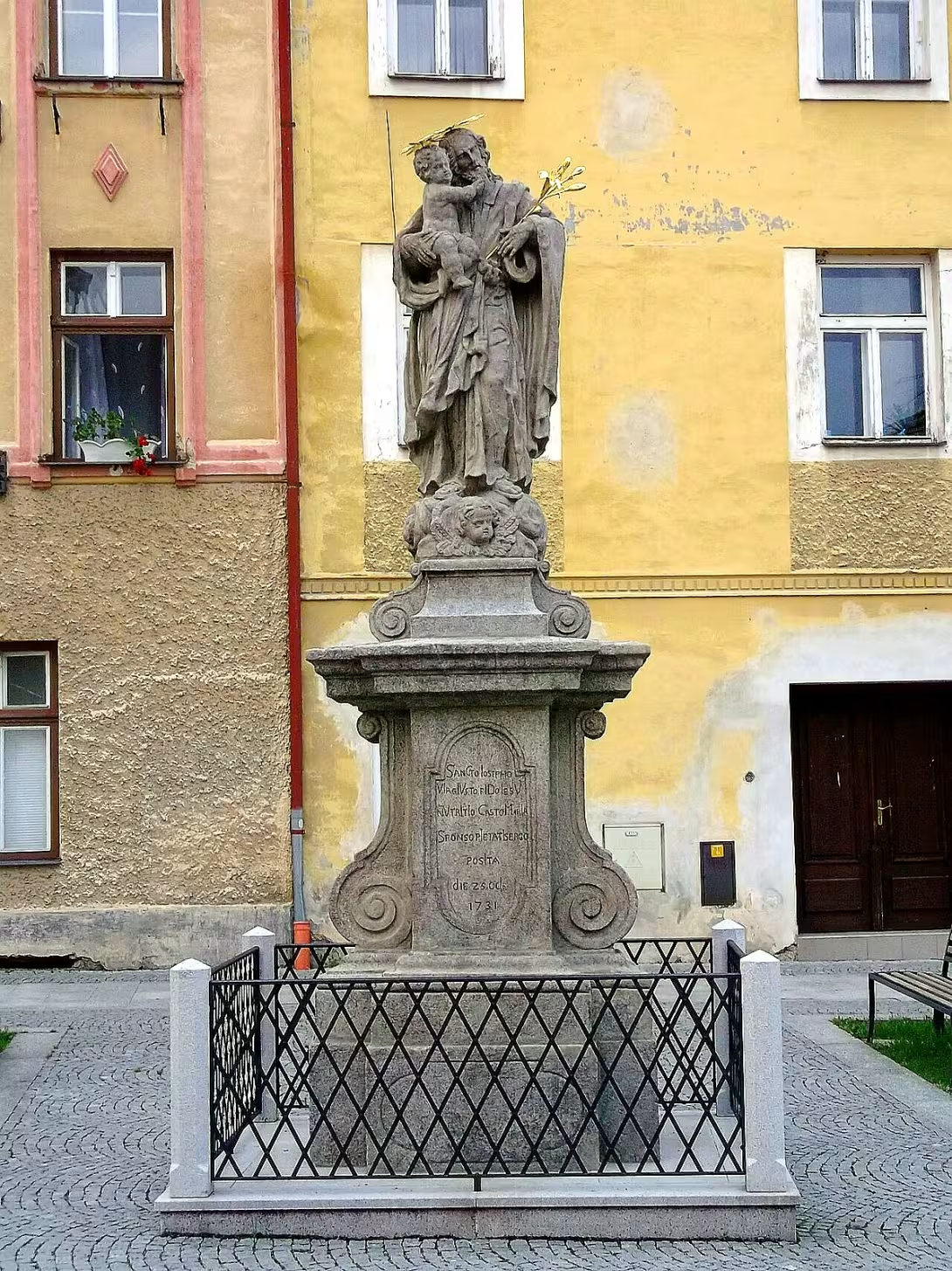
Sloup se sochou svatého Josefa Pěstouna is a baroque monument located on Svoboda Square in Zlatých Hory, Jeseník district. This object represents a quality work of Silesian sculpture tradition and is an important part of the urban space. It was included in the list of cultural monuments of the Czech Republic before 1988 and belongs to the town monument zone Zlaté Hor.
The statue was festively mounted on October 25, 1731 at the initiative of the then mayor J. G. Wietze. At the time of its creation, at the beginning of the 18th century, there was a Baroque period, which was reflected in Central European religious and secular art and architecture.
The monument is carved out of rough-grained Bosnian sandstone. Its construction consists of a multi-level prism base decorated with volutes, which ends with a profiled ledge. Above it is a low base with side voltages. The statue of St. Joseph stands in contrast on clouds with winged heads of angels. In his right hand he holds Jesus, holding his beard with his right hand, while holding the cloak and the golden lily. His head is leaning towards Jesus. The whole object is protected by a fence made of stone columns and a metal grid.
The statue was restored several times, the first reconstruction took place in 1851 and the next in 1999. In 2011 there was a comprehensive restoration carried out by academic sculptor Jakub Gajda. The recovery costs were paid out of 50% by the Olomouc Region Regional Office.
On the plinth of the statue there are inscriptions in the form of chronograms. The front page contains the text: SANCTO IOSEPO VIRO IVSTO FIDO IESV NVTRITIO CASTO MARIA SPONSO PIETATIS ERGO POSITA die 25.oct. 1731. The back page of the inscription reads: AD TE S IOSEPHE PIE SVSPIRAMVS EIA PIVS SVCCVRRE NOBIS FF IAH PZ. These texts celebrate Saint Joseph and the people here, which is a historical name for Zlaté Hory. The abbreviations used include FF (Fieri Fecit - made), IAH (Iosepho Ad Honor - Josef) and PZ (Popular Zuckmantel - people of Zucckmantl).
This Baroque monument represents an important historical point for visitors to the central part of the city. It is a suitable destination for those who want to familiarise themselves with the art of Silesian provenance.
Historical milestones
- 1731
- Festive installation of the statue of St. Joseph Pošten.
- 1851
- First reconstruction of the statue.
- 1999
- Second reconstruction of the statue.
- 2011
- Total restoration by academic sculptor Jakub Gajda.
Architectural development
The statue is carved from rough grain sandstone and has a several-stage base decorated with volutes. On the statue stands Saint Joseph in contrast, holding Jesus by the beard. The statue is enclosed by a fence with stone posts and a metal grid.
Historical events
- 1731
- Festive installation of the statue of St. Joseph Pošten.
- 1851
- First reconstruction of the statue.
- 1999
- Second reconstruction of the statue.
- 2011
- Total restoration by academic sculptor Jakub Gajda.
Points of interest
- The statue was festively mounted on October 25, 1731 at the initiative of the then mayor J. G. Wietze. - The monument is carved from a rough-grained Bosnian sandstone. - The statue depicts Jesus, who is playing by the beard of St. Joseph. - On the plinth are inscriptions in the form of chronograms that mention the historical name Zucckmantl. - In 2011, the academic sculptor Jakub Gajda carried out a complex restoration.
Guide
Show guide text
This text was created by artificial intelligence and has not been editorially reviewed. It may contain inaccuracies.
Welcome to the Golden Mountains. You have just stopped at Liberty Square, where one of the most important and beautiful symbols of this city stands before you. You are standing right in front of a monumental column that dominates the whole area with its presence and immediately encourages you to stop, to quietly observe and to feel the history that is felt at every step. This column with the statue of St. Joseph Pošten is not just an ordinary stone piece, which stands here as decoration. He is a living witness for many centuries, who lasts here as a fixed point in the midst of a changing world and as evidence of the artistic expression of the human spirit. Feel the atmosphere of this square where Baroque art meets the daily life of the city and where history becomes part of your present moment.
Let us now return together to a deep past to understand how this pillar came into being and why it is so important for the city. In order to truly understand its meaning, we must return to 1731 in our thoughts. That was the year this statue was ceremonially placed in its place. But it was no random moment or simple construction. This whole process was driven by a strong will and vision of the then mayor, who was called J. G. Wietze. It was his initiative, his effort and his desire to secure this spiritual and artistic element for the city that made this column an essential part of Freedom Square. Since then, this pillar has been a solid part of the urban monument zone and reminds us of the era when the Baroque style became the main way in which people expressed their faith, their beauty and their social position. It is a work that was created in times of great emotion and expressed through a stone that resists time.
Now pay attention to the very form of the monument and what you see right in front of you right now. If you look closer at the surface of the statue, you can see its very specific and unique texture. This whole piece is carved from a rough-grained Bosnian sandstone. This material plays a key role in the entire work of the statue. Its rougher structure allows light and shadows to form constantly changing shapes and depths on the surface of the stone. When you look at the statue from different angles, you see how the material reacts to light, how it highlights shapes and how it gives the whole piece its unmistakable character. This statue belongs to the works of Silesian provenance, which means that in its details and overall composition you can find a print of the local artistic spirit and tradition that has evolved in the region for centuries. It is a work that requires not only great technical skill, but also a deep understanding of the very nature of the stone that the sculptor worked with.
Now, when you look up and focus your eyes on the characters themselves, you see something that carries a deep human feeling that may surprise you. The statue depicts St. Joseph Pošten, but not in the noblest, furthest or most serious form you might imagine looking at religious monuments. Because there's a little Jesus present. Notice the unexpected playfulness that radiates from the entire work. The little Jesus is just holding the beard of St. Joseph. This one detail changes the whole atmosphere of this monument. Instead of a steep and cold statue, we meet here with a moment of family proximity, tenderness and child intransigence. It is precisely this detail that makes this baroque work such an extraordinary and human work. It can reach every visitor with its unexpected humanity and ability to tell the story of relationship and love through stone.
If you look at the base, the plinth on which this whole column stands, you might encounter another fascinating and mysterious element. In this place there are inscriptions which have a very specific and specific form. It's called chronographs. For some, at first glance, they may look like ordinary texts or historical records, but they're actually hidden secrets. These inscriptions contain a hidden date which is encoded in the text using a certain way of writing letters. It is the way that older masters and scholars left a legacy for future generations to know exactly when the work was completed or when something fundamental happened. It's like history is trying to talk to us through hidden codes carved right into stone, waiting to be rediscovered.
However, this monument was not only a one-off event from 1731, but is the result of a very long history of care, maintenance and restoration. To make her look like you see her today, she had to go through some important stages of restoration that made her what she is today. In order to see this symbol of the city in its beauty, people had to take care of it even in difficult times. The first significant renewal took place in 1851, when the people at that time decided that this inheritance was too valuable to let go. Another important step was taken in 1999 when the statue was treated carefully again. Finally, in 2011, there was an overall and very thorough restoration carried out by academic sculptor Jakub Gajda. It is thanks to this continuous care that lasts over 300 years, this pillar is still so preserved and can remind us today of its original baroque beauty. Each of these revival was an important bridge between the past and the present which allowed this piece of Silesian art to survive until our time.
You're standing here now in front of something much bigger than just a stone statue on a tall pole. You stand before a deep union of history, art, faith, and human endeavor to keep beautiful things from disappearing. Whether you were intrigued by the unexpected playfulness of little Jesus, or fascinated by the secrets of hidden inscriptions on the plinth, or by the texture of sandstone, we hope that this moment of stopping by the monument brought you a new perception of the Golden Hors. Continue to take a peaceful walk around the city, explore other parts of the square, look at the surrounding buildings and let yourself drift through the atmosphere of this place. Thank you for taking this moment and spending it with us at this important monument. We wish you the lovely rest of your visit.
Tips for visitors
The best time to visit St. Joseph's statue in the Golden Mountains is in spring or autumn. During these months, the weather is pleasant and sunny, which allows for full appression of the statue without unpleasant temperature extremes. In addition, Liberty Square is less visited at these times, which ensures a quieter atmosphere.
We recommend checking the current connection before travelling.
When visiting, you can bring a camera or a mobile phone to capture a beautiful view of the column. Also remember about the protective coat if the weather is unpredictable, and about the sunglasses during bright days.
Photography of the statue offers the best results in the morning or evening light, when lighting is less intense and shadow effects add depth to the images. Also, make sure there are no restrictions on the use of tube cameras in Freedom Square.
In the vicinity of Zlaté Hor you can visit the historical height, which is located nearby. It is an ideal place for families with children, where they can enjoy a view of the landscape and learn more about regional history.
Frequently asked questions
Can the monument be visited?
This is a structure in a public space that can usually be seen from outside free of charge. We have not verified that this particular one is freely accessible.
Where is the monument?
Location: Zlaté Hory. The map on this page shows the exact spot.
Why is the monument protected?
It is listed in the Central List of Cultural Monuments of the Czech Republic as a cultural monument (register no. 1000128414).
Businesses nearby
Do you run a restaurant, accommodation, shop, museum, rental, wellness or other visitor service near this monument? Show yourself directly to the people heading to it — this is how they will see you in the app and on the web:
Nearby
🏰 Historic sites (108)
- Městské hornické muzeum 0.1 km +420584425329 web
- Leuchtenstein 1.7 km
- Edelstein 3.2 km
- Edelštejn 3.3 km
- Cześć poległym za ojczyznę 1939-1945 3.5 km
- Konrad Habel Platz 3.9 km
- Pętla Leśna 4.2 km
- Dawna skocznia narciarska Seiffentalschanze z 1932 roku 4.3 km
- pomník obětem 1. světové války 4.5 km
- Głuchołazy Zdrój 5.1 km
- kaple Dušičková 5.6 km
- kaple Bolestné Panny Marie 5.6 km
- Pomník padlým v 1. světové válce 6.1 km
- Muzeum 6.4 km
- socha Panny Marie 6.5 km
- hornický pomník 6.5 km
- Tkalcovna na Rejvízu 7.3 km 420 603 249 551
- Muzeum tkalcovství 7.3 km
- Památník obětem 1. světové války 8.2 km
- Koberštejn 8.3 km
🍽️ Restaurants and dining (109)
- U Radnice 0.0 km Náměstí Svobody 40 +420584425630 web
- Bufet Lukas 0.1 km Náměstí Svobody 28
- Hostinec Koruna 0.1 km Náměstí Svobody 23
- Pivní bar Lyra 0.1 km Náměstí Svobody 22
- Bar Herna Nonstop 0.1 km Palackého 68
- U Barona 0.4 km
- U Barona 0.4 km Wolkerova
- Hotel Praděd Thamm 0.6 km
- Sokolovna - Zámeček 0.6 km Sokolská
- Picolo 1.2 km Krnovská
- Zlatokopecké sruby 2.4 km
- Włoski Smak 3.2 km web
- Ziemniaczana Kopa 3.4 km +48601225990
- Zajazd Zagroda 4.2 km +48774391383 web
- Kawiarnia ParKula 4.4 km Parkowa 10
- Hotýlek U Pekina 4.4 km +420 721 335 365 web
- V Gruntě 4.5 km +420 584 45 30 33 web
- Amorek 5.0 km Aleja Jana Pawła II 37 +48 774396277
- Carina 5.8 km
- Łowisko na Wyspie 5.9 km
🏨 Accommodation (77)
- Penzion Modrý zvonek 0.1 km Náměstí Svobody 88
- Hotel Minerál 0.3 km Polská 392 +420737241321 web
- Hotel Praděd Thamm 0.6 km +420 730 155 166 web
- Penzion a restaurace U Horáků 1.5 km 584 425 981 web
- Agroturystyka Oberówka 1.7 km +48605053390 web
- Aspen 3.4 km web
- Středisko Doubrava 3.4 km Ondřejovice 53 +420732639352
- Pokoje Gościnne Pod Sosnami 3.4 km +48785251930
- Ziemowit 3.5 km
- u Agnieszki 3.6 km
- Zapomniany Zdrój 3.8 km web
- Hotýlek U Pekina 4.4 km +420 721 335 365 web
- V Gruntě 4.5 km +420 584 453 033 web
- Gościniec Pod Bukiem 4.9 km
- Sudety 5.0 km Aleja Jana Pawła II 25 web
- Skowronek 5.1 km Generała Władysława Andersa web
- Złota Dolina 5.2 km +48 77 887 21 55; +48 77 439 75 53; +48 794 043 500 web
- Banderoza 5.3 km web
- Ośrodek Wczasowo-Wypoczynkowy „Ruch” 5.8 km Generała Władysława Andersa
- Szkolne Schronisko Młodzieżowe w Głuchołazach 5.9 km +48 77 439 7779 web
🚲 Rentals and sport (23)
- Sport Ivan 0.1 km Náměstí Svobody 87 +420584425503
- Hala sportowa 6.0 km Marii Curie-Skłodowskiej 32
- Sportservis Tomšů 6.5 km +420 775 608 705 web
- Lanový park 12.2 km
- Na Smrťáku 13.2 km
- Tenisový klub Jeseník 13.8 km
- Woox - Sport Outlet 13.8 km
- Sportisimo 13.9 km
- Hala Sportowa Obuwnik 14.1 km Łucznicza 1
- Sport 2000 14.1 km +420 603 272 053 web
- OTOSPORT 1993 s.r.o. - Jeseník 14.1 km Sadová 881 +420 77 723 1230 web
- FIT:KO Jeseník 14.1 km +420 737 258 707 web
- Sportmax 14.1 km
- Woox 14.1 km web
- JeseníkyTour.eu 14.1 km +420 732 277 135 web
- Velosport 14.2 km Školní +420 584 401 160
- Klub Sportowy Obuwnik 14.2 km
- ARDON workwear & outdoor 14.2 km nám. Svobody 831/21 web
- kilpi 14.3 km Gogolova 92/2
- Sport servis Tomšů 14.3 km +420 776 608 706 web
🥾 Hiking and nature (262)
- Zapora Jarnołtówek 2.3 km
- Hornická osada 2.4 km
- Biskupská kupa 2.5 km
- Biskupská kupa (rozhledna) 2.5 km
- Zlatokopecký skanzen - Zlatorudné mlýny 2.5 km +420 588 884 618 web
- Biskupská 2.5 km
- Plešivec 2.9 km
- Kamień Wisielczy 2.9 km
- Skalna Góra 3.1 km
- Czapka 3.1 km
- Štěpánčina studánka 3.2 km
- Pramen svatého Rocha 3.3 km web
- Ovčácký vrch 3.3 km
- Nad Petrovou chatou 3.3 km
- Zámecký vrch 3.3 km
- Tylna Kopa 3.5 km
- Bukowa Góra 3.8 km
- Piekiełko 3.8 km
- Skały Karliki 3.9 km
- Skały Karliki 3.9 km
Accommodation nearby
Themed route
Thematic cruise route from the village Zlaté Hory
1.Sloup se sochou svatého Josefa Pěstouna - Type: Religious monument - Why is it worth visiting: This column is an important symbol of faith and local tradition. The statue of St. Joseph Pošten, patron of family and workers, attracts attention with its historical value and artistic performance.
2. Chapel of the Assumption of the Virgin Mary - Type: Chapel - Why is it worth visiting: This chapel is a place of peace and shelter for locals and visitors. Its architecture and interior decoration represent an interesting example of regional sacral art.
3. Local Church - Type: Church - Why is it worth visiting: Visit the local church, which is the center of the spiritual life of the village. Its history and architectural features are attractive to every passenger interested in history and culture.
4. Garden with memorial cross - Type: Memorial site - Why is it worth visiting: This place serves as a reminder of the historical events and personalities that shaped today's village. The garden offers quiet surroundings for reflection and worship.
5. Local Market - Type: Market - Why is it worth a visit: Visit the local marketplace where you can see and buy regional products. It's a great way to get to know local food and traditions.
This route allows you to deeply understand the cultural and spiritual life of the village Zlaté Hory.
Seasonal recommendations
Spring - In March and April, the first leaves flourish around the column and the trees along the road get a fine green color. The light is soft, the sun appears in the late morning and the statue of St. Joseph Pošten thus receives almost a golden touch. In this period the crowds are still relatively thin, so it is advisable to arrive around 10 a.m. when there is still enough light and before the afternoon sun. We recommend a light jacket or sweater because the morning can be colder, and comfortable shoes on uneven terrain.
Summer - In July and August, the column stands in full sunlight, the surrounding meadows are green and the flowers bloom in full bloom. Intense light highlights the details of the statue, but at the same time it can be hot and the reflection of the sun on the stone dazzling. In the summer months, the largest crowds form around the monument, which is why it is best to arrive early, preferably between eight and nine in the morning, before visitors disperse across the whole area. We recommend a hat, sunglasses, light breathable clothes and plenty of fluids; if possible, use the shadow along the road or bring a small umbrella.
Autumn - In September and October, the landscape around the pillar is covered in warm shades of yellow, orange and red. Sun rays fall at an angle, creating dramatic shadows and highlighting the texture of the stone. The weather can be variable, with occasional rain showers, and temperatures move around colder values. The ideal is to plan a visit to the late afternoon when the sun slowly boils down and lighting is softer. It is advisable to carry a waterproof jacket, fixed shoes and possibly a small umbrella; A warmer sweater or scarf ensures comfort during cooler moments.
Winter - In December and January the column is often covered with snow, which gives it a quiet and majestic look. Short daylight and low sun angle create fine blue shades that underline the statue. We recommend a warm winter jacket, hat, gloves and tight shoes with anti-slip soles; If snow is deep, it is advisable to have chopsticks or other stability aids. In winter the visitors are the least, so you can admire the statue in peace without rush.
Visualizations and artistic views

The visualisations are generated by artificial intelligence and serve as inspiration.
Photos from the area
Real photos taken near the monument


Zdroj a licence jsou uvedeny u každého snímku.
Tips from visitors
No tips yet. Be the first!
Log in and add your tip.
Sources and literature
Photos: JiriMatejicek / CC BY-SA 3.0 — Wikimedia Commons. The author and licence also appear when you hover over the image.
Faktickým podkladem tohoto textu byl článek na Wikipedii, jehož autory jsou přispěvatelé Wikipedie. Článek je dostupný pod licencí CC BY-SA 4.0.
Location on the map

Příběhy a pověsti
Legendy, pověsti a příběhy spjaté s touto památkou
Fotografie návštěvníků
Zatím žádné fotografie. Buďte první, kdo přidá fotografii z návštěvy!
Log in a přidejte svou fotografii nebo hodnoťte.
Za ověřenou návštěvu v aplikaci získáte víc bodů — poznáme podle GPS, že jste na místě.
Reviews and comments