



Sloup se sochou svatého Václava (Smidary) Statue column
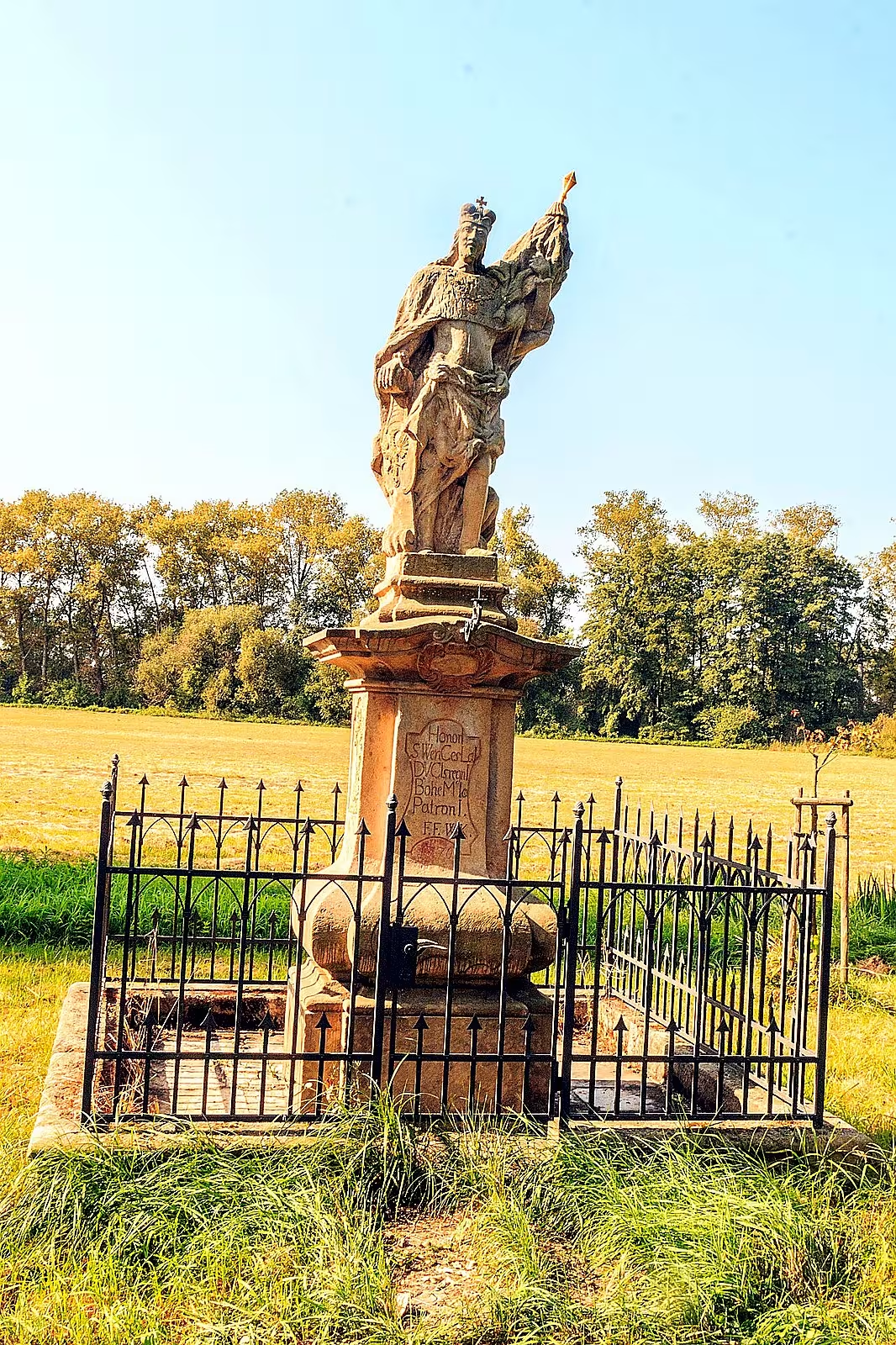
The column with the statue of St. Wenceslas, situated on the road to Kotelice before entering the former water mill Medřeč in the village Smidary, is a late Baroque sandstone statue from 1770. This building, located in a square sandstone fence with a decorative cast iron grate, was declared a cultural monument of the Czech Republic in 2006. The statue of St. Wenceslas is depicted in life size in a prince's garment with a crown, leaning on the shield and holding the banners. Pillar under the statue bears the Latin inscription dedicated to St. Wenceslas as patron of the Czech Kingdom and the reliefs of St. George and St. Florian.
The statue was created in the late Baroque period, which represented a period of rich artistic expression for Czech countries. Baroque style is characterized by dramatic forms and details, which is also evident on this object. The sandstone statue of St. Wenceslas stands on a prism plinth with a profiled upper part. The pillar under the statue has a tumobically extended lower part and is finished with a shallow bent ledge with a decorative cartouche, which has a metal candlestick. On the pillar are placed reliefs of St. George's killing dragon and St. Florian burning house, which adds symbolic importance to the statue.
The history of the building is associated with its location at the former water mill Medřeč. Although specific information about the original owners or administrators is missing, the statue was submitted to a restaurant in 2013, indicating its lasting cultural and historical value. In 2006 the building was officially registered as a real-estate cultural monument of the Czech Republic, thus recognising its significance.
The statue of St. Wenceslas is not only an artistic splendor but also a symbolic place. The Latin inscription on the pillar celebrates St. Wenceslas as the patron saint of the Czech Kingdom, which highlights its importance for Czech history and culture. The relief depictions of the saints George and Florian add another layer of symbolism, representing the virtues of bravery and protection.
Today the column with the statue of St. Wenceslas is an important cultural monument that attracts visitors from all over the Czech Republic. Its location at the former mill Medřeč and its proximity to the road on the Chodelice makes the statue easily accessible to tourists. Visiting this place offers not only a view of the artwork, but also an opportunity to immerse yourself in the history and culture of the region.
The statue of St. Wenceslas in Smidar is a reminder of the rich history of Czech countries and their artistic tradition. Its protection and maintenance for future generations are important to continue to appreciate this cultural treasure. Visiting this place is not only a way to the past, but also an opportunity to honor history and art.
Then and now
Drag the slider to compare how the landmark may have looked when it was built with the view today.
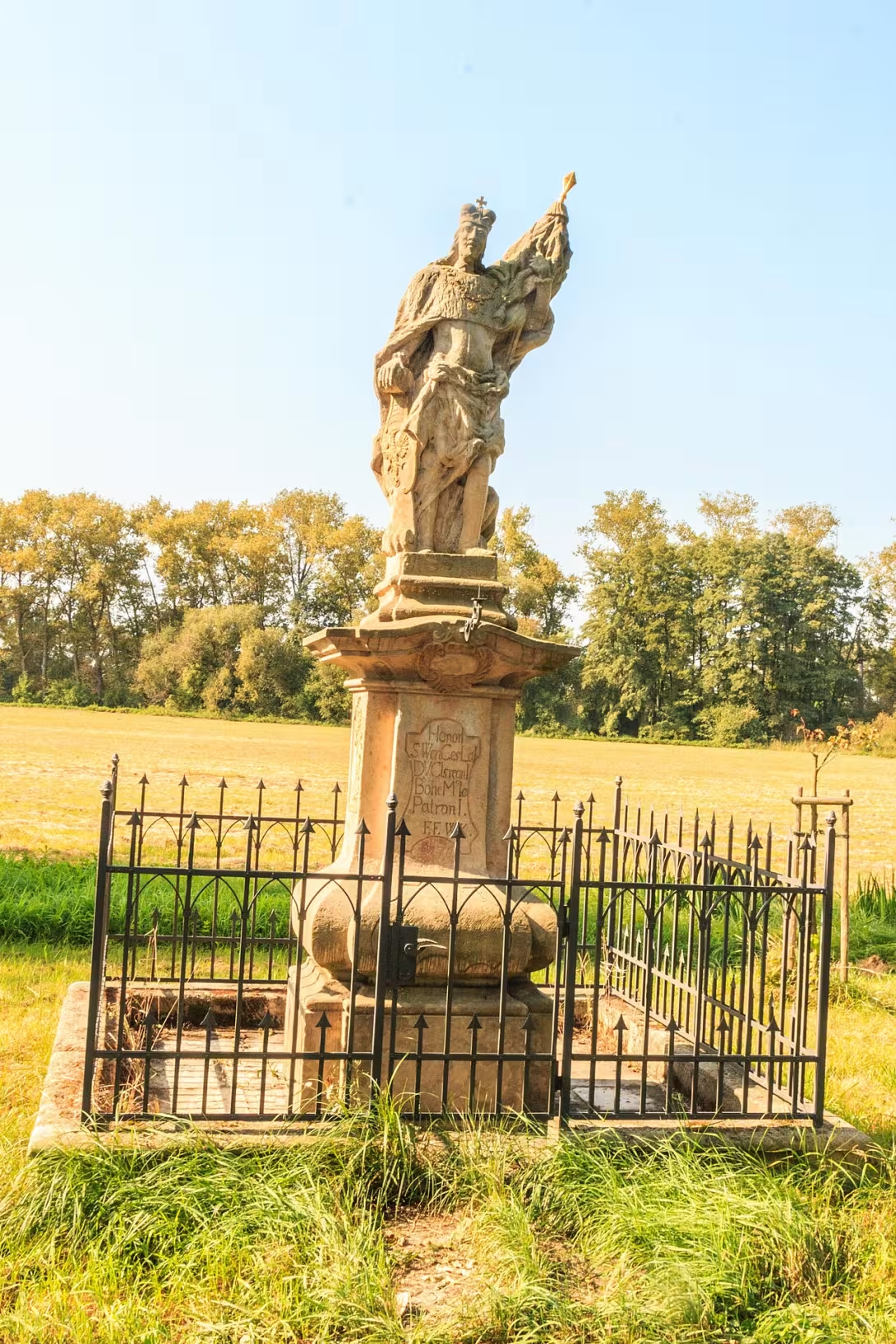

The historical appearance on the left is an AI-generated visualisation and serves as inspiration only.
Historical milestones
- 1770
- formation of the statue
- 2006
- registration in the register of real cultural monuments of the Czech Republic
- 2013
- restaurant statues
Architectural development
The building is made of sandstone in late Baroque style. It consists of a prism plinth, a pillar with a ledge and a metal candlestick and a statue itself on its own plinth. The whole file is closed in sandstone fence with cast iron grid.
Historical events
24. 3. 2006 - declaration by the object of the real cultural monument of the Czech Republic; 2013 - restaurant sculpture.
Points of interest
- The column with the statue of St. Wenceslas is a late Baroque sandstone statue from 1770. - The building was declared a cultural monument of the Czech Republic in 2006. - The statue of St. Wenceslas is displayed in life size with crown, shield and flags. - On the pillar are the reliefs of St. George's Killing Dragon and St. Florian Fire House. - The statue was subjected to a restaurant in 2013, which shows its lasting cultural and historical value.
Guide
Show guide text
This text was created by artificial intelligence and has not been editorially reviewed. It may contain inaccuracies.
Welcome to the Smidars at Chotollic! You are standing in front of a unique monument that captures every lover of history and art - a pillar with a statue of St. Wenceslas. This late Baroque view is the real work of the past, which will welcome you with its peaceful impression and historical depth.
Let's look at how this monument came to be. The year 1770 was the year when the statue of St. Wenceslas first appeared on the road leading to the former water mill Medřoč. Although we are not sure of the names of her creators, it is clear that the statue was made with great care and artistic desire. Its creation could be inspired by the need to provide a spiritual shelter to travellers or emphasize the importance of St. Wenceslas for this area.
Look up and you'll see a sandstone statue that stands in life size. Saint Wenceslas is depicted here in a prince's garment with a crown on his head, which reminds him of his importance and position in Czech history. His hands hold the banners, leaning on the shield with the relief of the eagle - symbols of power and protection. On the pillar under the statue you will find the Latin inscription along with the reliefs of St. George's Killing Dragon, which adds another layer of meaning and symbolism.
Now let's focus on architectural details. The statue is placed in a square sandstone fence with a decorative cast iron grate, which gives the overall picture nobility and elegance. This space not only protects the memory from damage, but also creates a quiet place to think.
An interesting aspect of this place is the connection with other historical personalities. In addition to St. Wenceslas, there are references to St. George and St. Florian, suggesting a deep spiritual tradition and connection with the legends and stories that shaped this place.
An interesting fact is that this building was officially declared a cultural monument of the Czech Republic in 2006. This highlights its historical and cultural importance. In addition, the statue was subjected to a restaurant in 2013, which ensures its preservation for future generations.
We wish this monument to develop your knowledge and love of history. Look around, notice the details and let the stories this column with the statue of St. Wenceslas has for treasure. We hope that this experience will be interesting and inspiring for you.
Thank you for your attentive listening and wish you a good day! Don't forget to also explore the other beauty this area offers.
Tips for visitors
The best time to visit the column with the statue of St. Wenceslas is during the summer months when the weather is favourable and lighting is ideal for photography. The sun enters a position that illuminates the statue from the outside in the afternoon, allowing it to capture its details.
For those travelling by public transport, it is advisable to check current connections in previous days using a search engine to get as close to the location as possible. Transportation to the Smidars is quite comfortable.
When visiting, take a suitable suit according to the weather because there is often a wind. Photographers should bring their equipment and perhaps a monopode for stable images of the statue. It is advisable for families with children to prepare toys or books because there is no internal space to stay.
Photography of the column with the statue of St. Wenceslas offers several perspectives. The best place for images is from the outside, from the road towards Chotelice, where it is possible to capture the overall picture of the statue and its surroundings. Sunlight at noon provides the best conditions for details.
In the immediate vicinity is the former water mill Medřeč, which can be an interesting other attraction. It is also possible to take a short walk around the surrounding area and enjoy the natural environment. For families with children it may be interesting to watch the water move around the old mill.
Frequently asked questions
Can the monument be visited?
This is a structure in a public space that can usually be seen from outside free of charge. We have not verified that this particular one is freely accessible.
Where is the monument?
Location: Smidary. The map on this page shows the exact spot.
Why is the monument protected?
It is listed in the Central List of Cultural Monuments of the Czech Republic as a cultural monument (register no. 1755442126).
Businesses nearby
Do you run a restaurant, accommodation, shop, museum, rental, wellness or other visitor service near this monument? Show yourself directly to the people heading to it — this is how they will see you in the app and on the web:
Nearby
V bezprostřední blízkosti se nachází někdejší vodní mlýn Medříč a silnice směr Chotělice.
Accommodation nearby
Themed route
Thematic cruise route from the village Smidary
1.Sloup se sochou svatého Václava (Smidary)
Type: Historical monument
Why is it worth visiting: This column is an important symbol of local tradition and spirituality. The statue of St. Wenceslas, patron saint of Bohemia, reminds of the historical and cultural value of the area.
2. The former water mill Medřoč
Type: Historical monument
Why is it worth visiting: The mill is a witness to the past life of the village, when water played a key role in production and everyday life. Its architecture and location on the river Medřeč offer a view of the past.
3. Road direction Hostile
Type: Natural walk
Why is it worth a visit: This road offers a beautiful view of the surrounding countryside and is an ideal place to relax after visiting the sights. The road leading to Chotolice allows you to enjoy a quiet moment in the company of nature.
This route offers a combination of historical and natural experiences that are easily accessible near the village Smidary.
Seasonal recommendations
Spring: In the spring period, the Sloup with the statue of St. Wenceslas in Smidar is lit by sunlight, which gives the monument a live shine. Flowers around the object begin to bloom and bring their characteristic scent to the surroundings. The atmosphere is full of new breaths and promises beautiful days. For a visit it is recommended to wear light clothes because temperatures may be medium, but prepare for possible rain or moisture. The best time for a tour is usually in the morning or in the evening when there are fewer people and temperatures are milder.
Summer: In summer, the Pláp with the statue of St. Wenceslas in Smidar takes up life thanks to long sunny days. The dazzling lighting increases the beauty of the statue and surrounding nature, which is full of flowering plants and green leaves. The atmosphere is warm and visitors enjoy the outdoor environment. It is recommended to wear light clothes, sunflower and perhaps an umbrella for possible lunches. The best time to visit is in the morning or in the evening to ease the sunburn.
Autumn: In autumn, the Sláp with the statue of St. Wenceslas in Smidars becomes melancholy beauty due to changing colour tones of leaves. Sunshine sundays take turns with cold and wet bottoms, which adds mild weathering to the atmosphere. For visiting, it is advisable to wear multi-layer clothes to protect yourself from cold and possible rain. The best time for a tour is in the morning or in the evening when there are fewer people and temperatures are mild.
Winter: In the winter months, the Sláp with the statue of St. Wenceslas in Smidar is gaining character due to the snow blanket and the icy atmosphere. Sun rays that shine through the clouds illuminate the statue and its surroundings in a strange way. The atmosphere is calm and sometimes dull. It is recommended to wear warm clothes, including hat and gloves to protect yourself from cold. The best time to visit is in the morning or in the evening when there is a softer temperature and fewer people.
Visualizations and artistic views


The visualisations are generated by artificial intelligence and serve as inspiration.
Photos from the area
Real photos taken near the monument


Zdroj a licence jsou uvedeny u každého snímku.
Tips from visitors
No tips yet. Be the first!
Log in and add your tip.
Sources and literature
Photos: Petr1888 / CC BY-SA 4.0 — Wikimedia Commons. The author and licence also appear when you hover over the image.
Faktickým podkladem tohoto textu byl článek na Wikipedii, jehož autory jsou přispěvatelé Wikipedie. Článek je dostupný pod licencí CC BY-SA 4.0.
Location on the map

Příběhy a pověsti
Legendy, pověsti a příběhy spjaté s touto památkou
Fotografie návštěvníků
Zatím žádné fotografie. Buďte první, kdo přidá fotografii z návštěvy!
Log in a přidejte svou fotografii nebo hodnoťte.
Za ověřenou návštěvu v aplikaci získáte víc bodů — poznáme podle GPS, že jste na místě.
Reviews and comments