



Socha svatého Jana Nepomuckého (Smidary) Statue
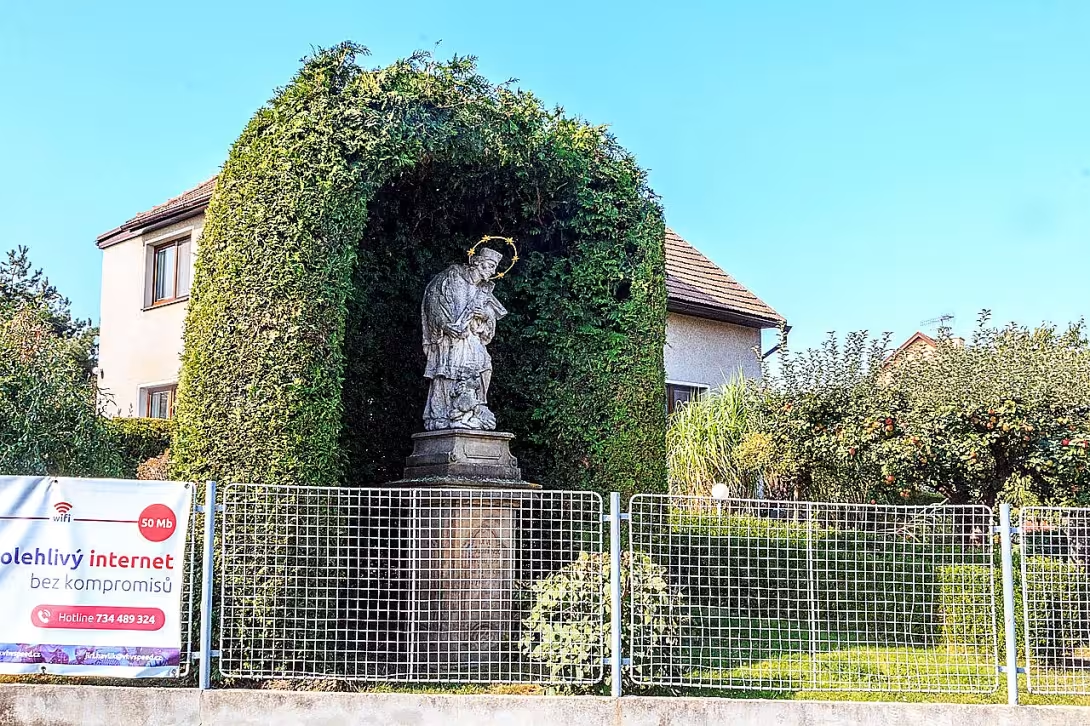
The Baroque sandstone statue of St. John Nepomuk in the Smidars in Králové Hradeck dates back to 1726. Since 2007 it has been protected as a real-estate cultural monument of the Czech Republic. The work of an unknown author is remarkable by its unconventional location in the natural niche, which forms an uprooted bush of winter-strase.
The statue was created during the period of the high Baroque. At that time, St. John Nepomuk's cult in the Czech countries was strongly supported as a symbol of Catholic counter-Reformation and national identity. The exact circumstances of the work are unknown and the creator remains anonymous. However, the 1726 is evidenced directly in the monument by a chronogram carved in the cartouche on the front of the pillar.
The object is carved out of sandstone and is slightly undersized. The saint is depicted in traditional clothing with a biret on his head and a halo. With his left hand, he hugs the crucifix to which he puts his face, while with his right hand he holds it from the bottom. The figure of putti at the feet of the saint looks up to him. The whole sculpture rests on the pillar of the ledge on which the plinth is decorated with volutes and a simple frame.
The monument is located in the garden of the house near the intersection of the road leading to Loučná Hora. In 2003 it underwent a professional restoration which ensured its preservation for future generations. Since 1st March 2007 the building has been officially listed in the list of real cultural monuments of the Czech Republic.
Today this Baroque sculpture is accessible to the public within the village Smidary. Visiting the site offers the opportunity to see a demonstration of period sacral creation. Thanks to the untraditional fit into the hedges of the honeysuckle, this is a unique example of the connection of the artwork with the natural element.
Then and now
Drag the slider to compare how the landmark may have looked when it was built with the view today.
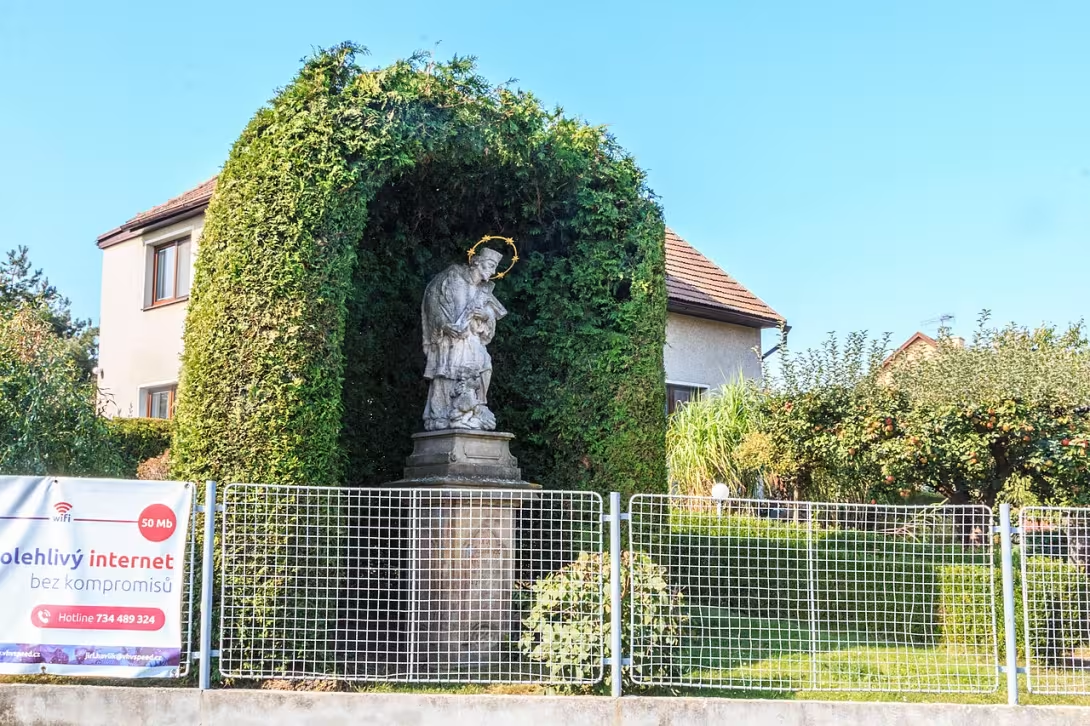
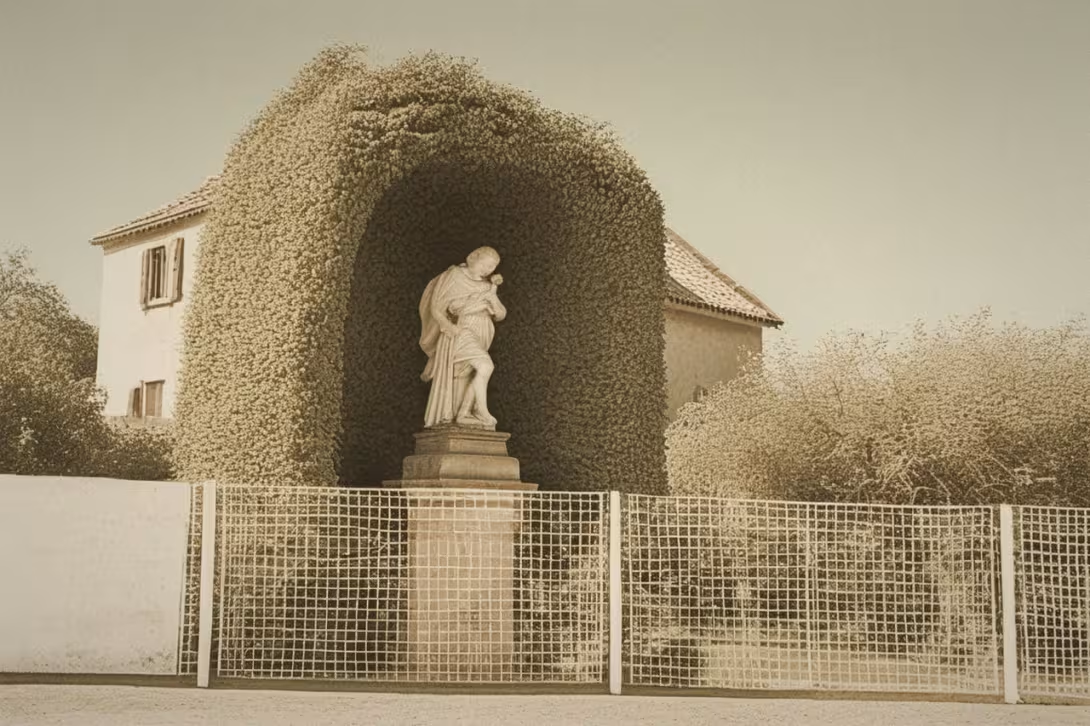
The historical appearance on the left is an AI-generated visualisation and serves as inspiration only.
Historical milestones
- 1726
- The creation of a statue, supported by a chronogram on the front of the pillar.
- 2003
- Restoration of the monument performed.
- 2007
- Statue declared a real-estate cultural monument of the Czech Republic.
Architectural development
The statue is carved from sandstone and placed on a pillar ended by a ledge. On the ledge there is a falcon with volutes and an decorative frame, on which the figure of the saint itself lies in traditional garment with biret and halo.
Historical events
The statue was restored in 2003. Since 1 March 2007, the statue has been protected as a real-estate cultural monument.
Points of interest
- The statue is remarkable by its untraditional location in the natural niche, which forms an uprooted shrub of the honeysuckle. - A thousand seven hundred twenty-six are documented directly in the monument by a chronogram carved in the cartouche on the front of the pillar. - The work is carved from sandstone and is slightly below-life size. - There's a little angel at the feet of a saint who looks up to him. - The monument is located in the garden of the house near the intersection of the road leading to Loučnou Hora.
Guide
Show guide text
This text was created by artificial intelligence and has not been editorially reviewed. It may contain inaccuracies.
Welcome to the picturesque town of Smidary, where time seems to run slower and where every alley hides its own story. You are standing at the intersection of the road leading towards Loučná Hora and in front of you there is a view of one of the most beautiful and untraditional pieces of baroque sculpture in this area. It is not a magnificent cathedral, nor an impressive castle, but a modest but extremely impressive statue of St. John Nepomuk. The first thing that will probably stop you is not the holy one, but the place where it is. This monument does not stand out on the high square or on the edge of the road, but is gently, almost secret, stored in a natural niche. The growing bush of the winter-grass forms a natural green gate around the statue, which protects it and also distinguishes it from ordinary street statues. It's a place that requires you to stop, listen to silence, and let this unusual atmosphere of peace and respect affect you.
Let's move a step closer so that we can better understand what is happening to us. This Baroque sandstone sculpture was created in 1726, which is the time when the Baroque was at its absolute peak in our borders. Although the name of the author remains unknown for history, his work speaks a clear and eloquent language of that time. The saint is displayed in a slightly sublife size, which gives him a human, accessible dimension, although his attitude emits spiritual size. It stands on a solid pillar which is richly decorated with embossed cartouche. These decorative elements are not just an ornament, but they carry a deeper meaning. On the front side of the pillar, in one of these cartouche, is carved a chronogram that confirms the year of creation of the work. It is proof of how carefully this work was planned and carried out, even though after centuries we no longer know the hands that shaped it.
Now pay attention to details that reveal the skill of the master. Look up at St. John Nepomuk's head. His expression is focused, clung to the sky, which is typical of the baroque iconography of this saint. He holds a crucifix in his hands, a symbol of his martyr's death and his loyalty to his sanctification. This statue is not just a static object, but it captures the moment of spiritual tension and prayer. Its material, sandstone, has a warm, yellowish colour, which contrasts beautifully with the dark green leaves of the honeysuckle around it. Sandstone is a stone that changes its appearance with time, and it is the patina of years that lie on it that gives the whole piece a melancholy beauty.
The key story attached to this monument is the story of St. John Nepomuk himself. He was a Czech priest, musician and martyr who was drowned in the river Vltava in 1393 for refusing to reveal the secret of the holy confession. His worship was widespread in the Czech Republic mainly in the 18th century, that is, at the time this statue was created. People liked him as a patron of the flood, but also as a protector of loss and guide in mental crises. The location of the statue in such a hiding place, protected by nature, may symbolize the protection and solace that Saint John brought to the believers. He was their silent guide in difficult times.
The interesting thing that makes this monument unique is that it is not displayed directly in the public area, but is privately, but accessible, located in the garden by the house. This unconventional way of presenting an art work is quite rare in the Baroque. Wintercraft, the bush that surrounds the statue, is not a random choice. Winterfell is a evergreen shrub that symbolizes the eternity and imperfections of faith. Its thick branches form a kind of natural canopy that protects the statue from rain and snow, but also covers it in the atmosphere with a mystery. It is a place where human work and nature unite into a harmonious whole.
The history of this monument does not end in 1726. In 2003, the statue was subjected to a thorough restoration, which returned its original beauty and saved it from further disintegration. The sandstone is a weather sensitive rock, and without maintenance, it could fall apart in a few decades. Restaurant work was necessary to preserve this cultural heritage. And in 2007, the statue was officially declared a cultural monument of the Czech Republic. This award confirms its importance not only for the city of Smidary, but for our entire culture.
Imagine what this statue looked like over 300 years ago. It was probably freshly carved, with sharp edges and bright sand. Wintering around her may have been a small seedling that has grown with time to its present size. The people who walked through here probably stopped to light a candle or pray for a while. Today you walk through here, and even though you may not know who Jan Nepomuk was, you feel the strange atmosphere of the place where the prayer took place.
Let's stop for a while and listen to the silence. You hear the roar of the leaves of the honeysuckle, which is the only sound in this corner. This sound is like music that accompanies your visit. The statue watches you with its stone eyes, which are clothed in a palate of time. He is a silent witness to history who has seen the coming and going of many generations. His presence here is not random, but he is the result of long-term respect and care for this place.
If you look more carefully at the relief cartouche on the pillar, you'll see how finely worked out they are. Every line, every detail was carved with love and precision. This is proof that even then it was believed that art was to serve God and the people. The statue isn't just a decoration, it's a spiritual statement. It's an invitation to think, to pray, to seek peace within yourself.
This monument is also proof of the importance of protecting cultural heritage. Without restoration in 2003, it could now only be a pile of broken stone. Without a declaration for a cultural monument in 2007, it could easily be damaged or even destroyed. We therefore thank those who take care of it and who ensure that future generations can also be inspired.
Now that you've met the story of this statue, you have the opportunity to take a closer look. Get closer to the pillar and look at the chronogram. Try to imagine what happened when this inscription was carved. Was
Tips for visitors
The best time to visit is during the morning hours when the sun lights up the front of the sandstone statue and highlights the details of baroque art. Due to the location in the garden next to the house, the light at this time is the most suitable for viewing and observing the fine features of the sculpture work.
For photography, I recommend using a wide-angle lens to capture the statue in the context of the surrounding space. The best pictures can be taken from the pavement at the crossroads, where there is a good view in memory without having to enter private property.
On your way to Smidar, take a telescope to help you explore the details of the statue of St. John Nepomuk, especially if you are watching it from a greater distance from the garden fence.
The village Smidary is located in the district of Hradec Králové, which offers a quiet atmosphere for a short walk.
You can bring the story of St. John Nepomucký to children as a protector of bridges and water, which can be an interesting specialization of the trip to eastern Bohemia.
Frequently asked questions
Can the monument be visited?
This is a structure in a public space that can usually be seen from outside free of charge. We have not verified that this particular one is freely accessible.
Where is the monument?
Location: Smidary. The map on this page shows the exact spot.
Why is the monument protected?
It is listed in the Central List of Cultural Monuments of the Czech Republic as a cultural monument (register no. 1754733937).
Businesses nearby
Do you run a restaurant, accommodation, shop, museum, rental, wellness or other visitor service near this monument? Show yourself directly to the people heading to it — this is how they will see you in the app and on the web:
Nearby
Obec Smidary v okrese Hradec Králové, v blízkosti se nachází silnice na Loučnou Horu.
Accommodation nearby
Themed route
1. Municipality of Smidary (type: settlement). Start your journey in this location. It's a good starting point for the whole trip. 2.Socha svatého Jana Nepomuckého (Smidary) (type: statue). This is the main objective of your visit. This monument is the center of the route. 3. Roads on Loučné Hora (type: path). This road is located nearby. It offers a route for walking around.
Seasonal recommendations
In the spring, the statue comes alive with fresh green and blooming nature, creating an optimistic atmosphere. The soft spring light gently hits the stone surface of the Holy One. We recommend dressing in layers, so that you don't get cold wind, and visit the place in the morning when the air is the cleanest.
In the summer months, the area is dominated by green and intense sunlight, which highlights the details of the statue. The atmosphere is hot and calm. The best time to visit is early morning or late evening when the sun doesn't burn. Remember light clothes and sun protection.
Autumn brings colorful leaves and frequent fogs to Smidar, which give the memory a mysterious and melancholy touch. The light is golden in this period and comes from lower positions. It is advisable to carry a waterproof coat or umbrella and a warm sweater for a comfortable tour.
In winter, the statue may look very dramatic, especially if it is covered by a layer of snow. The contrast of white precipitation and grey stone makes the air very clean and quiet to form a brave mood. For the cold, choose warm shoes, gloves and a hat so that the cold doesn't drive you out quickly.
Visualizations and artistic views


The visualisations are generated by artificial intelligence and serve as inspiration.
Photos from the area
Real photos taken near the monument


Zdroj a licence jsou uvedeny u každého snímku.
Tips from visitors
No tips yet. Be the first!
Log in and add your tip.
Sources and literature
Photos: Petr1888 / CC BY-SA 4.0 — Wikimedia Commons. The author and licence also appear when you hover over the image.
Faktickým podkladem tohoto textu byl článek na Wikipedii, jehož autory jsou přispěvatelé Wikipedie. Článek je dostupný pod licencí CC BY-SA 4.0.
Location on the map


Příběhy a pověsti
Legendy, pověsti a příběhy spjaté s touto památkou
Fotografie návštěvníků
Zatím žádné fotografie. Buďte první, kdo přidá fotografii z návštěvy!
Log in a přidejte svou fotografii nebo hodnoťte.
Za ověřenou návštěvu v aplikaci získáte víc bodů — poznáme podle GPS, že jste na místě.
Reviews and comments