



Sloup se sousoším Nejsvětější Trojice (Kynšperk nad Ohří) Holy trinity column
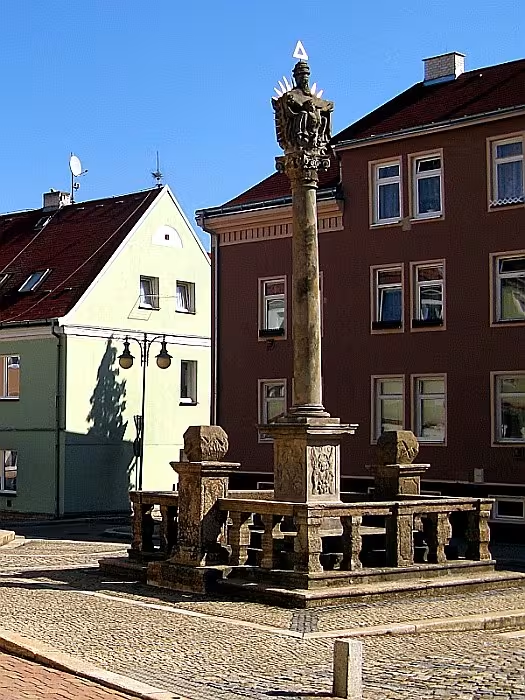
The column with the statue of the Holy Trinity in Kynjejnik nad Ohří is a Baroque sculpture from 1700. The townspeople had him erected as a votive gift for saving the city with plague wounds. The monument stands on Peace Square in the historical heart of the town in Sokolov district and since 1963 it has been protected as a cultural monument.
The creation of the building is evidenced by the inscription with the year MDCC (1700). During the period of the high Baroque, it was common in European cities to build pestilence columns as a sign of piety and thanks for the end of epidemics. The author of the work was Cheb sculptor Vilém Felsner.
The construction consists of a Corinthian column on a square support. On the prism plinth is carved German inscription, which in translation means: "To honor the Holy Trinity, this column was erected in 1700." The decoration is supplemented by the relief of thorn crowns, acantic ripples on the sides and figure relief on the back. At the top of the pillar is a two-sided sculpture of the Holy Trinity in the iconographic type of the Throne of Grace, where God the Father hides under the cloak of the Son. The main construction includes a balustrado made of grey-ochre granite, which originally carried statues of St. John Nepomuk and St. Judy Tadeas. The column and the statues were made of fine to medium grain sandstone.
History of the monument in the 20th century marked the poor technical condition and degradation of the material. Already in 1931, the State Monument Office drew attention to the heavily stale sandstone parts and to the threat of accompanying statues. The City Council then carried out only partial corrections for financial reasons; total reconstruction took place in 1937. After World War II, the state of the building continued to decline, leading to the loss of both statues of saints. Balustrad was not repaired until 1988-1990.
The last extensive restoration took place in November 2000, when the surface of the stone was cleaned, molten and preserved. In 2001, the sculpture was supplemented with a gilded halo made of copper sheet, made according to period photographs. The check in June 2003 confirmed that the monument is in good condition and the metal clamps are not corrosive.
Today the column is an important piece of Baroque sculpture and a reminder of the history of the city. Visitors can look directly at the Square of Peace, where they form an important element of the historical centre of Kynbrilk nad Ohří. The object offers insight into religious life and artistic feeling in the early 18th century.
Historical milestones
- 1700
- Raise the column of the Holy Trinity.
- 1963
- Writing between cultural monuments.
- 2001
- Complement the halo according to period photographs.
Architectural development
The original Baroque work from 1700 was made of sandstone, and the balustrad is made of granite. During the 20th century the monument suffered material degradation and loss of accompanying statues of saints. In the years 1988- 1990 the balustrad was repaired and in 2001 the sculpture was supplemented by a gilded halo.
Historical events
1700: Storing the column as a thank you for saving the city of plague. 1963: Declaration for cultural heritage. 2000: Last extensive restoration of the monument.
Points of interest
- The column was built by townsfolk as a gift for avoiding plague wounds in the city. - The author of the work was sculptor Vilém Felsner, who came from Cheb. - At the top of the column is God the Father who hides the Son under his cloak. - The grey-ochre granite balustre originally included the statues of St. John Nepomuk and St. Judy Tadeas, which later disappeared. - In 2001 a gilded halo made of copper sheet according to old photographs was added to the sculpture.
Guide
Show guide text
This text was created by artificial intelligence and has not been editorially reviewed. It may contain inaccuracies.
Welcome to Kynjewelry above Ohří, near one of the most famous monuments of this city - a pillar with the statue of the Holy Trinity. You are now faced with a fascinating baroque work that will undoubtedly impress you with its beauty and historical significance.
This column was erected in 1700 as a veto gift for townspeople. It was a time of fear and hope because the city avoided the plague. The townspeople decided to pay tribute to their gratitude for this monumental work. Authorization belongs to the Cheb sculptor Vilém Felsner, who breathed into this monument and created not only artistic value but also an emotional connection between people and their faith.
Take a look up at the Corinthian column with the top sculpture of the throne of grace. Notice the elegant design that attracts attention and leads the eyes to a celestial image. At the top is God the Father who hides the Son under his cloak - a symbol of protection and grace.
It is interesting to realize that this column was not only an artistic work, but also a connection between people in times of crisis. Although particular historical figures are not known, it is clear that it was a joint effort and faith that led to its creation.
In 1963, this column was officially recognised as a cultural monument. And as far as interesting things are concerned, until 2001, the halo was added to the top according to the period photographs to make the image as close to the original appearance as possible.
Let's move on and see more details. Note the balustrade made of grey-ochre granite, which once supplemented the statues of St. John Nepomuk and other saints.
This column is really a unique work that combines art, history and faith. Try the atmosphere of this monument and be approached by its meaning.
Thank you for your visit! If you are interested in further exploring Kynjejk over Ohří, you will find many other attractions. Be happy and continue your discovery!
Tips for visitors
The best time to visit is in the morning or during the golden watch before sunset, when soft light will highlight beautifully baroque details of sculptures and plastic shapes of figures. At this time the square is quieter and the sun rays create interesting shadows on the stone surface.
For photography I recommend to choose a wide-angle lens for capturing the entire column in the context of the historical building of the square. If you want detailed images of statues, use a longer focus that allows you to capture the delicate features of the faces and the dynamics of the robes without the need to approach the monument directly.
When visiting with children you can use the square space to walk and tell stories about the history of the city. The monument serves as a great starting point for exploring baroque art, which thanks to its monumentality will attract younger visitors.
In the immediate vicinity of the monument is located the historical center of the city, which encourages you to walk between ancient houses. After a tour of the square you can go to the nearby Ohří River, whose shores offer a pleasant environment for relaxing and observing nature near the city building.
Bring comfortable shoes for walking on historic tiles and a camera. Since the monument is located in public space, no special equipment is needed, only good mood and desire to discover the beauty of baroque sculpture in the open air.
Frequently asked questions
Can the monument be visited?
This is a structure in a public space that can usually be seen from outside free of charge. We have not verified that this particular one is freely accessible.
Where is the monument?
Location: Kynšperk nad Ohří. The map on this page shows the exact spot.
Why is the monument protected?
It is listed in the Central List of Cultural Monuments of the Czech Republic as a cultural monument (register no. 1000157568).
Businesses nearby
Do you run a restaurant, accommodation, shop, museum, rental, wellness or other visitor service near this monument? Show yourself directly to the people heading to it — this is how they will see you in the app and on the web:
Events nearby

Zdroj akcí: otevřená data měst a obcí ČR (Národní katalog otevřených dat) a kalendář akcí Národního památkového ústavu.
Nearby
Historické centrum města Kynšperk nad Ohří, řeka Ohře.
Accommodation nearby
Trips and activities nearby
Guided tours, tickets and activities nearby from GetYourGuide
Affiliate link: if you buy from the partner, we may receive a commission. The price for you does not change.
Search tours and activities →Themed route
1. Historical center of the city Kynšperk nad Ohří (Type: City area) - Explore the old alleys and explore the atmosphere of this place. 2. The column with the statue of the Holy Trinity (Type: Memorial) - Admire this Baroque work of art, which is the main point of your journey. 3rd River Ohře (Type: Water flow) - Visit the shores of water for a quiet ending of your walk.
Seasonal recommendations
Spring In the spring months the space around the pillar is refreshed with the first green shoots and flowering bushes, which gives the Baroque sculptures a fine, lively contrast; The morning sun breaks the dew fog and silver breaks on stone coats, creating ideal conditions for shooting details without harsh shadows. The visit is suitable for late afternoon hours when the light is warmer and the local pavement is dry after possible morning rains; wear a layer with a light wind jacket, suitable for possible wet lawn edges and expect a quieter atmosphere than in full season.
Summer The high summer sun illuminates the memory of the peak, which requires a choice of time either early in the morning or later in the afternoon to avoid bulking surfaces and hard contrasts in photographs; trees nearby give a rare shadow, but their crowns can limit the view of the upper parts of the column. Wear a hat, sunglasses and sufficient drinking, shoes freely for walking through squares; The room around the monument can be more lively in the high season thanks to the passages of tourists and cyclists, so for a more peaceful tour choose a working day.
Autumn The golden to red leaves of surrounding trees and shrubs cover the columns into warm colored gamma, which amplifies the dramatic expression of the Baroque and creates a romantic, slightly melancholy mood with a stronger, softer light; Early frown or light fog gives a mystical touch. Customize the clothes with unstable temperature - warm top, scarf and bulletproof layer are necessary, shoes with good profile will help on wet leaves and possible mud; The evenings start early, so plan to visit late afternoon for enough daylight.
Hot, non-release layers, hat, gloves and shoes with anti-slip heel are essential; daylight is short, so the best time is around noon when visibility is best and temperature is highest.
Visualizations and artistic views

The visualisations are generated by artificial intelligence and serve as inspiration.
Photos from the area
Real photos taken near the monument


Zdroj a licence jsou uvedeny u každého snímku.
Tips from visitors
No tips yet. Be the first!
Log in and add your tip.
Sources and literature
Photos: Sovicka169 / CC BY-SA 4.0 — Wikimedia Commons. The author and licence also appear when you hover over the image.
Faktickým podkladem tohoto textu byl článek na Wikipedii, jehož autory jsou přispěvatelé Wikipedie. Článek je dostupný pod licencí CC BY-SA 4.0.
Location on the map
Příběhy a pověsti
Legendy, pověsti a příběhy spjaté s touto památkou

Fotografie návštěvníků
Zatím žádné fotografie. Buďte první, kdo přidá fotografii z návštěvy!
Log in a přidejte svou fotografii nebo hodnoťte.
Za ověřenou návštěvu v aplikaci získáte víc bodů — poznáme podle GPS, že jste na místě.
Reviews and comments