



Slovanský dům Building
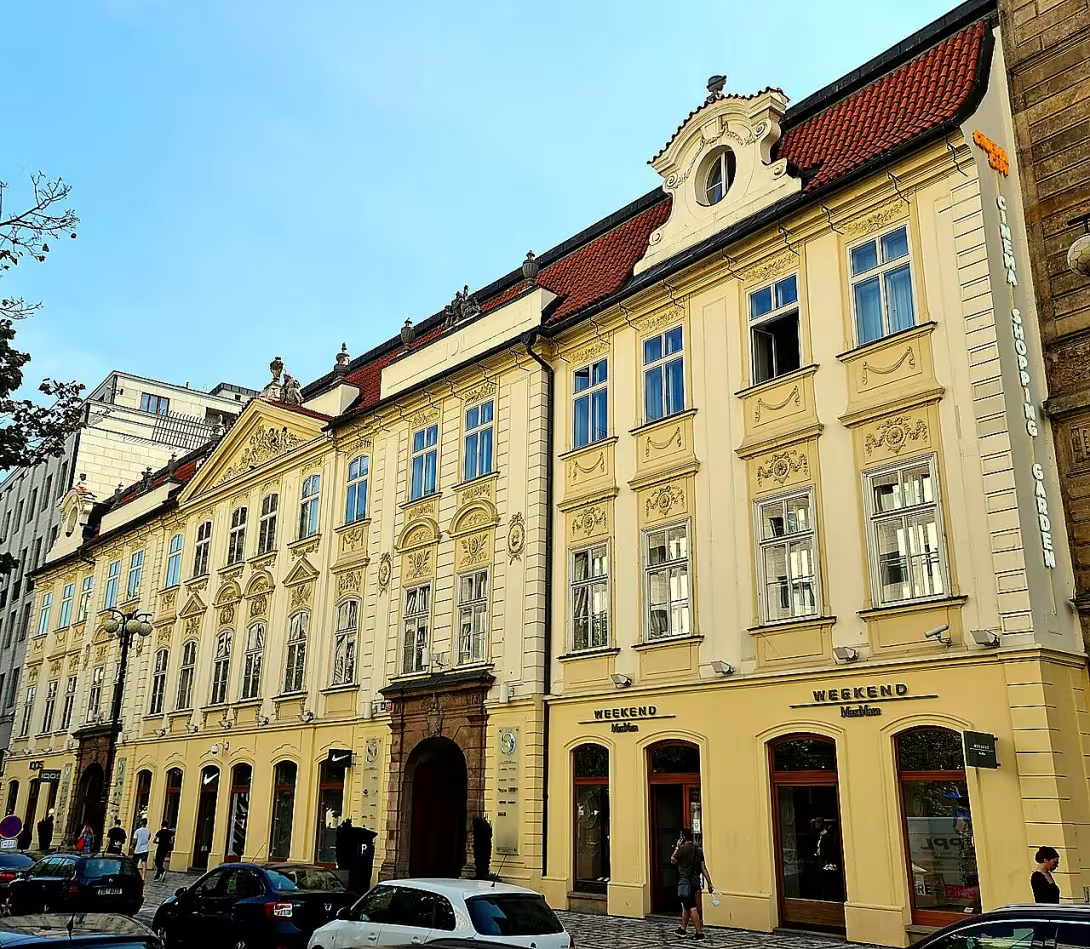
Slovanský dům is an important social, cultural and business center located in the street On a ditch in Prague 1. The core of this complex is a classical palace, which was built around 1697 as the original Baroque residence and since 1964 it has been protected as a cultural monument. The building occupies the position of one of the dominant center of the capital and has undergone a number of significant building and social changes throughout its history, from the noble residence to the German Federal House to the modern multifunctional complex.
The creation of the original building dates back to the end of the seventeenth century, namely around 1697, when the Baroque palace was built for Jan Bartholomew Vernier of Rougemont. At that time, the Czech countries were in the Baroque period, marked by the renewal and construction development after the 30-year war, while Europe was going through an era of consolidation of absolute sovereign powers and significant cultural changes. This period is also linked to the creation of a French garden in the splendor of the palace, which is captured on the copper-engraving of Kaspar Wussin from 1700.
The main building of the current site bears traces of several construction phases. The original Baroque palace, known as Vernierovský, was preserved early Baroque, including two portals during the Classicist reconstruction around 1797, but both extreme wings were raised. This reconstruction was designed for Jan V. Tuskany by František Heger and according to the book of Prague builders, Ignác Alois Palliardi was also involved. In the following centuries there were other modifications, for example between 1933 and 1934 he modernized the interior of Fritz Lehman. At the end of the twentieth century, the whole complex underwent extensive reconstruction according to the project completed by Subterra in 2000. The construction of a new multicinema building and the modification of the premises surrounding the former courtyard were included, and the area can be passed from the Na trench street to the Senovážné square.
The list of owners and administrators of the palace reflects changes in Prague's society. After the first owner of Jan Bartholomew Vernier of Rougemont was owned by Count Vršovci and Příchovský. Since 1797 it belonged to Janu V. Tuskany, bought by real estate speculator Josef Likawetz in 1833 and was acquired four years later by textile entrepreneur Leopold Dormitzer, after which he inherited Babetta Dormitzerová. In 1873, the building was purchased by a German association. After World War II he became the owner of the Czechoslovak State and since 1997 he has been owned under the City of Prague, which rented him for 77 years to the Prague Communications and Social Centre. The cost of a major reconstruction at the end of the twentieth century exceeded one billion crowns in the then prices and one of the companies of the entrepreneur Sebastian Pawlowskiego was an investor.
The use of the building has changed significantly over the years. In 1825, shops and warehouses began to emerge on the ground floor, while floors served for residential purposes. Leopold Dormitzer has set up a large business and production centre with warehouses, shops, workshops and hostels. Between 1875 and 1945, the object served the German society under the name of the German House and acted as a social and political centre of the German-speaking Pražani known as the Deutsches Casino. In 1945 the object was renamed Slovanský dům. In the seventies of the twentieth century there was a famous wine bar Svíčkárna and one of the great buildings was based in the Central Puppet Theatre since 1950, later the Minor Theatre, which had to be cleaned out before the reconstruction of the end of the century. The building was also housed by a group of German writers and artists in Czech Concordia. Part of the modernized center became a multicinema with ten halls opened on December 6, 2000 by the premiere of the film Boutique. In the following years, international premieres took place with the participation of personalities such as Sean Connery, or the introduction of a picture of the Returning Bottle.
Today, Slovanský dům operates as a lively social, cultural and business center, offering visitors offices, shops, restaurants, cafes and multicinema. It is connected with the Czech National Bank building and the former Earth Bank building in Na trench street. This monument combines the original Baroque and Classicist architecture with the modern operation of the city and represents a valuable proof of the building development of the centre of Prague. Visit Slovanský dům and discover the place where historical building layers meet the contemporary cultural life of the metropolis.
Then and now
Drag the slider to compare how the landmark may have looked when it was built with the view today.
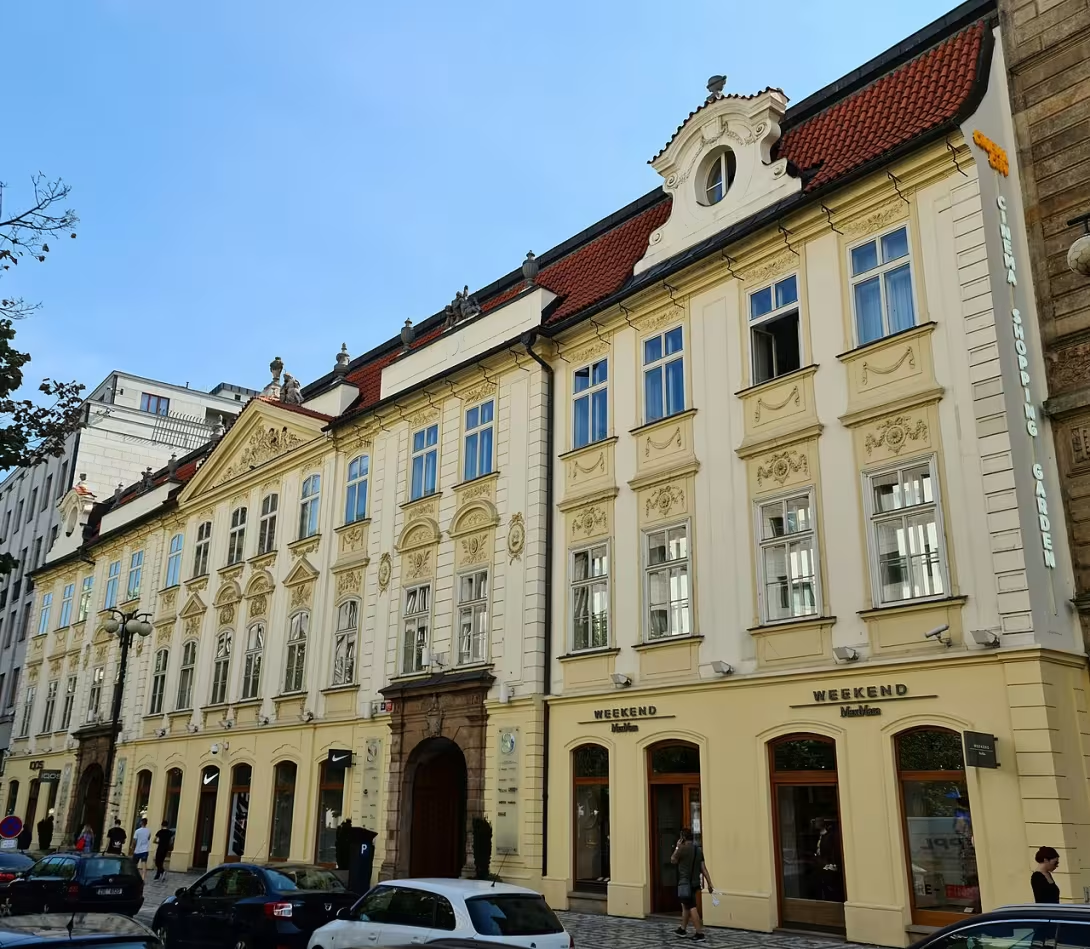

The historical appearance on the left is an AI-generated visualisation and serves as inspiration only.
Historical milestones
- 1697
- Construction of the Baroque Vernier Palace for Jan Bartholomew Vernier of Rougemont.
- 1797
- Classicist reconstruction of the palace for Jan V. Tuscan.
- 1945
- Renaming the object from the German House to Slovanský dům.
- 1964
- The palace was declared a cultural monument.
Architectural development
The original building was built as a Baroque palace around 1697, including a French garden. A classical reconstruction took place around 1797, which preserved early Baroque portals and increased extreme wings. In the twentieth century there was modernization of interiors and at the end of the century there was extensive reconstruction of the entire complex, including construction of multicinemas.
Historical events
1697: Construction of the original Baroque Vernier Palace. 1797: Classicist reconstruction of the palace according to František Heger's design. 1875 to 1945: Use of the building by a German association under the name German House. End of the 20th century: Extensive reconstruction of the complex into a modern social and business center.
Owners
Jan Bartoloměj Vernier z Rougemontu (since 1697), Count Vršovci and Příchovský, Jan V. Tuskany (since 1797), Josef Likawetz (since 1833), Leopold Dormitzer (since 1837), German Association (since 1873), Czechoslovak State (after 1945), Prague Capital City (since 1997 with long-term lease of Prague Communications and Social Center)
Points of interest
- The core of the complex is a classical palace, which was built around 1697 as a baroque residence and since 1964 it has been protected as a cultural monument. - The original Baroque palace was built for Jan Bartholomew Vernier of Rougemont. - In the splendor of the palace was created a French garden which is captured on the copper engraving of Kaspar Wussin from 1700. - From 1933 to 1934, the interior of Fritz Lehman was modernized and the entire complex was remodeled in the late twentieth century. - The costs of major reconstruction at the end of the twentieth century exceeded one billion crowns in the then prices.
Guide
Show guide text
This text was created by artificial intelligence and has not been editorially reviewed. It may contain inaccuracies.
Welcome to this important place of history and architecture - Slavic House, a key point in the centre of Prague, specifically in the street Na trench. You are standing in front of a monumental front that is witnessing the rich historical changes and cultural development of this place. Notice the grandeur of a building whose elegant lines tell stories of the past century.
Slovanský dům has roots dating back to 1697. At that time it was built as a baroque Vernier palace for Jan Bartholomew Vernier of Rougemont, a rich businessman with ambitions to transform his residence in Prague into an impressive residence. As the 18th century came to an end, the palace underwent a classical reconstruction on Jan V. Tuscan's intention, which gave him new elegance and harmony.
Let's move on to the architecture of this impressive object. Look up and notice the facade with its Classicist elements which are the result of the reconstruction of 1797. These details reflect the elegant style of the time when architecture was focused on balance and symmetry. In the splendor space you can see the French garden, which provides a place of quiet atmosphere.
The key personalities associated with this place have enriched his history. Jan Bartholomew Vernier was not the only important name; After him came Jan V. Tuskany, who left his shadow on the classical form of the palace. Other characters like Josef Likawetz and Leopold Dormitzer also played a role in the history of this place.
The interesting thing is that Slovanský dům has undergone several changes to its current form. In 1945 the object was renamed from the German House to the Slovanský dům, which symbolizes a new era in its history. This change indicated the arrival of new values and a sense of place.
Now that we've been through this rich inheritance, the invitation is open for further examination of the Slavic House. Take a look at the shops and cultural space within the building that still attracts visitors from all over the world. We welcome you to further explore this fascinating place and its stories. We hope you enjoy your visit to the Slavic House as much as we do. When we meet again in another historic place!
Tips for visitors
The best time to visit the Slavic House is in the morning, where there is calm and you can enjoy the historical interiors and a landscaped garden without large crowds of people. Take comfortable shoes on the pavement in the surrounding streets and the camera to capture beautiful moments. For photography it is best to use the morning light in the historic garden of the interblock or details of the architecture of the palace. In the immediate vicinity, within 30 minutes' walk you can visit the impressive building of the Czech National Bank, the historical building of the former Zemská banka, the famous street Na Příkopě, nearby Senování Square or the lively Vodickov Street. For families with children this place is great thanks to a quiet garden where small visitors can relax from the busy big city.
Frequently asked questions
Can the monument be visited?
The building is in use (offices, a school, shops and the like). The interior is generally accessible only during operating hours and tours are not usually offered; we have not verified the details. You can see the exterior from the street.
Where is the monument?
Location: Praha 1, Hlavní město Praha. The map on this page shows the exact spot.
Why is the monument protected?
It is listed in the Central List of Cultural Monuments of the Czech Republic as a cultural monument (register no. 1000152038).
Businesses nearby
Do you run a restaurant, accommodation, shop, museum, rental, wellness or other visitor service near this monument? Show yourself directly to the people heading to it — this is how they will see you in the app and on the web:
Events nearby

Zdroj akcí: otevřená data měst a obcí ČR (Národní katalog otevřených dat) a kalendář akcí Národního památkového ústavu.
Nearby
Budova České národní banky, budova bývalé Zemské banky, ulice Na Příkopě, Senovážné náměstí, Vodičkova ulice.
Accommodation nearby
Trips and activities nearby
Guided tours, tickets and activities nearby from GetYourGuide
Affiliate link: if you buy from the partner, we may receive a commission. The price for you does not change.
Search tours and activities →Themed route
1. Czech National Bank Building Type: Historical and current financial institution Why is it worth a visit: This monumental building located nearby represents an important example of interwar modern architecture and the power of money in the heart of the metropolis.
2. Street On the Trench Type: Historical city class Why is it worth a visit: This busy artery, which once defined the border between the Old Town and the New Town, offers a unique walk lined with fancy palaces.
3. Former Earth Bank Building Type: Architectural monument Why is it worth a visit: The building will be impressed by its magnificent facade and art decoration, which reflects the expansion of construction in the turn of the nineteenth and twentieth centuries.
4. Sensational Square Type: Historical area Why is it worth a visit: Open space in the historical heart of the city, where you can admire interesting sculptures and observe the excitement of everyday life.
5. Slovanský dům (Palace) Type: Main destination and social palace Why is it worth a visit: The beautifully renovated complex combines a historic atmosphere with modern shops and a quiet interlock ideal to relax.
6. Vodičkova Street Type: City street Why is it worth a visit: A busy street full of historic houses that will safely guide you through this part of the metropolis and allow you to feel the city's heartbeat.
Seasonal recommendations
Spring brings the awakening nature to the hidden garden yard of this Prague palace, where the sun's rays penetrate through freshly squeaked tree crowns and create a finesse of light and shadow on historical facades. The air smells of wet soil and first flowers in a closed atrium, which attracts peaceful walks without rush. The number of tourists is still acceptable at this time, but on weekends, the inner space is quickly filled by locals looking for peace before urban activity. We recommend wearing a light coat or sweater because spring weather is usually variable and sitting on outdoor benches can be cold. The best time for a peaceful visit is in the morning right after opening, when the sun only rises above the roof of the buildings.
The summer will light up a large interblock with sharp midday light, which is reflected from light plaster and creates a Mediterranean atmosphere, complemented by grown green plants in pots and loud noise from nearby outdoor restaurants. The atmosphere is very lively, full of energy and ubiquitous noise of open-air conversations, which completely changes the nature of an otherwise peaceful place. The main tourist season brings large crowds of people, so it is necessary to count on more full passages and less privacy for historical elements. Choose breathable clothes from natural materials and don't forget the headgear because the temperature is high in a closed yard. The ideal time for arrival is early in the morning or on the contrary in the late evening, when the heat will relax and lighting architectural details will soften the atmosphere.
Autumn covers the whole area in a melancholy veil, when the old trees in the yard drop their golden yellow leaves and autumn fog is caught in the vast passages and windows of the palace. Soft, muted light penetrates the low horizon and makes the ancient brick and stone tiles stand out, creating an ideal environment for chamber lovers. The flow of visitors is falling, which allows uninterrupted admiration of architecture at its own pace. Put on a warm waterproof jacket and tight shoes because fallen leaves can slide on paved roads and the afternoon cold spreads quickly. The best time to visit is a dry afternoon, where there is the greatest silence and space serves as a great refuge from the cold.
Winter will turn this historic palace into a quiet refuge from the cold outside world, with soon-to-come darkness giving rise to artificial lighting, which radiates the entrances with warm rays and creates a festive mood throughout the complex. The air is sharp and frosty, but inside the covered passages there is a pleasant curtain where you can admire clean lines of perfectly maintained buildings without disturbing influences. The number of visitors falls to a minimum, you will only meet a few random bystanders, which guarantees maximum privacy. Winter clothes, i.e. warm coat, hat and gloves are absolutely necessary, especially if you are staying on an outdoor walk by the yard. The best time for a tour is a late afternoon when the lights are on and the city outside is shrouded in the evening's peace.
Visualizations and artistic views


The visualisations are generated by artificial intelligence and serve as inspiration.
Photos from the area
Real photos taken near the monument


Zdroj a licence jsou uvedeny u každého snímku.
Tips from visitors
No tips yet. Be the first!
Log in and add your tip.
Sources and literature
Photos: Ricardalovesmonuments / CC BY-SA 4.0 — Wikimedia Commons. The author and licence also appear when you hover over the image.
Faktickým podkladem tohoto textu byl článek na Wikipedii, jehož autory jsou přispěvatelé Wikipedie. Článek je dostupný pod licencí CC BY-SA 4.0.
Location on the map
Příběhy a pověsti
Legendy, pověsti a příběhy spjaté s touto památkou
Fotografie návštěvníků
Zatím žádné fotografie. Buďte první, kdo přidá fotografii z návštěvy!
Log in a přidejte svou fotografii nebo hodnoťte.
Za ověřenou návštěvu v aplikaci získáte víc bodů — poznáme podle GPS, že jste na místě.
Reviews and comments