






Smírčí kámen U zmrzlých Monument
Smírčí kámen U zmrzlých is a small stone monument from the 17th century, located in the village of Polná in Jihlava. The building is located in a wall off the road II / 351 towards Brzkov. Since 1973 it has been entered in the state list of cultural monuments under the number 32680 / 7-5145.
The foundation of the monument falls into the 17th century, i.e. the period of the Thirty Years War and the subsequent reCatholisation. At that time, small sacral and peacekeeping objects were commonly found in the landscape, which were meant to resemble sudden deaths or tragic accidents. More detailed reports have not been made on the particular circumstances of the stone, but its existence is closely linked to local tradition and folk memory.
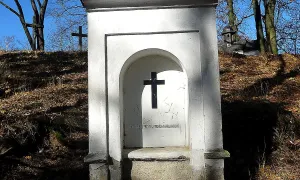
The monument takes the form of a rectangular stone plate with rounded upper corners carved from local material. On the front, there is a Greek cross relief on the mast. Under the shoulders of the crosses are two smaller reliefs that can represent other crosses or swords. The construction is located right in the wall by the road, which is typical of this type of monument.
The location is called The Ice Cream. It directly refers to the legend that a woman with two children froze to death in these places during a violent blizzard. The stone serves as a memento that resembles this human tragedy.
At present, a peace stone is protected as a real cultural monument. For visitors it is an interesting document of historical small architecture, which completes the character of the agricultural landscape of the Bohemian Moravian Highlands. Visiting this place offers the opportunity to stop by the monument, which, after centuries, tells us about the twisted fate of our ancestors in the harsh conditions of nature.
Historical milestones
- Around 1600-1699
- The creation of a peace stone during the period of 30 years of war and reCatholisation
- 1973
- The entry of a peace stone into the state list of cultural monuments
Architectural development
It is a stone cross stone that was carved in the 17th century. The construction uses the local stone and is set in a wall off the road.
Historical events
1973: Registration in the state list of cultural monuments.
Points of interest
- The monument dates back to the 17th century, the period of the Thirty Years' War and Recatolation. - The stone takes the form of a rectangular plate with rounded upper corners and the relief of the Greek cross on the mast. - Under the shoulders of the crosses are carved two smaller reliefs that can represent other crosses or swords. - The name of the place U Ice cream refers to a rumor about a woman with two children who froze to death during a violent blizzard. - The building has since 1973 been entered in the state list of cultural monuments under the number 32680 / 7-5145.
Guide
Show guide text
This text was created by artificial intelligence and has not been editorially reviewed. It may contain inaccuracies.
Welcome to one of those quiet, but extremely talkative witnesses of history, which are often located directly on our travels, and yet in the heat of everyday motion it is perhaps easy to overlook. You're standing in front of the frozen rock. You may have noticed from your approach that this is not a monumental statue or a high monument, but something much more intimate. In front of your eyes is a small, stone plate, which, by its simplicity and rigour, tells a story older than many generations of people who have walked through here. Feel this atmosphere of calm and stopping. This object has a specific shape of a rectangular plate whose upper corners are not sharp, but are finely rounded, which gives the whole stone a certain organic face, as if time tried to wipe out its edges with each next century.
Let us now return together in time to understand why this stone is standing here and what kind of world the people who left it must have moved. This monument dates back to the 17th century. Imagine a period around the years of 26 to 99, when Europe and our countries shook in the foundations. It was a time of thirty years of war, an era of constant movement of troops, uncertainty and profound social change. At the same time, there was a period of reCatholisation, which meant a fundamental change in the perception of faith in the very spiritual life of people. Peace stones like this did not form as mere ornaments. They were legal and moral instruments. At a time when disputes were resolved in a different way than today, these stones were used to express reconciliation after a crime or to commemorate an event that required public recognition and correction. Even if we don't know the names of the individuals behind the creation of this stone, we can imagine them as people of the time - perhaps someone who sought forgiveness, or someone who wanted to write an event that was not to be forgotten.
Now pay attention to the details you have right in front of you. Get closer to the front of the stone and look at what the craftsmen carved into the hard material. The dominant element is the relief of the Greek cross, which is placed on the mast. This symbol has a depth and a presence that immediately captures your view. It is a sign that at that time had a clear moral and religious significance. But if you look even more carefully, under the shoulders of this main cross, you will encounter more, smaller details. Two other smaller reliefs are carved here. And this is where the most interesting part of the tour begins. These small shapes are carved in such a way that their exact form remains the subject of consideration. It could be another minor cross that emphasizes religious quite, or it could be swords that refer to violence or judicial decisions associated with the creation of this stone. This ambiguity of carved characters gives the memory its mystery and makes us think about exactly what the people at the time were trying to write in this stone.
Did you know that this tiny object has great weight in our eyes? Although it may seem like a modest piece of stone by the road, in the year one thousand nine hundred seventy-three it was officially included in the state list of cultural monuments. This confirms that even small things like this are an indispensable part of our history and identity. It is proof that even in oblivion at the edge of the road can be preserved a rare trace of the past.
And what might be the biggest mystery this space has to offer is the name of the site itself. You're standing in a place called The Frozen. Why is this party called that? Is this a reference to some tragic event that took place here in a freezing period? Or is it a name that disappeared in time and remained as an echo of an ancient event? This question remains without a clear answer, and that is what lies in the power of this place. Anyone who passes through here can, in their mind, ask themselves this question and be carried away by imagination.
Now that you've examined this stone and sucked its atmosphere, I suggest you continue your journey. You may be tempted to continue towards Polna or Brzkov, but keep this moment of silence and reflection. Smírčí kámen U zmrzlých is just one of the many clues that history has left us, and its presence here reminds us that even the smallest gesture or the smallest stone can carry within itself the whole world of ancient people, their fears, their faith and their efforts for justice. Thank you for stopping by and paying attention to this silent witness to the past. We wish you a beautiful and inspiring next trip.
Tips for visitors
{'Navsteva': 'The best time to visit is spring or autumn, when the surrounding landscape of the Bohemian Moravian Highlands is the most colourful and the road between Polna and Brzkov offers pleasant conditions for walking without summer heat.', 'transport': 'The monument is located on the second-class road. Parking is possible on the side of the road at a safe distance from the stone, but be careful about the traffic. The location is available by car and public transport, check the current connection in the search engine.', 'equipped': 'We recommend fixed shoes suitable for road and adjacent woods. Don't forget the repellent if you plan a longer walk into the surrounding agricultural landscape.', 'photographers': 'For the purchase of quality stone pictures is ideal soft light during the morning or late afternoon. The object is best photographed from the front to excel details carved into the stone board.', 'of all _ and _ families': 'Visit the historical core of the city Polná, which offers rich cultural activities. For families with children, the surroundings are ideal for easy trips to local forests, where you can combine history with outdoor stays.'}
Businesses nearby
Do you run a restaurant, accommodation, shop, museum, rental, wellness or other visitor service near this monument? Show yourself directly to the people heading to it — this is how they will see you in the app and on the web:
Nearby
City Polná with historical core, surrounding forests and agricultural landscape of the Bohemian Moravian Highlands.
Accommodation nearby
Themed route
1. City Polná with historical core - Type: historical center. Explore the picturesque streets and feel the atmosphere of the old town. 2. Agricultural landscape of the Bohemian Moravian Highlands - Type: rural landscape. Enjoy open spaces and typical shapes of local terrain. 3. Ambient forests - Type: forest vegetation. Take a walk on the trail in a cold place under the trees. 4. Smírčí kámen U zmrzlých - Type: memorial. Discover this important stone that serves as a silent witness to the past.
Seasonal recommendations
In spring, the monument surrounds the awakening green and fine morning sun, which creates a fresh atmosphere. I recommend moisture-resistant shoes, because the surrounding road can be muddy on a defrosted ground. An ideal visit in the morning is when the air is the cleanest.
The summer season brings rich green leaves and sharp light that highlights the details of the stone. Due to higher temperatures and the main tourist season, it is advisable to come early in the morning to avoid clumps of people. Don't forget light clothing and plenty of fluids.
The autumn here is the melancholy, underscored by golden colours of leaves and frequent fog. It's the best time to think and photograph in a soft afternoon light. Get dressed in layered clothes to protect you from the cold wind.
In winter, the monument is very steep and quiet, especially if the stone is covered with a layer of snow. For short days plan your trip in the morning and dress very warm. At this time of year, the memorial is the quietest.
Visualizations and artistic views

The visualisations are generated by artificial intelligence and serve as inspiration.
Tips from visitors
No tips yet. Be the first!
Log in and add your tip.
Sources and literature
Faktickým podkladem tohoto textu byl článek na Wikipedii, jehož autory jsou přispěvatelé Wikipedie. Článek je dostupný pod licencí CC BY-SA 4.0.
Location on the map
More monuments – Polná
Show all in the municipality
Příběhy a pověsti
Legendy, pověsti a příběhy spjaté s touto památkou
Fotografie návštěvníků
Zatím žádné fotografie. Buďte první, kdo přidá fotografii z návštěvy!
Přihlaste se a přidejte svou fotografii nebo hodnoťte.
Za ověřenou návštěvu v aplikaci získáte víc bodů — poznáme podle GPS, že jste na místě.
Reviews and comments