



Socha Nejsvětější Trojice (Jakubovice) Statue
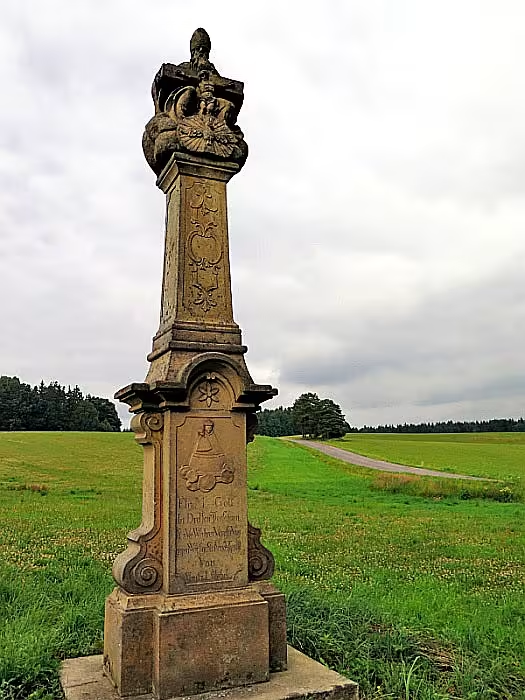
The Baroque sandstone sculpture of the Holy Trinity, located at the field road leading from Jakubovice to Mariánské Hora in Ústí nad Orlicí district, is an important cultural monument of the Czech Republic. This statue, dating back to 1768, represents a key example of baroque art and folk worship in Czech countries. Since 1958 it has been protected as a real-estate cultural monument of the Czech Republic.
The creation of sculpture dates back to the second half of the 18th century, a period of peak Baroque tradition in Czech countries. This was an era of strong influence from the Catholic Church and the development of pilgrimage, which was reflected in the creation of the columns of the Holy Trinity. The chronogram in the monument confirms the year 1768 as the date of its creation.
The architecture of the sculpture is characteristic of the Baroque style, using sandstone and elements of the rocajle. The total shape of the statue includes a low prism base with a pre-set forehead, on which stands a pillar decorated with distinctive voltages. On the pillar there is a conical obelisk of square cross-section, whose embossed motifs and linear fields add the statue richness of detail. The summit consists of the statue of the Holy Trinity: God the Father with the tiara holding the crucifix, at the feet of the dove in the halo representing the Holy Spirit. On the back of the pedestal is carved inscription from 1936, which documents the renovation of the monument.
The history of the statue did not detect dramatic changes in ownership or administration. Its main destiny was the renovation in 1936, which ensured the preservation of its details and aesthetic integrity. In 1958, the statue was officially declared a real cultural monument of the Czech Republic.
Among the key features of the ensemble are the relief of the Virgin Mary with Jesus on the pillar, accompanied by German inscription. This detail shows the multicultural background and influence of different linguistic communities in the region.
Today stands the statue The Holy Trinity as an important historical and cultural point on the road to Mariánska Hora. It is accessible to tourists who are interested in Baroque art and spiritual traditions of Czech countries. Visiting this monument offers not only a view of a beautiful work of art, but also an opportunity to deepen the understanding of the historical and religious context of the area.
Statue of the Holy One The Trinity is not only a monument to artistic importance, but also a witness to the spiritual traditions of the region. It is a reminder of the past and inspiration for current and future generations. Exploring this monument offers a unique view of the rich cultural heritage of the Czech Republic, which makes it necessary for everyone interested in history and art.
Then and now
Drag the slider to compare how the landmark may have looked when it was built with the view today.
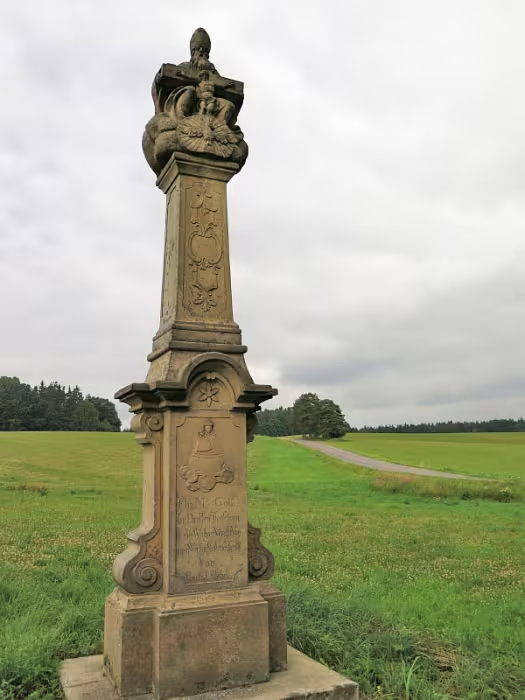

The historical appearance on the left is an AI-generated visualisation and serves as inspiration only.
Historical milestones
- 1768
- formation of chronograms
- 1936
- renovation of the monument
- 1958
- announcement by the object of the real cultural monument of the Czech Republic
Architectural development
The monument is made of sandstone in Baroque style with elements of rocajle. The renovation took place in 1936, which is evidenced by the inscription on the back of the pedestal. The construction includes a pedestal, a pillar with the relief of the Virgin Mary and the ending obelisk.
Points of interest
- Baroque sandstone sculpture The Holy Trinity is an important cultural monument of the Czech Republic. - The chronogram confirms 1768 as the date of its creation. - Since 1958 it has been protected as a real-estate cultural monument of the Czech Republic. - Renovation in 1936 ensured the preservation of details and aesthetic integrity of the statue. - On the pillar is the relief of the Virgin Mary with Jesus, accompanied by German inscription.
Guide
Show guide text
This text was created by artificial intelligence and has not been editorially reviewed. It may contain inaccuracies.
Welcome to this special place where history meets the calm of an open landscape. You are standing on a field road which leads from Jakubovice towards the important pilgrim place Mariánska Hora. Before your eyes, there is a monumental sandstone sculpture that carries the soul of the Vergang century. Feel the atmosphere, how this work of art stands in the middle of nature and how its serious form matches the surrounding space. It's a place that encourages you to stop, to look quietly and to think about what people left behind long before us.
Now let's look at how this sculpture came into being and why it stands here. This Baroque work is not just a random element in the landscape, but a firm point of faith and art. The entire sculpture was created in seven hundred and sixty-eight. At the time when the Baroque style expressed its greatest strength and emotion, this work was carved to remind the divine presence of all those who passed through here. Even though we no longer know the names of the particular architects or sculptors who carved this sandstone, their championships are evident in every detail. They have created a work that has resisted time and which, after centuries, still tells its story through its form and its seriousness.
Now pay attention to the architecture itself and the details you have right in front of you. Look at the foundation on which the whole building stands. It's a solid sandstone base that gives stability to the entire sculpture. Above it you will see a low base, which is the first level of this vertical structure. It makes the prism pillar stick. Notice how this pillar is not simple, but is richly decorated with volutes. These curves, which resemble curved leaves or waves, supply a whole of dynamics and movement, which is typical of the style in which the work was created. There is an obelisk above the pillar. If you approach it, you can see the fine rokaj relief motifs that decorate its surface. These decorative shapes make sandstone light and elegant. And finally, look up to the very top. There is the most important - the display of the Holy Trinity. You will see the God of the Father there, you will see Christ crucified and you will feel the presence of the Holy Spirit. This whole sculpture is a harmonious total, where the strength of the stone connects with the tenderness of artistic detail.
Maybe you can think of someone who visited this place. Even though historical records do not indicate the specific personalities associated with this sculpture, we can imagine thousands of people walking through here before us. It could have been pilgrims who set off on their way to Mariánska Mountain, people looking for spiritual peace or answers to their questions. For them, this sculpture was the point of stopping, the place of prayer and orientation in the landscape. Everyone who stopped here left a piece of their own history and emotions in this place.
But there is also one interesting thing that can interest you. As you've noticed, this work is very old, but it also looks like it's being maintained in good condition. That's not a coincidence. In order to preserve all the delicate details that you see now, an important renovation had to take place. It took place in the year of a thousand nine hundred thirty-six. Thanks to the care at the time, the aesthetic integrity and all the small shapes that make this sculpture so special were preserved. In order to protect this monument for all future generations, it was officially declared a real cultural monument of the Czech Republic in the year one thousand nine hundred fifty-eight. It is therefore not only an artistic object, but also a precious treasure of our country, which has its legal protection.
You can also think about how the date of its origin is hidden in this work. In Baroque times, so-called chronogram was often used. This means that in the text that was part of the monument, certain letters were selected to reveal the year of origin after their addition. This is a fascinating way in which the creators of seven hundred sixty-eight left a mark of their time right in the very structure of their work.
Now that you have better knowledge of this Baroque sculpture and its history, I suggest you continue your journey. The path leads you further, in the same direction, to the pilgrimage point of Mariánska Hora. Let yourself reach the beauty of this open landscape and feel the calm this place offers. Thank you for stopping by and paying attention to this historic monument. We wish you a nice and peaceful walk.
Tips for visitors
The best time to visit is in the summer period, when the light is best for photography and the overall impression of the place is clearer. In addition, the pilgrimage journey to Mariánska Hora can occasionally be celebrated, which adds a visit to a specific atmosphere.
Public transport is also practical, but check the current connections and times when planning a visit.
We recommend taking with you shoes suitable for walking along the path, sunglasses and sun protection. If you intend to take pictures, also bring a camera or a mobile phone with good camera quality.
The ideal place for photographers to capture a statue The Holy Trinity at noon, when the sun illuminates the statue from the side. This allows interesting effects of shadows and depths.
In the surroundings you can visit the pilgrimage site Mariánska Hora, which offers rich history and beautiful views. For families with children it may be interesting to explore the surrounding natural environment and perhaps some entertainment activities that are often offered during pilgrimage periods.
Frequently asked questions
Can the monument be visited?
This is a structure in a public space that can usually be seen from outside free of charge. We have not verified that this particular one is freely accessible.
Why is the monument protected?
It is listed in the Central List of Cultural Monuments of the Czech Republic as a cultural monument (register no. 1000138684).
Businesses nearby
Do you run a restaurant, accommodation, shop, museum, rental, wellness or other visitor service near this monument? Show yourself directly to the people heading to it — this is how they will see you in the app and on the web:
Nearby
Poutní místo Mariánská Hora.
Accommodation nearby
Themed route
Socha Nejsvětější Trojice (Jakubovice) Type: Monument, statue Why is it worth a visit: This statue represents the key point of your journey and offers a view of traditional sacral art in the region. It is an ideal place for a short stop and contemplation of local history.
Mariánska Hora Type: Pilgrimage place Why is it worth a visit: This famous pilgrimage place is located in the immediate vicinity of the main destination and attracts pilgrims and tourists with its spiritual atmosphere. The visit complements the thematic nature of the route connected with faith and tradition.
Mariánska Hora Type: Pilgrimage place Why is worth a visit: The second stop at this place allows a deeper exploration of the area, which offers peace and inspiration. It's a great opportunity to relax and enjoy the environment before returning.
Mariánska Hora Type: Pilgrimage place Why is it worth a visit: The last point of the route at this important place closes your expedition. Here you can complete your program and leave with a feeling of achieved goal and satisfaction from visited sites.
Socha Nejsvětější Trojice (Jakubovice) Type: Monument, statue Why is worth a visit: Returning to the main destination at the end of the route allows you to revalue the details of the statue in a quiet environment. In this way, the circle of your thematic journey is closed and remains in mind as the main dominant of the day.
Seasonal recommendations
Spring: In spring, the Statue of the Holy Trinity in Jakubovice is transformed into an exciting scene, where flowering shrubs and trees discover their first glimpse of life. The sun illuminates the statue with warm rays that highlight its details in a new light. When visiting, it is advisable to resist possible rain breaks and wear clothes that are easily adapted to rapid weather changes. The best time for a tour is in the early afternoon light or evening when the atmosphere is calm and the sounds of nature are at the forefront.
Summer: During the summer season, the Statue of the Holy Trinity becomes the center of attention in a green environment where the sun is highest and the sun shines long days. Intense lighting makes the statue lively and distinctive, which attracts visitors looking for a quiet place to rest. It is recommended to visit early in the morning or late in the evening to avoid the hottest hours and overfill tourists. Don't forget light clothes and sun protection.
Autumn: In the autumn, the atmosphere around the Statue of the Holy Trinity is strange when tree leaves turn into living shades and fall to the ground. The sunny days are short, but the sun illuminates the statue in warm light, adding a nostalgic touch. This is the perfect time for a quiet tour without large crowds. It is recommended to wear clothes suitable for colder weather and protective glasses if you would like to look at falling leaves.
Winter: In winter, the Statue of the Holy Trinity is turned into a slightly darker atmosphere, when the sun's rays illuminate the statue in cold light. If the snow shines on the spot, it adds a magical touch and the trees gain a pure pale brown shade. Visit her in the early afternoon light or evening for a quiet experience. Remember the warm clothes and protection against the cold air to make the visit comfortable and pleasant.
Visualizations and artistic views


The visualisations are generated by artificial intelligence and serve as inspiration.
Tips from visitors
No tips yet. Be the first!
Log in and add your tip.
Sources and literature
Photos: Sovicka169 / CC BY-SA 4.0 — Wikimedia Commons. The author and licence also appear when you hover over the image.
Faktickým podkladem tohoto textu byl článek na Wikipedii, jehož autory jsou přispěvatelé Wikipedie. Článek je dostupný pod licencí CC BY-SA 4.0.
Location on the map
More monuments – Pardubický kraj
Show all in the region

Příběhy a pověsti
Legendy, pověsti a příběhy spjaté s touto památkou
Fotografie návštěvníků
Zatím žádné fotografie. Buďte první, kdo přidá fotografii z návštěvy!
Log in a přidejte svou fotografii nebo hodnoťte.
Za ověřenou návštěvu v aplikaci získáte víc bodů — poznáme podle GPS, že jste na místě.
Reviews and comments