



Socha Pieta Statue
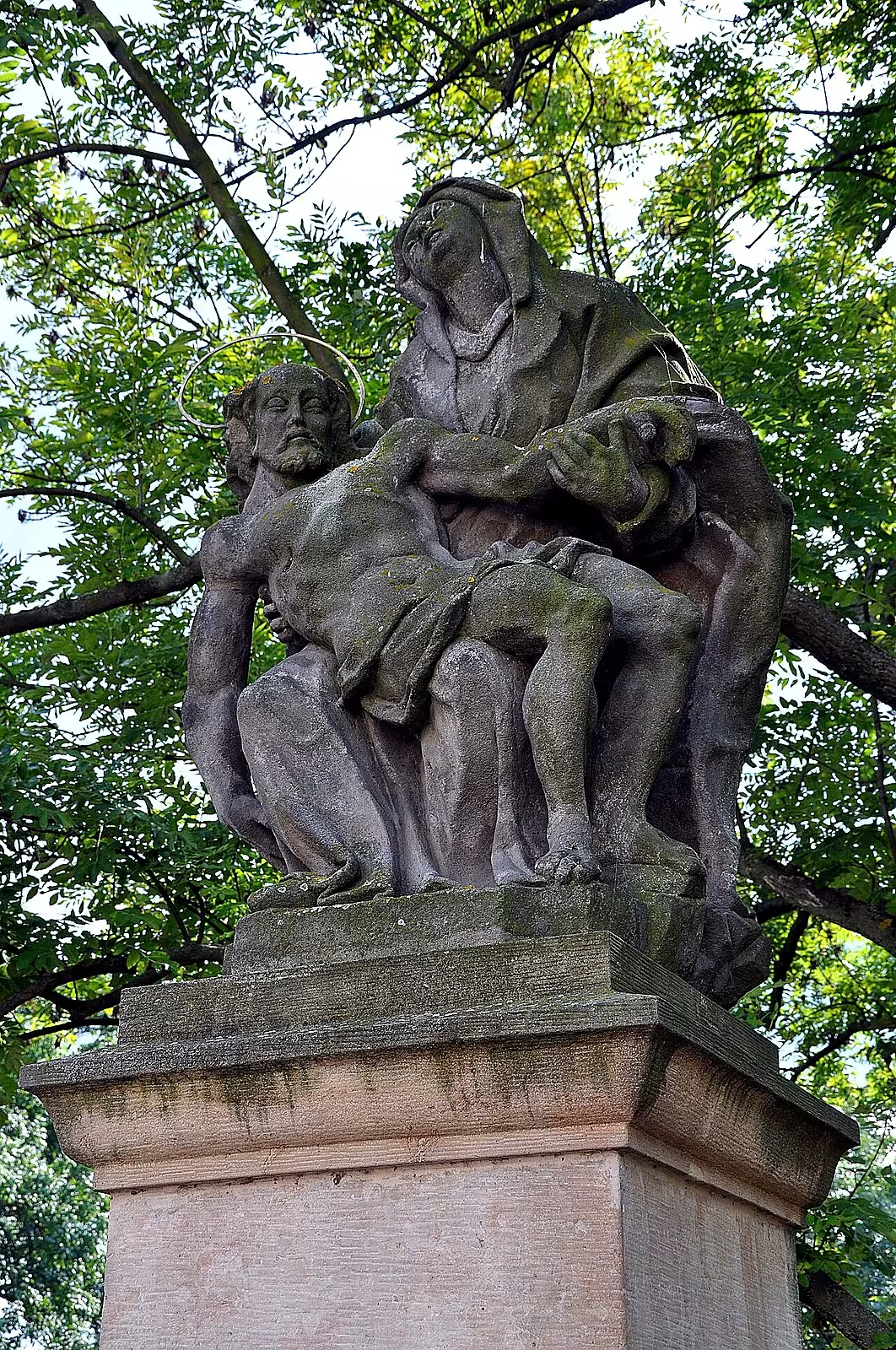
The Baroque sandstone statue Pieta in Chrudim is an important cultural monument from the second half of the 18th century, which has been protected by the state since 1958. The work, attributed to the Chrudim sculptor Peter Filip, is located in Široká Street and forms part of the historical urban planning of the city.
The statue was created during the period of the high baroque and the coming enlightenment, when the sacral decoration of the urban space in the Czech countries was on the rise. It is assumed that the author is a Chrudim sculptor and stonemason Petr Filip. Originally, the sculpture was part of a larger set of works installed on the sill in Široká Street.
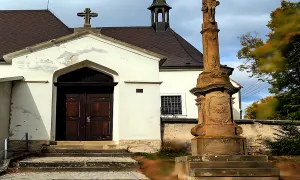
The visual representation corresponds to the baroque style and uses sandstone as a basic material. On a low prism pedestal and a higher pillar with a profiled ledge is placed a statue of the Virgin Mary in life size. The character is dressed in a richly dressed dress and on his lap holds the body of Jesus Christ after his removal from the cross. The head of the Virgin Mary is bent towards the right shoulder and her face is headed toward heaven.
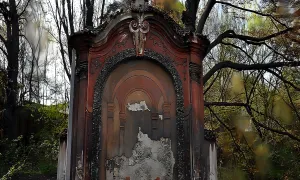
The fate of the monument during the 20th century affected the development of urban infrastructure. In 1960, the statue was moved to a former cemetery near St. Michael's archangel church due to the extension of the Wide Street. It was not returned to its original location in Široká Street until 1997 when it was installed on a modern sandstone ramp rising from the bridge near the museum above the city drive.
Today Pieta is again part of the city space near the Koželužské mill and the drive. Its location on the ramp at the stairs underlines the historical steeping of Baroque art with the urban development of Chrudim.
This monument represents valuable proof of craftsmanship of local sculptors of the 18th century and commemorates the transformation of urban buildings. A visit to Wide Street offers the opportunity to see this work in its authentic context over the city drive.
Then and now
Drag the slider to compare how the landmark may have looked when it was built with the view today.
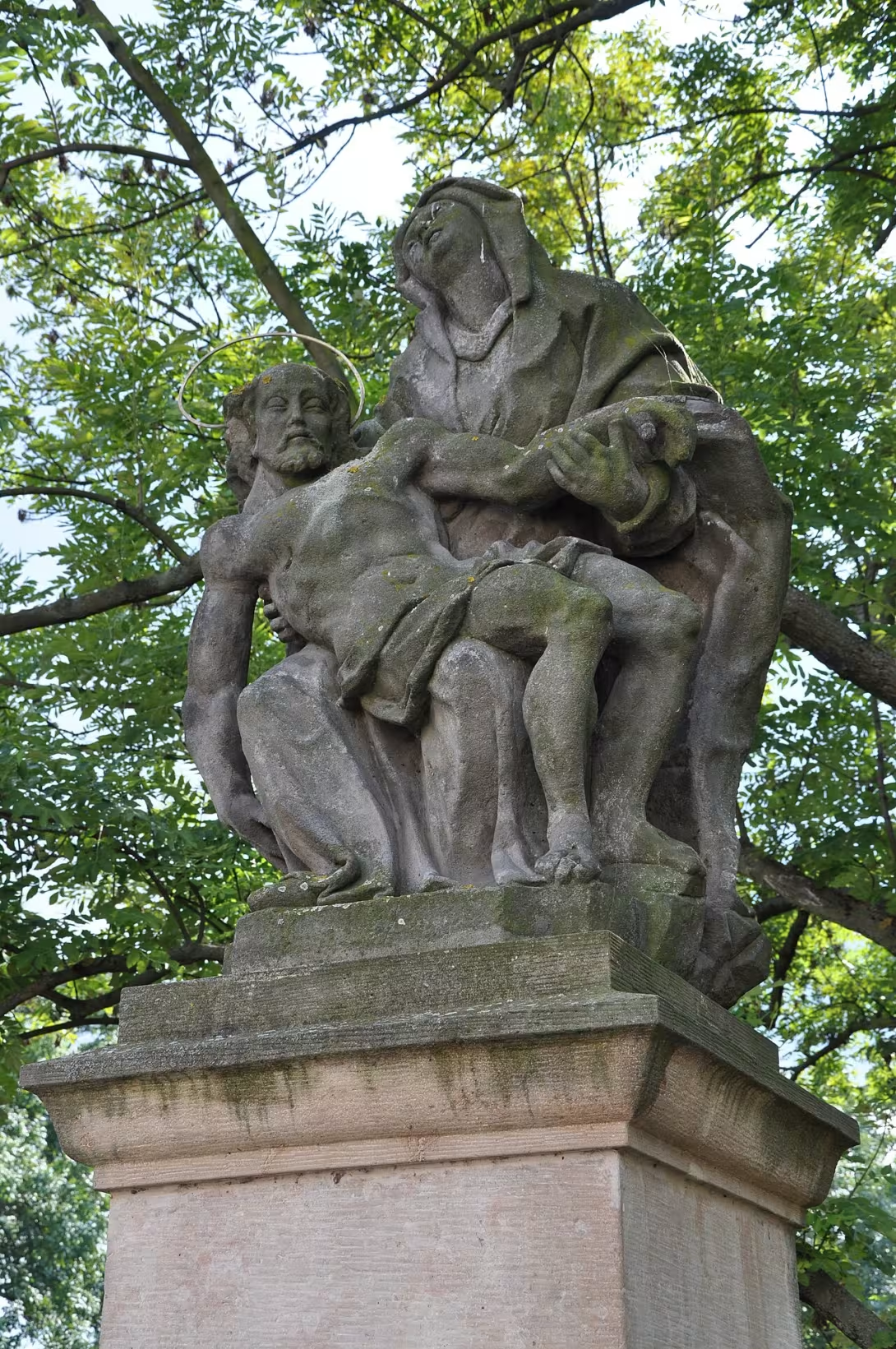

The historical appearance on the left is an AI-generated visualisation and serves as inspiration only.
Historical milestones
- 1958
- The statue was declared a real estate cultural monument of the Czech Republic.
- 1960
- Moving the statue to the cemetery at the church of St. Michael the Archangel to expand the Wide Street.
- 1997
- Return the statue to the modern sandstone windowsill in Široká Street.
Architectural development
The statue was made of sandstone in Baroque style. Originally it was part of a set of works on the sill in Široká Street, where it was returned to the newly built ramp after decades in the cemetery.
Historical events
In 1960, the statue was moved to the cemetery by the church of St. Michael the Archangel because of the expansion of the street. In 1997, the monument returned to its original place on the modern parapet in Široké Street.
Points of interest
The statue has been protected by the state since 1958. - The work is attributed to the Chrudim sculptor and stonemason Peter Philip. - In 1960, the statue was moved to the cemetery by St. Michael's Church to expand the street. - The sculpture returned to its original location on Wide Street in 1997. - The Virgin Mary holds the body of Jesus Christ on her lap after he's taken off the cross.
Guide
Show guide text
This text was created by artificial intelligence and has not been editorially reviewed. It may contain inaccuracies.
Welcome to Chrudim. You're standing in one of those places where time stops and where the history of the city touches you right now. Look ahead. What you see is not just an ordinary piece of stone, but a deep expression of the human feeling that has stood here for centuries. Before your eyes, the statue is known as Pieta. Feel the seriousness that radiates from this work. It's a scene full of silence and sadness caught in a still sandstone. You see this woman, the Virgin Mary, in her arms, on her lap, holding the body of her son, Jesus Christ. It's a moment right after his body was taken from the cross. This whole scene, even though it's carved into hard material, seems incredibly fragile and human.
Now let's go deeper into the past to understand how this work came about. This Baroque statue is not news, but it is a witness of ancient times, namely the second half of the eighteenth century. At that time the Baroque style was in its greatest strength and this work is its beautiful and sad example. To know who is behind this masterpiece, we need to look at the name of the man who breathed his life into him. It's Petr Filip. He was a local artist, a man who meant a great deal to this town. Petr Filip was not only a sculptor, he was also an experienced stonemason. This is very important, because thanks to this double profession he managed to work with sandstone with incredible precision. He understood not only how to create a beautiful shape, but also how to care about this material and how to conjure up the appearance of softness where there is actually a hard stone.
Now pay attention to the details you have right in front of you right now. Notice how the Virgin Mary is displayed. She's life-sized, which means her character has the dimensions of a real person. This gives the whole scene incredible proximity. When you look at her, you feel like you're standing right in front of a real woman at her hardest time. Look at her clothes. The sculptor Filip in the sandstone was able to create a richly dressed gown. Notice the waves and landfills of the substance that appear to be light and moving, although they are merely carved shapes in stone. This whole statue stands on a high pillar with a decorated, profiled ledge. This pillar is not random, it is part of a modern sandstone parapet, which is located right here in Široká Street. This whole structure is used to see the statue as an important point in this urban space.
Although there are no other specific human stories in the records about the characters that the statue depicts, we can think about how much the character of Peter Filip in Chrudim must have been valued. For his work to survive for so long and so carefully preserved, it had to be truly extraordinary. Petr Filip left its soul and its skill here, which we can now perceive in every view of this sandstone block.
You may be interested in one very interesting thing that has happened to this statue over the last few years. It's a story of loss and subsequent return. This statue has a very stormy path. Already in the year one thousand nine hundred fifty-eight this statue was declared a real-estate cultural monument of the Czech Republic, which gave it high protection and the status of an enormous treasure. But in the year one thousand nine hundred sixty something happened that must have been sad for many people in the city. Due to the planned expansion of Široké Street, the statue had to be removed from its original location. They moved her to the cemetery at St. Michael's archangel. Imagine that time when this important work of art, which was to be seen right in the street, was hidden in the silence of the cemetery garden. It was a time when the statue became part of the peace and quiet of the resting place.
Fortunately, things have come back to normal. After years of waiting, the statue came home. In the year one thousand nine hundred ninety-seven it was finally placed again on its modern sandstone parapet right here in Široké Street. So it's a statue that found its way back to the people it belongs to. This return was an important moment for the whole city because it restored the continuity of history in this urban space.
Now that you have seen this memory and understood its meaning, I suggest you continue your walk. Chrudim has many other hidden treasures waiting for you on every other street. Let the atmosphere of this city drift and continue to discover its beauty. Thank you for spending this moment with this historical monument and for paying attention to the details that are here. We wish you a beautiful rest of the day and other interesting experiences during your next survey.
Tips for visitors
The best time to visit is in the morning or at sunset, when soft light highlights the details of sandstone sculpture and creates an impressive atmosphere for observing baroque features.
The monument can be easily reached by foot from the city centre.
We recommend you take the camera with you with the lens for detailed shots and comfortable shoes for a walk along the city drive, which allows you to view the statue from different angles.
During a short walk in the immediate surroundings, you can admire the architecture of the Koželužský mill, watch the flow of the city jet or visit the nearby church of St. Michael's Archangel.
For families with children the place is suitable as a stop when walking through the city; children can observe the water in the drive and parents can bring the story of baroque art to them through this sculpture work.
Frequently asked questions
Can the monument be visited?
This is a structure in a public space that can usually be seen from outside free of charge. We have not verified that this particular one is freely accessible.
Where is the monument?
Location: Chrudim IV, Pardubický kraj. The map on this page shows the exact spot.
Why is the monument protected?
It is listed in the Central List of Cultural Monuments of the Czech Republic as a cultural monument (register no. 1646497955).
Businesses nearby
Do you run a restaurant, accommodation, shop, museum, rental, wellness or other visitor service near this monument? Show yourself directly to the people heading to it — this is how they will see you in the app and on the web:
Events nearby
Zdroj akcí: otevřená data měst a obcí ČR (Národní katalog otevřených dat) a kalendář akcí Národního památkového ústavu.
Nearby
V bezprostřední blízkosti se nachází Koželužský mlýn, městský náhon a kostel svatého Michaela archanděla.
Accommodation nearby
Themed route
Thematic cruise route with Statue of Pieta in Chrudim IV
1.Socha Pieta Type: Artistic installation. A unique modern interpretation of the biblical theme in the city centre, which combines religious and contemporary artistic statements. Suitable for art lovers and philosophical reflection.
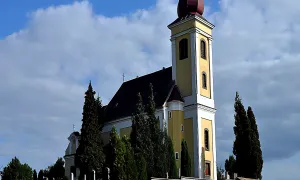
2. Church of St. Michael the Archangel Type: Gothic sacral structure, about 200 metres from Pieta. Interesting is his late Gothic architecture and historical significance as a parish church. The interior offers a quiet environment for relaxation after a tour of the statue.
3. Leather mill Type: Technical monument, about 150 metres from the church. Originally a fur processing water mill, now used for cultural events. The facade and the drive resemble the industrial history of the city.
4. Urban Drive Type: Historical water flow flowing between the mill and the church. Ideal for a short walk along the water channel that once powered mills. The surrounding area offers a peaceful atmosphere and the possibility of observing nature.
Recommended order: Start at Pieta, proceed to the church, then to the mill and the drive. The route is compact and suitable for a half-day trip.
Seasonal recommendations
Spring Spring on Chrudim is the time when the statue of Pieta awakens to life after winter peace. The sun illuminates her face with a fine, scattered light that creates frosted shadows on the stone faces and emphasizes fine features. Nature wakes up to green, but the leaves on the trees are not so dense, so the sights of the surrounding landscape are opening from the monument. The atmosphere is light, as if time has stopped - ideal for meditation over art. In this period, however, the monument is often visited by families with children who come here in pleasant weather. I recommend visiting her early in the morning when it's still cold and the crowds are smaller. Suitable is light, but protective clothing - the sun may be sunny, but the winds are still cold. Don't forget the sunglasses, because the reflection of the light from the stone can be strong.
Summer Summer brings warm sunshine to Chrudim and long days when the statue of Pieta shines under bright celestial light. The temperature often exceeds 30 degrees, so the stone sculpture acts as a natural cooling surface - you can cool off by touching it. Nature is full of blooming beauty, but high temperatures and humidity can make the monument seem a little suffocating. The atmosphere is lively, full of tourists, but also locals who come here for picnics or walks. In the main summer season it is best to come in the morning when the heat is even more tolerable and the crowds are not yet so dense. Suitable is light but loose clothes, hat and plenty of water. Don't forget the sunscreen because the sun on the open surfaces is intense.
Autumn The autumn of Chrudim brings a magical atmosphere where the Pieta statue is projected into the golden and red shades of leaves that fall around. The sun is no longer so strong, but its light is warmer, scattered clouds create soft shadows on stone faces. Nature is painted in autumn shades, but it is already beginning to fade - the winds are cold and wet, which can make the stone statue seem a little wet. The atmosphere is calm, almost mysterious, as if time had slowed down. In this period, the monument is visited by fewer people, but there is something special in private. I recommend visiting her in the morning when the light is most pleasant and the temperature is still favourable. Suitable is warmer clothes, but still light - autumn weather is variable. Don't forget the umbrella, because occasional showers are common.
Winter Winter on Chrudim brings Piety statues peace and quiet, which is almost sacred. The snow covers the surrounding landscape with a white blanket, while the statue stands intact, as if waiting for spring. The sun is weak, but its light reflects from snow and creates fine, silvery shadows on the stone faces. The atmosphere is quiet, almost meditative - ideal for those looking for an escape from the rush. In winter, the monument is visited by fewer people, but those who come here will appreciate its quiet beauty. I recommend visiting it in the morning, when the light is the most pleasant and the temperature still tolerable. Hot clothes are suitable, but not too heavy - moving on rocks in heavy shoes is not pleasant. Don't forget the gloves, because the air is cold and the winds can be sharp.
Visualizations and artistic views


The visualisations are generated by artificial intelligence and serve as inspiration.
Photos from the area
Real photos taken near the monument


Zdroj a licence jsou uvedeny u každého snímku.
Tips from visitors
No tips yet. Be the first!
Log in and add your tip.
Sources and literature
Photos: Ben Skála / CC BY-SA 3.0 — Wikimedia Commons. The author and licence also appear when you hover over the image.
Faktickým podkladem tohoto textu byl článek na Wikipedii, jehož autory jsou přispěvatelé Wikipedie. Článek je dostupný pod licencí CC BY-SA 4.0.
Location on the map
Příběhy a pověsti
Legendy, pověsti a příběhy spjaté s touto památkou

Fotografie návštěvníků
Zatím žádné fotografie. Buďte první, kdo přidá fotografii z návštěvy!
Log in a přidejte svou fotografii nebo hodnoťte.
Za ověřenou návštěvu v aplikaci získáte víc bodů — poznáme podle GPS, že jste na místě.
Reviews and comments