



Socha svatého Antonína Paduánského (Medlešice) Statue
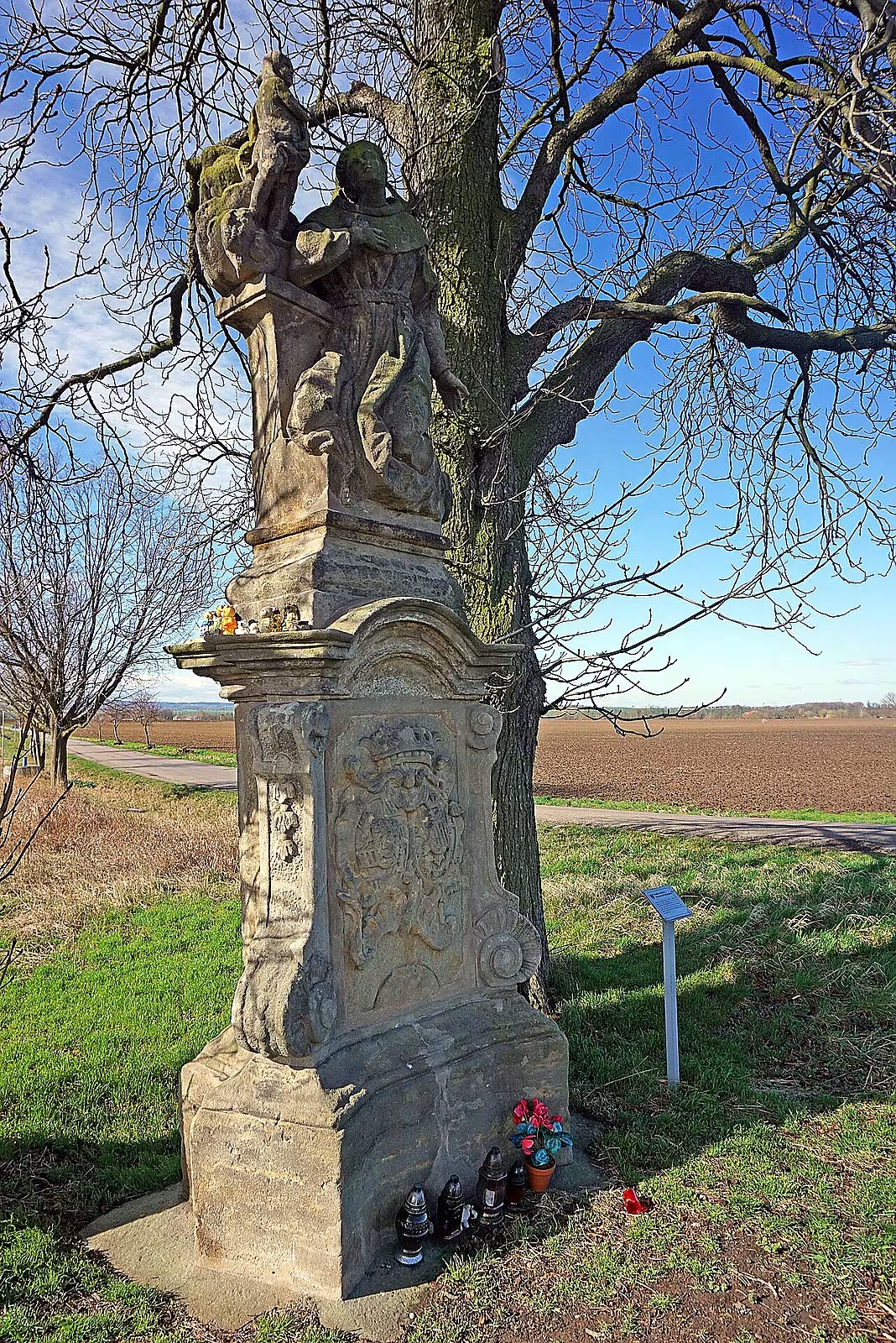
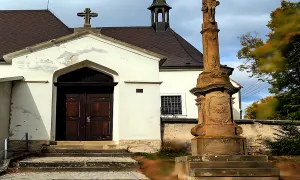
The late Baroque sandstone statue of St. Anthony of Paduan, located between two grown chestnuts in the fields at the rectangular corner of the road leading from Medlešice to Markovic, is a unique cultural heritage of the Czech Republic. This statue, created in the second half of the 18th century by an unknown author, has been protected as a real-estate cultural monument since 2005. Its location about 1 km southwest of the village centre Medlešice in the district of Chrudim and the depiction of St. Anthony kneeling before Jesus, which according to legend appeared to him, makes the statue not only an artistic monument but also a spiritual place.
The statue of St. Anthony of Paduan is an example of baroque art that took place in Bohemia in the second half of the 18th century. This period was characterized by rich architecture and art with emphasis on dramatic effect and details, which is also evident in this representation of St. Anthony. The Portuguese Franciscan of the 13th century is presented here as a young religious man kneeling before Jesus, which refers to the legend of revelation.
The architectural statue stands on a sandstone base with a square base, topped by profiling. The Pillar is decorated with volutes and embossed alliances in the rocaic cartouche, completed with crown. A saint kneeling on a pillar rests his elbow on a pedestal, facing a tiny statue of Jesus with a covered cover. This detailed depiction of a saint in the form of a young monk dressed in a monk's robe with a cingula, which looks to the head of Jesus, brings not only aesthetic value but also deep symbolic meaning.
Although there are not many marks on the actual creation and history of this statue, its classification as a real cultural monument of the Czech Republic in 2005 highlights its importance for regional heritage. The statue of St. Anthony of Paduan not only represents artistic value, but also serves as a local spiritual and cultural centre.
Today, the statue of St. Anthony of Paduan stands in the fields at the right turn of the road, accessible to anyone who feels inclined to explore the history and art of Czech rural areas. Its location between two massive eaters creates an idyllic environment that attracts visitors not only for their beauty, but also for historical and spiritual value. The statue of St. Anthony of Paduan in Medlešice is therefore a place worth visiting not only from an artistic and historical point of view, but also for personal reflection on the spiritual values it represents.
Historical milestones
- around 1750
- The creation of a statue of St. Anthony of Paduan in the second half of the 18th century.
- 2005
- The statue was classified as a real-estate cultural monument of the Czech Republic.
Architectural development
The statue stands on a sandstone base with a square base, topped by profiling. Pillar of the statue is decorated with volutes and embossed alliances in the year cartouche. A saint kneeling on a pillar rests his elbow on a pedestal facing a tiny statue of Jesus.
Points of interest
- The late Baroque sandstone statue of St. Anthony of Paduan is a unique cultural heritage of the Czech Republic. - The statue has been protected as a real cultural monument since 2005. - The depiction of St. Anthony kneeling before Jesus refers to the legend of revelation. - The statue stands on a sandstone base with a square base, decorated with volutes and embossed alliances. - It is located between two massive eels in the fields at the right turn of the road.
Guide
Show guide text
This text was created by artificial intelligence and has not been editorially reviewed. It may contain inaccuracies.
Welcome to Medlesice. Stop for a moment, take a breath and look around you. Right now, you're facing one of the silent witnesses of local history who has been guarding the path of the wandering for centuries. The statue of St. Anthony of Padua stands before you. Note how in a strange and peaceful way this monument is planted in the landscape. You're standing in the fields, in a place where the roads from Medlesic to Markovic turn sharply at the right angle. It is this position that gives the place some dynamism, while the statue itself brings a deep room into space. Look above and around you. The statue is framed by two grown, massive chestnuts. These trees are not just a random addition, but they form a natural open-air temple with a stone image. The leaves of chestnuts provide shade in summer and in autumn colours it covers the memory into golden light, which only confirms the sense of the sanctity of this particular place.
Now let's look at where this statue came from and what its historical context is. We are in the presence of a work which was created in the second half of the eighteenth century, namely around the year seven hundred and fifty. It's a period we call a late Baroque in the history of art. The Baroque was a style full of emotion, motion and spiritual enthusiasm, and even though this statue is in the landscape itself, it carries all these elements. Who created it? That's one of those beautiful secrets history sometimes retains. The author of the statue remains unknown. There's no signature, no record in the archives that tells us exactly whose hand carved these shapes into stone. Yet the craftsmanship of the author is obvious. However, this anonymity adds a certain timeless character to the work. The statue stood here for decades, watching changes in the landscape, generations of people passing this corner and the gradual course of time. Its value was officially recognised in the year two thousand and five, when the statue was classified as a real-estate cultural monument of the Czech Republic. This means that the state recognised its uniqueness and ensured that it was protected for future generations.
Now pay attention to the design itself and what you see right in front of you. Look at the material the statue is made of. It's sandstone, typical material for the Central European sculpture of that time. Sandstone is a grateful material that allows delicate processing of details, but at the same time is prone to the effects of weather, which gives the statue a patina and a sense of antiquity. Notice also the foundation on which the statue stands. Even the pedestal is made of sandstone and forms a stable base that elevates the holy figure above the surrounding fields.
Now, if you look closely at the figure itself, you will see St. Anthony of Padua. Notice its position. Saint Anthony is not depicted in the position we are used to with many statues. He's on his knees. This humility in the gesture is crucial for understanding the whole work. In front of him is Jesus. The entire composition captures an intimate and deeply spiritual moment. Why is Saint Anthony in this position? The answer leads us to the legend of revelation. According to tradition, little Jesus appeared to St. Anthony, which was the moment of the highest spiritual experience and confirmation of his faith. It is this miracle that is depicted here in stone. Saint Anthony in humility recognizes the divinity before him, and it is this interaction between an adult man and a child that creates the emotional center of the whole monument. It's a picture of love, faith and absolute devotion.
What's interesting is how this statue works in space. Imagine how, at the time of its creation, almost three styles ago, it affected the passenger. In a landscape where there were no modern brands or asphalt roads, such a statue in the corner was not only a spiritual sanctuary, but also an orientation point. The passengers stopped here, prayed or just rested in the shade of the young chestnuts. It is a unique cultural heritage that links the religious symbol with the natural beauty of the Czech landscape. The fact that the statue has endured all these years in an open field is truly fascinating. She survived the storm, the frost, and the changes in political regimes, and yet she stands here as a symbol of hope and peace.
You may wonder why this statue was chosen to protect as a cultural monument. The answer lies in her authenticity. The late Baroque style combined with a concrete iconographic depiction of the revelation of Jesus makes this work a rare piece of regional art. It is not only a religious object, but also a historical document about how people in the eighteenth century perceived their faith and expressed it through art in the space of their community.
Now that you are aware of all the details, from the sandstone base to the kneeling figure of the holy to the surrounding chestnuts, I suggest you calm down for a moment. Close your eyes and imagine what this place looked like centuries ago. Hear only the roar of the leaves and the distant sounds of the countryside. Feel the calm emanating from this place. This statue teaches us to stop in today's rush world and pay attention to things that are of lasting value.
Looking at St. Anthony, we realize that even small, stealth monuments in the fields can be of great importance. They are the anchors of our identity and memory. This statue in Medlešice is just the anchor. It's a silent testimony about the craftsmanship of an unknown author and the deep spirituality of the people who once placed it here.
Your short trip to the statue of St. Anthony of Padua is slowly coming to an end. I hope this meeting with the late Baroque has brought you a sense of peace and that you have been able to appreciate the beauty of this sandstone work. Before you go any further, I suggest you go around the statue again and feel it from different angles. Note how the shadows on the stone change depending on the position of the sun and how the statue naturally intermingles with the surrounding greenery.
We now invite you to explore the surroundings of Medlešice. Who knows, you may encounter other hidden treasures waiting to be discovered. We wish you a pleasant continued journey, quiet thoughts and many new experiences in discovering the beauty of our landscape. Thank you for spending this time with us at this unique monument. Goodbye.
Tips for visitors
The best time to visit the statue of St. Anthony of Paduan in Medlešice is autumn or spring when the surrounding chestnuts are in full bloom or covered with golden leaves. These seasons offer beautiful lighting conditions for photography and pleasant temperatures for walking.
The location is easily accessible by car and public transport. For those travelling by public transport, it is appropriate to verify the current connection in the previous search engine.
When visiting take with you comfortable shoes and protective clothing, because walking around the statue may include walking along the lawn or field path. Remember also the umbrella and water, especially in warmer months.
The ideal place for photography is in front of the statue, where light is reflected from both sides of the chestnut. The best time for photography is in the morning or in the evening when light is softer and shadow effects are more pronounced.
Around the statue there is a rectangular corner of the road, which offers beautiful panoramic views of the area. If you have more time, you can visit the nearby village of Markovice, where there are other historical monuments and picturesque rural regions.
Frequently asked questions
Can the monument be visited?
This is a structure in a public space that can usually be seen from outside free of charge. We have not verified that this particular one is freely accessible.
Where is the monument?
Location: Medlešice. The map on this page shows the exact spot.
Why is the monument protected?
It is listed in the Central List of Cultural Monuments of the Czech Republic as a cultural monument (register no. 1533460362).
Businesses nearby
Do you run a restaurant, accommodation, shop, museum, rental, wellness or other visitor service near this monument? Show yourself directly to the people heading to it — this is how they will see you in the app and on the web:
Events nearby
Zdroj akcí: otevřená data měst a obcí ČR (Národní katalog otevřených dat) a kalendář akcí Národního památkového ústavu.
Nearby
🏰 Historic sites (261)
- Zámek Medlešice 0.6 km
- Obětem boje 1. a 2. světové války 0.9 km
- obětem světových válek 1.7 km
- SILVER A - Adolf Švadlenka 1.8 km
- Památce národního osvobození a obětem 1. sv. války 1.9 km
- V loučkách 2.3 km web
- Kalliopé 2.7 km
- Josef Vaněk a Karel Kudrna 2.8 km
- Obětem 1. sv. války 2.9 km
- Regionální muzeum v Chrudimi 3.1 km
- památník obětí I. a II. světové války 3.2 km
- Galerie ART Chrudim 3.3 km web
- Tomáš Garrigue Masaryk 3.4 km
- Muzeum loutkářských kultur 3.4 km Břetislavova 74
- Slezákova ulice 3.4 km
- plk. Jaroslav Kudláček - RAF 3.4 km
- Jan Hus 3.5 km
- Muzeum barokních soch 3.5 km
- Českým velikánům 3.8 km
- Lukáš Syrůček (2009) 4.0 km
🍽️ Restaurants and dining (448)
- Pivovarská hospoda Medlešice 0.5 km
- U Marka 0.9 km
- Dřenická hospoda 1.8 km
- Blatenský Dvůr 1.8 km
- Na Netřebě 1.9 km
- Na Hřišti 2.0 km
- Pizzerie Gurman 2.1 km +420 722 403 406
- Restaurace Na Sklepích 2.5 km
- U Džbánu 2.8 km
- Istanbul Kebab 2.9 km
- Kruh Zdraví 3.0 km
- U Loutkáře 3.0 km +420731410880 web
- Hospůdka Na Návsi 3.0 km
- Bistro Filištínská 3.1 km
- Celia 3.1 km
- U Čerta 3.1 km
- La Bella 3.2 km
- Döner Kebab Belkis 3.2 km
- Pizzerie pod náměstím 3.2 km
- AKafe 3.2 km
🏨 Accommodation (54)
- Penzion Na Sklepích 2.5 km web
- Slavie 3.1 km
- Penzion U Náhonu 3.4 km
- Žižka I. 3.5 km
- Penzion a restaurace Šenk 5.0 km web
- Penzion Skylark 5.9 km Teplého 1673 +420 605 001 555 web
- Ubytovna 5.9 km web
- Penzion Jasopa 6.2 km Průmyslová 560 +420 725 565 534 web
- Birdie 6.5 km Hlaváčova 392
- Penzion Fajn 6.5 km Žižkova 770
- Arnošt 6.5 km web
- Hotel Euro 6.6 km Jiráskova 2781 +420 466 414 255 web
- Penzion City 6.6 km Hronovická 708 +420 777 002 272 web
- Penzion Cafe City 6.6 km Hronovická 708 +420 777 002 272 web
- Ubytování v Pardubicích 6.7 km
- Pension Podkova 6.7 km Smilova 335 +420 466 611 206 web
- Penzion 2727 6.7 km
- Hotel Atrium 6.7 km Smilova +420 466 615 146
- Pension Austria 6.8 km Smilova 312 +420 721 500 150 web
- Penzion Hacienda Ranchero 7.0 km web
🚲 Rentals and sport (65)
- Vesna OK Sport 3.2 km
- Fitcentrum 3.4 km Palackého třída 806
- Sportovní Hala Chrudim 3.6 km
- Sportisimo 4.5 km
- Cyklo Pejcha 5.0 km Chrudimská 145 +420 733 735 500 web
- HOBBY BIKE - cykloservis 5.5 km Staňkova 2114 web
- Wanted sport s.r.o. 5.5 km náměstí Dukelských hrdinů 2233 +420 732 650 792 web
- Sportovně střelecký klub TMS Pardubice 5.9 km web
- Cyklo Bike 6.0 km
- Vektor sportcentrum 6.2 km web
- Plochá dráha Zlatá přilba 6.3 km
- Areál orientačního běhu 6.3 km web
- Sportovně relaxační areál Popkovice 6.4 km
- Automotoklub Zlatá přiba Pardubice 6.4 km Motoristů 300 web
- Global Sport 6.6 km +420775070712 web
- Cyklo POKR 6.6 km 17. listopadu 216 web
- Brouzdaliště 6.7 km
- Velo Blažek 6.7 km Palackého třída 2411 +420 608 213 022 web
- Sport Vision 6.8 km Palackého třída 2748 web
- CYKLO CONTENT 6.8 km +420466615277 web
🥾 Hiking and nature (112)
- Na kopci 2.5 km
- Městský park 2.6 km
- Park Republiky 3.3 km
- Klášterní zahrady 3.4 km
- Střelnice 3.6 km
- Zieglerovy sady 3.6 km
- Červená studánka 3.7 km web
- Piškvorky 4.1 km
- Naučné hranolky 4.1 km
- tvrz Nemošice 5.1 km web
- Habrov 5.3 km
- Mostní pilíř technické cvičiště 5.9 km web
- Na podhůře 6.2 km web
- Park Vinice 6.2 km
- Park Pardubičky 6.4 km
- SILVER A - Josef Chrbolka 6.5 km web
- Na skalách 6.5 km
- Rozhledna Bára 6.5 km web
- Zámeček 6.6 km
- Náměstí Československých legií 6.7 km
Accommodation nearby
Themed route
1. Access to the monument (path) - The path to the statue, which serves for the first dating with the location of the work. 2. Statue of St. Anthony of Padua (statue) - The main point of the route where you can observe the details of the Holy Plastic View. 3. Statue base (architectural element) - The lower part of the monument that carries the figure itself. 4. Space around the statue (area) - A place to circumvent the monument and observe it from different sides.
Seasonal recommendations
Spring: In the spring period, the statue of St. Anthony of Paduan in Medlešice is covered in flowers and new leaves of trees, which adds to the surrounding environment a sense of renewal. The sunny noon illuminates the statue with a fine light, which emphasizes its details and creates a comfortable atmosphere for the tour. For a visit it is advisable to prepare light clothes with the possibility to add top clothing because temperatures can change quickly. The best time to tour is in the early afternoon when the sun is not too bitter and the crowds are usually smaller.
Summer: For years, the statue appears in the glow of long days, allowing it to be viewed in the best light. The warm air and flowering surrounding nature create a lively atmosphere that is ideal for relaxing in the countryside. When visiting, it is recommended to wear festive clothes and protective sunglasses because the sun can be very strong. The best time for a tour is in the early morning or in the evening, when temperatures are milder and crowds are decreasing.
Autumn: In the autumn period, the statue of St. Anthony of the Paduan melancholic character begins when the surrounding nature is covered with red and yellow leaves. The sunny days in this period illuminate the statue with a fine light, which increases its beauty. For the visit it is advisable to wear top clothing and possibly blankets, as temperatures can be reduced quickly. The best time for a tour is in the prehistoric hours when the sun is still in the sky and the crowds are usually smaller.
Winter: The winter statue of St. Anthony of Paduan can be seen in special lighting when the sun rises and sets early. Freezing air and maybe even a snow blanket add a statue of a romantic touch. When visiting, it is important to dress warm, including a blanket or coat and protective pants. The best time for a tour is at noon, when the sunlight illuminates the statue and the crowds are usually smaller.
Visualizations and artistic views

The visualisations are generated by artificial intelligence and serve as inspiration.
Tips from visitors
No tips yet. Be the first!
Log in and add your tip.
Sources and literature
Photos: MartinVeselka / CC BY-SA 4.0 — Wikimedia Commons. The author and licence also appear when you hover over the image.
Faktickým podkladem tohoto textu byl článek na Wikipedii, jehož autory jsou přispěvatelé Wikipedie. Článek je dostupný pod licencí CC BY-SA 4.0.
Location on the map
Příběhy a pověsti
Legendy, pověsti a příběhy spjaté s touto památkou
Fotografie návštěvníků
Zatím žádné fotografie. Buďte první, kdo přidá fotografii z návštěvy!
Log in a přidejte svou fotografii nebo hodnoťte.
Za ověřenou návštěvu v aplikaci získáte víc bodů — poznáme podle GPS, že jste na místě.
Reviews and comments