



Socha svatého Jana Nepomuckého (Heřmanův Městec) Statue
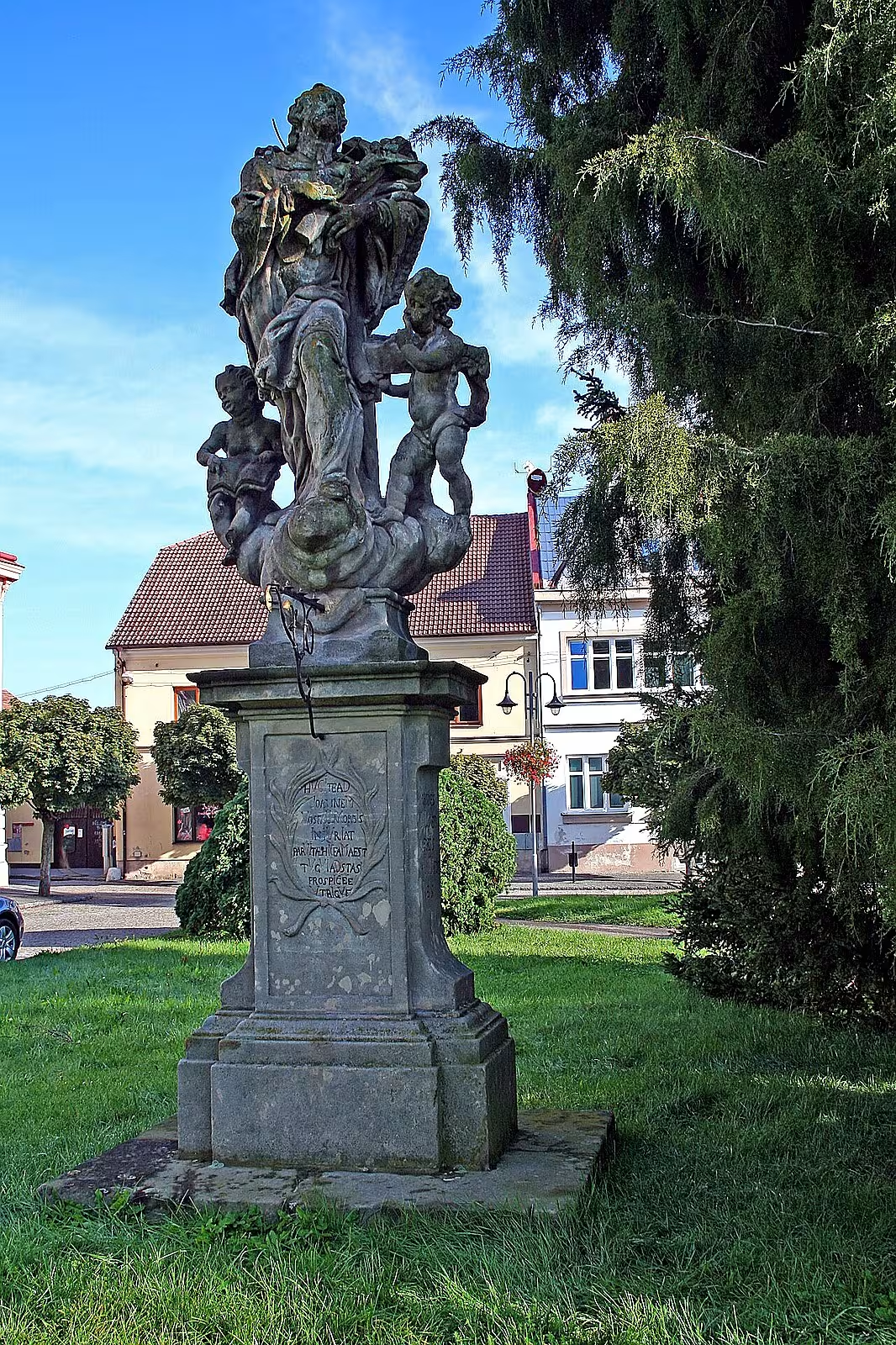
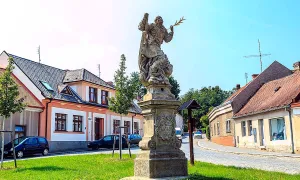
The Baroque sandstone statue of St. John Nepomuk stands on Masaryk Square in Heřman's City in Chrudim. The work of an unknown author dates back to 1729 and has since 1964 been protected as a real cultural monument.
The creation of the statue falls into the period of the high Baroque. At that time, respect for this saint in Czech countries was strongly supported by both the Catholic Church and the Habsburg Monarchy as a symbol of anti-reform efforts. The building was erected as a visual counterpart to the older statue of St. Wenceslas, which has been standing in the square since 1723.
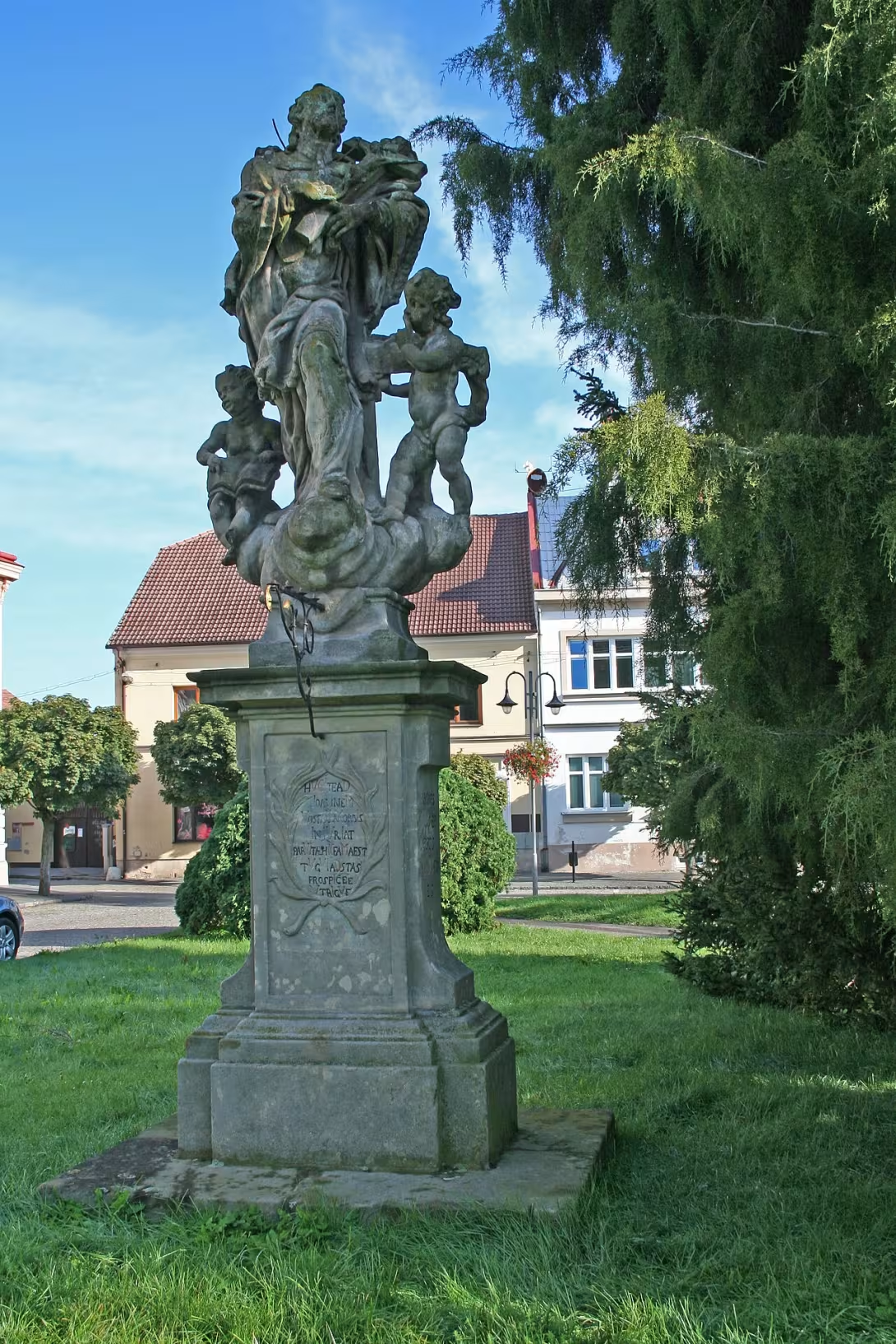
The statue is carved out of sandstone and placed on a profiled pedestal with a pillar that ends with a ledge. On the front side of the pillar is a deep frame with a inscription lined with two branches; The metal curtain for the lantern is embedded in it. The back of the pillar bears a Latin inscription with a chronogram, which secretly indicates the year of origin of 1729. Other Latin texts are carved on the sides of the pillar. The statue of a lifelike saint stands on the clouds, dressed in mascara, holding a crucifix in her arms. The head of the saint is decorated with a halo and his gaze is toward heaven. At the feet of the statue there are two smaller figures of angels. The entire composition is designed exclusively for the front view, the rear side is not processed.
The monument is located on Masaryk Square west of the fountain, opposite the castle. In 2015, the sculpture underwent a total renovation which ensured its preservation for future generations.
This object represents an important proof of Baroque piety and urban solution of the historic city centre. When visiting Heřman's City, it is worth paying attention to details of stonework on the pillar and the overall composition of the sculpture in the context of the surrounding square.
Then and now
Drag the slider to compare how the landmark may have looked when it was built with the view today.
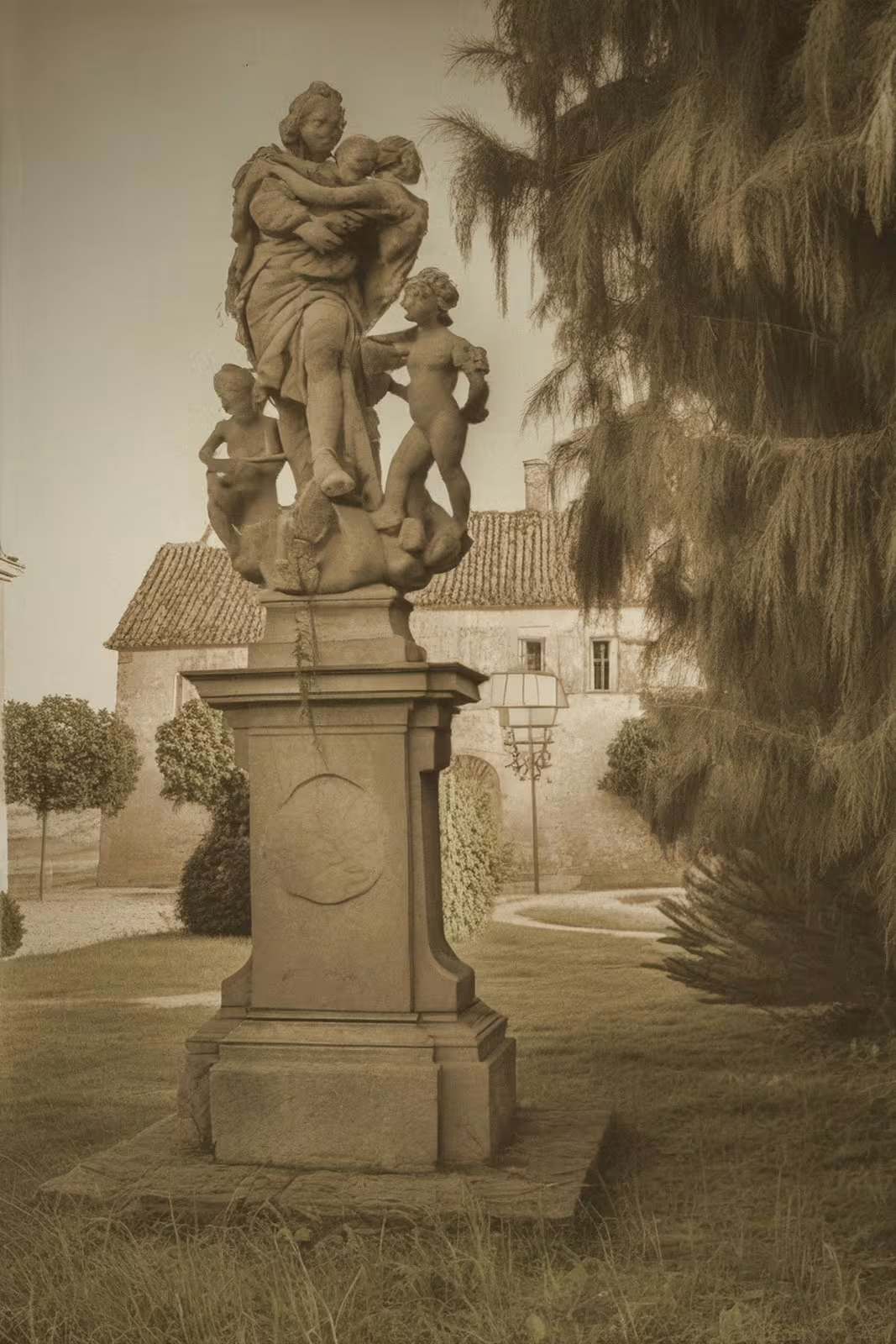
The historical appearance on the left is an AI-generated visualisation and serves as inspiration only.
Historical milestones
- 1729
- The statue of Masaryk Square.
- 1964
- Registration between real-estate cultural monuments.
- 2015
- Implementation of the overall reconstruction of the sculpture.
Architectural development
The statue is carved from sandstone and placed on a profiled pedestal with a pillar. On the back of the pillar is a sign with a chronogram referring to the year of origin. The composition of the sculpture is designed exclusively for the front view.
Historical events
1729: The statue in the square. 1964: Declaration for a real estate cultural monument. 2015: Total reconstruction of sculptures.
Points of interest
The statue dates back to 1729 and its author is an unknown artist. - The building was built as a visual counterpart to the older statue of St. Wenceslas, which has been standing in the square since 1723. - On the back of the pillar there is a inscription with a chronogram which secretly indicates the year of creation of the work. - The composition of the statue is created only for the front view because the back is not processed. - In 2015, the sculpture went through a total renewal to be preserved for future generations.
Guide
Show guide text
This text was created by artificial intelligence and has not been editorially reviewed. It may contain inaccuracies.
Welcome to Masaryk Square in Høman City. You're standing in front of one of the most important symbols of this place, the Baroque sandstone statue of St. John Nepomuk. Before you go any further, I suggest you stop and just observe. Feel the atmosphere of this square where history meets the present. In front of your eyes is a work that has been here for over 300 years and which carries the incredible power of ancient art. This sandstone, from which the statue is carved, has a special texture that changes depending on how the light hits it. It's a material that is alive, that breathes and tells us a story about a time that flows relentlessly.
Now let's go back deep into the past together to understand why this work is here. Imagine the year seven hundred twenty-two nine. The world around us was quite different, people lived in a different rhythm and their view of the world was strongly influenced by the faith and art of the baroque. It was this year that this statue was erected in this place. Although it is no longer known who was the exact author of this work, its championship is evident in every carved detail. The artist who shaped this stone must have had incredible patience and a sense of material. This statue wasn't built at random. We knew that it had its fixed place within the overall balance of the square. In fact, there was an older statue of St. Wenceslas before him for several years, namely from the year seven hundred twenty-two and three. This newer statue of St. John was thus created as a visual counterpart to obtain its proper balance, dignity and harmony. It was a deliberate work that was meant to connect different figures and create a space that seemed coherent and harmonious.
Now pay attention to the work itself and try to look at it in more detail. I suggest you slowly shift the view from the ground itself upwards. You'll see two smaller characters at the holy feet. They are angels who seem to be part of the celestial events and who accompany the saint in his ascension. Then look above, where the character itself begins to float. See those clouds? The entire composition is designed so that Saint John is not only a static object, but to act as if he was floating in the celestial spheres. The saint is depicted in life-size, which means that his presence here is very strong and almost like the presence of a living person standing right in front of you. Notice his clothes. It is dressed in a garment with rich eyelash, which is a typical sign of baroque style, who loved movement, dynamics and the game of light and shadow on the surface of the stone. The Holy One holds a crucifix in his arms, a symbol of his deep faith and sacrifice. This whole sandstone work is proof of incredible skill, even though the name of the creator remains hidden in history.
Did you know that this object is very rare to us and we have to take care of it? Since the year one thousand nine hundred sixty-four, this statue has been protected as a real cultural monument. This means that its value for our city and for the whole nation is recognised and provided by law. In order to serve future generations, this sandstone had to go through care. In the year two thousand fifteen, the entire sculpture was renovated. This work was necessary to preserve the beauty and integrity of the details you see right now. Thanks to this renewal, we can monitor the purity of the lines and the preservation of the fine algae on the holy garment.
And now I'm going to tell you something that you can't see at first sight that can impress anyone who looks at this work with more curiosity. If you had the opportunity to go around this pillar and look at its back side, you would encounter a secret. There's a sign that contains a so-called chronogram. It is a fascinating way that ancient masters were able to draw the hidden message directly into the work itself. This inscription contains letters bearing hidden numerical values. In this way the artist had carved out the year of the creation of the work, but he did so so that a attentive observer must come to him. It's like a hidden code that connects art to mathematics and that waits for anyone who wants to search for more than just what you can see at first sight.
This statue of St. John Nepomuk is not just a stone object. He's a witness to history who saw the city change over the centuries. He stood here during wars, during peaceful times and during the great changes brought about by modern age. Yet it still stands here, firm and unwavering, as a reminder of our roots and our cultural heritage.
Now that you know the story of this monument, its history and its hidden secrets, I suggest you continue your walk around the City of Høman. Let yourself be carried away by the beauty of the square and pay attention to other details offered by this city. Every stone and every building here has their own story waiting to be discovered. Thank you for stopping by to devote your time to this historic monument. We wish you a beautiful and inspiring walk around our city.
Tips for visitors
To visit the statue is ideal morning when the sun illuminates the front side of the work and allows to capture details of sandstone sculpture without disturbing shadows. The place is freely accessible in the square, so you can avoid crowds in the early hours. For photography I recommend to choose an angle from a slight ceiling that highlights the baroque dynamics of the character. Take only the camera or phone with you, no special equipment is needed. In the immediate vicinity you can visit the castle in Høman's Town or see the opposite statue of St. Wenceslas, which is a pleasant walk suitable for families with children who can safely run on the square.
Frequently asked questions
Can the monument be visited?
This is a structure in a public space that can usually be seen from outside free of charge. We have not verified that this particular one is freely accessible.
Where is the monument?
Location: Heřmanův Městec, Pardubický kraj. The map on this page shows the exact spot.
Why is the monument protected?
It is listed in the Central List of Cultural Monuments of the Czech Republic as a cultural monument (register no. 1000134058).
Businesses nearby
Do you run a restaurant, accommodation, shop, museum, rental, wellness or other visitor service near this monument? Show yourself directly to the people heading to it — this is how they will see you in the app and on the web:
Nearby
Masarykovo náměstí, zámek v Heřmanově Městci, socha svatého Václava.
Accommodation nearby
Trips and activities nearby
Guided tours, tickets and activities nearby from GetYourGuide
Affiliate link: if you buy from the partner, we may receive a commission. The price for you does not change.
Search tours and activities →Seasonal recommendations
Spring: In the spring period, the statue of St. John Nepomuk in Heřman's City is illuminated by sunlight, which highlights its details and adds a fine warm colour to it. Nature wakes up from winter sleep; The flowering shrubs and trees are beginning to frown, creating a lively and beautiful atmosphere. This is the perfect time to visit because the crowds are not too many so you can enjoy a quiet experience. We recommend wearing clothes suitable for mild temperature and taking advantage of a quiet morning or late afternoon to visit to enjoy a quiet moment.
Summer: During the summer period, the statue of St. John Nepomuk is lit with long and warm days, allowing it to be explored in full beauty. Nature around it is in a flood of flowering flowers and green trees, which adds a colorful touch to the whole environment. The atmosphere is full of energy and life, but that also means high traffic. We recommend visiting early in the morning or later in the evening to avoid crowds. Remember the sun protection - wear a tie and sunglasses.
Autumn: In the autumn season the bloating leaves of the trees in Hermanov City provide a colour palette from golden to red-brown, giving the statue of St. John Nepomuk a unique background. Solar lighting is milder and the temperature becomes more welcoming, thus creating a calm and relief to the swelled atmosphere. This period can be ideal for visiting, because crowds are not as many as in the summer peak period. We recommend wearing clothes suitable for mild temperature and consider visiting during afternoon hours when the light is most beautiful.
Winter: The winter season brings the statue of St. John Nepomuk in the City of Heřman to a quiet and quiet atmosphere, where it is illuminated by soft light. Nature is becoming inhospitable because of snow and ice leaves, which gives the memory a melancholy touch. This is the time when opening times may be shorter and more accessible for visitors. Visitors are advised to wear warm clothes and take advantage of quiet morning or late afternoon hours when there are fewer people. Winter visit offers a unique view of the memory in the snow curtain.
Visualizations and artistic views


The visualisations are generated by artificial intelligence and serve as inspiration.
Photos from the area
Real photos taken near the monument


Zdroj a licence jsou uvedeny u každého snímku.
Tips from visitors
No tips yet. Be the first!
Log in and add your tip.
Sources and literature
Photos: Canella23 / CC BY-SA 3.0 — Wikimedia Commons. The author and licence also appear when you hover over the image.
Faktickým podkladem tohoto textu byl článek na Wikipedii, jehož autory jsou přispěvatelé Wikipedie. Článek je dostupný pod licencí CC BY-SA 4.0.
Location on the map

Příběhy a pověsti
Legendy, pověsti a příběhy spjaté s touto památkou
Fotografie návštěvníků
Zatím žádné fotografie. Buďte první, kdo přidá fotografii z návštěvy!
Log in a přidejte svou fotografii nebo hodnoťte.
Za ověřenou návštěvu v aplikaci získáte víc bodů — poznáme podle GPS, že jste na místě.
Reviews and comments