



Socha svatého Jana Nepomuckého (Kovanice) Statue
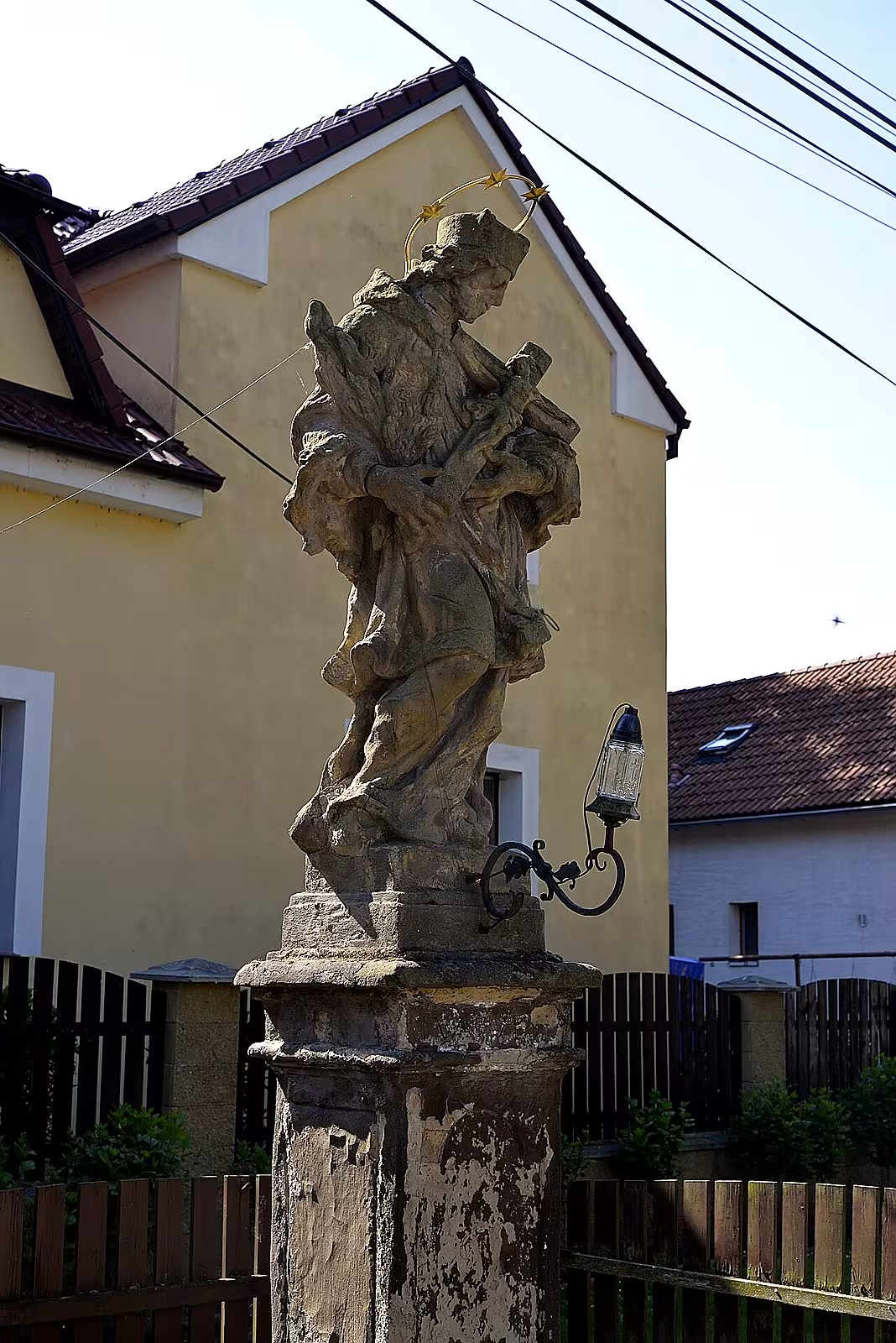
The statue of St. John Nepomuk, located on the village Kovanice in the district of Nymburk, is a Baroque sandstone statue from the first third of the 18th century. This monument has significant cultural value and has been declared a cultural monument since 1965. The statue stands in front of the house no. 7, near the kindergarten and church of St. Wenceslas, which makes it a significant part of the local environment.
The creation of the statue dates back to a period of Baroque art flourishing in Central Europe. Although the specific author remains unknown, its eastern Bohemian origin with Gothic elements is evident from style and details.
The architectural statue stands on a high prism plinth with a graduated ledge. The Sokl carries an embedded, arch-closed mirror with a majestic inscription I.W.C.V.B.V.L., which adds historical and aesthetic importance to the whole piece. Around the plinth is a garden made of iron pipes, which gives the statue a unique characteristic.
The statue itself measures 170 cm and is made in life size. The saint stands in a contrapost typical of Gothic sculpture, with his left bent leg and an escibly bent body axis. His face is thin with a pointed beard. Clothes include cleric, rochet and short fur coat, with a biret on his head. Both hands are drawn to the body, the left holds the crucifix tilted across the chest, leaning against the palm of the right hand. There is an iron gold circle around the head with five six-pointed stars.
In 2012, the statue led by Vojtěch Adamek was repaired. The correction was supplemented by restoration research, which ensures the preservation and protection of this cultural heritage for future generations.
The statue of St. John Nepomuk in Kovanice is not only a work of art but also a witness to historical changes and traditions. Its presence at the local village highlights the cultural wealth of the village and its links with the Baroque period. The Statue of the Statue of Culture confirms its importance and ensures that it is protected for future visitors.
Today the statue is easily accessible at the village Kovanice. Its location near other historical monuments, such as St. Wenceslas's Church and the kindergarten, makes it an attractive destination for tourists and locals. Visiting this statue offers an opportunity to become acquainted with the rich history and artistic heritage of the region.
The statue of St. John Nepomuk is not only a monument, but also an inspiration to worship traditions and preserve cultural heritage. Her visit offers a unique view of the past and recalls the importance of protecting historical monuments for future generations.
Historical milestones
- 1965
- The statue was declared a cultural monument.
- 2012
- Repair of the statue and restoration research.
Historical events
- 1965
- The statue was declared a cultural monument.
- 2012
- There was a repair of the statue and restoration research.
Points of interest
- It's a Baroque sandstone statue from the first third of the 18th century, which has been a cultural monument since 1965. - Sokl of the statue bears the inscription I.W.C.V.B.V.L. and is surrounded by a garden of iron pipes. - The statue measures 170 cm and the saint stands on it in a contrast typical of Gothic sculpture. - A gold-plated iron circle with five six-pointed stars is drawn around the Holy Head. - In 2012 he led the reconstruction of the statue and restoration research of Vojtěch Adamek.
Guide
Show guide text
This text was created by artificial intelligence and has not been editorially reviewed. It may contain inaccuracies.
Welcome to Kovanice. Stop for a moment, take a breath and focus fully on what you see right in front of you. You stand before the silent but speaking witness of the past, which is the statue of St. John Nepomuk. He is a character who has been here for a very long time and completes the character of this place with his presence. The first thing you're probably interested in is the material from which the entire sculpture is carved. It is a sandstone, a stone that carries a trace of time, a delicate roughness and a specific shade that is so typical of older Czech sculpture. Feel how this stone works in today's light and how naturally it fits into the surroundings.
Now let's look at where this statue came from and at what time it came from. This sandstone work dates back to the first third of the eighteenth century. So imagine the world almost three years ago, at a time when there was a Baroque period that loved dynamics, emotions and detail. Although we do not know the name of a particular artist who took the chisel and set out in this stone the form of a saint, his craftsmanship is obvious. The statue was created not only as a religious symbol, but as an aesthetic element that was meant to attract attention and inspire respect. Its historical value was officially recognized in the year nine hundred and sixty-five when the statue was declared a cultural monument. This means that the state has recognised that this work is an important part of our common heritage and deserves protection for future generations.
Now I want to invite you to take note of the specific details that make the overall impression of this work. Let's start at the bottom of the base. Note that the statue is not on the ground, but it is hovering on a so-called prism plinth. It's a solid, geometric foundation that gives the whole piece stability and dignity. If you approach it, you'll see that this base is surrounded by a small garden. But it's not a hedge garden, it's made of iron pipes. This element not only serves as stone protection, but adds a certain framework to the whole. Look carefully at the plinth itself, where you will find the mysterious inscription. There are engraved letters I.W.C.V.B.V.L. This acronym remains a puzzle for us, perhaps the name of the founder, the donor, or some Latin wish that everyone understood at the time of the creation of the statue, but today they make us think and seek answers.
Now move your view above, to the holy figure itself. The statue measures exactly 150 centimeters, which is almost human height, making St. John Nepomukki very present as if he were sharing this space with you right now. Pay attention to his attitude. Notice he's not standing stiff and straight, but his body is in a fine, natural tilt. It's called contrast in art. It's a way of displaying when the body weight is transferred to one leg while the other remains looser. This element is typical of Gothic sculpture, and it is here that we see a fascinating connection of Baroque origin sculpture with elements that refer to much older, Gothic tradition. This creates an interesting contrast and shows how different epochs intersect in art.
Now look at the holy garment which is prepared with great care. Saint Jan Nepomucký is dressed exactly as it looked to the Knutsky state of that time. It is wearing a cleric, which is a long, quintz robe, and through it a rochet, i.e. a white canvas or linen dress shirt with lace, which was part of a liturgical garment. The top is thrown short coat, which gives the whole set layers and volume. Try to imagine how much patience the sculptor must have had to make a hard sandstone feel of fine fabric and clothing.
If you move the view completely up to the holy head, you'll see a biret, a typical square hat. But that's not all. Around the Holy Head is one of the most significant elements of the entire work. It's an iron circle that's gold-plated, and there are stars on it. This element symbolizes holiness and celestial glory. The golden shine of this circle in contrast to the matte sandstone attracts the eye and reminds us of the otherworldly nature of the character we see here.
Although we do not know the specific personalities that would be associated with this particular statue in Kovanice, we know that the monument has undergone an important process of care. Time is relentless to sandstone, rain and frost will carve out their tracks. Therefore in the year two thousand and twelve the statue was repaired and restoration research was carried out. This means that experts carefully examined the state of stone, removed impurities and tried to return the statue to its original beauty and stability. Thanks to this care, we can now admire details that could otherwise be irreparably lost.
What's interesting is how this statue combines different worlds. We have a baroque time of creation, a Gothic way of posturing the body, mysterious abbreviations on the plinth and the celestial symbolism of golden stars. It's a little piece of history that closes faith, art and craft for centuries. Who was behind those letters on the plinth? Why was this particular attitude chosen? These questions remain open and make this sculpture not only a religious object, but also a small historical mystery that you can solve in your mind while you're bypassing it.
Now that you are aware of all the details from the iron pipes to the mysterious inscription to the gilded stars above the holy head, I suggest you stay with the statue for a while longer. Feel the calm that radiates from it, and think of all the people who have passed it over the last 300 years. This statue saw generations of Kovanic, heard their conversations and watched the world change around it while it itself remained in a still sandstone.
Thank you for letting me accompany you to this beautiful monument. I hope her details and history interest you. Now invited to further explore the surroundings and discover other hidden corners of this place. We wish you a pleasant continued journey and many other observations. Goodbye.
Tips for visitors
The best time to visit the statue of St. John Nepomuk in Kovanice is an early afternoon when the sun illuminates the statue from both sides and provides ideal conditions for photography. Sun rays highlight the details of Gothic elements in contrast.
The means of access can be found both by car and public transport. It is recommended to verify the current connection using a search engine or local sources.
When visiting the statue, it is recommended to bring a camera or a mobile phone to capture details. The photo is especially successful from a distance where the surrounding area and the inscription on the plinth can be included.
In the vicinity of the statue there is a picturesque garden made of iron pipes, which can be especially interesting for families with children. Children can enjoy exploring this unique space and understanding its importance.
Last but not least, it is possible to visit other historical monuments or natural beauty in the surroundings, located within 30 minutes of Kovanic. When planning a visit, it is appropriate to check up-to-date information on availability and operating times.
Frequently asked questions
Can the monument be visited?
This is a structure in a public space that can usually be seen from outside free of charge. We have not verified that this particular one is freely accessible.
Where is the monument?
Location: Kovanice. The map on this page shows the exact spot.
Why is the monument protected?
It is listed in the Central List of Cultural Monuments of the Czech Republic as a cultural monument (register no. 1000127069).
Businesses nearby
Do you run a restaurant, accommodation, shop, museum, rental, wellness or other visitor service near this monument? Show yourself directly to the people heading to it — this is how they will see you in the app and on the web:
Nearby
🏰 Historic sites (102)
- Zámek Kovanice 0.1 km
- Tyrš 1.9 km
- Rusínek - hřbitov ruských vojáků z roku 1813 2.1 km
- Svatý Vojtěch 2.8 km
- Svatý Jan Nepomucký 2.9 km
- Mohyla 2.9 km web
- mariánský sloup 3.0 km
- Josef Pollak, Filip Pollak, Otilie Pollaková 3.0 km
- 1914-1918 Ve světové válce padlým vojínům z Křečkova 3.0 km
- Vlastivědné muzeum 3.0 km
- Pickovi 3.0 km
- Pamětní deska Bedřicha Krátkorukého 3.2 km
- Glückner Rudolf 3.2 km
- Glücknerová Matylda 3.2 km
- Glückner Josef 3.2 km
- Mistr Jan Hus a památník padlých v 1. a 2. světové válce 3.2 km
- Bohumil a Pavla Steinerovi 3.2 km
- Božena Němcová v Nymburce 3.3 km
- Památník padlých z 1. světové války 3.3 km
- František Löwit 3.5 km
🍽️ Restaurants and dining (137)
- Hospůdka u křížku 0.0 km
- Občerstvení u Štiky 0.1 km web
- Veslák 2.2 km
- Hospoda u Kocoura 2.7 km
- Stará rybárna 2.8 km
- Balada 2.9 km
- Café Society 2.9 km
- Pizzeria Castello 2.9 km
- Long Bistro 2.9 km
- Biograf 2.9 km Náměstí Přemyslovců 40/6
- U Gregorů 3.0 km
- Eliška 3.0 km
- Sklep 3.0 km
- Art Deco 3.0 km
- Di Wang 3.0 km
- Záložna 3.0 km
- Havana 3.0 km Náměstí Přemyslovců 169
- U Janouška 3.1 km
- U Anny Šmejdířky 3.1 km
- Jídelna 3.1 km
🏨 Accommodation (37)
- U mašinky 2.2 km
- Hotel Bene 2.6 km
- Grand hotel Postřižiny 2.9 km
- Penzion U Vinotéky 3.0 km
- Penzion Na Staré poště 3.1 km Tyršova 226/23 +420 727 835 455 web
- Hotel NED HOCKEY 3.2 km
- Rehabilitační centrum Máj 3.6 km 9. května 640 +420 325 503 380 web
- Hotel Zámeček 3.8 km Husova 232/II +420 325 503 300 web
- Villa A. Málka 4.0 km
- Hotel Park 4.2 km
- Mamma’s Boutique Hotel 4.2 km
- Depandance Felicitas 4.2 km
- Spa Hotel Felicitas 4.2 km nám. T.G. Masaryka 1437/3 +420 704 970 964 web
- Dagmar 4.2 km
- Hotel Bellevue Tlapák 4.2 km nám. T.G.Masaryka 654/2 +420 325 606 666 web
- Twenty 4.2 km Jiřího náměstí 34/20
- Alfa 4.2 km nám. T.G. Masaryka 653/4 +420 704 172 825 web
- Hotel Libenský 4.3 km nám. T.G.Masaryka 437/II +420 325 606 333 web
- Homér 4.3 km
- Hotel Central Park 4.3 km nám. T.G. Masaryka 1413 +420325511992 web
🚲 Rentals and sport (23)
- Sportovní centrum Nymburk 1.4 km Sportovní 1802
- Vodní sporty 2.0 km
- Cyklo-house 2.6 km
- Veřejné přístaviště Nymburk 2.7 km
- LUKYSPORT 3.0 km
- Sokolovna 3.1 km
- MTB shop 3.5 km
- Městská sportovní hala 3.5 km Na Vinici 766 +420 733 184 793
- BSR Podebrady 4.5 km Tyršova 26
- Sokol Podebrady 4.5 km Tyršova 26/9
- Cyklo Vondr 4.7 km +420 776 627 471 web
- TJ LTC Poděbrady 4.8 km
- Sportovní centrum Linhart 4.8 km +420 325 610 161 web
- Sokolovna 7.9 km
- Na Růžku 8.7 km
- sportovní střelnice 11.2 km
- Sokolovna 11.3 km
- Policejní střelecký klub Union Praha 11.5 km
- Cyklomont 11.7 km
- Koupaliště Radim 11.9 km
🥾 Hiking and nature (49)
- Park Ing. Emila Zimmlera 2.8 km
- Park Pod Hradbami 2.8 km
- Park Ing. Emila Zimmlera 2.8 km
- Park Na Hradišti 2.9 km
- Svatojánský park 2.9 km
- Svatojánský park 2.9 km
- Park U Vodárenské věže 3.1 km
- Park Hrdinů 3.2 km
- Svatojiřský park 3.2 km
- Löwittova vila 3.5 km
- Park Ing. Wilhelma Hellwaga 3.5 km
- Park v Kolonii 3.6 km
- Lázeňský park 4.1 km
- Květinové hodiny 4.2 km
- Purkyňovy sady 4.6 km
- Lokomotiva 702 514-6 4.6 km
- Kubovy sady 4.7 km
- Písečný přesyp u Píst 5.6 km
- Sadka 7.9 km
- rozhledna Romanka 9.4 km
Accommodation nearby
Trips and activities nearby
Guided tours, tickets and activities nearby from GetYourGuide
Affiliate link: if you buy from the partner, we may receive a commission. The price for you does not change.
Search tours and activities →Themed route
Thematic cruise route: Socha svatého Jana Nepomuckého (Kovanice)
1. Statue of St. John Nepomuk - Type: Historical statue - Why is it worth a visit: This famous statue is the most famous symbol of the village Kovanice. It represents St. John Nepomuk, who became patron of secrecy and protector against treacherous languages. It's an ideal place to understand the historical significance of this character.
2. Kovanice: Rural Environment - Type: Municipal centre - Why is it worth a visit: After visiting the statue you can see the quiet streets and houses in the village Kovanice. This stop allows you to feel the atmosphere of the traditional Czech countryside, where history intersects with everyday life.
3. Metallic Church - Type: Religious monument - Why is it worth visiting: The church in Kovanice is another important historical and cultural place. Its architecture and interior offer a view of the rich ecclesiastical tradition of the area, which complements the visit of the statue of St. John Nepomuk.
4. Natural walk around Kovanic - Type: Walk - Why is worth a visit: Surrounded village nature offers beautiful surrounding routes that allow you to relax to explore the local landscape. It is an ideal way to relax after visiting monuments and get closer to the original character of this part of Bohemia.
This route will guide you through key historical and natural aspects of the village Kovanice, allowing you to experience its rich culture and tradition.
Seasonal recommendations
Spring: At this time of the year, the surroundings of the statue of St. John Nepomuk in Kovanice are revived by flowers and greenery, which adds to her charm. The sun's rays illuminate the statue, making it even stronger against the background of a newly growing bush and trees. When visiting, it is recommended to wear light clothes to enjoy warm sunny days without discomfort. The best time for a tour is at noon when the light is strongest and nature offers the most beauty.
Summer: Summer brings long sunny days with intense lighting, which makes the statue of St. John Nepomuk in Kovanice particularly bright. This season the surroundings can be warm and wet, so it is advisable to prepare a protective hat and sunglasses. A pharmacy or a green meadow nearby can provide shelter from the sun. The best time for a tour is in the morning or evening to avoid overheated noon.
Autumn: In autumn, the surroundings of the statue of St. John Nepomuk in Kovanice gain color shades. Leaves of trees and shrubs colour the landscape into living varieties, adding an atmosphere of peace and tranquility. The sun is soon hidden behind the horizon, so it is advisable to visit the monument in time to see the statue during sunlight. Good shoes and clothes to protect against cold are recommended for warm autumn days.
Winter: Winter in Kovanice brings colder air and shorter days, which changes the atmosphere around the statue of St. John Nepomuk. Sun rays become less intense and long evenings bring a different view of the memory. In this season it is advisable to wear warm clothes, including hat and gloves, so that you can enjoy the tour without discomfort. The best time to visit is in the morning when the sun's rays still light the statue especially before the beginning of cold evenings.
Visualizations and artistic views

The visualisations are generated by artificial intelligence and serve as inspiration.
Photos from the area
Real photos taken near the monument


Zdroj a licence jsou uvedeny u každého snímku.
Tips from visitors
No tips yet. Be the first!
Log in and add your tip.
Sources and literature
Photos: Jirka Dl / CC BY-SA 4.0 — Wikimedia Commons. The author and licence also appear when you hover over the image.
Faktickým podkladem tohoto textu byl článek na Wikipedii, jehož autory jsou přispěvatelé Wikipedie. Článek je dostupný pod licencí CC BY-SA 4.0.
Location on the map





Příběhy a pověsti
Legendy, pověsti a příběhy spjaté s touto památkou
Fotografie návštěvníků
Zatím žádné fotografie. Buďte první, kdo přidá fotografii z návštěvy!
Log in a přidejte svou fotografii nebo hodnoťte.
Za ověřenou návštěvu v aplikaci získáte víc bodů — poznáme podle GPS, že jste na místě.
Reviews and comments