



Socha svatého Václava (Bartoušov) Statue
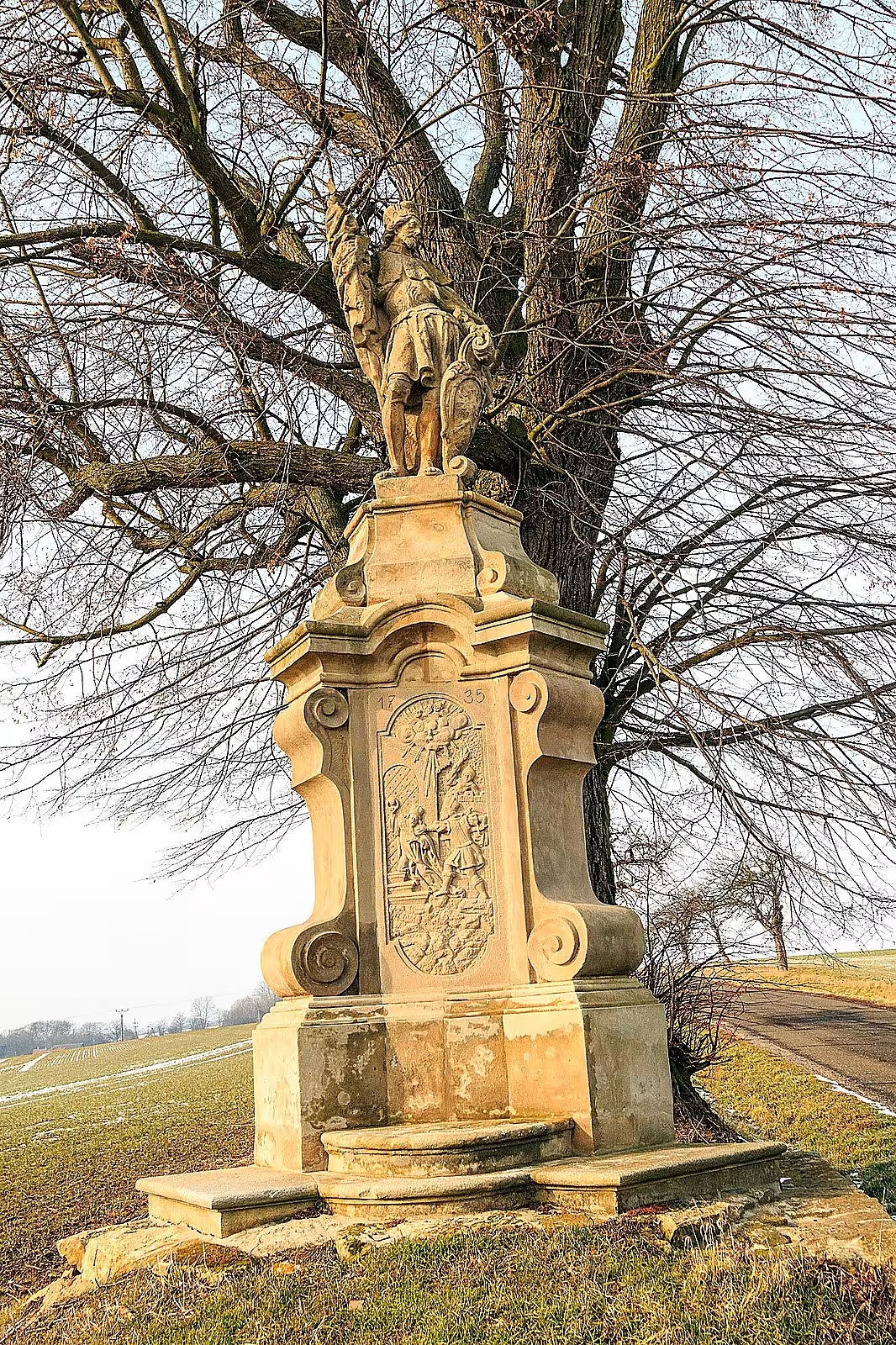
The late Baroque sandstone statue of St. Wenceslas from 1735 stands on the town of Bartoušov, which is a local part of the village Jičíněves in the district of Jicin. The work of an unknown author, made of bright sandstone, is a protected cultural monument registered in the catalogue of the National Heritage Institute under the register number SAR 28600 / 6-1458 and underwent professional restoration in 2013. This monument is an important example of the sacral sculpture associated with the cult of Czech patron.
This building was created in 1735 during the period when Baroque art was culminating in Czech countries. This strongly linked religious piety to the landscape, and St. Wenceslas's cult was then seen as a powerful symbol of the Earth's identity. The name of the creator was not preserved, but the work bears a high artistic value of the then late Baroque production.
The sculpture itself is located on an arc plinth, which lies on two semi-circular degrees. It is followed by a base decorated with volutes. It bears a detailed relief depicting the murder of St. Wenceslas, above which is marked by gold writing the roaring of the statue 1735. The base ends with a profiled ledge, followed by a smaller hexagon volcano. On it is a statue of St. Wenceslas in life size. The saint is depicted in a common iconographic concept, wearing a short skirt, armor and a prince's hat. In his right hand he carries a flag, with which he rests on the ground, and in his left he holds a shield with a sacred eagle.
The historical fates of the building over the centuries do not specify further details about the historical owners or administrators of the monument.
Key events in modern history are documented in 2013, when this cultural monument underwent professional restoration. A remarkable element is the base of the statue with a detailed relief of the tragic murder of St. Wenceslas and the original roasting marked with gold letters.
Today, the monument is located on the road III. Class no. 28027 leading to the village of Keteň, not far from the intersection with the road I. Class no. I / 32 in the district of Jičín. The surrounding environment and the location of the communication makes this place easily accessible to interested people about history and baroque art. The visit offers a direct meeting with authentic Baroque plastics in the Czech landscape, whose value lies in the original visual rendering and historical legacy associated with the Czech patron.
Then and now
Drag the slider to compare how the landmark may have looked when it was built with the view today.
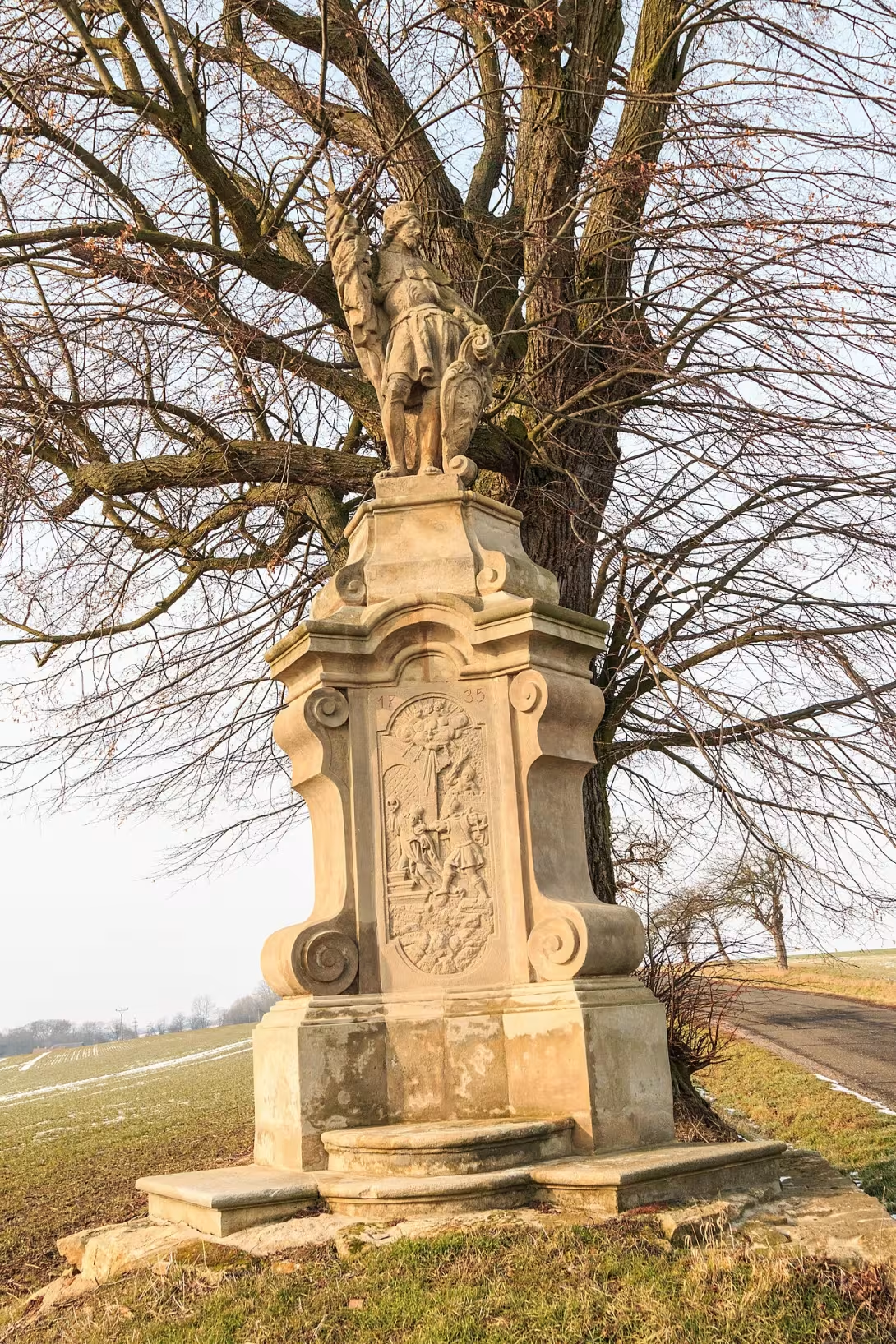

The historical appearance on the left is an AI-generated visualisation and serves as inspiration only.
Historical milestones
- 1735
- The creation of a statue of St. Wenceslas in the village of Bartoušov.
- 2013
- Professional restoration of the statue of St. Wenceslas.
Architectural development
The statue is placed on an arc plinth with two semi-circular stages. On a pedestal decorated with volutes is a relief depicting the murder of St. Wenceslas. The year of origin is marked above the relief. The sculpture itself stands on a smaller hexagon volcano.
Historical events
1735: The creation of the late Baroque statue of St. Wenceslas. 2013: Professional restoration of cultural monuments.
Points of interest
- The late Baroque sandstone statue of St. Wenceslas dates back to 1735 and is the work of an unknown author. - There is a detailed relief depicting the murder of St. Wenceslas on the pedestal and above it is marked with golden letters the roaring of the statue. - The saint is displayed in life size with short skirt, armour, prince's cap, flag and shield with the wedding eagle. - In 2013, this cultural monument underwent professional restoration. - The statue stands at the Bartoušov village's cadastral on the road leading to the village of Ketenz.
Guide
Show guide text
This text was created by artificial intelligence and has not been editorially reviewed. It may contain inaccuracies.
Welcome to this lovely place. You are standing right in front of a rare historical monument, which is the late Baroque sandstone statue of St. Wenceslas, located in the town of Bartoušov near Jičíněsi. If you look before you, you will see a work made of light sandstone, which breathes upon you through the atmosphere of the past centuries and its peaceful nobility.
Let's go back in time together and look at the historical context of this creation. The work itself dates back to a thousand seven hundred thirty-five. The creator of this piece of art remains unknown, but his handwriting and craftsmanship are admirable even after centuries. The creation of the statue falls into the late Baroque period, when the landscape was enriched with small sacral monuments, which were not only of religious importance, but also of natural dominance of rural space. At that time, people expressed their faith and respect for the patrons of the Czech country by building such works to protect crops, travellers and the whole village.
Now pay attention to the architecture itself and the details you have right in front of you. The Světec is displayed here in life size in traditional iconographic concept. Take a closer look at his clothes and equipment. Saint Wenceslas is dressed in armour, over which he has a short skirt, and on his head he carries a prince's hat. In his right hand he holds a flag, which is supported by the ground, and in his left hand he carries a shield decorated with a wedding eagle. The whole statue emits strength and spiritual peace.
When you fold down a little bit below, notice the base on which this statue stands. There is a detailed relief depicting the dramatic scene, namely the murder of St. Wenceslas. Just above this relief is marked with gold writing the roaring of the statue, which resembles the year thousand seven hundred thirty-five. The golden font on the bright sandstone still shines beautifully and captures every observer.
The personality associated with this place, Prince Václav, is the main patron of our country. His life and tragic death in the tenth century became the basis for creating Czech statehood and national identity. Although many centuries have passed since his death, his legacy continues to live in the form of monuments such as this one in Bartoušov. People looked up to him as protectors of peace and justice.
The interesting thing about this place is that the statue went through a professional restoration in the recent past, namely in the year two thousand thirteen. Thanks to this, today we can look at her details in such purity and beauty as the hand of an original, even unknown artist inhaled. It is admirable how craftsmen managed to work with light and sandstone to make the character so vibrant and noble.
I hope you enjoyed stopping by this monument today. You can stand here for a while, feel the calm of the surrounding nature and let history take hold of you, which is literally tangible here. Thank you for your attention, I wish you a nice rest of the day and a good trip on your next discovery of interesting places in the vicinity of Jičinev. Goodbye.
Tips for visitors
The best time to visit the statue of St. Wenceslas is in the spring or autumn season, when the weather is pleasant and the sun illuminates the statue in a special way. This time of year also offers beautiful nature around the monument.
Transport to the place may take place by car or public transport; it is advisable to use online search engines for current connection information.
When visiting the statue of St. Wenceslas, bring sun protection glasses, umbrella in case of unpredictable weather and suitable shoes for walking on outdoor roads. Photos can be captured from different angles around the statue, especially when the sun is behind it.
For families with children, this monument is ideal for a short walk. Children can look at the historical statue and the natural environment around it, offering the opportunity to explore the surrounding forests or fields.
It is possible to visit the village Jičíněves or Keten in the vicinity. These places offer opportunities to explore local peculiarities and enjoy peace in a picturesque environment.
Frequently asked questions
Can the monument be visited?
This is a structure in a public space that can usually be seen from outside free of charge. We have not verified that this particular one is freely accessible.
Where is the monument?
Location: Jičíněves, Královéhradecký kraj. The map on this page shows the exact spot.
Why is the monument protected?
It is listed in the Central List of Cultural Monuments of the Czech Republic as a cultural monument (register no. 1000139919).
Businesses nearby
Do you run a restaurant, accommodation, shop, museum, rental, wellness or other visitor service near this monument? Show yourself directly to the people heading to it — this is how they will see you in the app and on the web:
Nearby
Socha stojí u silnice III. třídy vedoucí do vesnice Keteň nedaleko křižovatky se silnicí I. třídy v okrese Jičín.
Accommodation nearby
Themed route
Socha svatého Václava (Bartoušov) Statue This valuable monument is located on a third-class road leading to the village of Keteň near the intersection with the first-class road. It is worth visiting for its historical artistic value and peaceful atmosphere of rural space.
Seasonal recommendations
Spring: In the spring period, the statue of St. Wenceslas in Bartoušov is illuminated by sunlight, which brings live shine to the green beauty of the surrounding fields and trees. The atmosphere is full of new beginnings and hope. It is advisable to visit the memory in the early afternoon, when the crowd decreases and nature offers its most beautiful form. We recommend wearing clothes suitable for mild temperatures because it can be cold in the morning and warm at noon.
Summer: In summer, the Statue of St. Wenceslas is surrounded by full flowers and greenery, which brings colorful colours to the panorama. Sun day creates ideal conditions for long walks and relaxation in the outdoor area. Visitors are advised to come early in the morning or later in the evening to avoid the noon heat and crowd. Don't forget to wear sun protection and plenty of drinking water.
Autumn: In autumn months the surroundings of the monument are lit with golden and red leaves, which adds a romantic feeling to the visit. The atmosphere is calm and mild, often accompanied by sun days or the first freezing winds. We recommend visiting a monument in the early afternoon when nature appears in its best form. It is advisable to wear clothes on layers and carry an umbrella for suddenly occurring weather.
Winter: Winter brings a peaceful and quiet look to the memory of the Statue of St. Wenceslas when the surrounding area is covered with snow. The sunny days offer beautiful lights on the statue and its surroundings, while the frost gives the atmosphere a magical touch. Visitors are advised to visit the memory early in the morning or late in the evening when the crowd decreases and the temperature is tempered. It is important to wear warm clothes, including fur helmets and protective shoes, and be prepared for shorter opening times.
Visualizations and artistic views


The visualisations are generated by artificial intelligence and serve as inspiration.
Photos from the area
Real photos taken near the monument

Zdroj a licence jsou uvedeny u každého snímku.
Tips from visitors
No tips yet. Be the first!
Log in and add your tip.
Sources and literature
Photos: Petr1888 / CC BY-SA 4.0 — Wikimedia Commons. The author and licence also appear when you hover over the image.
Faktickým podkladem tohoto textu byl článek na Wikipedii, jehož autory jsou přispěvatelé Wikipedie. Článek je dostupný pod licencí CC BY-SA 4.0.
Location on the map
Příběhy a pověsti
Legendy, pověsti a příběhy spjaté s touto památkou
Fotografie návštěvníků
Zatím žádné fotografie. Buďte první, kdo přidá fotografii z návštěvy!
Log in a přidejte svou fotografii nebo hodnoťte.
Za ověřenou návštěvu v aplikaci získáte víc bodů — poznáme podle GPS, že jste na místě.
Reviews and comments