



Socha Vltavy Statue
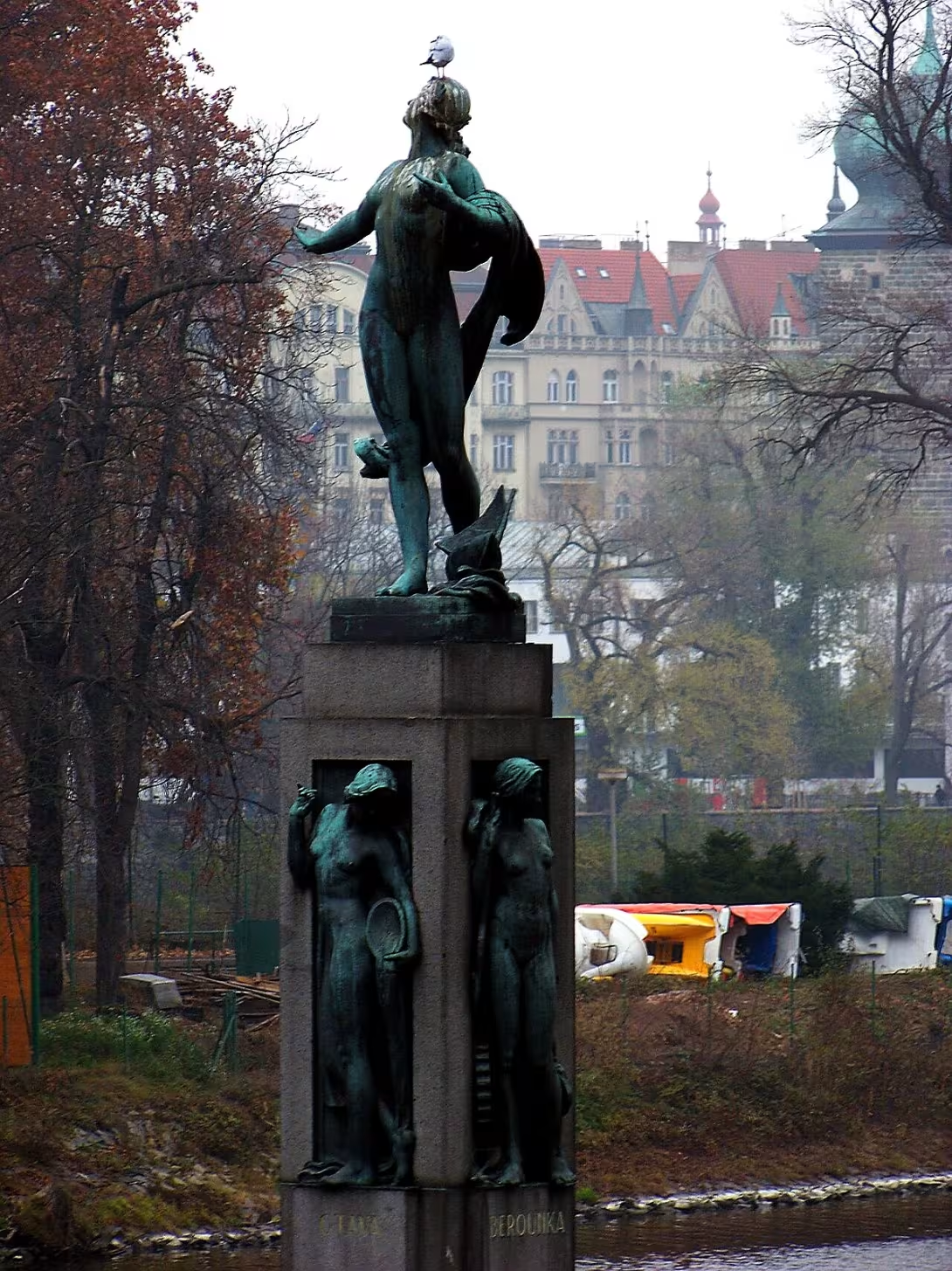
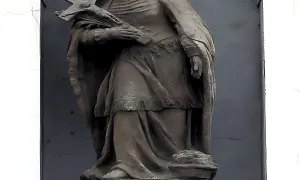
Socha Vltavy is a granite obelisk with allegorical characters of the river Vltava and its tributaries. He is standing in Prague on Smíchov behind a wall near Children's Island. The work was created in 1916, it was located in 1927 and since 1964 it has been included in the state list of cultural monuments.
The author of all plastics is Czech sculptor Josef Václav Pekárek, famous for his allegorical works. The architect František Sander and stonemason Palouš collaborated on the realization of the monument. In its installation in 1927, Czechoslovakia experienced national renewal and cultural development, while Europe recovered from the consequences of the First World War.
The monument is a four-sided granite prism. On top of it stands a 2.8 meter tall bronze statue of Vltava in the form of a naked, dancing girl. The figure is turned to the Legion Bridge and looks to the right through the Shooting Island to the National Theatre. There's an anchor at her feet, and a strip of cloth flows through her arm.
On the sides of the obelisk are four other female figures symbolizing the tributaries of the Vltava. The north side is decorated by a gold-panning girl who represents Otava. The east side consists of a figure with a fish representing Sazava, a southern girl with a bouquet symbolizing Lužnice and a western girl with a toothed wheel representing Berounka.
This sculpture is one of several pictures of Vltava in Prague. We'll find another one at the Terezka fountain in Clam-Gallas Palace, on the ramp of the National Museum, on the wall of the Podolské Waterworks or on the front of the former Military Geographical Institute. Similar symbolism of the Vltava confluence with Malš in the form of two girls is also found in České Budějovice.
Socha Vltavy is now a visible part of Prague Smíchova in the immediate vicinity of Children's Island. The work represents a valuable example of allegorical sculpture from the beginning of the 20th century. It is advisable to include it in sightseeing walks along the river bank.
Then and now
Drag the slider to compare how the landmark may have looked when it was built with the view today.
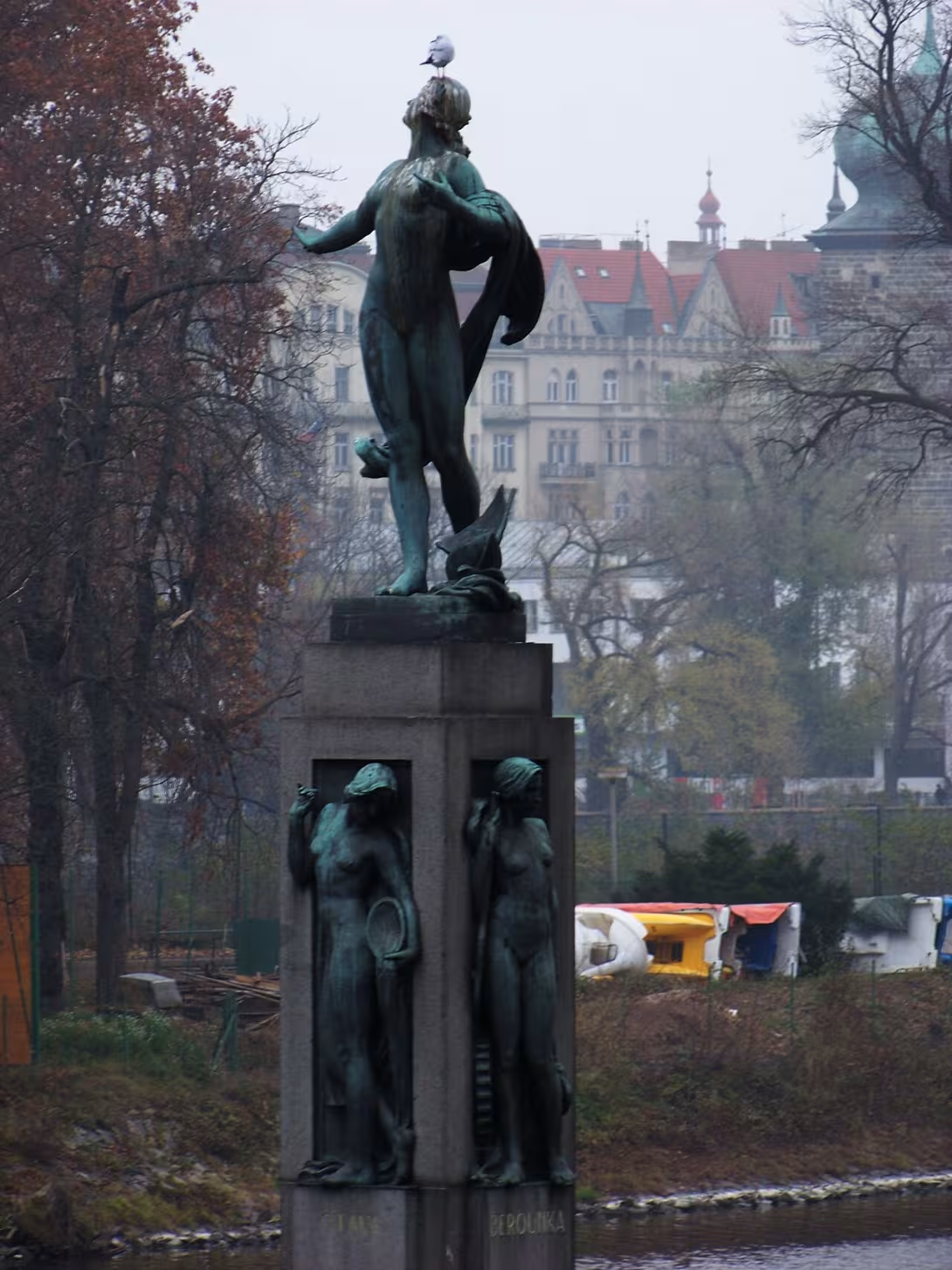
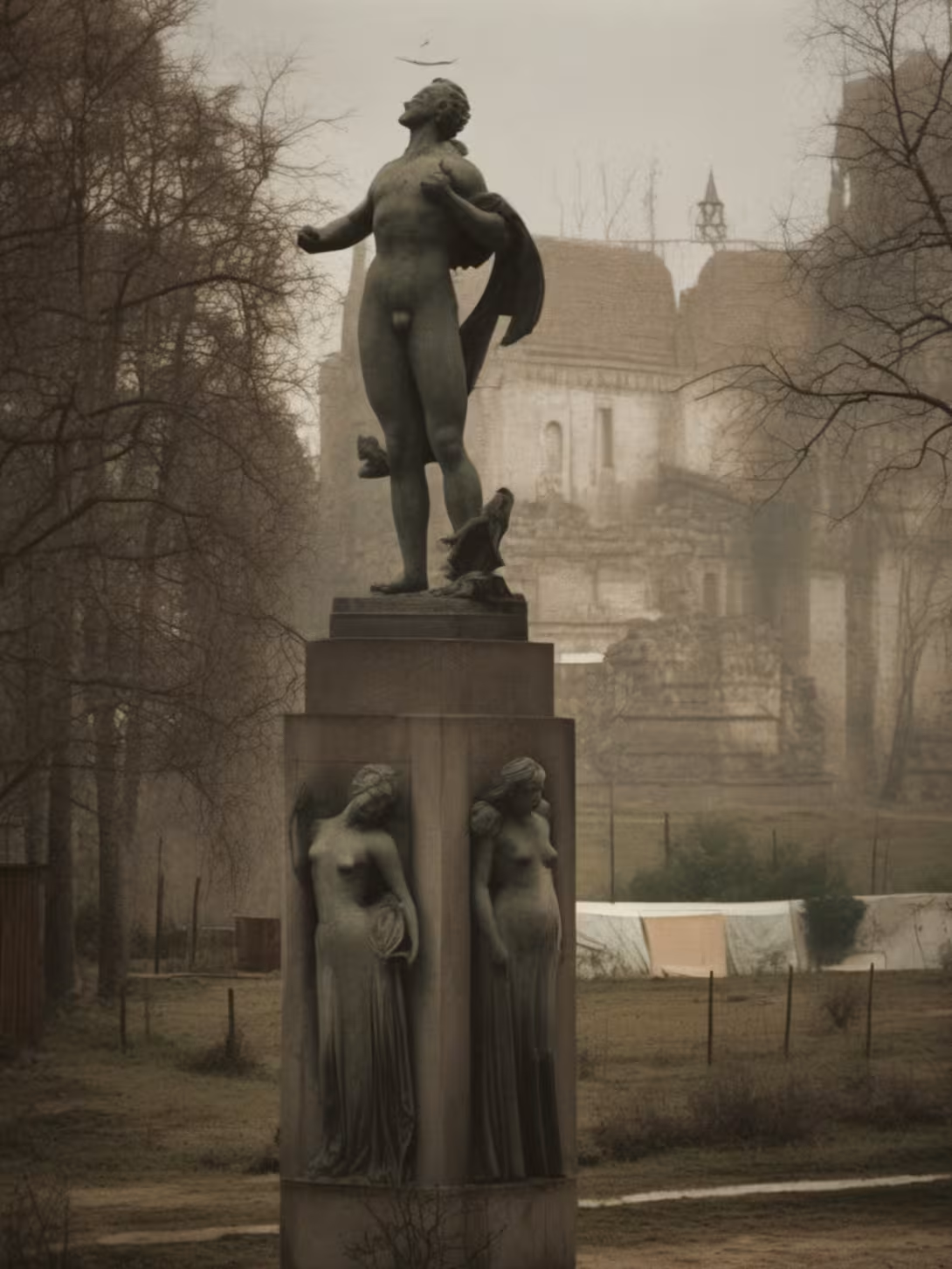
The historical appearance on the left is an AI-generated visualisation and serves as inspiration only.
Historical milestones
- 1916
- The creation of the statue of the Vltava
- 1927
- Installation of the statue on Smíchov
- 1964
- Registration in the state list of cultural monuments
Historical events
- 1916
- A statue was created.
- 1927
- Putting the statue in its place.
- 1964
- Registration in the state list of cultural monuments.
Points of interest
- Socha Vltavy is a granite obelisk with allegorical characters of the river Vltava and its tributaries. - The work was created in 1916, it was located in 1927 and since 1964 it has been included in the state list of cultural monuments. - The author of the statue is Czech sculptor Josef Václav Pekárek, famous for his allegorical works. - On top of the obelisk stands a 2.8 meter tall bronze statue of Vltava in the form of a naked girl facing the Legion Bridge. - On the sides of the obelisk are four other female figures symbolizing the tributaries of the Vltava: Otava, Sazava, Lužnice and Berounka.
Guide
Show guide text
This text was created by artificial intelligence and has not been editorially reviewed. It may contain inaccuracies.
Welcome to Smíchov, one of the historically rich places in Prague, where you are currently in front of one of the most remarkable allegorical works of Czech sculpture art. You're standing in front of a granite obelisk with a bronze figure called Vltava, who greets you with symbols of wealth and history of our country.
Socha Vltavy was made in 1916 by Czech sculptor Josef Václav Bakárek, known for his allegorical work. This work of art was not only placed on Smíchov in 1927, but also acquired the status of cultural monument in 1964. It emerged as a symbolic reminder of the four main tributaries of the river Vltava: Otava, Sazava, Lužnice and Berounka.
Take a look up to the top of the obelisk where the bronze statue is located. This character not only represents the River Vltava, but also symbolizes the connection and strength of four of its main sources. It's a great example of architectural art combined with sculpture.
Let's move on to the history and personalities that shaped this memory. František Sander, one of the architects of the time, collaborated on this project, which is proof of its influence in the field of sculpture and architecture. Another personality associated with this monument is Palouš, who also contributed to its success.
The interesting thing about this statue is that even after centuries it stands as a testament to the artistic spirit and history of our country. It is a reminder not only of the water flow, but also of the cultural stream that formed Czech society.
Let us now explore the surroundings and enjoy the atmosphere of Smíchova. This monument is just one of many reasons why you should look at other historical places in Prague.
Thank you for your visit to the Vltava statue. We hope you enjoyed this guide and that it inspired you to explore other parts of our beautiful metropolis. We wish you a lot of pleasant discovery times!
Tips for visitors
The best time to visit the statue Vltava is a morning or afternoon light where the sun hits the bronze allegory and granite base, which creates interesting shadows and highlights the details of the statue. Since the monument is located in the open space of Smíchov, it is ideal to avoid direct noon sun, which can be uncomfortable for longer stays.
Transport availability is ensured both by car and public transport. For public transport we recommend to use local stops, with current connections and line numbers best verified directly in the search engine or on the website of the transport company.
When visiting, bring comfortable shoes, because the surroundings of the monument may be uneven and a walk along the river bank requires firm shoes. We also recommend that you bring drinking water and light meals if you plan a longer stay in the area where the proximity of refreshments is not always guaranteed.
For photography is the best place right at the base of the statue, where you can capture a general view of the allegory of Vltava and its surroundings. The ideal light occurs at dawn or at dusk, when the sky is coloured and the statue is well distinguished from the background. Watch out for reflections on bronze parts of the statue, which can be disruptive when the sun is sharp.
In the immediate vicinity of the monument is located Children's Island, which is a great place for families with children. It is a space suitable for play and rest, so a visit to the statue can easily be combined with a walk around this island. It is important for families to ensure the safety of children near water and river.
Frequently asked questions
Can the monument be visited?
This is a structure in a public space that can usually be seen from outside free of charge. We have not verified that this particular one is freely accessible.
Where is the monument?
Location: Smíchov, Hlavní město Praha. The map on this page shows the exact spot.
Why is the monument protected?
It is listed in the Central List of Cultural Monuments of the Czech Republic as a cultural monument (register no. 1000152399).
Businesses nearby
Do you run a restaurant, accommodation, shop, museum, rental, wellness or other visitor service near this monument? Show yourself directly to the people heading to it — this is how they will see you in the app and on the web:
Events nearby

Zdroj akcí: otevřená data měst a obcí ČR (Národní katalog otevřených dat) a kalendář akcí Národního památkového ústavu.
Nearby
Dětský ostrov
Most Legií
Střelecký ostrov
Accommodation nearby
Trips and activities nearby
Guided tours, tickets and activities nearby from GetYourGuide
Affiliate link: if you buy from the partner, we may receive a commission. The price for you does not change.
Search tours and activities →Themed route
Thematic cruise route from the village Smíchov
1.Socha Vltavy (statue) - Why is it worth visiting: This statue is an iconic representation of local culture and art that symbolizes the importance of the river for the region. It is the starting point of our trip where you can enjoy a beautiful view of the surroundings.
2. Children's Island - Why is worth visiting: This peace and quiet space is ideal for relaxation and relaxation. In addition, it offers a view of the urban landscape from a different angle, allowing you to learn about the Smíchov area.
3. Legion Bridge - Why is it worth a visit: The bridge is not only an important transport link, but also an architectural work with historical significance. His views on both sides of the Vltava are beautiful and offer beautiful photos.
4. Shooting Island - Why is it worth a visit: This place is known for its history and natural environment, which allows you to relax walks. It's a great way to relax after visiting other places.
5. Return to the Statue of Vltava After exploring the surrounding areas, go back to where you started. Observe how the trip changed your perspective on this monument and its surroundings.
This route offers a combination of cultural, historical and natural experiences that are easily accessible in the Smíchov area.
Seasonal recommendations
Seasonal recommendation for visiting the historical monument. Monuments: Socha Vltavy (statue), Smíchov Status: Good
In spring, the surroundings of the statue begin to turn green and the air is fresh. Light is soft in this period and very pleasant to observe details. I recommend a visit to the morning hours when there are the least people. Dress well, because the morning cold can change quickly with heat.
In the summer, there are the most people and the sun shines very intensively. The atmosphere is alive, but heat can be tiring. The best time to visit is early in the morning to avoid the biggest crowds and the highest heat. Choose a light outfit and don't forget drinking mode.
Autumn brings golden shades and often fog to this part of town, which creates a melancholy mood. The sun is lower, which creates beautiful long shadows. It is advisable to have a warmer top layer and solid footwear with you, because moisture can make the road less stable.
It is quiet in winter time and there is often a freezing atmosphere. Days are short, so plan a tour around noon to use the maximum amount of daylight. The need is very warm clothes, including jackets, scarves and gloves, so that the cold does not affect you.
Visualizations and artistic views


The visualisations are generated by artificial intelligence and serve as inspiration.
Photos from the area
Real photos taken near the monument


Zdroj a licence jsou uvedeny u každého snímku.
Tips from visitors
No tips yet. Be the first!
Log in and add your tip.
Sources and literature
Photos: I would appreciate being notified if you use my work outside Wikimedia. More of my work can be found in my personal gall / CC BY-SA 3.0 — Wikimedia Commons. The author and licence also appear when you hover over the image.
Faktickým podkladem tohoto textu byl článek na Wikipedii, jehož autory jsou přispěvatelé Wikipedie. Článek je dostupný pod licencí CC BY-SA 4.0.
Location on the map
Příběhy a pověsti
Legendy, pověsti a příběhy spjaté s touto památkou
Fotografie návštěvníků
Zatím žádné fotografie. Buďte první, kdo přidá fotografii z návštěvy!
Log in a přidejte svou fotografii nebo hodnoťte.
Za ověřenou návštěvu v aplikaci získáte víc bodů — poznáme podle GPS, že jste na místě.
Reviews and comments