



Srbecká lávka Bridge
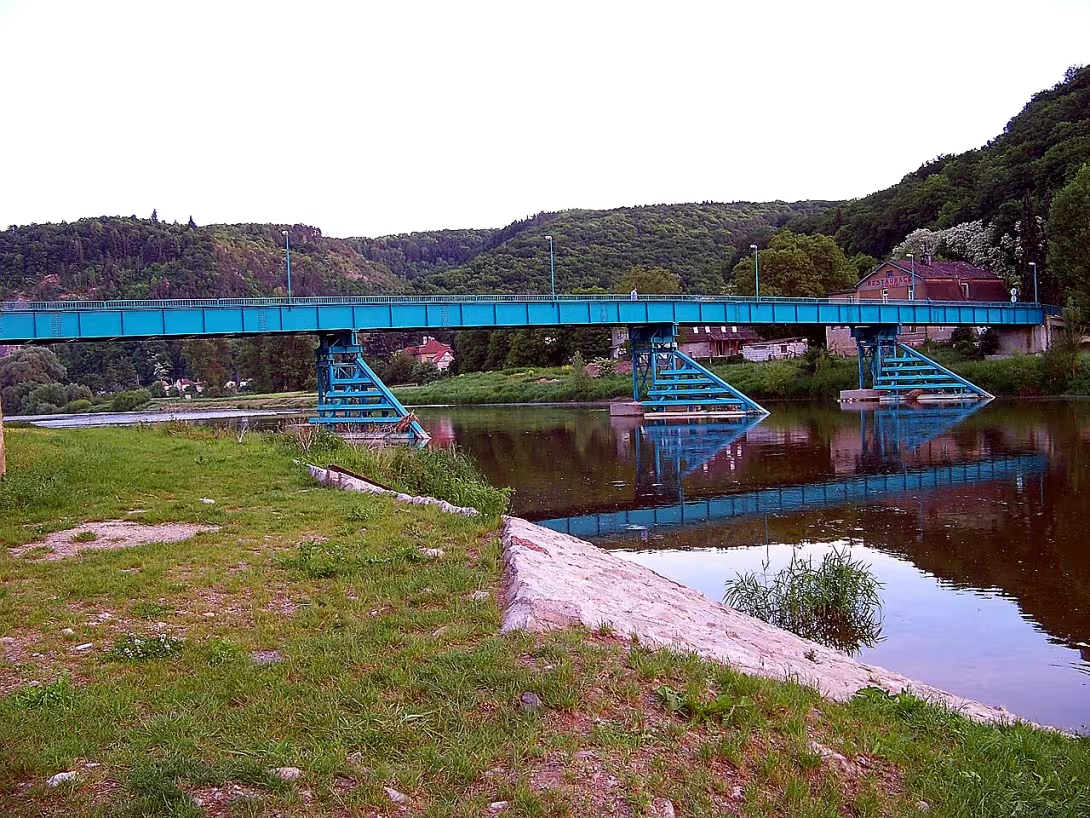
Srbecká lávka is a light road bridge over the river Beroun in Serbia in the district of Beroun. It acquired its present form in 2003, when a new steel structure with asphalt bridge and traffic lights was built. The bridge is interesting because its place has long served as a crossing of the river in various forms.
Originally in Serbia, Beroun was overcome through a ford. This primitive transition was later replaced by a road ferry, which was operated here until 1986.
In 1958, the army built a pontoon bridge, but it destroyed the flood after less than a week. The bridge was subsequently rebuilt in military training. The first footbridge was built in 1960, destroyed in June 1981 by the flood. In the same year 1981 a new footbridge with a wooden bridge was built to enable single-lane car operation. However, this building lasted only until 2002, when another flood destroyed it. The current steel bridge was built in 2003.
The bridge has a total length of 98,2 metres and a bright width of five metres, of which is 3,25 metres per lane and 1,25 metres per sidewalk. The structure is a continuous beam of four fields 24 meters long. Three steel pillars, consisting of piping 273 × 10 millimetres, are located in the river. The pillars are based on 880 millimetres of diameter piles at a depth of six to seven metres. The extreme supports are reinforced concrete monolithic, also based on five pilots of the same diameter.
Lávka is part of the local communication in the administration of the village Srbsko, it is stopped from the railway stop towards the village. It is mainly used for local transport with a capacity limited to five tonnes - trucks and buses cannot pass through it. The operation controls two-colour signals and the road sign limits the maximum speed to 30 km / h. Guided by the footbridge three tourist routes to the club of Czech tourists (blue, green and yellow markings) and cycling route number 8245 called the St. Ludmila Trail. The inspection visit in January 2019 revealed a failure of insulation and leakage in the area of bridge conclusions, which could lead to a further reduction in load capacity if there is a duration.
Historical milestones
- before 1986
- In Serbia, there was a ford and later a ferry that was in operation until 1986.
- 1958
- The army built a pontoon bridge that was dismantled after a week because of the flood and later rebuilt in military training.
- 1960
- The first footbridge was built, destroyed by the flood in June 1981.
- 1981
- New footbridge with wooden bridge and allowing single-lane car operation, destroyed by floods in 2002.
- 2003
- Contemporary steel bridge with asphalt bridge and traffic-controlled traffic lights built.
Architectural development
The bridge was built in 2003 as a steel construction with a asphalt bridge. Previous versions of the footbridge were wooden and destroyed by floods in 1981 and 2002. The bridge has a static continuous beam system with a fixed support in the middle and is based on the pilots in the Berounky river. Pillars are protected by steel leprosy.
Points of interest
- The bridge was originally overtaken by simple brood, later replaced by a ferry until 1986.
- In 1958, the army built a pontoon bridge which, after a week, destroyed the flood and was rebuilt in military training.
- The first footbridge was built in 1960, but in June 1981 the flood destroyed it.
- In 1981 a new footbridge was built with a wooden bridge for car traffic, which lasted only until 2002.
- In 2003 the current steel bridge with asphalt bridge and traffic lights were built.
Guide
This guide is narrated by a synthetic voice generated by artificial intelligence.
Show guide text
This text was created by artificial intelligence and has not been editorially reviewed. It may contain inaccuracies.
Srbecká lávka is a light bridge across the Berounka River in Srbsko in the Beroun District. It connects the railway station with the village and belongs to the local road network, which is maintained by the municipality of Srbsko.
People have crossed the river here since time immemorial. First by ford, later by a road ferry that operated until nineteen eighty-six. In nineteen fifty-eight, the army built a pontoon bridge here. After a week, they dismantled it because of a flood, and later they built it again as part of military exercises. The first pedestrian bridge was built in nineteen sixty and lasted until June nineteen eighty-one, when a flood destroyed it. That same year, a new bridge was completed with a wooden deck, which could now handle one lane of car traffic. The water took this one too, this time during the flood of two thousand and two. A year later, the present metal bridge with an asphalt deck was built.
The bridge is ninety-eight point two meters long and five meters wide. Most of the width is taken up by the traffic lane, with a sidewalk next to it. The structure rests on five supports and consists of a continuous beam with four spans, each twenty-four meters long. Three steel piers stand directly in the riverbed. Each one is made up of four steel tubes and the foundations extend to a depth of six to seven meters on piles. The piers are protected by steel ice breakers. The end abutments on both banks are reinforced concrete.
Although it is primarily a pedestrian bridge, vehicles up to a total weight of five tons are allowed to use it. Only one vehicle at a time and in one direction, traffic is controlled by traffic lights, and the speed limit is thirty kilometers per hour. Trucks and buses cannot cross it. During an inspection in January two thousand and nineteen, the most serious defect proved to be leaks at the expansion joints.
How busy the bridge is was shown by a count in spring two thousand and eleven. On one Monday in April, five hundred and seventy-seven cars and almost four hundred pedestrians crossed it in twelve hours. On a May Saturday, it was over a thousand cars, three hundred and sixty-two cyclists, two thousand one hundred and ten pedestrians, and one hundred and fifteen dogs.
The bridge is also important for hikers. Blue, green, and yellow hiking trails run across it, as well as a cycling route called the Trail of Saint Ludmila.
Tips for visitors
The best time to visit the Serbian footbridge is in spring or autumn when nature is around the most beautiful and temperatures are pleasant. It can be hot here in the summer and there can be a crowd of people on the bridge, while in winter access can be restricted due to snow or ice on the bridge. At these times it is also ideal to visit the footbridge early in the morning or in the evening when the light is softer and the photos stand out.
Parking at the Srbek bridge is possible in several places around the village Srbsko. It is recommended to arrive by car because public transport to this place is not very frequent. You can find out more about parking zones and traffic options on local information boards or in a tourist centre in the nearby city. If you arrive by car, you can also use the bike paths that lead along the river Berounky.
When visiting the Srbek bridge, take comfortable shoes, because the path along the bridge and the surrounding area can be uneven. We also recommend taking enough water, because in the summer months it may be hot in the sun. If you are planning to photograph, do not forget the camera or smartphone with a good lens quality. For families with children it is advisable to take some fun, such as toys or small games that children can play while walking.
The best places for shooting Srbek's footbridge are from both sides of the bridge, where there is a view of the river Beroun and surrounding landscape. For the best light is the perfect time morning or evening when the sun shines from an angle and creates interesting shadows. If you want to capture the overall view of the bridge, it is worth standing on the edge of the bridge and photographing towards the river. There are also beautiful views of the forests and cycling trails around the bridge.
In the vicinity of the Srbek bridge is worth visiting local forests that offer peaceful walks and opportunities to observe nature. There is also the possibility to use the bike paths that follow the river Beroun and allow beautiful views of the landscape. These trails are suitable for cyclists and pedestrians. It is interesting for families with children to visit local natural areas where children can discover and play in nature.
For families with children, visiting the Srbek footbridge is a great opportunity for active spending time. Children can see the bridge and its construction, which is interesting even for younger visitors. In the vicinity you can find places where children can have fun, for example when walking through forests or along the river. It is also recommended to bring some small games or toys that children can play during the visit.
Frequently asked questions
Is Srbecká lávka open to the public?
Yes, Srbecká lávka is open to the public. There are special groups for disabled people.
How do I get to the place by car / public transport?
The nearest public transport stop is Beroun, from here you can reach by taxi or bus. You can drive directly to the bridge.
How much is the entrance fee and is it paid on the spot?
Payment is made at the place where you can buy other souvenirs.
Is the tour suitable for children and seniors?
Yes, Srbecká lávka is suitable for visiting families with children as well as for seniors. There are several levels of bridge that are accessible to people with disabilities.
How long does the tour take?
The tour of the Srbek bridge takes approximately 30 minutes. At this time you can see the bridge and surroundings.
What are the opening times and booking is required?
Srbecká lávka is open all year round, but best time to visit them from April to October. Reservation is not necessary, but it is recommended to contact the administrator in advance when visiting larger groups.
What's interesting in the immediate vicinity?
In the immediate vicinity of the Srbecká footbridge there is a nature reserve with rich fauna and flora. You can visit other locations such as Beroun Valley or Křivoklát Castle.
For kids
Imagine coming back 23 years... Until Srbsko was still young and Berounka flowed like a small river. There were people who lived here for a living through agriculture and pasture. The locals were called Serbs, who loved their homeland and were proud of their culture.
This area was then full of forests and fertile land. People settled here and built their first settlements. Beroun was like a small stream that crossed the whole territory. Local people used it to water fields and pasture.
Businesses nearby
Do you run a restaurant, accommodation, shop, museum, rental, wellness or other visitor service near this monument? Show yourself directly to the people heading to it — this is how they will see you in the app and on the web:
Events nearby



Zdroj akcí: otevřená data měst a obcí ČR (Národní katalog otevřených dat) a kalendář akcí Národního památkového ústavu.
Nearby
In the vicinity of Srbecká footbridge there is a natural landscape with river Beroun and possibilities for hiking and cycling. There are also other historical and natural sites nearby, such as local forests and cycling trails.
Accommodation nearby
Trips and activities nearby
Guided tours, tickets and activities nearby from GetYourGuide
Affiliate link: if you buy from the partner, we may receive a commission. The price for you does not change.
Search tours and activities →Themed route
Thematic cruise route Srbecká lávka and surroundings
1.Srbecká lávka * Type: * historic bridge over Beroun * Why? * Unique combination of reinforced concrete structure from 1929 and picturesque views of the river. The bridge connects both sides of the village and offers an ideal starting point for further tours.
2. On the way to the bike path along Beroun * Type: * hiking and cycling route Why? A walking or cycling walk along the asphalt trail along the Berounka (about 2 km from the footbridge) leads pleasantly green shores and offers a quiet sitting by the water.
3. Forest Circuit by Srbecká footbridge * Type: * natural path * Why? * A short, about a kilometer long circle between the woods and the river valley shows local flora and fauna. Suitable for short stopping with breathing fresh air.
4. Return through the cycle path * Type: * Active transport Why? The return path along the same path allows you to use the bike path (approximately 3 km) for relaxation or active movement overlooking the surrounding countryside.
The route is simple, approximately 5-6 kilometers long, and combines the main monument with the natural beauties of Beroun and forests in the surrounding area.
Seasonal recommendations
Spring Srbecká lávka offers a unique atmosphere in the spring months, when nature wakes up after winter peace. The sun illuminates the stone arches of the bridge with a fine, scattered light, while the primrose blossoms flourish around and the woods dress in green. The air is still cold, but it is already penetrating through the warm rays that attract to walk around. The specific advantage is that at this time the monument is less visited than in the summer months, which allows a peaceful examination of historical details. However, it is recommended to wear light but warmer layers, as morning and evening temperatures may be even colder. The best time to visit is early morning when the light is pleasant and the crowds are minimal. If you go on a trip, don't forget the comfortable shoes, because spring rains can make it difficult to travel on stone paths.
Summer In the summer months, Srbecká lávka becomes one of the most visited places in the area, as warm weather attracts tourists from the wide area. The sun shines intensively here, and it is therefore advisable to visit the memory early in the morning or at sunset when light is lighter and temperatures are more pleasant. The atmosphere is alive because cultural events or markets often take place around the bridge. The specific feature is that in the main summer season there are often families with children who enjoy walking around. It is recommended to dress light, airy clothes and not forget the sunglasses and sunscreen. If you plan to visit in July or August, avoid the noon hours when the most crowds and the highest temperatures are.
Autumn Autumn on the Srbek footbridge brings a unique magical atmosphere where leaves on trees turn into golden, orange and red shades. The sun already bears the intensity of summer, but its rays reflect from the colored leaves and create picturesque scenery. The air is clean and refreshing, which makes the visit a pleasant experience. The specific advantage is that at this time the monument is again less visited than in the summer months, which allows a peaceful walk. It is recommended to wear warmer layers as temperatures fall gradually, and not forget the umbrella because autumn rains are common. The best time to visit is in September when the weather is still pleasant and nature is in full beauty.
Winter The winter visit to Srbecká footbridge offers a quiet and mysterious atmosphere, where a quiet landscape covered with snow spreads around the bridge. The sun shines at a low angle here, creating long shadows and golden sparks on rocks. The air is cold and clean, which gives the visit a special charm. The specific advantage is that in the winter months the monument is almost empty, which allows a quiet exploration without crowds. It is recommended to wear warm clothes, including wool sweaters and waterproof shoes, as temperatures may be low and precipitation frequent. The best time to visit is in the morning when the light is most pleasant and the temperature is even softer. If you go on a trip, don't forget a warm drink to help you cope with the cold air.
Visualizations and artistic views


The visualisations are generated by artificial intelligence and serve as inspiration.
Photos from the area
Real photos taken near the monument

Zdroj a licence jsou uvedeny u každého snímku.
Tips from visitors
No tips yet. Be the first!
Log in and add your tip.
Sources and literature
Photos: cs:ŠJů / CC BY-SA 3.0 — Wikimedia Commons. The author and licence also appear when you hover over the image.
Faktickým podkladem tohoto textu byl článek na Wikipedii, jehož autory jsou přispěvatelé Wikipedie. Článek je dostupný pod licencí CC BY-SA 4.0.
Location on the map





Příběhy a pověsti
Legendy, pověsti a příběhy spjaté s touto památkou

Fotografie návštěvníků
Zatím žádné fotografie. Buďte první, kdo přidá fotografii z návštěvy!
Log in a přidejte svou fotografii nebo hodnoťte.
Za ověřenou návštěvu v aplikaci získáte víc bodů — poznáme podle GPS, že jste na místě.
Reviews and comments