






Středověké opevnění v Nymburce Town walls
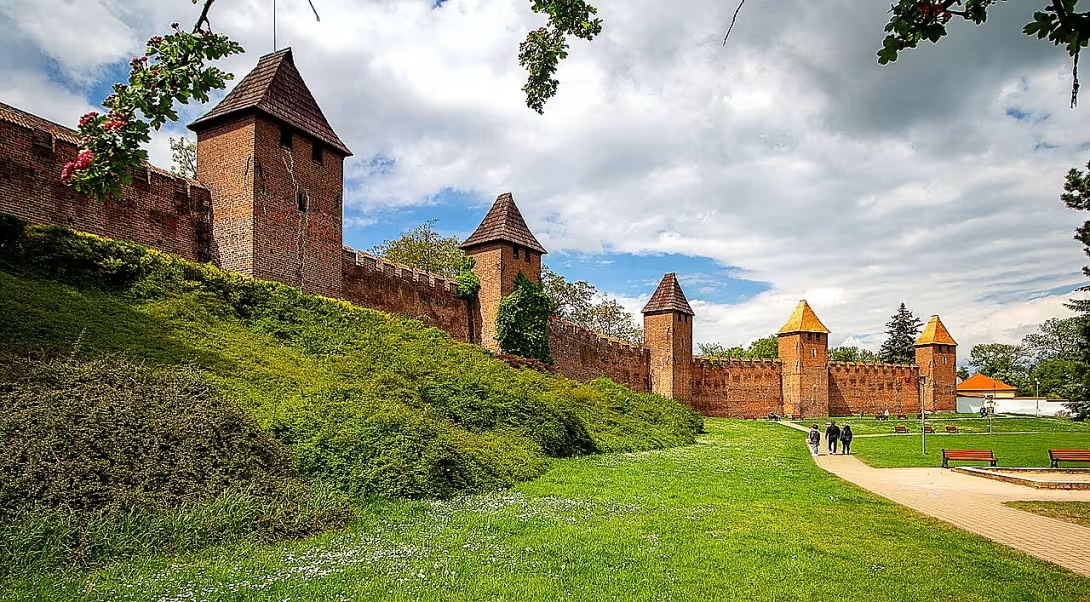
Medieval fortifications Nymburka, located on the streets of Hradec, Jezezická, Na Rejdiště and Na Harbour, is protected as a cultural monument of the Czech Republic. This historic building was probably founded by King Prehmat Otakar II. Around 1275 and later expanded under the rule of Václav II. It is important thanks to its architecture, historical context and unique elements such as the castle moats. It is a distinct fact that it is one of the few medieval fortifications with preserved water moats.
The construction of the walls began right after the founding of the city by the King Primohmi Otakar II. In the late 13th century, especially under the rule of Václav II, their development was further deepened. Colonists from the lower Rhine region brought the brick wall technique as a result of the lack of quality stone in Central Polabi. This effective method of construction was used in the implementation of walls with regularly located towers which were open towards the city.
Architecturally, the fortifications are built out of solid burnt bricks with a mixture of optic debris and lime mortar. The wall had a length of approximately 1,600 metres and a height of 7- 8 metres, while the towers were slightly higher. After Hussite wars, the wall was reinforced with a new moat and a park wall from the spade. The city was led by four main passageways: Svatojiřská, Velibská (Byslavská), Bobnická and Mostecká gates.
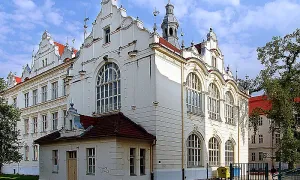
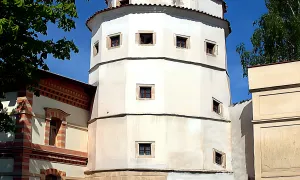
During the Thirty Years' War, the city was conquered by the Swedes, suggesting a dramatic fate of fortification. After the war destruction and great fire in 1838, which led to the demolition of several gates, the walls were gradually demolished or used for new buildings. In the years 1905- 1909 architect Ludvík Labler reconstructed the northern section of the walls with towers in the part Na port into a romantic form, making these parts a symbol of the city.
Today Nymburka is protected as a cultural monument and parts of the walls have been repaired in the years 2000-2006. The towers in the street Na Reydiste have been open to the public since April 2022. Visitors can explore historical objects and their unique elements such as Small and Large Valas. The uniqueness of these walls of water ditches is that river water is still flowing in them.
The Nymburk fortification is an important historical place that shows a rich past and medieval architecture. The visit offers insight into the development of urban defence systems and reminds of events forming the region. Exploring this place is not only a way to the past, but also an opportunity to appreciate efforts to preserve it for future generations.
Historical milestones
- Around 1275
- The founding of the city and the beginning of the wall construction by the King Premohmi Otakar II.
- End of 13th Century
- Development and deepening of fortifications under the rule of Václav II.
- po Hussite War
- Strengthening the wall with a new moat and a park wall
- 1838
- Large fire leading to the demolition of several city gates
- 1905-1909
- Romantic reconstruction of the northern section of the walls by architect Ludwig Labler
- 2000-2006
- Repair of parts of Nymburk walls
Architectural development
The wall of the wall was built of solid burnt bricks with a core made of optic debris and calcium mortar. The wall was approximately 1,600 metres long and reached a height of 7- 8 metres, with towers slightly higher. After Hussite wars, the walls were reinforced with a new moat and a parking wall.
Historical events
- 17th Century
- During the Thirty Years' War, the city of Nymburk was conquered by the Swedes.
- 1838
- The Great Fire in Nymburk led to the demolition of several gates, including the Mostecký and Bboloslav gates.
Points of interest
- It is one of the few medieval fortifications with preserved water trenches in which river water flows to this day. - Due to the lack of quality stone in Central Polaba, colonists from the lower Rhine area brought the brick wall technique. - The wall was approximately 1,600 metres long and 7- 8 metres high. - The city was led by four main passageways: Svatojiřská, Velibská, Bobnická and Mostecká gates. - Architect Ludvík Labler reconstructed the northern part of the walls in 1905-1909 into a romantic form.
Guide
Show guide text
This text was created by artificial intelligence and has not been editorially reviewed. It may contain inaccuracies.
Welcome to Nymburk, a city that still tells its face stories of the days of knights and kings. Right now, you're facing one of the most important testimonies of Nymburk history, in front of its medieval walls. Stop for a moment, take a breath and feel the atmosphere of this place. Before you stands the masonry, which for centuries separated the safety of urban space from the unknown outside world. If you look at these walls, you may see only old bricks and stone in them, but you are actually looking at the embodied ambition of Czech rulers and the courage of the people who built this city.
Let's go back more than 700 years together. It's 1275, and at that time, there is King Přemysl Otakar the Second. He was the one who laid the foundations for the Nymburk fortification. At the time, it was not just an issue of aesthetics, but, above all, survival and strategic control over the territory. Nymburk was supposed to be a strong support point and therefore the construction of walls was a priority. But their work did not end with one monarch. When Václav the Second, in the late 1930s, joined the throne, he decided to further develop and deepen the fortification. Imagine the thousands of hours of work, the noise of stones and bricks that the city had to accompany when the walls grew to their full size to provide maximum protection to the inhabitants.
Now pay attention to the material from which the walls are built. If you notice the surface of the walls, you'll see the predominance of bricks. This is a fascinating detail, because in Central Polabi at that time the quality natural stone was missing suitable for such massive buildings. And this is where the interesting human element enters the story. The brick-to-Nymburk technique was not brought by local but colonists who came here from the lower Rhine area. They brought not only their craft and knowledge, but also a whole new way of building, which was modern and efficient in our regions at the time. This brick architecture gave the walls their specific character and resistance.
When you look at the extent of what you see, you realize that the original wall was really monumental. It was approximately 16 hundred metres in length and was between seven and eight metres in height. Try to draw in your mind this tall wall, which surrounded the whole city and in its gates the constant violence of merchants and soldiers. Over time, however, the city's needs changed and the form of fortifications with them. After the Hussite wars that left deep traces in the landscape, it was clear that the walls needed strengthening. At that time, a new moat was built and the parking walls were added, which were made of opposites. This material added another layer of protection and changed its visual form.
But history is not only about building, but also about extinction and renewal. Nymburk went through eight hundred thirty-eight tragic times in the year when a large fire destroyed part of the city. It was this fire that led to some of the city gates being demolished, which changed the city's silhouette forever and the way it was entered. But the ghosts of the past in Nymburk didn't disappear. At the beginning of the twentieth century, namely between the years one thousand nine hundred five and one thousand nine hundred nine, architect Louis Labler came with a vision of romantic reconstruction. He focused mainly on the northern part of the walls, which, thanks to his work, has lived a new life and has become a place where history encounters with aesthetic care for the memory. In recent years, between two thousand and two thousand six, further repairs have been made to keep these valuable parts of the walls for future generations.
And now I will lead you to something that is truly exceptional within the entire medieval fortification in our countries. Look around the walls. Nymburk is one of the few places where water ditches have been preserved to date, where river water is still flowing. Imagine the strategic significance of this during the siege. Water was not only an obstacle to the enemy, but it was also a living element of the city. The fact that the water still flows in the trenches links the present to a deep past in direct contact. He's a silent witness for centuries who still fulfils his role, though not as a defense, but as a beautiful element of the urban landscape.
Today, when you walk through the streets of Hradec, Horseman, in Rediště or on the Port, you are basically following the footsteps of history. Each meter of these walls tells about the people who lived here, about the kings who planned their power here, and about the craftsmen who, with patience, wrote brick by brick. The walls are not just a dead stone, they are a monument to Czech culture and proof of how Nymburk evolved from a fortified medieval town in a modern center.
Now I encourage you to take your own path along these walls. Go through their progress, feel the cold of bricks under your fingers and listen to the noise of water in the trenches. Try to imagine what the city would look like if these walls were still fully functioning and the gates were closed. Let your curiosity guide you and discover the details you missed at first glance. Nymburk has many hidden layers in it and these walls are the first and most important layer that puts you in its secrets.
Thank you for stopping by this wonderful monument. I hope this short trip to history has helped you see the Nymburk walls in a new light. I wish you a pleasant continuation in discovering the beauty of this city. Goodbye.
Tips for visitors
For the best experience of the medieval fortification tour we recommend a visit in the late afternoon. At this time the sun creates interesting shadows and colors on the historical image, which gives the monument an authentic look. There are also fewer people, which makes it easier to observe architecture.
You can easily reach the walls on foot from the centre of Nymburka or use public transport. If you are travelling by car, we recommend looking for a parking space in the wider vicinity of the historical core, because there may be limited capacity in the streets directly next to the monument. Check the current transport connection in electronic search engines.
For a comfortable walk around the streets of Hradec, Horseman and others we recommend to wear comfortable shoes suitable for historical surfaces. For visitors with children, the area around the walls is suitable for a short walk, but it is good to have drinking water and any refreshments to make the visit pleasant.
If you are interested in photography, you will get the best results in sunny weather when you can see the structure of the stone and bricks. The best angles for pictures of walls offer views from the streets that are burying them, especially when the light is soft and rough.
Businesses nearby
Do you run a restaurant, accommodation, shop, museum, rental, wellness or other visitor service near this monument? Show yourself directly to the people heading to it — this is how they will see you in the app and on the web:
Nearby
🏰 Historic sites (119)
- Mohyla 0.1 km web
- Saint Vojtě 0.1 km
- Marian Column 0.3 km
- Josef Pollak, Filip Pollak, Otilie Pollaková 0.3 km
- Saint Jan Nepomucký 0.4 km
- Natural Museum 0.4 km
- Master Jan Hus and memorial of the fallen in World War I and World War II 0.4 km
- Pickovi 0.5 km
- Bohumil and Pavel Steinerovi 0.5 km
- Bozena 0.5 km
- Glückner Rudolf 0.6 km
- Glückner Matylda 0.6 km
- Glückner Josef 0.6 km
- František Löwit 0.7 km
- Lustig Leopold 0.7 km
- Lustig Josefina 0.8 km
- Lustig Hedvika 0.8 km
- Tyrš 0.9 km
- Rusínek - cemetery of Russian soldiers from 1813 1.3 km
- Castle Kovanice 2.7 km
🍽️ Restaurants and dining (174)
- Balada 0.1 km
- Long Bistro 0.1 km
- Old fisherna 0.1 km
- U Gregory 0.1 km
- Klep 0.2 km
- Art Deco 0.2 km
- Café Society 0.2 km
- Pizzeria Castello 0.2 km
- Biograf 0.2 km Nástí Přemyslívov 40 / 6
- _ 0.3 km
- U Water plant 0.3 km
- Di Wang 0.3 km
- Backups 0.3 km
- Havana 0.3 km Nástí Přemyslívov 169
- Eliska 0.4 km
- Jedelna 0.4 km
- Charlies 0.4 km
- Pub u Kocoura 0.4 km
- U Janouska 0.5 km
- Bistro On Old Poště 0.6 km Tyršova 226 / 23 + 420 727 835 455 web
🏨 Accommodation (38)
- Grand hotel Stationery 0.2 km
- Guesthouse U Vinotéky 0.2 km
- Guesthouse On Old Poště 0.7 km Tyršova 226 / 23 + 420 727 835 455 web
- Hotel NED HOCKEY 0.8 km
- Hotel Bene 1.3 km
- U machine 1.3 km
- Rehabilitation Centre Máj 6.4 km 9 May 640 + 420 325 503 380 web
- Hotel Castle 6.6 km Husova 232 / II + 420 325 503 300 web
- Villa A. Málka 6.8 km
- Hotel Park 7.0 km
- Spa Hotel Felicitas 7.0 km nu. T.G. Masaryka 1437 / 3 + 420 704 970 964 web
- Mamma's Boutique Hotel 7.0 km
- Depandance Felicitas 7.0 km
- Dagmar 7.0 km
- Alfa 7.0 km nu. T.G. Masaryk 653 / 4 + 420 704 172 825 web
- Hotel Bellevue Tlapák 7.1 km nu. T.G.Masaryka 654 / 2 + 420 325 606 666 web
- Twenty 7.1 km Jiří Square 34 / 20
- Hotel Libenský 7.1 km nu. T.G.Masaryka 437 / II + 420 325 606 333 web
- Homér 7.1 km
- Hotel Island Garni 7.1 km web
🚲 Rentals and sport (32)
- Public port Nymburk 0.1 km
- LUKYSPORT 0.2 km
- Cyclo-house 0.5 km
- Sokolovna 0.5 km
- MTB shop 0.7 km
- Water sports 0.9 km
- Sport Center Nymburk 1.4 km Sport 1802
- Urban sports hala 6.3 km Na Vinec 766 + 420 733 184 793
- Sokolovna 6.5 km
- BSR 7.3 km Tyršova 26
- Sokol Podabrada 7.3 km Tyršova 26 / 9
- Cyklo Vondr 7.5 km + 420 776 627 471 web
- Sports Center Linhart 7.6 km + 420 325 610 161 web
- TJ LTC Poděbrady 7.6 km
- Sokol Dojany 10.0 km
- Sports shooting range 10.3 km
- Sokolovna 10.8 km
- Police shooting club Union Praha 10.9 km
- Cyclomont 11.2 km
- Na Pink 11.4 km
🥾 Hiking and nature (60)
- Park Under Hradbami 0.0 km
- Park Na Hradiště 0.2 km
- Park Ing. Emila Zimmlera 0.2 km
- Park Ing. Emila Zimmlera 0.2 km
- Park U Water Tower 0.3 km
- Svatojani park 0.4 km
- Svatojani park 0.4 km
- Park Heroes 0.4 km
- Löwittova vila 0.7 km
- Park Ing. Wilhelm Hellwaga 0.8 km
- Park in Kolonii 0.8 km
- Svatojiřská park 0.8 km
- Lokomotiva 702 514-6 2.0 km
- Sandy overfill at Sist 4.3 km
- Spa park 6.9 km
- Flower clocks 7.0 km
- Purkyně sets 7.5 km
- Kub sets 7.6 km
- Sadka 7.7 km
- View Romanka 8.0 km
Accommodation nearby
Themed route
1. City walls (Type: Historical fortifications) - A walk along these massive structures will allow you to observe closely the medieval architecture of the defense system. 2. Castle Tower (Type: Architectural element) - This part of the fortification offers a unique view of the stone masonry details and the overall structure of the walls. 3. Tanks at the walls (Type: The immediate area) - In this space you can explore the connection of individual parts of the walls and their historical significance in peace.
Seasonal recommendations
Spring: In the spring season, the Středověké opevnění v Nymburce is transformed into the afterlife of the blooming nature, where the spreading shrubs and trees are marked with famous flowers. The sunny spring days provide a historical monument to freshness and life, complemented by mild heat of air. Visitors can enjoy a quieter visit without too many crowds, which allows intimate exploration of historical walls and walls. We recommend clothes suitable for mild temperatures with the possibility to add a layer in case of colder weather, especially in the morning or evening. The best time to visit is in the afternoon when the sun provides ideal light for photo and walk.
Summer: In summer Středověké opevnění v Nymburce gains life under the golden sun, when its historic walls are projected into light and create an unforgettable atmosphere. This season, fortification is a popular place for families with children and visitors looking for relief from the summer artery. Despite the beautiful weather, it is recommended to come early in the morning or late in the afternoon to avoid the peak crowds. Clothes should be light and light with sun protection such as hats and UV filters. Don't forget to always wear enough drinking.
Autumn: In autumn, Středověké opevnění v Nymburce offers a unique atmosphere where green nature is transformed into a wider palette of colours from yellow and orange leaves. The sunny autumn days provide a fine light effect that highlights the architectural details of the wall. Visitors can enjoy milder crowd visits and quieter walks. We recommend clothes suitable for colder weather, including warm clothes or jackets, because autumn days can suddenly be cold. The best time to visit is in the afternoon when the sun still touches the wall in warm light.
Winter: Winter Středověké opevnění v Nymburce offers a completely different atmosphere, where historical walls and walls are decorated with snow or appear in the light of ice colours. Although the opening hours may be shorter due to winter conditions, the visit is attractive for those seeking a calm and quiet atmosphere. Visitors should come with warm clothes, including leather shoes for light snow layers or ice. The best time to visit is usually the afternoon when winter sun can still appear and illuminate historical architectural elements.
Visualizations and artistic views

The visualisations are generated by artificial intelligence and serve as inspiration.
Photos from the area
Real photos taken near the monument


Zdroj a licence jsou uvedeny u každého snímku.
Tips from visitors
No tips yet. Be the first!
Log in and add your tip.
Sources and literature
Photos: VitVit / CC BY-SA 4.0 — Wikimedia Commons. The author and licence also appear when you hover over the image.
Faktickým podkladem tohoto textu byl článek na Wikipedii, jehož autory jsou přispěvatelé Wikipedie. Článek je dostupný pod licencí CC BY-SA 4.0.
Location on the map
Příběhy a pověsti
Legendy, pověsti a příběhy spjaté s touto památkou
Fotografie návštěvníků
Zatím žádné fotografie. Buďte první, kdo přidá fotografii z návštěvy!
Log in a přidejte svou fotografii nebo hodnoťte.
Za ověřenou návštěvu v aplikaci získáte víc bodů — poznáme podle GPS, že jste na místě.
Reviews and comments