






Sýpka s branou bývalého mlýna Granary
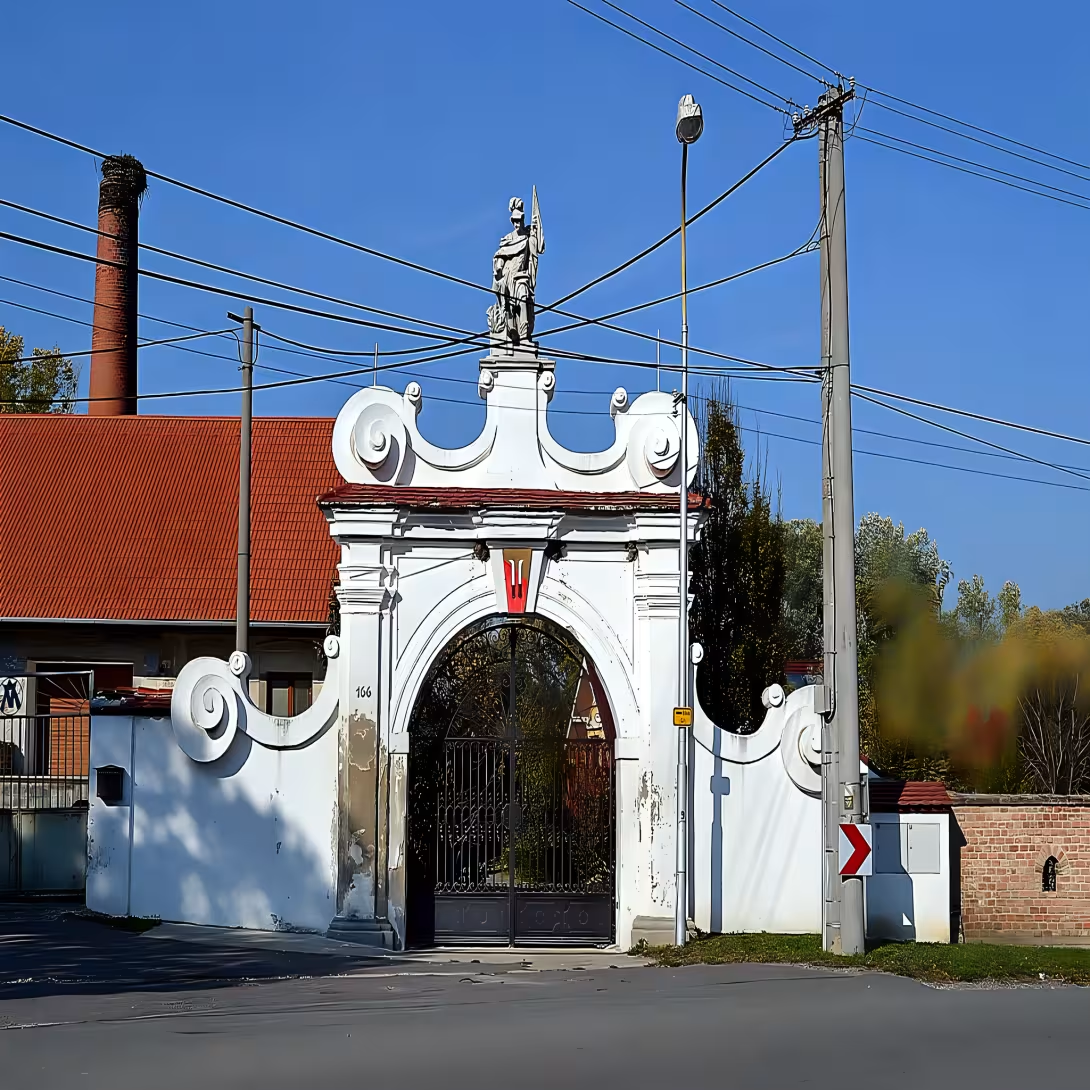
Sýpka s branou bývalého mlýna in the Lower Věstonice is the rest of the historic water mill that stood on the river Dyji. This monument was famous for its Baroque entrance gate, protected as a real cultural monument of the Czech Republic. The mill was first mentioned in 1377 and underwent several stages of reconstruction and development. After the fire in 1901, the planned renovation was not carried out, which led to its disappearance. Only the baroque entrance gate and part of the fenced wall are preserved today.
The mill was first mentioned in 1377, which suggests its long history. The administrator of the Liechtenstein manor of 1414 mentions a mill with a horse and in the following century there were changes in the structure when the old medieval mill was replaced by a newly built mill with eight compositions. This development reflected technological advances and the need for more efficient crop processing.
Architecturally, the original mill was built as a free standing building of a rectangular plan, half-ground and half-storey. On the corners she had Lizens and in the side facade there was entrance and door. In the back of the building there was a cordon ledge above the windows, while the shield wall was divided by two window axes. The medallion in the shape of a quadrilobum with the year 1754 is located in the shield and the roof ledge carried the roof rolled over the first floor of the valb.
The mill has undergone various property changes and dramatic events. In 1619 the mill and brewery were burned in the battle of the Moravian states with the imperial army. After renewal he became the largest in Moravia, but after 1655 he had only two compositions and was damaged during the war events with the Turks. In 1704, nine compositions were added to the mill, making it the fourth largest in Moravia.
At the end of the 19th century, the plant was prepared for the installation of turbines instead of water wheels, but the planned renovation was not due to the fire of 1901. A year later, there was a competition for his renewal, in which the company Mühlenbau Anstalt won at Maschinenfabrik Hoerde, Wien. Between 1927 and 1936 the regulation of Dyje took place, which led to the filling of the drive and removal of the stables and turbines. The mill was adapted to the granary and demolished in 1995.
Today, only the baroque entrance gate and part of the fenced wall are preserved, suggesting a rich history of this place. Although the mill no longer exists in its original form, its remains are an important cultural and historical element in the Lower Vestonice. Visit this place offers an opportunity to explore part of the past of the region and appreciate its historical values.
Sýpka s branou bývalého mlýna in the Lower Věstonice is not only a monument but also a witness to the changes faced by the region. Maintaining it reminds of the importance of protecting cultural heritage and offers visitors the opportunity to immerse themselves in the history of this area.
Historical milestones
- 1754
- The pendulum medallion with 1754 is located in the building's shield wall.
Architectural development
The original medieval mill was replaced in 1575 by a newly built mill with multiple compositions. During its existence it underwent several stages of development and damage, with preparation for installation of turbines instead of water wheels at the end of the 19th century.
Historical events
- 1377
- The mill is first mentioned.
- 1619
- The mill and brewery were burned in the battle of the Moravian states with the Imperial Army.
- 1901
- The mill burned down and the planned renovation was not carried out.
Points of interest
- Sýpka s branou bývalého mlýna is the rest of the historical water mill on the river Dyji.
- Baroque entrance gate is protected as a real cultural monument of the Czech Republic.
- The mill was first mentioned in 1377 and underwent several stages of reconstruction and development.
- After the fire in 1901, the planned renovation was not carried out, which led to its disappearance.
- Only the baroque entrance gate and part of the wall are preserved today.
Guide
Show guide text
This text was created by artificial intelligence and has not been editorially reviewed. It may contain inaccuracies.
Welcome to the Lower Vestons. You are standing right in front of a place that at first sight can act as a mere part of the old wall, but in fact it is a silent and deep witness to the ancient era, which shaped the life of the whole neighborhood. Before your eyes, there is a baroque entrance gate and part of the fenced wall, which are the last remnants of something much bigger and more important. These are relics of a former water mill that once ruled this place with the power of flowing water. Please feel the atmosphere of this place where history meets the present and where even the smallest stone details tell the story of flourishing and inevitable decline.
Let's go back deep into the past together to understand why this place is so important. This water mill was not just an ordinary building, it was the heart of the local economy and a key point for the whole community. Its roots go incredibly far, since the first historical mention of this mill on the Dyji River dates back to 1377. Imagine that time, the Middle Ages, when the closeness of water and the ability to use its power was vital to the survival and development of mankind. For centuries this mill has been going through various phases, constantly being rebuilt, expanded and modified to meet the needs of the time and the growing importance of this place. Every new layer of construction, every new stone in its walls, was proof of the constant movement and development that this mill represented over many generations.
Now pay attention to what you see right in front of you. Although most of the original mill building had long since died, this baroque entrance gate remains a monumental clue to the architecture at the time. Pay attention to its shape and elegance, which is typical of Baroque style. This gate is not just an entrance, it is a symbol of dignity and the importance of the entire object. Its existence is so important that it has been recognised as a real-estate cultural monument of the Czech Republic, which tells us that even in this fragment of history there is a value that we must protect for future generations.
Take a closer look at the shield wall of the building in the vicinity. If you approach it, you can see one of the most important details of this place. In the wall there is a medallion in the shape of a quadrilobus, which is a specific geometric shape resembling four petals or four arcs connected in one whole. This medallion is not only an ornament but an important historical figure because it contains the year 1754. This year allows us to determine more precisely when the construction was in one of its important phases and gives us a tangible continuous point with the past. This detail is like a time fingerprint that tells us that just in the mid-eighteenth century architecture has reached a certain level of expression here.
But the history of this place is not just a story about building and flourishing. It's also a story about loss and how quickly things can change. The key moment to decide today's appearance was 1901. This year there was a tragic event when the mill hit the fire. The fire was devastating and at that time represented a danger for wooden and combined structures that was almost impossible to stop. After this fire, a planned renovation was to be carried out to save the mill and allow it to continue its life. But fate wanted otherwise. Renovation was not carried out, which led to the phasing-out of the entire mill system. So what we are seeing today is the result of a failed effort to recover, and it is a reminder of how fragile human works can be in confrontation with the natural forces and decisions of then-people.
Please consider how different this place is from what it looked like a few hundred years ago. Imagine the noise of the flowing Dyje, the sound of the water hitting the mill wheels, the smell of freshly ground grain and the constant movement of people who came here to work and supply basic food. It is quiet here today, you hear only the sound of water and wind, but it is in this silence that the echo of history is best heard. This granary with a gate is not just the rest of the building, it is a monument to the time that passed and the human work that has been done here for centuries.
Although we do not know the names of the particular architects who designed this gate or the names of the individual owners who took care of the development of the mill, their presence is perceived through every working edge of the stone and every detail of the baroque design. Their work survived the fire, the destruction of the mill itself, and today it allows us to stop and think about the past.
Now, please, continue your walk and don't be drawn away from this one point alone. The surroundings of Lower Věstonic offers many other secrets and beautiful views of the landscape that the river Dyje has shaped for centuries. Feel the surrounding nature, which is slowly but surely attached to these historical remains and creates a fascinating contrast between the continuous cycle of nature and the static monument of human activity. Thank you for stopping by and paying attention to this piece of history. We wish you a pleasant rest of your journey and hope that this view of the former mill brought you new ideas and experiences. Goodbye.
Tips for visitors
The best time to visit the granary with the gate of the former mill in the Lower Vestonice is the spring and autumn season when the natural beauty surrounding is best visible. Sunny days provide ideal light for shooting historical ruins and surrounding regions.
Parking can be found near the river Dyje, where parking is also available by public transport. It may be advisable to use cars or take a bus to access the monument; the current connection can be verified in the online search engine.
When visiting, bring protective clothing because the weather can be unpredictable. It is suitable to photograph from the north side of the granary where the sun rays create a beautiful atmosphere in the background of ruins.
The Dyje River and other historical sites are located in the vicinity of the monument. Explore these places for full experience about regional history and nature. In addition, it is possible to visit the surrounding forests where children can play in the open space.
Businesses nearby
Do you run a restaurant, accommodation, shop, museum, rental, wellness or other visitor service near this monument? Show yourself directly to the people heading to it — this is how they will see you in the app and on the web:
Events nearby

Zdroj akcí: otevřená data měst a obcí ČR (Národní katalog otevřených dat) a kalendář akcí Národního památkového ústavu.
Nearby
The mill was located on the river Dyji, which is an important water artery in the region. There are other historical and natural monuments nearby.
Accommodation nearby
Themed route
Thematic cruise route from Dolní Věstonice
1. Sýpka s branou bývalého mlýna (mill) * Type: Historical landmark * This granary is part of a former mill that was located on the river Dyji. It is an important place to understand the history of milling and technology from the period when this activity was developed through the presence of hydroenergy.
2. Dyje River * Type: Natural landmark * By walking along the river Dyje you can enjoy beautiful views of its natural landscape. This water artery was key to the development of towns and villages in the region, reflecting the historical importance of this section.
3. Former Mill Station * Type: Historical landmark * There was also a station near the former mill, which served the transport of grain and other goods. If you visit this place, you will learn more about the transport system that supported the region's economy.
4. Historical Path * Type: Cultural landmark * A walk along the historic road leads around former mills and other industrial monuments that testify to the rich tradition of the area. This route offers a view of architectural history and technological development.
5. Natural park by the river Dyje * Type: Natural landmark * Near the river there is a natural park where you can explore wild flora and fauna. This park is an ideal place for relaxing and exploring the natural environment of the region.
This route offers a combination of historical and natural experiences that will allow you to understand the cultural and natural heritage of the Dolní Věstonice area.
Seasonal recommendations
Spring: In the spring, the surroundings of the former mill awaken to life and the fresh green creates fine sets to observe the remains of the granary. Light is soft in this period, which is ideal for capturing details of broken structures in the natural context. We recommend taking layered clothes because the morning cold can still be felt. The roads can be muddy because of spring rains, so it is worth choosing stronger shoes. Visit the place in the morning when there are the least people.
Summer: The summer season brings intense sunlight to Dolní Věstonice and a warm atmosphere that highlights the historical importance of this place. The landscape around the granary is in full bloom, but high temperatures can be challenging. Due to the increased number of visitors in the main summer season, it is best to arrive early in the morning to enjoy your peace and avoid the greatest heat. Don't forget the sun hat, enough drinking water and light, breathable clothes.
Autumn: The atmosphere of the autumn visit is influenced by golden tones of leaves and morning fog, which give the place a melancholy touch. The lighting is low and dramatic at this time, which underlines perfectly the shielded parts of the former mill. It is necessary to prepare for changing weather, therefore we recommend a waterproof jacket and shoes with good grip. The ideal time for walking is soon after sunrise, when fog most seems mysterious.
Winter: Zimą is turning its surroundings into a quiet and desolate landscape where frost and snow can highlight the contours of former walls. The atmosphere is calm and lonely, allowing deep perception of history without disturbing influences. Due to short days and low temperatures, it is necessary to wear very warm clothes and protect yourself from the wind. We recommend planning a visit around noon hours when the light is the most and the time of day is the longest.
Visualizations and artistic views

The visualisations are generated by artificial intelligence and serve as inspiration.
Photos from the area
Real photos taken near the monument


Zdroj a licence jsou uvedeny u každého snímku.
Tips from visitors
No tips yet. Be the first!
Log in and add your tip.
Sources and literature
Fotografie: RomanM82 / CC BY-SA 4.0, rozlišení zvýšeno umělou inteligencí — Wikimedia Commons. The author and licence also appear when you hover over the image.
Faktickým podkladem tohoto textu byl článek na Wikipedii, jehož autory jsou přispěvatelé Wikipedie. Článek je dostupný pod licencí CC BY-SA 4.0.
Location on the map
More monuments – Dolní Věstonice
Show all in the municipality

Příběhy a pověsti
Legendy, pověsti a příběhy spjaté s touto památkou

Fotografie návštěvníků
Zatím žádné fotografie. Buďte první, kdo přidá fotografii z návštěvy!
Přihlaste se a přidejte svou fotografii nebo hodnoťte.
Za ověřenou návštěvu v aplikaci získáte víc bodů — poznáme podle GPS, že jste na místě.
Reviews and comments