



Tank číslo 23 Monument
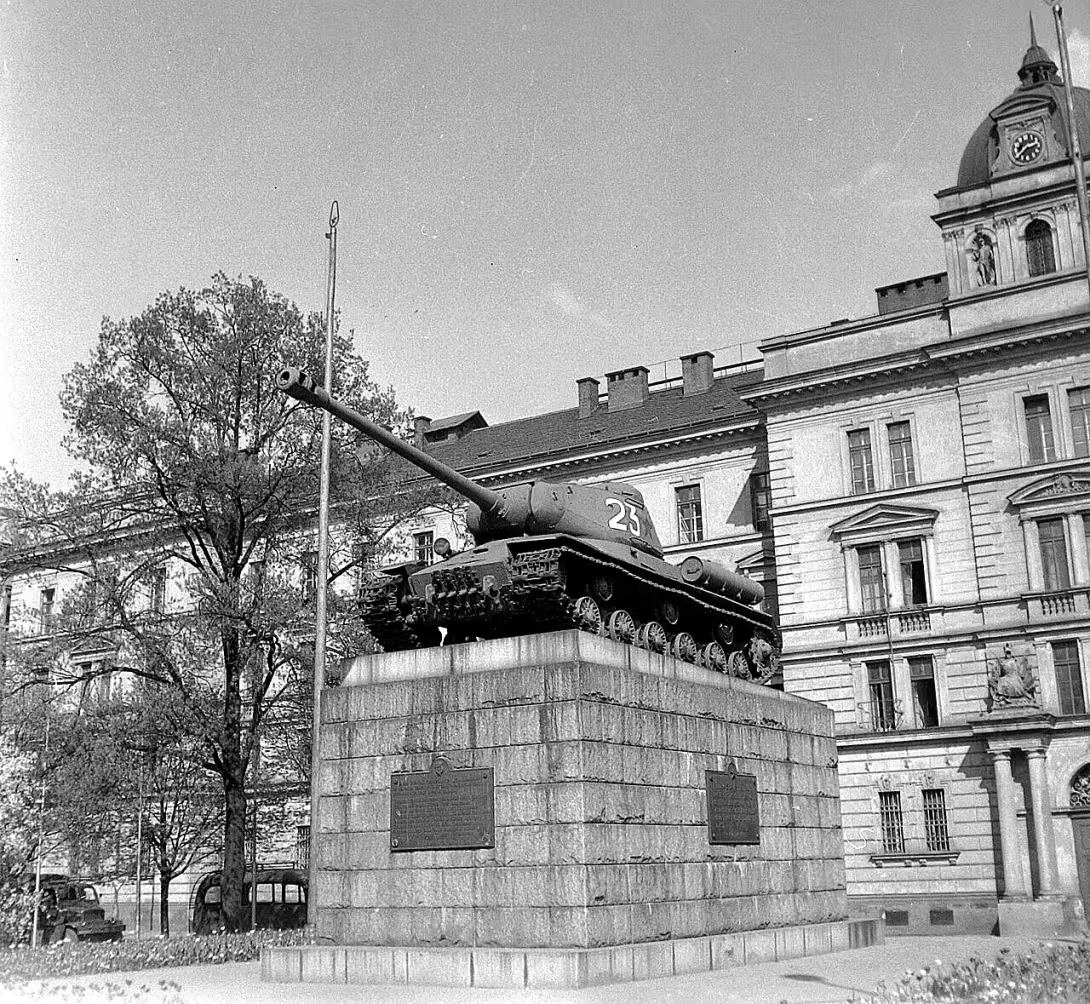
Tank číslo 23, known as the Pink Tank, is a Soviet heavy tank IS-2m located in Smíchov Square in Prague. It symbolizes the liberation of the city by the Red Army at the end of World War II and is remarkable for becoming a cultural monument due to its unconventional transformation in 1991. This monument commemorates the key historical events associated with the liberation of Prague and its symbolism has spread far beyond the original purpose.
The memorial was built shortly after the end of World War II, when it was decided to build a memorial in Smíchov Square (today's Square of Kinsky) as a thanks for the Soviet army's share in the liberation of Prague. The tank was donated to the city of Prague by the government of the USSR and festively revealed on July 29, 1945 the presence of Marshal Ivan Konev, Mayor Vack and other officials. Symbolized the first Soviet tank to enter Prague, although in fact another type was used (IS-2m instead of T-34 / 85) and marked with number 23. The base with bronze plates carried a inscription dedicated to the heroism of Soviet tankers.
The architecture of the monument consists in exposing the heavy tank IS-2m to a 5 m high stone base. The tank was located to aim the main projector from the pedestal to the west into the open space of the square. The original motor parts of the tank were removed in 1956 to prevent their possible misuse against the Communist regime.
Tank číslo 23 has undergone several key events during its existence. After 1989 there was a shift in the perception of the monument, when the imauthenticity of the tank and its real historical role were highlighted. In February 1991, historian Pavel Bělina argued for removing the tank from the view that it had neither historical nor moral value. However, on the night of the 27th to 28th April 1991, the tank was overlaid by the pink artist David Černý and his group, causing public discussions and protests by the Soviet government. The Tank was subsequently re-examined by a pink group of Members of the Federal Assembly for the Civil Forum, which led to its new designation as the Pink Tank.
Today, the Pink Tank is located at the Military Technical Museum in Lesany. Although it is no longer in its original place, its history and symbolism remain an important part of Czech culture. Visiting this museum offers an opportunity to explore not only the technical aspect of the tank, but also its complex history and influence on society.
Tank číslo 23 is more than just a monument; it is a testament to the complex history and transformations that shaped modern Europe. Its presence in the museum offers a unique opportunity to understand both the historical context of the liberation of Prague and the cultural dynamics of the 1990s. Exploring this monument is not only a way into the past, but also an opportunity to reflect on the relationship between history and its story in society today.
Historical milestones
- 1945
- Tank číslo 23 was donated to the city of Prague and festively revealed on July 29.
- 1956
- Removed motor components of the tank to prevent their misuse against communist regime.
- 1991
- The tank was overlaid by a pink artist David Cerný and his group, which triggered public discussions.
Historical events
- 1945
- Liberation of Prague by the Red Army.
- 1945
- The ceremonial discovery of the memorial in Smíchov Square.
- 1991
- The tank was overlaid with a pink artist David Black and its name changed to Pink Tank.
Points of interest
- Tank číslo 23 is known as the Pink Tank and symbolizes the liberation of Prague by the Red Army at the end of World War II. - The memorial was built shortly after the end of World War II in Smíchov Square (now the Square of Kinsky) as a thanks for the Soviet army's share in the liberation of Prague. - In 1991 there was an unconventional transformation, when the tank was overtaken by the pink artist David Černý and his group, which triggered public discussions. - Tank číslo 23 is now located at the Military Technical Museum in Lesany, offering an opportunity to explore its history and influence on society.
Guide
Show guide text
This text was created by artificial intelligence and has not been editorially reviewed. It may contain inaccuracies.
Welcome to Smíchov Square in the heart of Prague, where you are currently in front of one of the most memorable symbols of liberation of the city. Under your feet is Tank číslo 23, known as the Pink Tank, which stands as a witness to historical events that have changed the course of our country. This Soviet heavy tank is not only a monumental monument, but also a significant part of local culture and history.
The tank was donated to Prague as a thank you for the Red Army's efforts to liberate the capital from the Nazi occupation. The ceremonial unveiling took place on 29 July 1945, when the Pražans gathered in Smíchov Square to celebrate the end of World War II and new hope for the future. This monument was built shortly after the end of the war as a symbol of gratitude for the support the Soviet army provided during the liberation of the city.
Look up at the tank and notice its impressive dimensions. Tank číslo 23 is built from a solid steel piece, which with its weight expresses strength and resistance. Although engine parts were removed in 1956 to prevent their misuse against the communist regime, the tank still maintains its historical nature. In 1991, there was a significant change when the tank was overtaken by the pink artist David Černý and his group. This event triggered a public discussion about the importance of the monument and its symbolic dimensions.
Key figures associated with this history include generals Ivan Koněva, Dmitri Leljušenko and Ivan Honcharenka, who led the Red Army in the liberation of Prague. Their strategic decision and courage had a key impact on victory over the Nazi regime.
An interesting thing you won't miss is the color of the tank itself. The scaling of this historic car has become a symbolic gesture that has caused embarrassment and discussion about the relationship between the past and the present. This act of artistic intervention turned the tank from a war machine into an icon of cultural and historical reflection.
Let's move closer to the tank and notice its details. Despite its weight, there are as many as you can discover - from gun guns to protective panels. Each element tells the story of technology and strategies of the time.
Tank číslo 23 is not only a monument to history, but also a place where the past and present meet. Whether you're curious about history, art or technology, this tank offers a rich set of stories that await being discovered.
Allow me to invite you to further explore Smíchov Square and its surroundings. Whether you look at architectural beauty or discover other historical miracles, this corner of Prague has many stories for you. Thank you for your visit and I hope you liked Tank číslo 23 as a symbol of courage and sense of history.
Tips for visitors
Best time to visit Tank number 23 is in the early afternoon when the sun illuminates the statue in a way that highlights its historical weight. This time also brings fewer people and the better atmosphere to understand the importance of the monument.
Access to the tank is possible both by car and public transport. The best way to learn the current connection is to search online before visiting.
When visiting, take a camera or mobile phone with you to capture the tank from different angles. The best light for photography is in the early afternoon when the sun is not too high and the shadow effects are mild.
Around the tank is located Smíchov Square, which offers a wide range of restaurants and cafés. After exploring the sights you can enjoy an afternoon drink or lunch in one of these institutions.
For families with children, tank number 23 is an interesting subject for talks about history and war. In the vicinity of the square there are also other historical monuments that can be interesting for children.
Frequently asked questions
Can the monument be visited?
This is a structure in a public space that can usually be seen from outside free of charge. We have not verified that this particular one is freely accessible.
Why is the monument protected?
It is listed in the Central List of Cultural Monuments of the Czech Republic as a cultural monument (register no. 1000152391).
Businesses nearby
Do you run a restaurant, accommodation, shop, museum, rental, wellness or other visitor service near this monument? Show yourself directly to the people heading to it — this is how they will see you in the app and on the web:
Events nearby


Zdroj akcí: otevřená data měst a obcí ČR (Národní katalog otevřených dat) a kalendář akcí Národního památkového ústavu.
Nearby
🏰 Historic sites (101)
- „Růžový“ tank 0.0 km
- Vojenské technické muzeum Lešany 0.0 km web
- Pomník obětem 1. světové války 2.2 km
- K 80. narozeninám TGM (1930) 2.8 km
- Jan Morávek 3.0 km
- Pomník padlých 3.0 km
- Tvrziště 3.2 km
- Zbořený Kostelec 3.5 km
- Muzeum Štola Halíře 3.9 km +420241950791 web
- Starý silniční most 4.3 km
- Včelní hrádek 4.4 km
- Městské muzeum 4.5 km web
- Týnec nad Sázavou 4.5 km
- muzeum smaltu 4.6 km +420776151343
- Motocyklové a technické muzeum 4.6 km
- místo letecké nehody 4.7 km
- Tvrz Božešice 5.5 km web
- Regionální muzeum v Jílovém u Prahy 5.6 km
- Regionální muzeum 5.6 km
- Výstava čínského umění 6.1 km +420724252496 web
🍽️ Restaurants and dining (218)
- Kantýna 0.1 km
- U Krkovičky 1.2 km
- U Toničky 1.2 km
- Restaurace Na Zastávce 1.2 km
- Mlýn Brejlov 2.1 km web
- U Adenauera - Na Zastávce 2.3 km
- Občerstvení U Veselky 2.5 km
- Na Staré poště 2.9 km
- Na Staré poště 2.9 km
- U Vemenáče 3.0 km
- hospůdka U hastrmana 3.1 km
- U Holubů 3.7 km
- Brooklyn 3.9 km Družstevní 532
- U Vrtišků 4.0 km Pěší 194
- U pešoura 4.0 km
- Pizzeria Gianni 4.0 km Pěší 191
- Country Club u Čudy 4.1 km
- Restaurace a pizzerie 4.2 km
- U Lípy 4.3 km
- Hospoda&Bar V Náklí 4.4 km
🏨 Accommodation (59)
- Penzion Zámek Lešany 1.9 km
- Hotel Troníček 3.9 km web
- Hotel Týnec 4.4 km Klusáčkova 2 +420 317 729 050 web
- Vodácké tábořiště 4.5 km
- Ubytování Netvořice 4.5 km +420 776 151 343 web
- Penzion Magdalena 5.3 km +420 602 232 224 web
- Hotel Valnovka 6.4 km Benešovská 103
- penzion U Vlkové 6.7 km Benešovská 174
- Štiřínská stodola 7.8 km +420 323 607 784 web
- Hotel Zámek Štiřín 7.9 km web
- Penzion u přehrady 8.2 km
- Mandava 8.2 km
- Hotel Lauřím 8.3 km +420 317 779 193 web
- Kemp Pikovice 8.9 km web
- Penzion s možností hodinového ubytování 9.0 km
- Ve Mlejně 9.3 km
- Penzion Janata 9.6 km
- Camp Rabyne 9.8 km web
- Rozmarná Róza 10.0 km +420 733 204 376 web
- Hotel U Ledu 10.3 km Ringhofferova 336 web
🚲 Rentals and sport (32)
- Bisport 4.2 km
- Vodacké potřeby a půjčovna Bisport 4.2 km
- Bisport 4.3 km
- TK Týnec nad Sázavou 4.3 km +420 775 303 465
- Samba 4.4 km
- Bazén 4.9 km
- Zastávka Slapy PPS 8.1 km
- Bisport - pouze vyzvednutí 8.7 km
- Samba - pouze vyzvednutí 8.9 km
- cross arena 9.0 km
- Zastávka Štěchovice PPS 10.1 km
- tenis 10.3 km
- Stáj ForZeis 10.8 km +420603184939
- Marina Davle 11.0 km
- Davle, PPS 11.1 km
- Zastávka Měchenice PPS 12.2 km
- Sportcentrum Zámek Berchtold 12.2 km
- JK Harfa 12.4 km
- Sokolovna 12.9 km
- Lyže Yesenice 13.1 km
🥾 Hiking and nature (134)
- Jeskyně V Doubí 1.7 km
- Pod Vlčí roklí 2.0 km
- Vlčí rokle 2.3 km
- Baxova studánka 2.6 km
- Panská skála 2.7 km
- Vodní tunel pod tratí 2.9 km
- Holý vrch 2.9 km
- Kněží hora 3.1 km
- Grybla 3.2 km
- Studánka Trkač 3.6 km
- Studánka Holubí oko 3.7 km
- Čížov 3.8 km
- Štola Halíře 3.9 km
- Halíře 4.1 km
- Žampašská vyhlídka 4.3 km
- Žampašský viadukt 4.5 km
- Na vrchu 4.5 km
- Skalsko 4.5 km
- U kočky za komínem 4.6 km web
- Drnka 4.6 km
Accommodation nearby
Trips and activities nearby
Guided tours, tickets and activities nearby from GetYourGuide
Affiliate link: if you buy from the partner, we may receive a commission. The price for you does not change.
Search tours and activities →Themed route
1. Information boards (written description) - Here you will read about the history and importance of this machine. The text will help you better understand the circumstances of its creation. 2.Tank číslo 23 (memorial) - The main destination of the journey, which represents historical military technology. You can take a closer look at his appearance and details. 3. The base of the monument (stone base) - This part forms a solid basis for the machine. It serves as a place for memories and observation of the entire object. 4. The immediate area (outdoor area) - The space right at the monument, which allows free movement around the machine. It is a suitable place for a quiet view of the whole place.
Seasonal recommendations
Spring brings to the surroundings the awakening nature, which gradually loses its winter greyness and turns into a mosaic of light green shades. Light is often soft and scattered at this time, which creates a calm and thoughtful atmosphere suitable for silent observation of the historical object. The plants around the monument are beginning to bloom and the air is fresh, but it may be wet. For visiting is ideal morning hours when the surrounding area is quietest and the sun still does not illuminate the surfaces intensively enough to create sharp shadows. Clothes should be laminated because spring weather is usually variable and temperatures may vary significantly during the day. It is recommended to carry a light jacket and shoes that can withstand any mud or wet surface.
Summer offers the longest days and brightest lighting, which reveals details of tank construction and surrounding terrain. The sun is usually high, which can create strong contrasts and hot surfaces, so it is best to visit the memory either early in the morning or late in the afternoon when heat is more tolerable and light softer. Nature is in full bloom, green is rich and the air can be hot and stuffy, especially in the afternoon. It is important to prepare enough drinking mode and protect yourself from direct sun hat or cap. Clothes should be light and breathable to allow the body to remove heat. In the main summer season the surroundings can be more visited, therefore the quieter atmosphere is assured in less frequent times of the day.
Autumn brings a rich variety of colors to the landscape, from golden to brown, creating a dramatic and aesthetically impressive contrast to the metal structure of the monument. Light is usually lower and warmer, which extends shadows and gives the scene depth. The air is colder and often fresh, with the possibility of morning freezer. Nature begins to lose leaves around it, which may reveal more details of the terrain and the ground of the monument. For visiting is a suit in layers, including warmer layers and possibly waterproof jackets, because autumn rains are common. The best time is usually in the morning when the light is brightest and the temperature is highest. The atmosphere is quiet and thoughtful, ideal for long walks and observations.
Winter brings a quiet and often white atmosphere around the monument, which highlights the isolation and historical importance of the building. Snow can cover the ground and surrounding vegetation, creating a clean and minimalist visual impression. Light is often weak and gray, with short days, so it is best to visit the memory in the afternoon when the light is most intense. The temperatures are low and require robust winter clothes, including warm shoes, gloves and hats, so that the visitor doesn't have to worry about hypothermia. Nature is in resting mode, without leaves and flowers, allowing you to focus purely on architecture and history. The air is sharp and dry, which may be uncomfortable with longer standing in place.
Visualizations and artistic views

The visualisations are generated by artificial intelligence and serve as inspiration.
Photos from the area
Real photos taken near the monument


Zdroj a licence jsou uvedeny u každého snímku.
Tips from visitors
No tips yet. Be the first!
Log in and add your tip.
Sources and literature
Photos: FOTO:Fortepan — ID 23492: Adományozó/Donor: Gyöngyi. / CC BY-SA 3.0 — Wikimedia Commons. The author and licence also appear when you hover over the image.
Faktickým podkladem tohoto textu byl článek na Wikipedii, jehož autory jsou přispěvatelé Wikipedie. Článek je dostupný pod licencí CC BY-SA 4.0.
Location on the map





Příběhy a pověsti
Legendy, pověsti a příběhy spjaté s touto památkou
Fotografie návštěvníků
Zatím žádné fotografie. Buďte první, kdo přidá fotografii z návštěvy!
Log in a přidejte svou fotografii nebo hodnoťte.
Za ověřenou návštěvu v aplikaci získáte víc bodů — poznáme podle GPS, že jste na místě.
Reviews and comments