



Tomáškův vodní mlýn Water mill
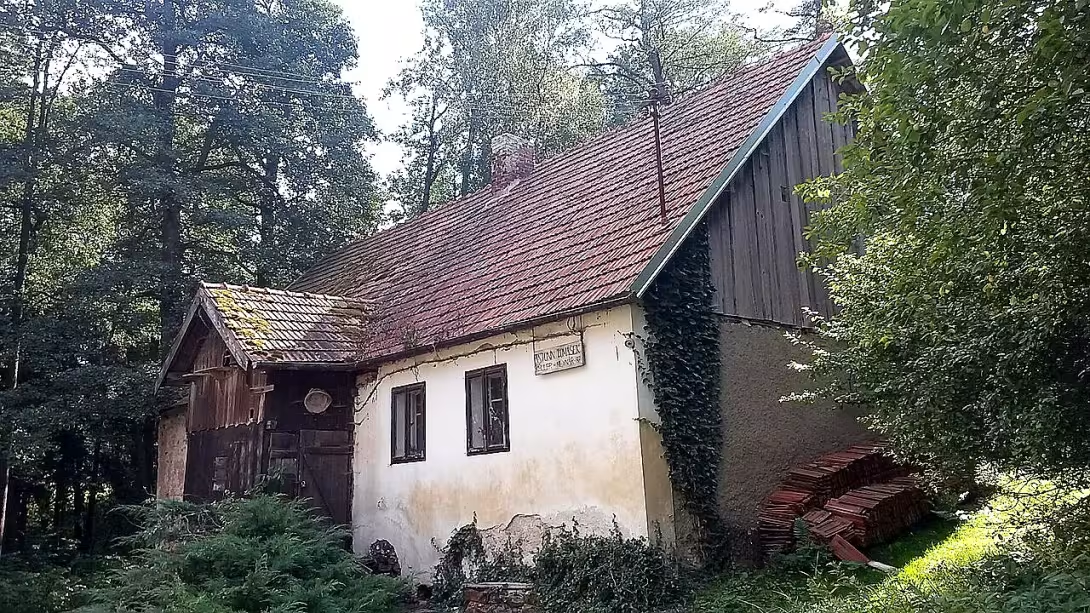
Tomáškův vodní mlýn, also known as Musil or Bubenescher Mühle, is a historic grain mill in the village of Lukavec in Pelhřimovsk. This real-estate cultural monument of the Czech Republic is located on the Kateřín creek. It represents a valuable document of traditional milling, whose beginnings date back to at least the 18th century.
The first documented encapsulation of the building comes from maps I. Military mapping from 1764 to 1768. In this period, when Teresian and Yosephin reforms were taking place in the Czech countries, rural mills were a key part of the local economy and the processing of agricultural crops. The oldest history of the building, however, was left with little concrete news.
The building is walled, grounded and has a core of massive quarry masonry. The mills and the residential area are separated, yet they are located under one saddle roof. The fridge is adjacent to the south side of the rectangular building. The entrance facade and the valley-oriented side to the creek are extremely high; the mill is entered through the wooden porch. In addition to mill No. 87, part of the monument protected area is also a barn and dam pond. Modern economic buildings stand east of the building.
The important milestone in history was 1890, when the mill in the estimated price of 1823 gold was auctioned by mlynář Tomášek, after which it bears the construction of its present name. In 1930, the operation of one wheel on top of the water was documented. This used a fall of 6 meters at a flow rate of 0,065 m ³ / s and reached a power output of 3,4 HP. The water was driven by a release at the foot of the dam of the pond situated above the mill.
The original mill composition has been preserved in the interior until today. The technical interest is mainly the cylindrical stool with one pair of serrated cylinders, which is located in a cast iron cabinet.
Tomáškův vodní mlýn is an authentic example of a technical monument that documents the development of rural milling over centuries. Visiting this place in Lukavec offers an opportunity to look into the history of crop processing and to recognize the design solutions that were necessary for the operation of water mills in the past.
Historical milestones
- 1764-1768
- First enchantment of the mill on map I. of military mapping.
- 1890
- The auction of the mill by Tommy the miller.
- 1930
- The operation of one wheel on the upper water of 3,4 HP output is demonstrated.
Architectural development
The object has a core from a massive quarry wall. The mill is adjacent to the rectangular building on the south side of the fridge. Economic buildings on the premises are of modern origin.
Historical events
The mill is first drawn on the map I. Military mapping in 1764-1768. In 1890, the mill was auctioned by Tommy the miller for 1823 gold.
Owners
Miller Tomášek (since 1890).
Points of interest
- The mill is also known as Musil or Bubenescher Mühle and is located on the Katerina stream. - The first documented encapsulation of the building comes from maps of the first military mapping from 1764 to 1768. - In 1890 the mill was auctioned by mlynář Tomášek, after which the construction of its present name is carried. - In 1930 the operation of one wheel on the upper water was documented, which achieved the performance of 3,4 horsepower. - The technical interest of the interior is a cylindrical stool with one pair of rolled cylinders located in a cast iron cabinet.
Guide
Show guide text
This text was created by artificial intelligence and has not been editorially reviewed. It may contain inaccuracies.
Welcome to Lukavec. You have just stopped in front of one of the most important technical units in the area, before Tomášek's water mill. You're standing in a place where nature and human labor have intertwined since centuries in the constant movement of water and stone. Look around you and feel the atmosphere of this sloping terrain. Look at the flow of the Katerinsky creek, which is absolutely crucial to the existence of this place. This whole space, from the sloping ground to the object itself, is designed to use every piece of energy that water offers. The first impression of this place should be a sense of stability and unwavering. This building is not just an ordinary house, but it is a witness of ancient times that resists the currents of time and elements.
Let us now go back together deep into the past to understand how deep the roots of this mill are in the history of this landscape. Although it may seem to us that history is only a distant memory, it is quite tangible at this mill. The first clear clues that allow us to put this object more accurately in history are found in documents from the mid-eighteenth century. Specifically, we must look at the period from 1764 to 1768. It was in these years that the mill was first drawn into maps as part of the first military mapping. This tells us that even then, this building was so important and strategically important that the military had to carefully record it. So this mill was not just a random addition to the landscape, but it stood there firmly and functionally over 200 years ago.
Now pay attention to the construction itself, which is right in front of your eyes. Notice the mass. The mill is flat and its body forms a solid wall. If you look at the detailed structure of the walls, you'll see the core of the massive quarry wall. This material gives the building its unusual weight and a sense of durability. The whole object is covered with a saddle roof, which harmoniously fits into the sloping landscape. It is fascinating to see how the entire disposition is dealt with under one roof. The mills, that is, the space for the actual production and working with water, and the residential area where people lived, are separated here, but they still form one whole. This method of construction was typical of places where work and life had to connect closely. In addition to the mill itself, you can see other important components of this complex, such as the barn and dam of the pond, which together form one functional system for water management.
When you look at this building, you might think of who has worked here over the years and how her name changed. The story of this place is closely linked to specific people. He was long spoken of by various names, in the past he was also known as Musil Mill or under the German name Bubenescher Mühle. However, the most significant breakthrough occurred in 1890. That was when the mill was auctioned off at the auction. His new owner was mlynář Tomášek. It is thanks to him and his work that the construction of his current, now known name is. Tommy became a symbol of the new era of this mill, and his name was carved into the history of this place permanently.
If you are interested in the technical side of things, let yourself be surprised by the strength that this building has been able to develop in the past. Although it may seem today that the technology is becoming more complex, in 1930 the operation of one wheel on top of the water was documented at this mill. Although it may seem like a trifle, this round had the power of three whole four horsepower. At that time, it was a considerable force that allowed grain processing and provided life for the entire community. This is proof of how effectively people were able to use the energy of the Katerinsky creek to make a living and develop their home.
Before leaving, however, I would like to invite you to a little reflection on everything you've seen. This mill is not just a pile of stone and wood. It's a living chronicle that tells us stories about miller, military mapping, and the constant struggle of man with the element of water. In the interior, the original mill composition is still preserved, which is rare and gives us the opportunity to touch history directly. Whether you decide to continue your tour of the area or stop by the water for a while, pay attention to the details you will find here. Every rock and every wave in the stream has its own story. We thank you for your visit and wish you a pleasant continuation in discovering the beauty of Lukavka.
Tips for visitors
For visiting the mill we recommend sunny days from spring to autumn, when the technical beauty of the building and surrounding nature at Kateřín creek excels. In the summer months there is a pleasant shade due to the proximity of the water.
You can easily reach the mill by car directly to the village Lukavec. Check public transport in the current search engines.
We recommend fixed shoes suitable for the sloping terrain and for movement near the water flow. Don't forget the camera because the contrast of the quarry wall and running water offers great compositions, especially in the soft morning light.
In the immediate surroundings you can explore the picturesque shores of the Katerinsky creek or walk to the pond above the mill that completes the historic atmosphere of the whole place.
For families with children the location is ideal for easy walking in nature. Children will appreciate water flow observation, but due to the ground at the mill, continuous supervision of adults is necessary.
Frequently asked questions
Can the monument be visited?
This is a technical monument. Some are open as exhibitions, others are out of use or on private land. We have not verified whether this one is accessible.
What are the opening hours and admission?
We have not verified the opening hours or admission. Current information is published by the operator.
Where is the monument?
Location: Lukavec, Kraj Vysočina. The map on this page shows the exact spot.
Why is the monument protected?
It is listed in the Central List of Cultural Monuments of the Czech Republic as a cultural monument (register no. 1000157679).
Businesses nearby
Do you run a restaurant, accommodation, shop, museum, rental, wellness or other visitor service near this monument? Show yourself directly to the people heading to it — this is how they will see you in the app and on the web:
Nearby
Kateřinský potok, obec Lukavec, rybník nad mlýnem.
Accommodation nearby
Themed route
1. Lukavec, village - Start trip in this village, which serves as a starting point for the next trip. 2. Kateřín stream, water flow - Walk along this stream offers contact with water in the natural landscape. 3. pond above the mill, water area - A place for a short rest near the water just before the main goal. 4. Tomáškův vodní mlýn, landmark - The main destination of the route, which represents the historic water mill.
Seasonal recommendations
Spring: During the spring season Tomáškův vodní mlýn takes on Lukavci a special dazzling shine when flowers and trees come to life. The sun shines warmer, but sometimes comes a mild rainy wind that gives the atmosphere of the mill a romantic nuance. Natural lighting is ideal for photos and walks on quiet walkways around the water. It is recommended to visit the memory early in the morning in order to enjoy mild spring temperatures before raising crowds. When visiting it is advisable to wear clothes according to the weather - you can meet the cool east wind, so light jackets or coats are useful.
Summer: In the summer months, Tomášek's mill in Lukavec is a popular destination for visitors looking for shelter in front of the main crowd of tourist destinations. Sunny days and warm evenings create a pleasant atmosphere for relaxation at the water stream. Natural green paradise offers ideal conditions for picnics or short walks. Due to the large number of visitors, it is advisable to come early on the day to avoid pushing and enjoy a quieter moment. Don't forget to protect against the sun - clips, hats and enough drinking connections are necessary.
Autumn: The autumn visit to Tomáškova Mill offers a unique opportunity to see the beauty of nature in a colorful dress. November leaves and mild temperatures make this time ideal for quiet walks and photo shots. While the sun becomes less intense, the atmosphere is full of peace and quiet. This season is particularly suitable for visiting the anniversary days or during short holidays, when the crowd decreases. Wear warm clothes and shoes because the weather can be variable with cool winds.
Winter: The winter visit to Tomášek Mill offers different views of the memory when surrounded by snow and ice. Beautiful snowy regions create a magical atmosphere that can be used in short walks or watching peaceful watercourses under snow vaults. The opening time is usually shorter and the traffic is greatly reduced, which allows for more intensive experience of the site. We recommend you come early in the day to enjoy a quiet time and to avoid warm clothes - jackets, blankets and shoes suitable for snow conditions.
Visualizations and artistic views


The visualisations are generated by artificial intelligence and serve as inspiration.
Tips from visitors
No tips yet. Be the first!
Log in and add your tip.
Sources and literature
Photos: Fried Marek / CC BY-SA 4.0 — Wikimedia Commons. The author and licence also appear when you hover over the image.
Faktickým podkladem tohoto textu byl článek na Wikipedii, jehož autory jsou přispěvatelé Wikipedie. Článek je dostupný pod licencí CC BY-SA 4.0.
Location on the map



Příběhy a pověsti
Legendy, pověsti a příběhy spjaté s touto památkou

Fotografie návštěvníků
Zatím žádné fotografie. Buďte první, kdo přidá fotografii z návštěvy!
Log in a přidejte svou fotografii nebo hodnoťte.
Za ověřenou návštěvu v aplikaci získáte víc bodů — poznáme podle GPS, že jste na místě.
Reviews and comments