






továrna na výrobu žesťových nástrojů Bohland a Fuchs Textile factory
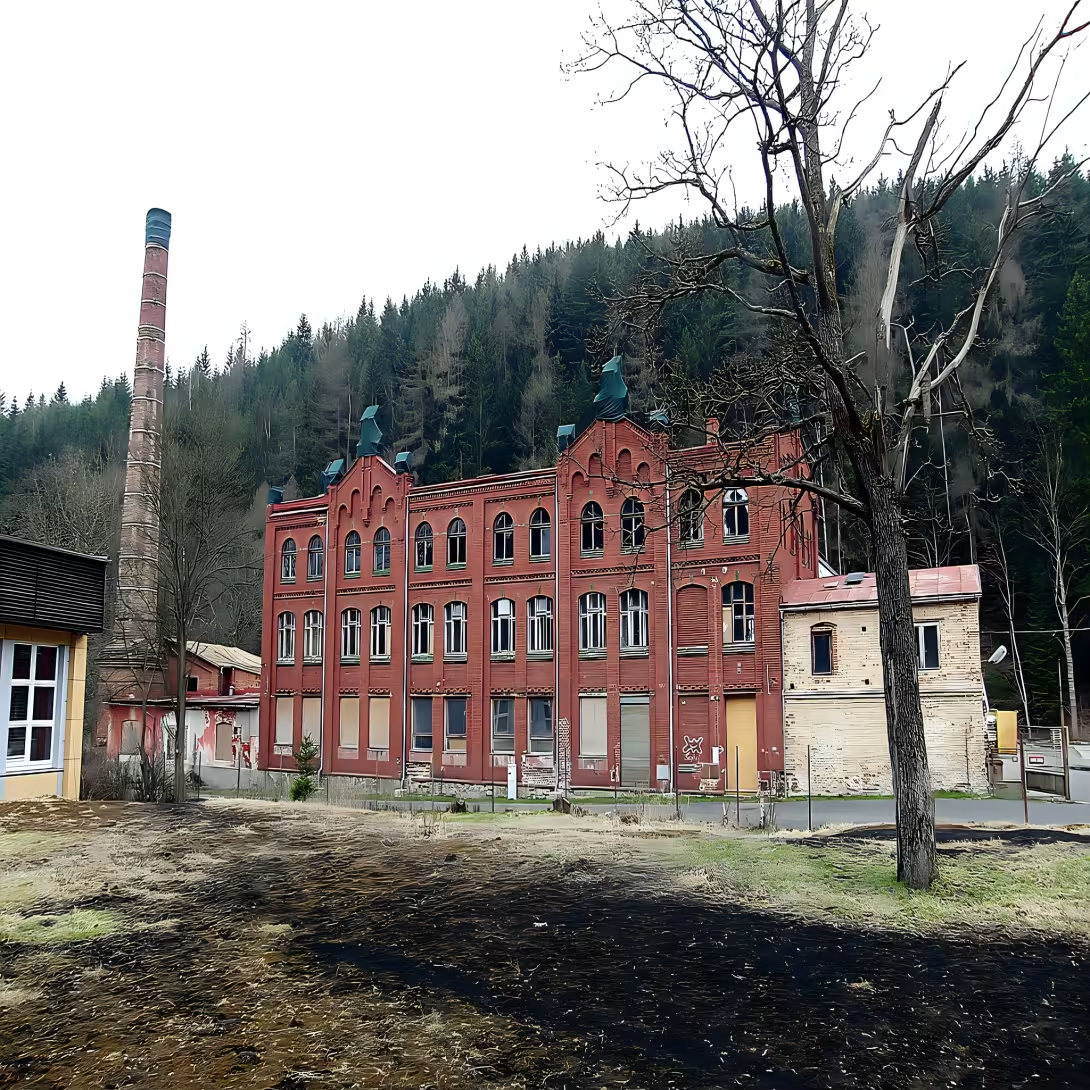
The former továrna na výrobu žesťových nástrojů Bohland a Fuchs in Kraslice in Sokolovsk is an important cultural monument of the Czech Republic. This industrial complex from the turn of the 19th and 20th centuries documents the history of world-famous production of musical instruments, which in the region followed a centuries-old tradition of copper and brass processing.
The expansion of production in Kraslice has enabled long-term experience with ore mining and brass processing; In the 18th century, the local brass factory was the only one of its kind in the Austrian monarchy. The company was founded by Gustav Bohland in 1850, since 1870 the company operated under the name Bohland & Fuchs. The development contributed to the construction of the turnoff of the Bustěhrad railway from Sokolov to Kraslice and the subsequent modernization introduced by Martin Fuchs. He installed steam engines and switched to serial production. As a result, the factory employed up to 500 workers and produced approximately 6,000 tools a year.
The building is a valuable example of the historic New Romanesque architecture with Art Nouveau elements. The main three-storey building with a low saddle roof stands at the left bank of the Silver Brook at the site of the former mill called Räumermühle. The facades are made of red brick masonry, which complement decorative elements of green glazed fittings. The facade divides twelve window axes divided by the lisen frames. The selected fields complete the triangular atics with the arc feature. There is also a separate boiler room and chimney.
Company ownership was gradually transferred within the Fuchs family. After the death of the founders, Johann and Hermann Fuchs led the business, later Karl and Adolf Fuchs. The products of the company, which included wings, basketboards, heligons, coupons, forest horns and drums, were awarded at world exhibitions in London, Paris, Vienna, Philadelphia and Chicago. The company had a business presence in many metropolis, from New York to Buenos Aires. The unique achievement was the production of a subcontrabass tube known as Riesen-Bass. This tool was created between 1910 and 1911 for the World Exhibition in New York and is written in the Guinness Book of Records.
After 1945, the factory became part of the Amati Kraslice association and was nationalized in 1948. In later years, the building served as a garage of ČSAD and subsequently faded. After taking over the city Kraslice, the site has been rescued and is currently used by the City Technical Services for waste recycling.
This object represents a valuable proof of industrial heritage and technical maturity of the region at the turn of the century. The visit to the premises offers an opportunity to see the history of one of the most important European workshops on the production of musical instruments, whose legacy persists in preserved architecture.
Historical milestones
- 1870
- The official start-up of the company under the name Bohland & Fuchs.
- 1911
- Finishing the production of a giant subcontraband tube for a world show in New York.
- 1948
- The nationalisation of the factory and its integration into the national enterprise Amati.
Architectural development
The building consists of a three-storey rectangular building with a saddle roof and a connecting rear storey building. The facades are made from a red red brick masonry, which is decorated with elements from green glazed fittings. The main facade is divided by twelve window axes and lisen frames.
Historical events
1870 founded by Bohland & Fuchs, 1910 / 1911 production of record subcontrabass tubes, 1948 nationalization of the company and integration into Amati Kraslice.
Owners
Gustav Bohland and Martin Fuchs (from 1870), family Fuchs, state (after 1948), city Kraslice.
Points of interest
- The local brass factory was the only one of its kind in the Austrian monarchy in the 18th century. - The factory employed up to 500 workers and produced approximately 6,000 tools a year. - The building is a valuable example of the historic New Romanesque architecture with elements of Art Nouveau and the facade forms a red brick wall with green glazed fittings. - The company produced a unique subcontraband tube called Riesen-Bass, which is written in the record book. - Company products won awards at world exhibitions in London, Paris, Vienna, Philadelphia and Chicago.
Guide
Show guide text
This text was created by artificial intelligence and has not been editorially reviewed. It may contain inaccuracies.
Welcome to Kraslice, a place where music is not just art, but a deeply rooted tradition that permeates every stone and every grain of dust in the area. Right now, you're standing in front of a building that was the true heart of the local industry in its greatest glory. In front of you is a former factory for the production of brisket tools by Bohland and Fuchs. The first thing you're interested in is her dominant appearance. Look at the facade formed by the red brick wall. It is a view that immediately returns us to an era of great industrial ambition and craft precision. Feel the atmosphere of this place, and imagine what noise and hustle it must have been when thousands of pipes, trombons and tubes came out of the workshops, which subsequently sounded in concert halls around the world.
Now let's get a little more immersed in the history of this place. To understand how this construction took place, we must return to 1870. It was this year that a company called Bohland and Fuchs officially started its operations. But it wasn't random placement. The factory building you see was built at the end of the nineteenth century in the place where the old mill used to stand. The strategic location on the shore of the Silver Creek was not only chosen for the beauty of the landscape, but above all for practical production needs. Water was a key source of energy at the time and an essential element of technological processes. At a small start, the company became a world-renowned producer thanks to the visionaries of the founders. Their instruments were not only functional, but they were the cutting edge of technological and acoustic development, which gave them a number of awards at prestigious world exhibitions.
Now pay attention to the architecture of the building itself. If you look carefully at the details of the facade, you will notice that the factory is not just a simple production hall. This is a valuable example of the historic New Romanesque architecture. Notice the robust elements that give the building a sense of stability and strength, which should reflect the prestige and wealth of the company. At the same time, the architecture did not just remain in the robust Romanesque style. If you look for finer lines and decorative elements, you will see the effects of Art Nouveau, which was at the peak of its popularity at the time of construction. It's a fascinating combination of industrial functionality and aesthetic elegance. The red brick combined with these styles creates a unique visual identity that makes the building more than just a factory but a real architectural monument of the region.
But who was behind this success? The history of this place is inextricably linked to the names of several men who put their lives and talents into making musical instruments. The main roles here belong to Gustavo Bohland and the Fuchs family. Martin, Johann, Hermann, Karel, and Adolf Fuchs together with Bohland created a team that could turn local craft into a global empire. Imagine the endless discussions about the tone, the quality of brass and how to make a tool that has the perfect sound. This family and business cooperation was a fundamental pillar on which the fame of the Kraslice brass instruments grew. Each of these men brought something different to the firm, whether it was a business vein, technical knowhow or a sense of musical aesthetics.
Now I'm going to show you one of the most fascinating facts in the factory. When we talk about ambition, we have to mention 1911. This year, Bohland and Fuchs completed the project, which at that time caused complete wonder. They made a giant subcontraband tube that was designed for a world exhibition in New York. Imagine an instrument whose dimensions exceeded any common idea of a musical instrument. It was basically an engineering challenge to show the world that they could make anything they could make up in Kraslice. This tube has become a symbol of the company's technological dominance and its ability to shift the boundaries of the possible.
But if we look even further into the past, we will find that the tradition of metal processing in this area goes much further. The interesting thing is that the local brass factory was already the only one of its kind in the entire Austrian monarchy in the eighteenth century. This gives us a clear idea of how unique knowledge and skills have been passed on to generations in Kraslice. This deep tradition has prepared the ground for the later expansion of Boland and Fuchs. At the time of its greatest boom, the factory was a huge employer. Imagine there were up to 500 workers working here. Every day, hundreds of people flow through here, making music history with their hands, hammers and instruments. Annual production amounted to approximately 6,000 instruments. This is an unimaginable amount of precise work that must have been coordinated in one building.
But every great era has its end. There was a breakthrough for Bohland and Fuchs in 1948. As part of the political changes at the time, the factory was nationalized. A private company with a long tradition and family character was incorporated into the national enterprise Amati. This move changed both administration and philosophy of operation, although the production of musical instruments in the region continued. The building that you are currently facing has thus remained silent witness to the transition from private business enthusiasm to centrally managed industry.
Today, thousands of hammers are no longer coming out of the factory and there are no more noisy discussions about new tube models. Yet this object is still living proof of how one city can influence world music culture. Now, if you look at the red bricks and the new-Romanesque details again, try to read the stories of the hundreds of workers and the ambitions of the Bohland and Fuchs families. This building is not just a pile of bricks, it's a massive passion for music and a precise craft.
Thank you for accompanying me on this short journey into the history of the Kraslice industry. Now I encourage you to look around in peace, to perceive the silence that rules this place today, and perhaps in your mind you have heard the echoes of all the instruments that were once created here. If you have time, I recommend exploring other corners of Kraslic, where music tradition still meets everyday life. I wish you a pleasant continuation in your discovery of this fascinating region. Goodbye.
Tips for visitors
The best time to visit is late spring or early autumn, when the weather in the Krušné Mountains is stable and surrounding nature offers ideal conditions for walking around the factory building.
The location is available by car and public transport; parking is possible in the adjacent streets of Kraslice. Please check the current public transport connections in the search engine.
Take fixed shoes and a camera to search for exteriors. The best light to capture the industrial details of the building is during the morning hours when the sun lights up the main facade.
In the surrounding area we recommend visiting the picturesque Silver stream, explore the historical center of Kraslice or go to the nearby village of Silver, which is closely linked to the tradition of brass shop.
The trip is suitable for families with older children who are interested in technical history. Walking around the Erzgebirge Mountains offers plenty of room to move, but we recommend having a snack and plenty of fluids.
Businesses nearby
Do you run a restaurant, accommodation, shop, museum, rental, wellness or other visitor service near this monument? Show yourself directly to the people heading to it — this is how they will see you in the app and on the web:
Nearby
Silver stream, city Kraslice, nearby village of Silver with history of brass, natural area of the Erzgebirge Mountains.
Accommodation nearby
Trips and activities nearby
Guided tours, tickets and activities nearby from GetYourGuide
Affiliate link: if you buy from the partner, we may receive a commission. The price for you does not change.
Search tours and activities →Themed route
Thematic cruise route: factory for the production of brass tools Bohland and Fuchs
1. Factory for the production of brass tools Bohland and Fuchs * Type: * Historical landmark * Why is it worth a visit: * This factory is one of the oldest industrial plants in Kraslice, which reflects the rich history of the brass industry. Visit and see how traditional brass tools have been produced before.
2. Silver stream * Type: * Natural water flow * Why is it worth a visit: * Beautiful natural course, which is an ideal place for a short walk or picnic. Silver stream revives the landscape around Kraslic and offers peaceful moments while walking.
3. City Kraslice * Type: * Historical city * Why is it worth a visit: * Kraslice is known for its rich history and traditions, especially in the field of ceramics. Explore the streets with characteristic houses and see how the city has evolved from the industrial center to the tourist destination.
4.Village Silver * Type: * Historical village * Why is it worth a visit: * Near Kraslic is a historically important village of Silver, known for its tradition of brass. Visit and see how various brass artifacts have been produced here before.
5. Natural area Krušné Hor * Type: * Nature * Why is it worth a visit: * This area offers beautiful landscapes and opportunities for various activities in nature. Explore mountain hills, enjoy a peaceful time in the natural environment of the Erzgebirge Mountains.
This route offers a combination of historical and natural experiences that perfectly reflect the rich cultural and natural heritage area around Kraslic.
Seasonal recommendations
In the spring, the landscape around Kraslice wakes up and in the surrounding forests it becomes pleasantly fresh. The lighting is delicate in this period, which complements the industrial atmosphere of historical spaces. It is advisable to choose layered clothes for a visit, as mountain weather can be unpredictable. Due to lower traffic, you can watch the production details without large crowds.
Summer months bring bright sunshine and a more lively atmosphere to the city. The main summer season is the most exciting, so we recommend arriving at the beginning of the morning to ensure a more peaceful tour. Clothes should be light and comfortable, ideal for walking around.
Autumn in this area offers a nostalgic atmosphere with a foggy morning clock and colorful leaves in the surrounding hills. The light is deeper in this period and the colors are more rich, which underlines the historical nature of the place. It is necessary to carry a waterproof jacket and a warmer layer because the weather is changing quickly. The best time to visit is clear afternoon hours.
The winter season is characterised by snow and a quiet, quiet environment in the Erzgebirge Mountains. In Advent Time, the place has a special charm, although the days are very short. Due to low temperatures, you need to take very warm clothes and plan a visit during a bright day so that you have enough light left to search.
Visualizations and artistic views

The visualisations are generated by artificial intelligence and serve as inspiration.
Photos from the area
Real photos taken near the monument


Zdroj a licence jsou uvedeny u každého snímku.
Tips from visitors
No tips yet. Be the first!
Log in and add your tip.
Sources and literature
Fotografie: Mejdlowiki / CC BY-SA 3.0, rozlišení zvýšeno umělou inteligencí — Wikimedia Commons. The author and licence also appear when you hover over the image.
Faktickým podkladem tohoto textu byl článek na Wikipedii, jehož autory jsou přispěvatelé Wikipedie. Článek je dostupný pod licencí CC BY-SA 4.0.
Location on the map
More monuments – Kraslice
Show all in the municipality
Příběhy a pověsti
Legendy, pověsti a příběhy spjaté s touto památkou
Fotografie návštěvníků
Zatím žádné fotografie. Buďte první, kdo přidá fotografii z návštěvy!
Přihlaste se a přidejte svou fotografii nebo hodnoťte.
Za ověřenou návštěvu v aplikaci získáte víc bodů — poznáme podle GPS, že jste na místě.
Reviews and comments