



Vila továrníka Wilhelma Fuchse Villa
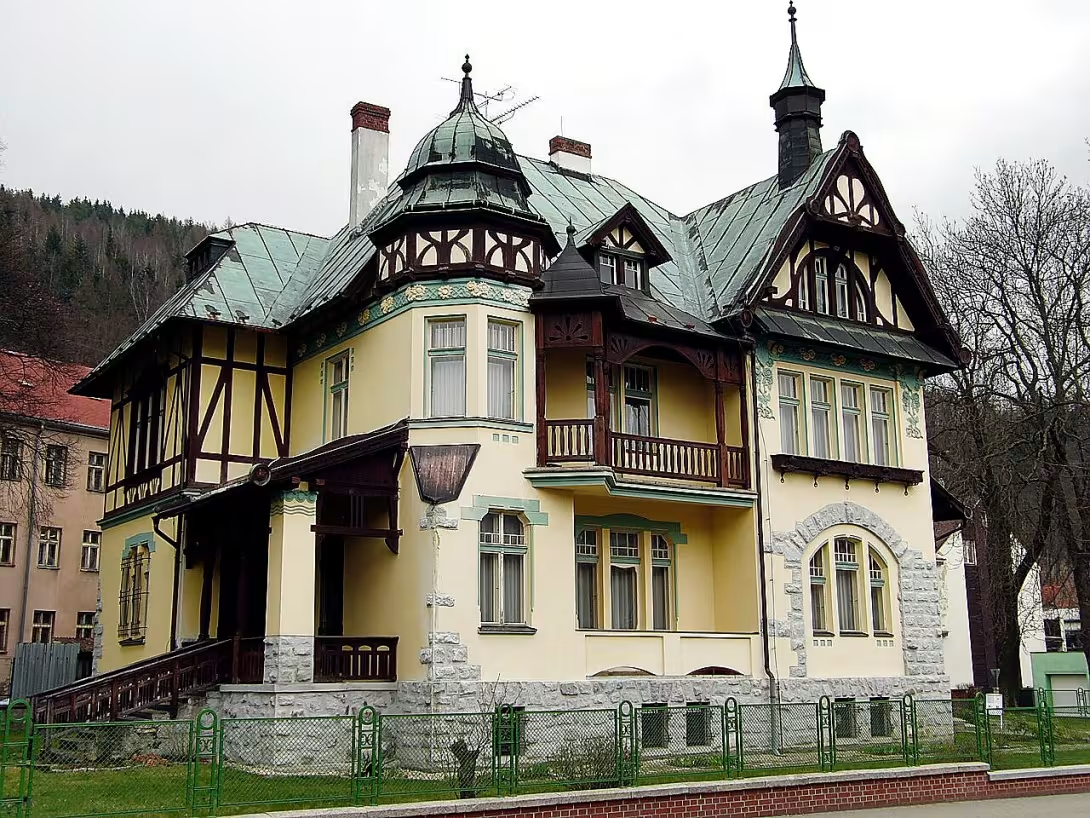
Villa of Manufacturer Wilhelm Fuchs in Kraslice is a notable example of early 20th-century Secession architecture, designed by architect Otto Steinl. Situated southeast of the town center near the Svatava River, this villa exemplifies both architectural innovation and the industrial prosperity of its time. Today, it functions as a municipal library, maintaining its historical importance while serving modern needs.
Commissioned by Wilhelm Fuchs, an influential textile manufacturer whose family significantly contributed to Kraslice's industrial growth, Otto Steinl designed this structure. Known for his work on Breinlova Villa in 1903, he crafted the villa to reflect personal taste and cultural aspirations of that era. The design mirrors broader European trends towards modernism and artistic innovation characteristic of the Secession movement.
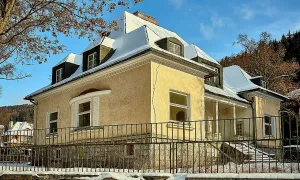
Architecturally, Fuchsova Villa showcases the Secession style with elements of Heimatstil. It features intricate woodwork, decorative facades, and a substantial stone foundation. Much of its original structure and details are preserved, including wooden staircases, stucco decorations, and carved wooden constructions. The design includes three above-ground floors in an almost unchanged original state, maintained through careful restoration.
Ownership transitioned from Wilhelm Fuchs, who died in 1910, to his firm Fuchs, Meindl, and Horn. In 1928, it was acquired by the Kreyová family. After World War II, the villa was confiscated by the local national committee and later repurposed for public use, including as a preschool before its restoration in 1998.
The villa's history includes significant events like Wilhelm Fuchs' death in 1910, leading to ownership changes. Post-1945, it was confiscated and adapted for community purposes, reflecting broader historical shifts in the region.
Today, Villa of Manufacturer Wilhelm Fuchs stands as a cultural landmark within Kraslice, housing the municipal library. Its designation as a cultural monument since 2012 highlights its architectural and historical significance. Visitors can explore its richly decorated interiors, featuring original elements like wooden wall paneling and stucco decorations. The villa's blend of Secession and Heimatstil styles offers a unique glimpse into early 20th-century Bohemian cultural heritage.
This monument is not only an example of architectural beauty but also reflects Kraslice's industrial past. Its continued use as a library ensures it remains an integral part of the community, inviting visitors to explore its historical and artistic significance.
Then and now
Drag the slider to compare how the landmark may have looked when it was built with the view today.
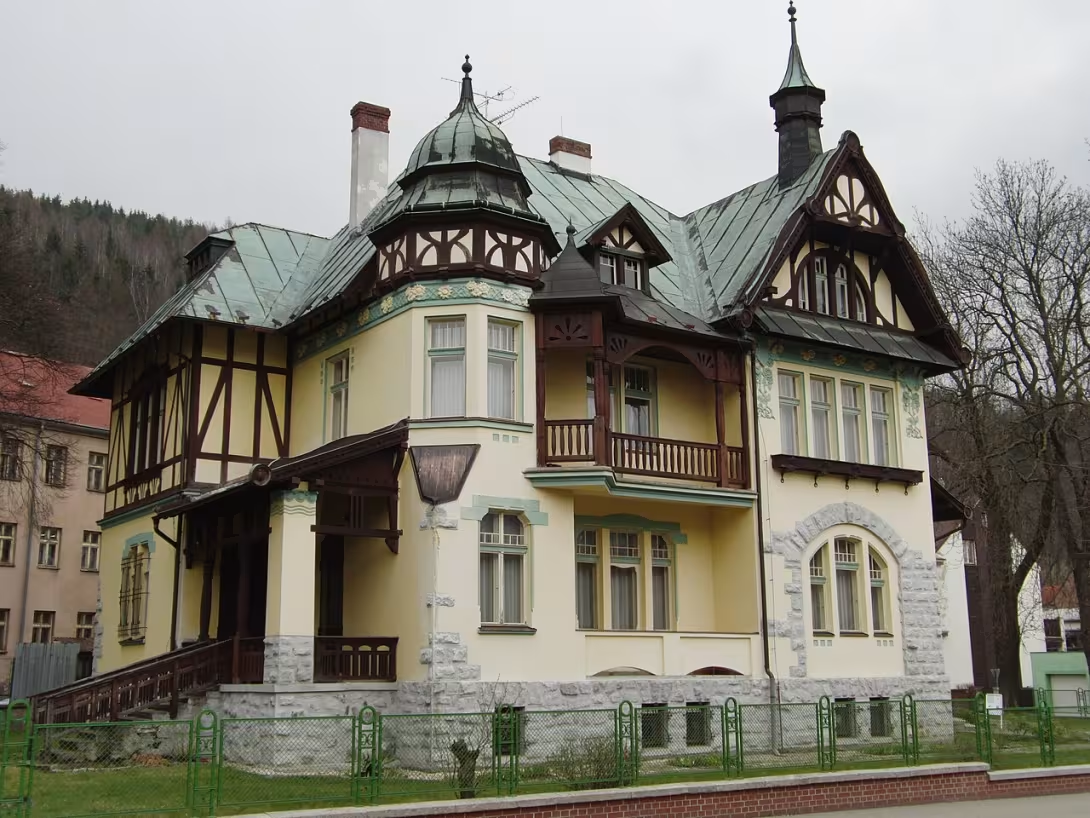

The historical appearance on the left is an AI-generated visualisation and serves as inspiration only.
Historical milestones
- 1903
- Otto Steinl designed his first building in Kraslice, Breinlova vila.
- 1910
- Wilhelm Fuchs passed away, leading to changes in the villa's ownership.
Architectural development
The villa showcases Secession style with elements of Heimatstil, featuring intricate woodwork and decorative facades. It has retained much of its original structure and details through the years, including wooden staircases and stucco decorations. A significant restoration took place in 1998 to preserve these features.
Historical events
1910: Wilhelm Fuchs passed away, leading to the villa's transition into corporate ownership.
Post-1945: The villa was confiscated and later used for public purposes.
Owners
Originally owned by Wilhelm Fuchs until his death in 1910, after which it was taken over by the firm Fuchs, Meindl and Horn. In 1928, ownership transferred to the Kreyová family. Post-World War II, it was confiscated and managed by the local national committee before being repurposed as a library.
Points of interest
- The villa's intricate woodwork includes unique carvings that depict scenes from Bohemian folklore, adding a layer of cultural storytelling to its architectural beauty.
- Legend has it that Wilhelm Fuchs' family had a secret room within the villa where they stored rare textiles and documents related to their industrial ventures, which were never found after his death in 1910.
- Despite its grand design, the villa once housed an innovative early 20th-century heating system using water from the nearby Svatava River, showcasing Fuchs' commitment to modernity and efficiency.
- During World War II, it is rumored that the villa served as a temporary hideout for local resistance fighters, utilizing its secluded location and robust construction to evade detection.
- The villa's transformation into a library was inspired by Wilhelm Fuchs’ daughter, who envisioned turning her father’s legacy into a center of learning and culture for future generations.
Guide
This guide is narrated by a synthetic voice generated by artificial intelligence.
Show guide text
This text was created by artificial intelligence and has not been editorially reviewed. It may contain inaccuracies.
The Fuchs Villa in Kraslice is an Art Nouveau building from the early twentieth century. It stands to the southeast of the city center, above the left bank of the Svatavy River on Dukelská Street. Today it houses the municipal library and has been protected as a cultural monument since two thousand and twelve.
The villa was built by Kraslice factory owner Wilhelm Fuchs for himself and his family. He came from a family of renowned textile entrepreneurs. His father Johann installed the first embroidery machine in Kraslice in eighteen sixty-two. Wilhelm studied at the Prague secondary technical school and the advanced textile technical school in Brno. Together with his brothers Jan and Josef, he then took over his father's machine embroidery factory. It initially operated under the name Johann Fuchs Söhne and after merging with Josef Meindl and Ferdinand Horn as the company Fuchs, Meindl and Horn. The villa was built in close proximity to the factory at that time. It was designed by Karlovy Vary architect Otto Steinl, who had previously built the Breinl Villa in Kraslice, which was completed in nineteen oh three.
After Fuchs's death in nineteen ten, the villa passed to the company. From nineteen twenty-eight, it was owned by the Krey family. After the Second World War it was confiscated and later housed a kindergarten. In nineteen ninety-eight it underwent reconstruction and from two thousand and four it has served the library.
The building is constructed in romanticizing Art Nouveau, in the then popular Heimat style. It has been preserved in almost its original state. The substantial base of rusticated stonework gives it an ancient appearance. The villa has three stories, the uppermost in the attic. The facades are divided by numerous risalits, bay windows, balconies and loggias. The most striking features are the illusory timber framing and wooden carved structures on the gables. The central wing of the main facade has a semicircular window in the gable and is topped by a small tower with a weathervane. On the northwest corner is a polygonal bay window with a sheet metal helmet roof. A short stone staircase leads to the main entrance and the entrance is protected by a covered vestibule with three arcades.
Behind the entrance is a small hall and beyond it a stairwell room lined with wood, lit by a large window. The original plans have not survived. On the ground floor there were probably reception rooms, on the upper floor bedrooms and in the attic small rooms. The wooden staircase with carved railings has been preserved, as well as wall paneling, painted window frames, tiled stoves, stucco decoration and all the original doors. In the dining room is a ceiling imitating a coffered ceiling with a rosette in the center.
Frequently asked questions
Can the monument be visited?
This is a residential or farm building, not a museum with opening hours. Please view it from public space and respect the owners' privacy. We have no information about access to the interior.
Where is the monument?
Location: Kraslice, Karlovarský kraj. The map on this page shows the exact spot.
Why is the monument protected?
It is listed in the Central List of Cultural Monuments of the Czech Republic as a cultural monument (register no. 1573264418).
Businesses nearby
Do you run a restaurant, accommodation, shop, museum, rental, wellness or other visitor service near this monument? Show yourself directly to the people heading to it — this is how they will see you in the app and on the web:
Nearby
Located near the Svatava River, the villa is surrounded by the picturesque landscape of Kraslice. The area includes other historical sites related to the textile industry, reflecting the town's industrial heritage.
Accommodation nearby
Trips and activities nearby
Guided tours, tickets and activities nearby from GetYourGuide
Affiliate link: if you buy from the partner, we may receive a commission. The price for you does not change.
Search tours and activities →Themed route
Text trasy:
1. Vila továrníka Wilhelma Fuchse Typ: historická architektura Proč stojí za návštěvu: Tato vila je unikátním příkladem secesní architektury a představuje významnou památku průmyslové historie Kraslic. Její architektonický design a historické hodnoty ji činí zajímavým cílem pro návštěvníky.
2. Textilní továrna Typ: historické průmyslové zařízení Proč stojí za návštěvu: Továrna představuje důležitou součást průmyslové historie Kraslic a je spojená s Wilhelmem Fuchsem, majitelem vily. Návštěva továrny poskytuje vhled do historie textilního průmyslu v regionu.
3. Nádraží Kraslice Typ: historické nádraží Proč stojí za návštěvu: Nádraží Kraslice je další památkou, která reflektuje průmyslovou minulost obce. Návštěva nádraží poskytuje příležitost prohlédnout si historické budovy a zahrát si roli cestujících z minulosti.
Seasonal recommendations
Jaro
In the spring season, Villa Wilhelma Fuchs is surrounded by blooming trees and flowers, creating a pleasant atmosphere. The specific spring lighting also creates a delightful glow. The ideal time to visit the villa is during Tuesday and Thursday morning hours, when it's open even for smaller numbers of visitors.
Léto
During the main summer season, Villa Wilhelma Fuchs is very popular with visitors. We recommend coming early to avoid large crowds that gather around noon. Don't forget to bring sunscreen and water, as it gets very hot outside during the summer.
Podzim
In the autumn season, Villa Wilhelma Fuchs is surrounded by the colors of fall foliage. The atmosphere is calm and pleasant, making it ideal for a peaceful tour of the villa. We recommend visiting the villa during the autumn to avoid large crowds that arrive in November and December.
Zima
We recommend visiting the villa in winter to avoid large crowds that come in February and March. Don't forget to bring warm clothing and shoes, as it gets very cold outside during the winter.
Visualizations and artistic views


The visualisations are generated by artificial intelligence and serve as inspiration.
Photos from the area
Real photos taken near the monument


Zdroj a licence jsou uvedeny u každého snímku.
Tips from visitors
No tips yet. Be the first!
Log in and add your tip.
Sources and literature
Photos: Mejdlowiki / CC BY-SA 3.0 — Wikimedia Commons. The author and licence also appear when you hover over the image.
Faktickým podkladem tohoto textu byl článek na Wikipedii, jehož autory jsou přispěvatelé Wikipedie. Článek je dostupný pod licencí CC BY-SA 4.0.
Location on the map
Příběhy a pověsti
Legendy, pověsti a příběhy spjaté s touto památkou
Fotografie návštěvníků
Zatím žádné fotografie. Buďte první, kdo přidá fotografii z návštěvy!
Log in a přidejte svou fotografii nebo hodnoťte.
Za ověřenou návštěvu v aplikaci získáte víc bodů — poznáme podle GPS, že jste na místě.
Reviews and comments