



Tvrz (1000121216) Fortress
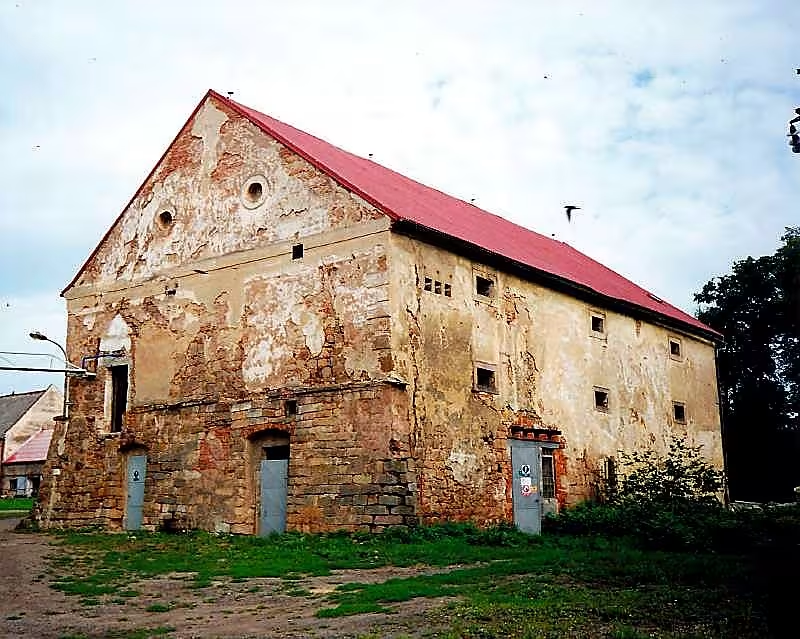
Wooden, oblong Gothic fortress converted to granary, is a cultural monument located in the village of Wooden in the district of Jičín. This historic building boasts a long and rich history ranging from the Middle Ages to the Renaissance to the present. Originally built as a fortress, it has undergone several transformations that reflect changes in its economic use and architectural style.
The first written mention of Woodwork dates back to 1388, when Jan from Woodwork is mentioned. In the following years the village was owned by various noble families, such as Otek of Labouna and Beneš of Timber. The first direct mention of the fort is from 1511 when Jindřich III. Berka z Dubé acquired it. During his reign, a brewery and a medovar were established on the spot, stressing the importance of the fort as an economic centre.
In the years 1560-1588 Wooden went through several changes of owners who attached it to the Kumburk estate. The fortress began to serve primarily economic purposes and the last mention of it dates back to 1636 when Rudolf of Tiefenbach acquired it.
During the Thirty Years' War, the property of Albrecht Jan Smiřický was confiscated by Emperor Ferdinandom II, and subsequently bought the manor Albrecht z Valdštejna. During his reign, the brewery was modernized, but after the death of Valdštejn the estate was again confiscated and transferred to Rudolf from Tiefenbach. After his death, the chateau belonged to the families of Sternberk, who converted it into a granary for a local brewery.
In the 18th century, the last significant modifications were made which affected its architecture. In 1710 the estate was acquired by the House of Trauttmansdorff, who led the brewery until 1945. After World War II, the property was confiscated and in 1995 the fort was registered as a cultural monument.
Architecturally, Wooden is originally a Gothic fortress that has undergone Renaissance modifications. Its rectangular shape and mannerist portal are significant elements, while the building has the sign of the Sternberk. Despite transformation to the granary, you can find traces of letter sgrafts.
Today, the site is protected as a cultural monument and served various purposes, including a poultry house. After 1993, it was privatized and, although not accessible to the public, its historical value remains unquestionable.
The woodwork is a testament to changes in Czech countries from the Middle Ages to the present. Its rich history and architectural features make it interesting for those interested in the past of our region. Visiting this memory is an opportunity to appreciate the long history and transformations that shaped her appearance and function.
Historical milestones
- 1388
- First written mention of Wooden.
- 1511
- The fort was won by Jindřich III. Berka z Dubé.
- 1541
- The lords of Dubé set up a brewery and a medovar on the spot.
- 1995
- Entry of the site into the list of cultural monuments.
Architectural development
Originally, the Gothic oblong fortress underwent Renaissance reconstruction, which left sgraffiti decorations and mannerist portal. During the period of the government of the Šternberk, the building was converted into a granary and a store for a brewery. The latest major modifications took place in the 18th century.
Historical events
1511 acquisition of the fortress by Henry Berkou from Dubé, 1541 establishment of brewery by gentlemen from Dubé, 1618 confiscation of property after the death of Albrecht Jan Smiřický, 1995 registration in the list of cultural monuments.
Owners
1393 Otek z Labouna, 1396 Beneš z Wooden, 1511 Jindřich III. Berka z Dubé, 1560 Zdeněk z Dubé, 1560 Petr z Šelmberk, 1588 Kateřina Donínská, 1596 Jan Rudolf Trčka z Lípy, 1618 Albrecht z Valdštejna, 1636 Rudolf z Tiefenbach, after 1676 genus Šternberk, from 1710 genus Trauttmansdorff, to 1945 Trauttmansdorff, from 1948 dairy plants in Jičín.
Points of interest
- Timber is a cultural monument located in the village of Timber in the district of Jičín. - The first written mention of the Wooden House dates back to the year 1388, when Jan from Wooden House is mentioned. - The fort was built like a fortress and has undergone several transformations, including conversion to a granary. - The first direct mention of the fort is from 1511 when Jindřich III. Berka z Dubé acquired it. - During the reign of Albrecht of Valdštejn, the brewery was modernized.
Guide
Show guide text
This text was created by artificial intelligence and has not been editorially reviewed. It may contain inaccuracies.
Welcome to Wooden. Stop for a moment, take a breath and look in front of you. You are standing in front of a building that carries a layer of several centuries of Czech history. At first glance you may not see the grave walls or tall towers that many of us associate with the idea of a medieval chateau, but it is in this permanent, rectangular, collapsed or rebuilt collapsed body that hides the story of a Gothic fortress. Feel the atmosphere of this place and try to imagine what this building looked like hundreds of years ago, when it served as a safe harbor and a symbol of power in the landscape. What you see today is a fascinating testimony about how the functions of buildings change, along with the times and needs of the people who inhabited and managed them.
Let us now return together in time to begin to make sense of the shape and character of this monument. The first written mention of the Woodwork introduced us until 1388. It is this year that the name of John of Timber appears in the documents, which tells us that there was already a fixed residence here in the late Middle Ages. At that time, this building was probably a typical Gothic fortress, which was intended not only to provide housing, but above all to ensure basic defence and control over the surrounding territory. Imagine the country back then, where such a fortress was the dominant of the village and the center of all social and economic events. It was the time of knights and chateau lords, when architecture was dictated primarily by practicality and security.
Now that you're standing outside the building, pay attention to its overall appearance. Notice its characteristic rectangular plan. This is the very basis of its original Gothic form. However, it is very interesting to see how this defence structure has transformed over time. Take a closer look at the facade and facade details. The building is not only a ragged remnant of the Middle Ages, but it bears clear signs of Renaissance architecture. If you look closely, you'll see elements that give the building a much lighter and more decorative expression. Note especially the sgraffiti that decorate the walls. Sgraffito is a technique in which the top layer of plaster is scraped off to show off the lower, darker colour, creating beautiful geometric or visual patterns. It is a typical element of the Renaissance, which was meant to give prestige and aesthetic value to buildings.
Another very important detail that you should now focus your attention on is the mannerist portal. Mannerism was a period that followed the high Renaissance and brought with it more playfulness, dynamism and unprecedented decoration. This portal, the entrance gate or door frame, is one of the most valuable architectural elements you can see here. It's where the function of entry meets artistic expression. It is these details that tell us that the fort was no longer just a military object, but it became a representative seat where the beauty and modern trends of the time were valued.
But who made the history of this place? Let's think about the personalities who left their mark here. The breaking point was 1511, when the fort came into the hands of Henry the third Berk of Dubé. The House of Berks of Dubé was very influential in these parts and it was their arrival that brought about a new dynamic. With them, the essence of the building began to change. In 1541 a brewery and a medovar were established, which completely changed the use of the premises. The fortress stopped being primarily a defensive point and began to transform into an economic building and granary. Imagine the noise, the smell of malt and honey and the constant movement of the people who worked here. The building became the heart of the economic development of the wooden estate.
Other important names appear in the history of this place, which are linked to the region and its administration. Among them are Albrecht z Valdštejna, one of the most powerful figures in Czech history, or Jan Rudolf Trčka z Lípy. Although they may not have spent every day here, their influence on the management of the estate and the surrounding countryside was reflected in how this fortress was managed and how its function developed. It is fascinating to think that one and the same building served knights, then influential nobles, and eventually became a practical space for storing grain and making beer.
Now, I want to impress you with one interesting thing that makes Timber a special place. Think about how rare it is today to see a building so clearly documenting its evolution. Most chateaux either remained in their original form as ruins, or were completely converted into baroque chateaux. But the wood trees chose another way. The transformation from a Gothic fortress to a Renaissance granary and an economic court is a process that shows us the true life of the medieval and modern estate. This building was not just a museum piece, but a living organism that adapted to what was necessary at the time. It is this primacy where the Gothic basis meets Renaissance sgraffiti and mannerist portal that makes this place a unique monument.
It is remarkable that this long journey from the first mention in 1388 to the period of brewing until the modern period was also officially recognised. In 1995, the whole complex was included in the list of cultural monuments, which means that the state recognized its irreplaceable value for our history and culture. So what you see today is not only an old building, but a protected witness to history that survived wars, regime changes, and economic crises.
Now that you know the story of this fort, I suggest you go around the building again slowly. Try to connect in your mind all the pieces of the puzzle we talked about. Look at the rectangular shape and imagine the Gothic walls. Then refocus on the sgraffiti and portal and experience the spirit of the Renaissance. Feel the silence that prevails today in Timberland and contradict it with the noisy operation of a 16th-century brewery.
The fortress in Wooden is a reminder that history is not only about great battles and kings, but also about everyday life, about crafts, about economics and how people cared for their homes and possessions. It's a place where practice meets art.
Thank you for accompanying me on this short journey through time. I hope this view of Wooden helped you see more than just the old walls. Now just feel the calm of the surrounding countryside and explore the rest of the premises at your own pace. I wish you a pleasant rest of the day and many other fascinating discoveries during your travels beyond history. Goodbye.
Tips for visitors
The best time to visit is early spring or late autumn when there is pleasant weather and fewer visitors, allowing you to walk calmly through historical spaces.
Take comfortable shoes, water and possibly a map or application with exposure information; A sunflower is also useful during hot days.
Photography excels with soft morning light on the outside walls and afternoon light in the courtyard, where historical details are reflected; best suited tripod and respect the prohibition of photography in protected areas.
For families with children are prepared interactive exhibitions and shorter routes that are safe and interesting, and it is advisable to plan breaks to rest in the resting area.
Frequently asked questions
Can the monument be visited?
Some buildings of this kind are open for guided tours, others serve another purpose or are privately owned. We have not verified whether and when this monument is open – please ask the operator.
What are the opening hours and admission?
We have not verified the opening hours or admission. Current information is published by the operator.
Where is the monument?
Location: Královéhradecký kraj. The map on this page shows the exact spot.
Why is the monument protected?
It is listed in the Central List of Cultural Monuments of the Czech Republic as a cultural monument (register no. 1000121216).
Businesses nearby
Do you run a restaurant, accommodation, shop, museum, rental, wellness or other visitor service near this monument? Show yourself directly to the people heading to it — this is how they will see you in the app and on the web:
Nearby
🏰 Historic sites (133)
- Mokřice 2.6 km
- Pomník T. G. Masaryka 4.4 km
- hrad Kumburk 4.5 km web
- památce Karla Hynka Máchy 4.5 km
- Zřícenina Bradlec 4.6 km
- Libosad 4.9 km
- Místní vlastivědné muzeum v Železnici 5.0 km Muzejní 181 +420732836309 web
- Zámek Kamenice 5.1 km
- Památník neštěstí na železničním přejezdu 5.9 km
- Antonín Štrauch 6.2 km
- Rudoarmějcům 6.2 km
- Josef Bohuslav Foerster 6.3 km
- Památník Viléma Konechlumského z Konecchlumí 6.3 km
- Karel Havlíček Borovský 6.4 km
- Tomáš Garrigue Masaryk 6.5 km
- K. V. Rais 6.5 km
- Klenotnice 6.6 km
- Jan Hus 6.7 km
- Suchardův dům 6.7 km
- Jan Amos Komenský 6.7 km
🍽️ Restaurants and dining (127)
- Restaurace Miloš Kuželka 0.1 km
- Růže 1.3 km
- Na Špici 1.4 km +420 493 597 548
- U Bílého lva 2.3 km
- Kozlovna 2.3 km
- Hospůdka U Kostela 3.0 km
- Restaurace Na Kumburáku 4.0 km web
- Hospoda u Jindry 4.8 km web
- Cafē Loggie 4.9 km
- Café Loggie 4.9 km web
- Mikulovská vinárna 4.9 km Náměstí Svobody +420 493 523 359 web
- Restaurace Na Klepandě 5.0 km
- U Muzea 5.1 km
- Hospoda Helvetia 5.1 km
- Café Pod Vinicí 5.1 km Nádražní 195 +420733533611 web
- Stop Cafe 5.2 km
- Stop Cafe 5.3 km
- Prostřední mlýn 5.9 km
- Restaurace Na sídlišti 6.0 km
- Na Sídlišti 6.0 km
🏨 Accommodation (54)
- Zdeněk Beneš 1.7 km +420 608 279 468
- U Bílého lva 2.2 km
- Penzion Kavka 4.1 km +420 777 260 571 web
- Pension u Jindra 4.8 km
- Penzion Bradlecký Mlýn 5.3 km +420 608 222 304
- Ranč na Kamenci 5.8 km +420 493 532 822
- Hotel Prostřední mlýn 5.9 km
- Ubytovna SPORT 6.0 km
- Hotel reSTART**** Superior 6.2 km Revoluční 1267 +420498019400
- Lukáš 6.4 km Argonská 467
- Grand Hotel Praha 6.6 km web
- Penzion Lucie 6.6 km
- Pension Novopacké sklepy 6.7 km web
- Pension U Sklepáka 6.7 km +420 493 722 872 web
- Hotel U Valdické Brány 6.8 km
- Ježkův statek 6.8 km +420731622580 web
- Hotel Paříž 6.8 km
- Penzion u České Koruny 6.9 km +420493531241
- Hotel Hradec 7.0 km Náměstí 54
- Věž Jičín - Romantika pro 2 7.1 km
🚲 Rentals and sport (17)
- Aqua centrum 6.1 km
- Bazén Nová Paka 6.1 km web
- Squash 6.2 km
- Tenis Nová Paka 6.4 km
- R.K. BIKE 6.4 km Pražská 515
- Sokol Nová Paka 6.6 km
- Sportisimo 6.8 km Riegrova 1263 +420724484985
- Koupaliště Kníže 7.0 km
- Cyklocentrum Souček 7.0 km Kollárova 43 +420493534061
- Koupaliště Nová Ves nad Popelkou 7.9 km
- Koupaliště 9.7 km
- Kola Šír 9.9 km T. G. Masaryka 297
- Letní stadion generála Ludvíka Svobody 10.8 km
- Skokanský můstek K70 11.2 km
- koupaliště Kruh 12.6 km
- Sokolovna 13.9 km
- Penzion Trautenberg - bazén 14.6 km
🥾 Hiking and nature (314)
- Lom 0.7 km
- Čihadla 1.5 km
- Vidlák 1.9 km
- Bývalá hasičská zbrojnice 2.1 km
- Na Zámcích 2.9 km
- Hrobka 3.1 km
- Kozinec 3.4 km
- Řízená střela 3.4 km
- Břízkovsko 3.5 km
- Kumburk 4.5 km
- Bradlec 4.6 km
- Poustevník 4.8 km
- Na Šamolce 4.8 km
- Železný 4.8 km
- vyhlídka Cyrila Boudy 4.9 km
- Ve Zlámaninách 5.1 km
- Zebín 5.2 km
- V Boroví 5.3 km
- Nad Příčnicí 5.4 km
- Poštmistrův kopec 5.5 km
Accommodation nearby
Themed route
1. The entrance gate, the gate, represents the first contact with history and shows the defence architecture of the object. 2. The inner courtyard, the premises, served as a central area for everyday activities of the inhabitants. 3. The main tower, the tower, offers views of the surrounding landscape and shows the technical possibilities of construction at the time. 4. Historical exposition, exposition, provides a detailed insight into life in the fortress through collection of objects.
Seasonal recommendations
Spring brings about the fortress of awakening nature and fresh greenery, which complements the historical appearance of the building. Light is soft and pleasant in this period, which creates an optimistic atmosphere. For the visit it is best to choose the morning hours when the air is still fresh. Due to the changing weather, we recommend that you prepare layered clothes to protect you from sudden cooling.
In the summer months, the atmosphere is intense and the sun illuminates every detail of the masonry. The dense vegetation provides a pleasant shade that is very welcome in the heat. In the main summer season we recommend arriving as early as possible in the morning to avoid the biggest crowds and high temperatures. Don't forget about fixed shoes for uneven terrain and plenty of drinking water.
Autumn season is defined by the foggy morning clock and golden shades of leaves that surround the historical masonry. The atmosphere is calm and slightly melancholic, which is ideal for photography. It is advisable to visit a place when the sun still illuminates the surroundings. Due to moisture and slippery roads, we recommend to wear a waterproof jacket and high-quality shoes with good grip.
Zimą makes the fortress very raw and monumental, especially if the surrounding area is covered with snow. The gray sky and cold underscore the historical nature of the place, but at the same time create a distant atmosphere. Due to the shorter time of day and lower temperature it is best to come around noon. It is necessary to carry very warm and wind-resistant clothes, as there may be considerable frost in open spaces.
Visualizations and artistic views


The visualisations are generated by artificial intelligence and serve as inspiration.
Photos from the area
Real photos taken near the monument


Zdroj a licence jsou uvedeny u každého snímku.
Tips from visitors
No tips yet. Be the first!
Log in and add your tip.
Sources and literature
Photos: Viktor Blažek / CC BY-SA 2.5 — Wikimedia Commons. The author and licence also appear when you hover over the image.
Faktickým podkladem tohoto textu byl článek na Wikipedii, jehož autory jsou přispěvatelé Wikipedie. Článek je dostupný pod licencí CC BY-SA 4.0.
Location on the map

Příběhy a pověsti
Legendy, pověsti a příběhy spjaté s touto památkou
Fotografie návštěvníků
Zatím žádné fotografie. Buďte první, kdo přidá fotografii z návštěvy!
Log in a přidejte svou fotografii nebo hodnoťte.
Za ověřenou návštěvu v aplikaci získáte víc bodů — poznáme podle GPS, že jste na místě.
Reviews and comments