



Týnišťský mlýn Water mill
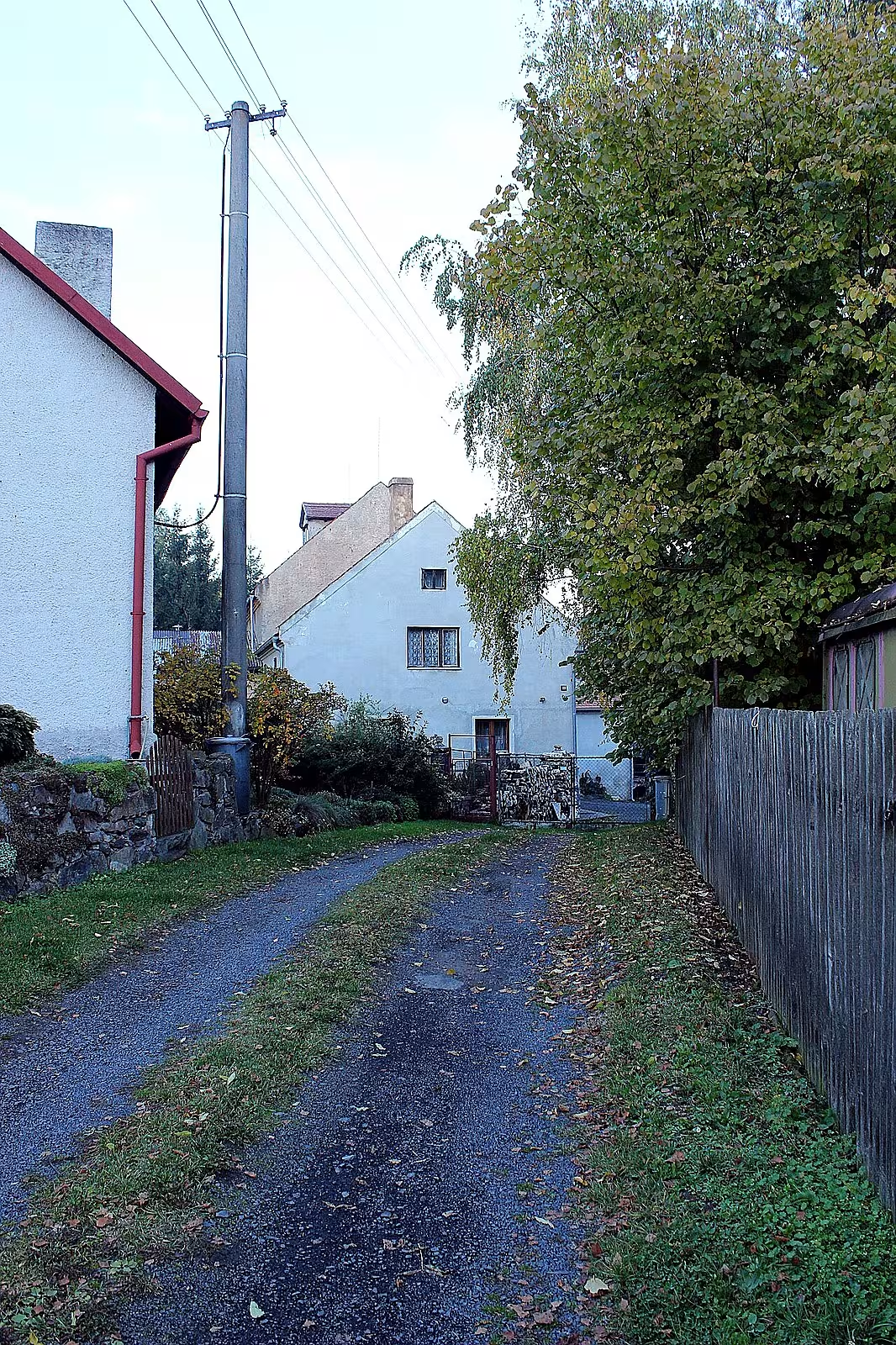
Týnišťský mlýn in Týníště near Verusicek in Karlovy Vary district is a historic water mill standing on the Lběbín creek. The area consists of a residential house, an administrative building and own mills. Since 2009 it has been protected as a real-estate cultural monument of the Czech Republic. Remarkable is the fact that it has preserved internal equipment from the 1930s, which still serves its purpose.
The oldest history of the mill is known from preserved records that it is first documented as a master's mill in the Stable Cadastral Land Books in 1841. At this time he operated in the house No. 23 Johann Wirkner. Since the 1960s, Josef Menzel became the owner.
Construction is a brick construction consisting of three mentioned parts. Originally, water was brought to the water wheel by a drive from the pond. By 1930, the mill had one Francis turbine, which had a vortex of 0.25 cubic meters per second, a drop of six meters and 15 horsepower. The internal technical equipment dates back to the 1930s.
In the period before World War II, the property belonged to the ancestors of the current owner, the Nachtman family. During the war, the building was forced into the administration, after which it was returned to the original owner. In 1957 the mill was nationalized and the owner was then entrusted with its administration. In 2020 Rostislav Černý is listed as owner or operator.
During the twentieth century, the operation had undergone significant changes. In 1957, flour ceased to wash and activity focused on the production of compound feed for animals that ended in the 1960s. In 2009 the building was declared a cultural monument of the Czech Republic.
Currently the mill is used again to squeeze and scrap grain, processing wheat, barley and maize. The preserved indoor equipment from the 1930s still serves its original function and thus gives an insight into the history of miller craft. Visiting this place in Týniste u Verusicek is a unique opportunity to learn about the preserved technical monument in the Lběbíinský creek.
Historical milestones
- 1841
- The mill is listed in the stable cadastral land books as a virgin.
- 1930
- The mill had one Francis turbine with 15 horsepower.
- 1957
- The mill was nationalized and the operation was changed to produce compound feed.
- 2009
- The building was registered as a real-estate cultural monument of the Czech Republic.
Architectural development
The building is a walled building consisting of three parts, which are a residential house, an administrative building and a mill. The water was originally guided to the water wheel by a drive from the pond, with one Francis turbine available for construction in 1930. The internal mill plant dates back to the 1930s.
Historical events
In 1841 the mill was first documented in the Stable Cadastral Land Books. During World War II, the mill was put into forced administration and subsequently nationalized in 1957. In 2009 the building was declared a cultural monument of the Czech Republic.
Owners
In 1841 Johann Wirkner is listed, since the 1960s Josef Menzel, before World War II, the Nachtman family and in 2020 Rostislav Černý.
Points of interest
- It has been protected as a real-estate cultural monument of the Czech Republic since 2009. - An internal device from the 1930s still serves its purpose. - In the land books it was documented as a mill in 1841. - The mill is again used for squeezing and shredding grain, processing wheat, barley and maize.
Guide
Show guide text
This text was created by artificial intelligence and has not been editorially reviewed. It may contain inaccuracies.
Welcome to the Tynist Mill. You have just arrived at a place where time seems to be a little different and where the murmur of water in the Lbestin stream tells stories many decades ago. You are standing in a picturesque environment near Verusicek, a place that is deeply connected with the rhythm of nature and the work of human hands. In front of your eyes is a whole that is not just an ordinary building but a harmonious set of three parts. Look at them carefully. You see here a residential house, which was used for living, an administrative building for running the whole operation and, of course, the mill itself, whose heart is the power of flowing water. This whole space seems like a whole unit that has resisted the changes in the world around it for centuries.
Let us now move further into the past together so that we can understand how this mill was formed and how important it was to the surrounding countryside. If we go back to 1841, we'll find a record in the land books at the time, the so-called stable cadastral, that this mill was marked as a virgin. This tells us that he was not just a regular place for grinding grain, but he had his ascending post status and belonged to the estate. It was an important point in the local economy, a place where forces of nature and people's needs met. The mill stood here firmly, as part of the wider order of the estate, and its existence was firmly written into the history of this region.
Now pay attention to how this space changed over time. Every era has left its mark. In 1930, the mill was already a very modern operation, as allowed by the time. He had a one-time problem with Francis' turbine, which had 15 horsepower. Imagine the power that made the water from the creek turn into movement and work. Later, in 1957, there was a big change that hit many similar places throughout the country. The mill was nationalized and its original purpose changed. Instead of grinding the grain for the locals, a compound feed was made here. So even though the resemblance of what was done inside has changed, instead of living and still using the power of water. It was only in 2009 that this precious object was officially recognized by its significance and registered as a real-estate cultural monument of the Czech Republic. This means that his history is now protected from oblivion and destruction.
Now if you look around and focus your view on the buildings themselves, notice their arrangement. Although we do not know the names of the particular architects who designed these structures, their work is clearly evident in how the buildings are functionally connected. The whole complex is designed to meet the needs of not only grinding, but also housing and administration. Feel the atmosphere of peace and stability. Each part of this set of buildings has its place and its role. Note how these three parts complement each other and create a comprehensive space that has adapted to the flow of water and to the needs of the people who lived and worked here.
The names of the people who left their trail are connected to this place. In the history of the Týnistský mill, characters like Johann Wirkner or Josef Menzel appear. Although their specific actions within this mill are not discussed in detail, their names are part of this history. The other names associated with this place are Nachtman and Rostislav Černý. Each of these names represents one chapter in the long history of this place, one human trace in the endless flow of time that flows along with the water in the stream.
But now I want to invite you to something really special, something that may surprise you. You may think that the historical mills are just museums where everything stopped and everything is just for inspection. But Týnišťský mlýn is different. She has one great mystery and one great joy. Note that the interior equipment that was installed here in the 1930s is not just displayed as a historical artifact. It still works. That's completely unusual. The device that was made almost a century ago still serves its original purpose. The mill is working again, squeezing again and cutting grain. If you stop and listen, you can feel the constant work. It processes both wheat and barley and can still perform its role by keeping its internal mechanisms in such good condition. It's like a time machine that doesn't break, but it still works day and night.
This mill is living proof that things made with care and reason can survive for centuries and still be useful. It is a connection between the old world and today, where technology from 1930 is still fighting the forces of nature and winning.
I hope that this view of Týnišťský mlýn enriched you and that you perceived its unique atmosphere. Now you know that you're not just in front of a group of buildings by the water, but in front of a place that has a soul that still beats the beat of grinding grain. Please continue your walk, feel the surroundings and enjoy the peace this place offers. Thank you for your attention and I wish you a wonderful time to discover the beauty of our country. Goodbye.
Tips for visitors
Best time to visit The Těnistský mill is in spring and autumn months when nature is full of blood. At these times, it is quieter and the atmosphere is unforgettable. Visit the mill in the morning to enjoy mild light and pleasant temperatures.
The mill can also be visited by public transport, and the best information about the current connection can be checked by online route search engine.
When visiting, make sure you have sun protection and plenty of drinking water. Thanks to the pleasant environment, light clothes and shoes are suitable for walking on the lawn.
The best place for photography is at the solitude of the mill, where water from the Lběbín stream moves around the old wall walls. The best light for photos offers morning and afternoon hours when the sun is lower in the sky.
In the vicinity of the Týniště Mill there is a Lběbín pond, which is an ideal place for a short walk or relaxation. Children will also enjoy it because it is possible to discover nature and observe different kinds of birds.
Frequently asked questions
Can the monument be visited?
This is a technical monument. Some are open as exhibitions, others are out of use or on private land. We have not verified whether this one is accessible.
What are the opening hours and admission?
We have not verified the opening hours or admission. Current information is published by the operator.
Where is the monument?
Location: Verušičky, Karlovarský kraj. The map on this page shows the exact spot.
Why is the monument protected?
It is listed in the Central List of Cultural Monuments of the Czech Republic as a cultural monument (register no. 1774283487).
Businesses nearby
Do you run a restaurant, accommodation, shop, museum, rental, wellness or other visitor service near this monument? Show yourself directly to the people heading to it — this is how they will see you in the app and on the web:
Events nearby
Zdroj akcí: otevřená data měst a obcí ČR (Národní katalog otevřených dat) a kalendář akcí Národního památkového ústavu.
Nearby
Mlýn se nachází na Lochotínském potoce v katastrálním území Týniště u Verušiček.
Accommodation nearby
Trips and activities nearby
Guided tours, tickets and activities nearby from GetYourGuide
Affiliate link: if you buy from the partner, we may receive a commission. The price for you does not change.
Search tours and activities →Themed route
Týnišťský mlýn Type: Historical industrial monument Why is it worth a visit: This building on the bank of the Lběbídino creek represents a rare example of the water management and mill craft in the region. Visitors can see the preserved technical equipment and learn about the history of cereal processing in the cadastral territory of Týništěch u Verusicek.
The River of London Type: Water flow Why is worth a visit: The natural environment around the flow forms a peaceful framework for walking towards the mill. The water that powered the mechanisms gives the place a specific atmosphere and allows us to observe the impact of nature on the historical installation.
Catastral territory Týniště u Verusicek Type: Geographic location Why is worth a visit: Walk around the mill allows you to see the typical landscape of this part of the village Verušičky. It is an ideal place to relax and gain a sense of disconnection from the urban bustle near the main destination of the route.
Municipality of Verušičky Type: Location Why is worth visiting: As a starting point or end point of the route offers basic infrastructure for visitors. Invitation to get acquainted with the local environment and cultural context in which the monument is located complements the experience of the tour of the mill itself.
The route is designed so that the visitor can explore the main destination and its immediate surroundings in peace without the need to travel to more remote locations that are not listed in the base. Emphasis is placed on the connection of technical history with the natural environment of the Lběbíinský creek.
Visualizations and artistic views


The visualisations are generated by artificial intelligence and serve as inspiration.
Photos from the area
Real photos taken near the monument

Zdroj a licence jsou uvedeny u každého snímku.
Tips from visitors
No tips yet. Be the first!
Log in and add your tip.
Sources and literature
Photos: Jan Polák / CC BY-SA 3.0 — Wikimedia Commons. The author and licence also appear when you hover over the image.
Faktickým podkladem tohoto textu byl článek na Wikipedii, jehož autory jsou přispěvatelé Wikipedie. Článek je dostupný pod licencí CC BY-SA 4.0.
Location on the map
More monuments – Verušičky
Show all in the municipality
Příběhy a pověsti
Legendy, pověsti a příběhy spjaté s touto památkou

Fotografie návštěvníků
Zatím žádné fotografie. Buďte první, kdo přidá fotografii z návštěvy!
Log in a přidejte svou fotografii nebo hodnoťte.
Za ověřenou návštěvu v aplikaci získáte víc bodů — poznáme podle GPS, že jste na místě.
Reviews and comments