

Usedlost čp. 2 (Saky) Homestead
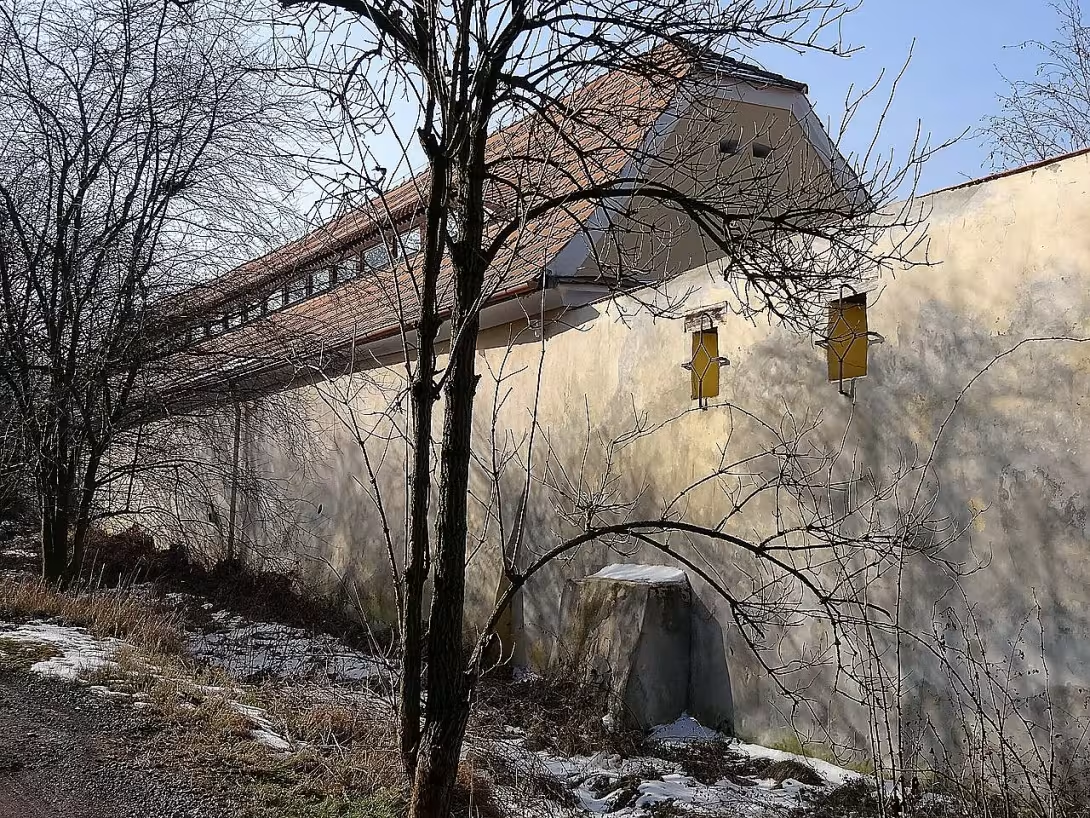
The settlement no. 2 in the village of Saka in the district of Kladno is an extremely valuable site of folk construction, the core of which dates back to the Middle Ages. The complex consists of several buildings, including a storey granary and garden, which encapsulates a stone wall from the local optics. The monument excels with a uniquely preserved gagged, dynamite scar from 1494, whose importance exceeds the region of central Bohemia.
The village of Saka is located about 5 km from the town of Salná in Central Bohemia. The building consists of several settlements grouped around an irregular village area. The history of the site itself extends deeper into the past than the written sources show. Ceramic fragments from the 13th, 14th and 15th centuries found in the filling shafts of the estate are the oldest known proof of the local settlement. Early medieval documents from the 11th to 13th centuries from the nearby area are mentioned by neighbouring village Jemníky, whose name is derived from digging pits. In nearby Knovíz, the sources from the 11th century show subjects working with iron ore. The end of the 15th century in Bohemia represented a period of gradual recovery after Hussite wars and the flowering of late Gothic construction, which includes the construction of the local cabin.
The architectural dominance of the complex consists of a residential building with a traditional tripartite layout, a patronic chamber piece and follow-up stables. The construction works as a classical work, with a younger tract added in the 1930s. But a unique element is the medieval core discovered in 1999, which consists of the remains of a grafted living room or a dyke scar. The Dendrochronological survey showed that the povas were made from over 100-year-old fir strains harvested in 1494. The walls of the cabin have preserved traces of dry operation, clay erasers of spar with limestone coatings, limestone coatings of beams and splints for logs. On the west side of the yard is a storehouse. Its ground floor is walled from a quad wall with valed vaults, while the floor has a frame construction with beam fillings with heating function. In the south-east of the court there is a storey building with chambers and a follow-up perpendicular. The current spatial layout of the entire complex is already documented on a map of a stable cadastral from 1840.
The specific owners and the dramatic fate of the estate over the centuries are not mentioned. The major milestone in modern history was 1987, when the estate was declared a cultural monument for its classical value. In 1999, the discovery of the already mentioned medieval grafted dynamite scar followed.
The most important attractions include the discovery of a buried shaft right under the residential house. Its bottom lies approximately 4.4 metres below the floor of the scar, the mouth has a diameter of about 3 metres and at the lowest part, the object expanded to the west by an incision cut into the rock. At the bottom, there was an iron hoop, and the rock analysis showed that the shafts were used to mine iron ore. A similar object of the same age was also found in the garden of the estate. The grafted dyke scar itself is one of the oldest preserved village grafted houses in Bohemia.
Currently, the estate is used for private housing and occasional social and cultural activities. There are meetings of experts and personalities over current topics, occasional concerts of classical and jazz music for invited guests and since 2022 also the creation of unique flowers from silver and gold. In April 2023, the world's unique GIYOU golden bouquet, composed of 118 flowers with a total weight of 738 grams, was considered to be the most valuable current gold bouquet in the world.
The Sakami area is an extremely valuable example of the development of rural construction from the end of the 15th to the first half of the 20th century, and shows the deep roots of folk architecture in Slanska. Visiting this place offers a unique view of the building history and authentic medieval countryside.
Then and now
Drag the slider to compare how the landmark may have looked when it was built with the view today.
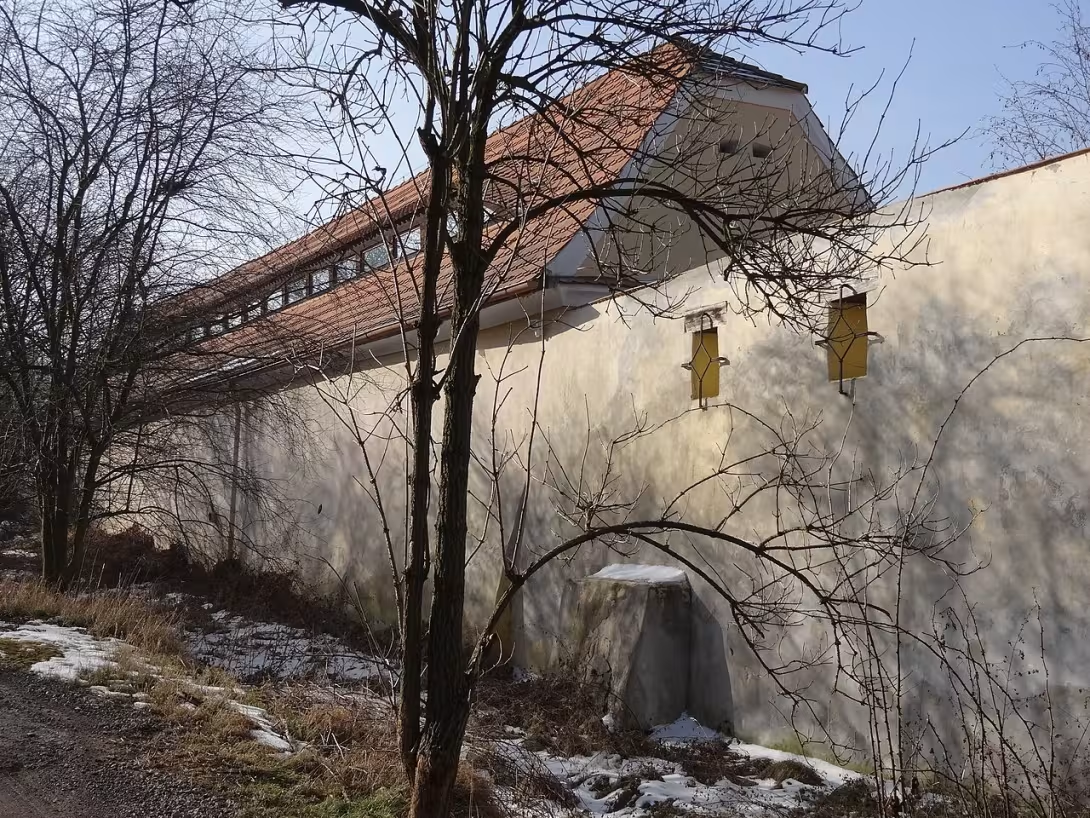

The historical appearance on the left is an AI-generated visualisation and serves as inspiration only.
Historical milestones
- 1494
- The cutting of edible strains used to build a dyke scar.
- 1840
- Proof of the current spatial layout of the site in a map of a stable cadastral.
- 1987
- A declaration by the estate for a cultural monument for its classical value.
- 1999
- Discover part of the medieval grafted living room.
Architectural development
The core is made up of a medieval grafted dyke scar from the end of the 15th century. Later, the construction was supplemented with classical elements and in the 1930s a younger tract was added. There is also a storehouse granary with a quad wall and high vaults on the ground floor.
Historical events
In 1494, the fir strains used to build a dyke scar were cut down. In 1987 the estate was declared a cultural monument. In 1999 a part of the medieval grafted living room was discovered in the estate.
Points of interest
- The area contains a unique preserved grafted, terry scar from 1494. - Ceramic fractions from the 13th, 14th and 15th centuries were found in the area. - Under the residential house and in the garden were discovered shafts which were used to mine iron ore. - The farmhouse garden is surrounded by a stone wall from the local optics. - Floor granary has a wall ground floor with vaults and a floor with frame construction for heating.
Guide
This guide is narrated by a synthetic voice generated by artificial intelligence.
Show guide text
This text was created by artificial intelligence and has not been editorially reviewed. It may contain inaccuracies.
Welcome to the settlement with number two in the village of Saka. You're standing in front of an area that's much more than just an ordinary old house. It is a real testimony about how the village construction in the area of Slovakia has changed over the centuries. Now if you look around you, you'll see a set of buildings that together form a harmonious whole. The dominance of the whole place is a residential building that hides secrets from the deep Middle Ages. Notice how the entire space is closed and separated from the surrounding area by a stone wall. This wall is not just a simple range of land, but it is built from a local optics, which is a typical stone for this area, which gives the whole area its specific, ground and solid characteristics.
Let's stop at the beginning of this place. The history of this estate will lead us to the end of the fifth century before our present time. Exactly in the year of the thousand four hundred ninety-four, the fir tribes were thrown down, which served as the basic building material for the formation of a dyke scar. So imagine that under the roof of this house there is a nucleus that remembers the time of the Middle Ages. The dynamic scar was at that time the fundamental building block of the home, the place where it was cooked, burned and lived, while the smoke from the fireplace escaped slowly through the roof structure. It is a unique piece of history that has been preserved to date in an extremely valuable form.
Now pay attention to the architecture and overall arrangement you see before you. Although the house was changing over time, its current form and spatial distribution are documented in maps of a stable cadastral from a thousand eight hundred forty. This means that what you are seeing today, in many ways, corresponds to the form of the early nineteenth century. In addition to the main residential house, feel the other buildings in the complex. Note, for example, the storehouse granary which was an essential part of each richer holding for the storage of cereals. The whole complex is an example of a practical approach to space where each building had its clearly defined function. Again, I recommend focusing on wall material. The local optics from which the walls are unbundled are very characteristic in this country and give us a clear idea of how people used the resources provided by the country itself under their feet.
When we think about the people who lived here, we have to acknowledge that the particular names of architects or prominent personalities associated with this place have remained forgotten. However, that is where the magic lies. It is not a monument to a famous person, but a monument to the everyday life of generations who have worked here, kept animals and procured their farms. It's a story about perseverance and how it gradually burrows history. In a thousand and nine hundred and eighty-seven, the estate was declared a cultural monument. The reason was mainly its classical value, which means that the construction bears the signs of purity and balance typical of this period.
But now I want to take you to the most interesting, secrets that were hidden deep beneath the surface of the earth. Imagine this home wasn't just about agriculture. In the surveys, shafts were discovered under the residential house and in the garden. These shafts were not intended for waste, but they were used for mining iron ore. This tells us that the inhabitants of this place were also engaged in mining, which adds a whole new dimension to the estate. Iron was a valuable material at the time and its extraction directly on the estate is indicative of the wealth of natural resources in this area.
But there are more mysteries and discoveries. In the year one thousand nine hundred ninety-nine there was a major discovery, when a part of the medieval grafted living room was raised to the surface. This confirmed the original assumptions of the construction age. And if you're interested in archaeology, know that ceramic fragments were found in the area dating back to the 13th, 14th and 15th centuries. This means that people lived in this place and formed their culture much longer than the grafting itself from the year one thousand four hundred ninety-four would give us at first sight. Each shard of pottery is like a small letter from the past telling us about the daily use of containers, about eating and about the craftsmanship of ancient inhabitants.
Now, if you look again at the general view of the estate, try to put all these pieces together. You can see the stone wall from the spliff, you can see the storey granary and imagine under your feet old mining shafts and deep in the house of fir tribes from the end of the fifth century. It is a fascinating layer of time where the Middle Ages encounter classicism and industrial activity with village peace. This estate is an example of how human life adapted to the conditions of the surroundings and how a simple grafted building became a complex complex that survived centuries.
I suggest you now walk quietly around the entire area, perceive the texture of stone walls, and try to imagine what sound the fir beams had to make when the first fires ignited in a dry scar more than five styles ago. Take note of the details of human work and time.
Thank you for your attention and I wish you a pleasant rest of the tour. I hope that this journey into the depths of history in the village of Saka has attracted you and that you are leaving with a new look at what home and tradition means. We wish you a beautiful day and a happy continuation in discovering our cultural monuments.
Tips for visitors
The best time to visit is the late spring or autumn, when the surrounding landscape of Slanska excels beautifully and trees do not interfere in the view of the architecture of the estate. Transport to the village of Saka can be arranged by your own car or public connections; Check the current traffic options in the travel search engines.
To visit we recommend to wear comfortable shoes suitable for rural surroundings. Since this is a residential area that is not a museum, prepare to be inspected only from the outside and respect the privacy of residents.
For the best photos we recommend morning or late afternoon light to highlight the details of the grafted core of the house. The most interesting angles of images offer views from surrounding paths that capture the overall character of village construction.
As part of a short trip you can visit the town of Salná, which is located just a few kilometres from the estate. For families with children it is ideal to walk around the village and observe old buildings, which can be an interesting lesson about how people lived in the past.
Frequently asked questions
Can the monument be visited?
This is a residential or farm building, not a museum with opening hours. Please view it from public space and respect the owners' privacy. We have no information about access to the interior.
Why is the monument protected?
It is listed in the Central List of Cultural Monuments of the Czech Republic as a cultural monument (register no. 1000158826).
Businesses nearby
Do you run a restaurant, accommodation, shop, museum, rental, wellness or other visitor service near this monument? Show yourself directly to the people heading to it — this is how they will see you in the app and on the web:
Nearby
🏰 Historic sites (84)
- Pomník obětem 1. světové války 2.1 km web
- Pomník obětem 2. SV 3.2 km
- bývalý důl Mayrau 3.5 km
- Vlastivědné muzeum ve Slaném 3.9 km
- Tomáš Garrigue Masaryk 3.9 km
- sv. Jiří bojující s drakem 4.1 km
- Oběti koncetračních táborů 4.2 km
- Antonín Dvořák 4.2 km
- Slánský menhir Tyršův kámen 4.7 km
- Vojenská technika 4.7 km
- Sládečkovo Vlastivědné Muzeum 5.3 km +420 312 248 045 web
- Bachrovna 5.3 km
- Mariánské sousoší 5.5 km
- sv. Jan Nepomucký 5.6 km
- Obětem náletu za 2. světové války 5.7 km
- Bunkr Drnov - Muzeum studené války a protivzdušné obrany 5.8 km web
- Antonín Dvořák 5.8 km
- Anton J. Čermák 5.8 km
- Bedřich Smetana 5.8 km
- Váňův kámen 5.9 km
🍽️ Restaurants and dining (247)
- Dělnický dům 1.2 km
- Pausa 1.4 km 5. května 292 +420777296996
- Hospoda 1.6 km
- Vyšehrad 3.1 km
- U Hubičků 3.2 km
- Phõ Lãng Viet 3.2 km Havlíčkovo nám. 1686
- Pizza Švermov 3.3 km 28. října 1212
- Sokolovna 3.3 km
- Pizza Knovíz 3.3 km
- U Holečků 3.4 km
- Motorest 3.4 km web
- Kuklík 3.4 km
- Ristorante Pizzeria Hemerkův Statek 3.6 km
- Fresh Corner 3.6 km
- Kufr 3.8 km
- Pivovar Antoš 3.8 km
- bar "Na růžku" 3.8 km
- Café Bar Church 3.8 km
- Lahůdky 3.9 km
- Ungelt 3.9 km Masarykovo náměstí 4
🏨 Accommodation (26)
- Ubytovna Slaný Trilorn 3.4 km Pražská 804 +420 605 080 064 web
- Atlas 3.8 km
- Hejtmanský dvůr 4.0 km web
- Ungelt 4.1 km
- Penzion 68 5.1 km
- Hoffmann 5.3 km
- Turistická ubytovna Centrum 5.7 km Váňova 322 +420603816906 web
- Hotel Merkur 5.8 km
- Ponte 5.9 km
- U Admirála 6.1 km web
- Penzion Tonička 6.3 km
- Penzion Vila Sítná 6.5 km
- Hotel Kladno 6.6 km náměstí Sítná 3113 +420 312 523 119 web
- Penzion Iris 6.6 km
- Sport Hotel Sletiště 6.8 km +420 312 249 465 web
- Ubytovna Racanda 6.8 km
- Ubytovna Na zvonečku 6.8 km
- U Zlatého selátka 6.9 km
- Ubytovna U Konvalinků 6.9 km
- Astra 8.0 km
🚲 Rentals and sport (48)
- Plovárna Slaný 3.5 km
- Střelnice na Haldě Vinařice 3.6 km web
- Studio BB 4.0 km
- eMsport 4.0 km
- Hokejbalové hřiště 4.1 km
- Tenisové kurty 4.3 km
- Sokolovna 4.3 km
- býv. voj. prostor 4.6 km
- Sportovní hala Háje 4.9 km web
- Kola Jiří Hlubovský 5.6 km
- SOKOL 5.7 km
- Sportovně-kulturní sdružení 5.7 km
- VehicleStore 5.7 km
- Živé vobrazy 5.9 km
- Sport Vision 6.0 km +420313101400 web
- Sportisimo 6.1 km Petra Bezruče 3388 +420226292590 web
- Sympa Sport2000 6.4 km +420774829852 web
- SK Kladno 6.5 km
- TJ Novoměstský Kladno 6.6 km
- Snowboard - lyže - boty 6.7 km
🥾 Hiking and nature (171)
- Obůrka Podháj - soukromý zoopark 1.1 km 778802121 web
- Vinařická hora 1.5 km
- Trebichovická olšinka 1.8 km
- Vinařice - náměstí 2.3 km
- Jáma Ronna 2.5 km
- Netovická stráň 2.6 km
- Jáma Theodor 3.0 km
- nám. Mikoláše Alše 3.0 km
- Kumpánova zahrada 3.5 km K. H. Borovského
- Východní věž 3.5 km
- Západní věž 3.5 km
- Jáma Robert 3.5 km
- Jáma Mayrau 3.6 km
- U Autobusového nádraží 3.7 km
- náměstí 9. května 3.7 km
- Jáma Barré 3.8 km
- Modletický dům 3.8 km
- U Antoše 3.8 km
- Park U křižovatky 3.8 km
- Park Plynárenská 3.8 km
Accommodation nearby
Trips and activities nearby
Guided tours, tickets and activities nearby from GetYourGuide
Affiliate link: if you buy from the partner, we may receive a commission. The price for you does not change.
Search tours and activities →Themed route
1.Usedlost čp. 2 (Saky) Type: Historical estate Why is it worth a visit: This main destination of our trip is located in the village of Saka. It represents traditional rural architecture and an interesting example of historical construction in the region.
2. Saka villages Type: Villages Why is it worth a visit: The whole village in Kladno district forms the immediate surroundings of our main monument. It offers a quiet rural atmosphere for a peaceful walk in the immediate vicinity of the starting point.
3. Around the village of Saka Type: Rural landscape Why is it worth a visit: This area around the village, which is located approximately five kilometres from the town of Sláňá, allows the perception of the character of the Czech landscape. It provides space to track adjacent fields and local routes.
Seasonal recommendations
Spring moons bring out the awakening nature, when the surrounding trees begin to burrow and the grass becomes fresh green. Sun rays fall on ancient walls at a milder angle, creating fine shadows and ideal conditions for shooting exteriors without sharp midday contrast. In this period, you will not meet almost any travelers, so you will enjoy the quiet atmosphere in complete silence.
During warm summer days, the historical farmhouse is surrounded by lush vegetation and high grain on adjacent grounds, which gives the whole place a picturesque character of traditional countryside. The sun shines long into the evening and the best light for admiring the outdoor details of architecture occurs early in the morning or vice versa in the late afternoon when the rays are golden and warm. In the high season, sometimes passers by on cycling trips, but there are no crowds of tourists. Wear light breathable clothes, don't forget the headgear and plenty of drinking water, because there are no shady forests or refreshments around the building.
Autumn time of the landscape into earthy colors rusty, yellow and brown, which suits the old brick and plaster and creates a nostalgic mood. The low sun creates long shadows, and the misty mornings of the country estate provide a mysterious character. Tourism is completely quiet at this time, so here you will be all alone. Plan your visit for the morning when the morning fog breaks. Take a warmer sweater, a waterproof windbreaker, and a tight pair of shoes, because leaves fall under your feet and wet ground.
The winter season turns the surroundings into a quiet white landscape, especially when the landscape is covered by snow cover. The lighting is usually very muted and the short day quickly passes into darkness, so it is the best time to stop around noon when daylight has the greatest power. There will be no crowds of people here in cold days, there is a deep calm around the estate. For this walk it is absolutely necessary to choose warm winter clothes, hat, gloves and high-quality shoes with anti-slip soles, because the roads around the object can freeze and the blowing cold wind leaves a feeling of cold very quickly.
Visualizations and artistic views


The visualisations are generated by artificial intelligence and serve as inspiration.
Photos from the area
Real photos taken near the monument


Zdroj a licence jsou uvedeny u každého snímku.
Tips from visitors
No tips yet. Be the first!
Log in and add your tip.
Sources and literature
Photos: MartinVeselka / CC BY-SA 4.0 — Wikimedia Commons. The author and licence also appear when you hover over the image.
Faktickým podkladem tohoto textu byl článek na Wikipedii, jehož autory jsou přispěvatelé Wikipedie. Článek je dostupný pod licencí CC BY-SA 4.0.
Location on the map
More monuments – Středočeský kraj
Show all in the region
Příběhy a pověsti
Legendy, pověsti a příběhy spjaté s touto památkou
Fotografie návštěvníků
Přidat fotografiiZatím žádné fotografie. Buďte první, kdo přidá fotografii z návštěvy!
Máte k místu vzpomínku nebo zajímavý příběh?
Log in a přidejte svou fotografii nebo hodnoťte.
Za ověřenou návštěvu v aplikaci získáte víc bodů — poznáme podle GPS, že jste na místě.
Reviews and comments