



Větrný mlýn (Rymice) Windmill
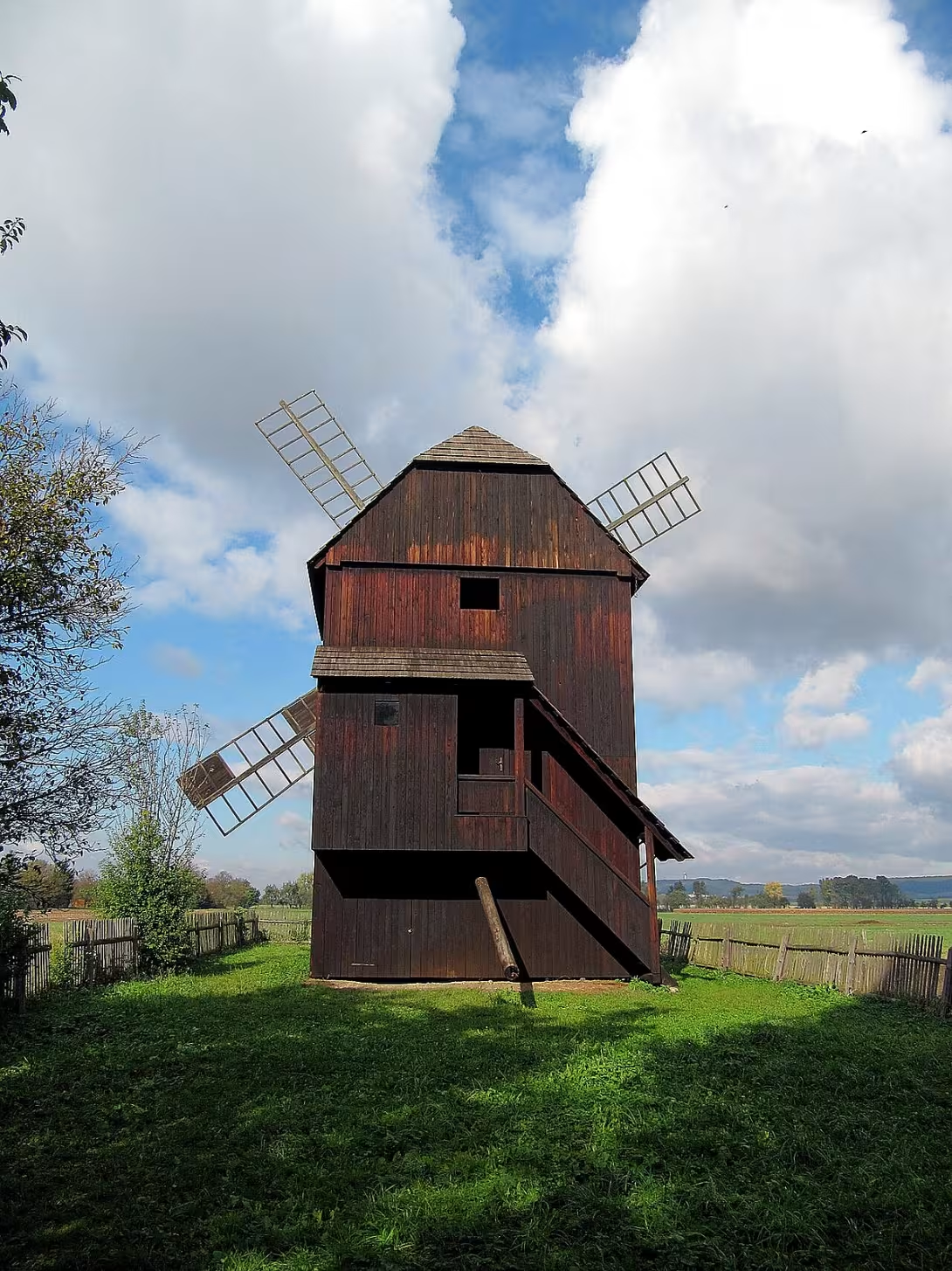
The windmill in Rymice is a classical construction of the German pillar type. It was created in 1795 in the village of Borenovice. Today, this technical monument is located in the area of the File of Folk Buildings in Rymice, Kroměříž and is open to the public.
The history of the mill began to be written at the end of the 18th century, at a time of maturing submission and development of small craft production. According to the preserved purchase contract, he purchased the construction plot František Hlobil for 60 gold which he paid back on debt. The operating conditions included an annual fee of two gold overheads and 18 gold municipalities, paid in two instalments. The mill served its purpose until World War II.
The construction has a floor plan of 5.8 to 5.8 meters and reaches a height of 11.2 meters. The wooden structure with a plate cover is covered with a saddle roof, which is on the shield with a flap and covered with shingles. A windwheel of 14.8 metres in diameter consists of four wings, each blade having an area of 6.5 square metres. In the interior there is one grinding composition with stones of 1.2 metres diameter; The bottom is 0.20 meters high and the tread is 0.17 meters high. A wheel of 3,3 metres in diameter is fitted with 96 teeth. When repaired in 1891, the shalanda was removed from the interior.
During its existence, the object underwent several major events. In 1891 it was overthrown by a storm followed by reconstruction. In 1932 the miller František Sklář tried to shut down the business and the mill, but the monument institute in Brno prevented him from doing so. After 1945, the building was decayed until it was moved to the museum in Rymice in 1977, where it was managed by the Museum of Kromerizska.
Today the mill is registered in the Central List of Cultural Monuments of the Czech Republic. Visitors can see it during seasonal operation of the skanzen. The building is a valuable document of technical history and miller craft, which, thanks to the interference of the monuments in the 1930's, has been preserved for future generations. A visit to the ryme skanzen offers a unique opportunity to get to know this monument directly in its authentic environment.
Then and now
Drag the slider to compare how the landmark may have looked when it was built with the view today.
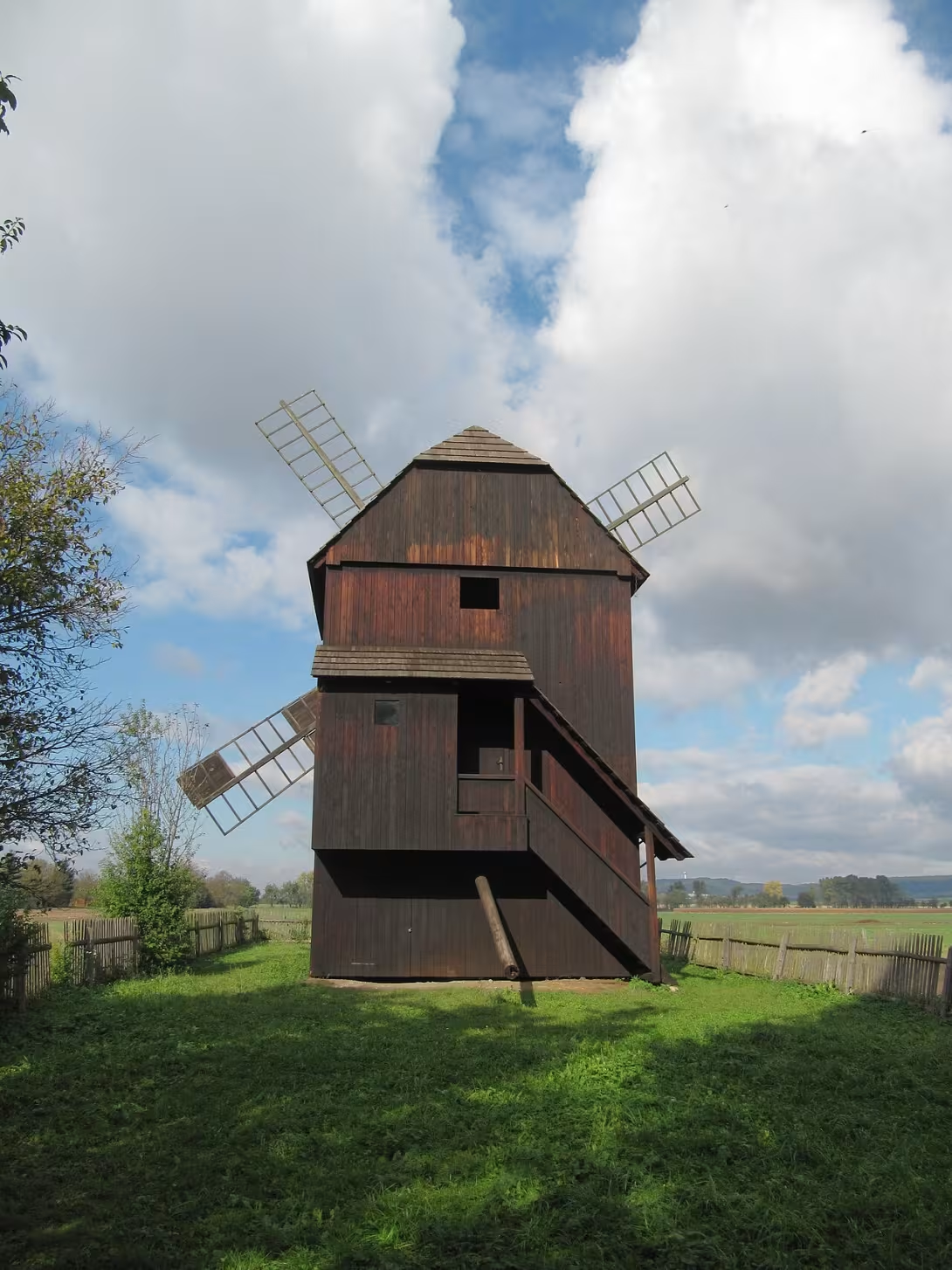

The historical appearance on the left is an AI-generated visualisation and serves as inspiration only.
Historical milestones
- 1795
- Construction of the mill in the village of Borenovice.
- 1891
- The mill was overthrown by the storm and subsequently repaired.
- 1977
- Transferring the mill to the museum in Rymice.
Architectural development
The mill is a wooden construction with a plate cover and a saddle roof. When repaired in 1891, the inner shalanda was removed. The wind wheel has a diameter of 14.8 metres and in the interior there is one grinding composition with stones of 1.2 metres in diameter.
Historical events
In 1891 the mill was overthrown by the storm and subsequently repaired. In 1932 he was saved from the abolition of the intervention of the monument institute. In 1977, the object was moved to a scan in Rymice.
Owners
Municipality of Borenovice, František Hlobil, František Sklář, Museum of Kromerizska.
Points of interest
- The windmill is a classical building of the German pillar type, which was founded in 1795 in the village of Borenovice. - The building plot for the mill was purchased by František Hlobil for 60 gold pieces that he paid back on debt. - In 1891, the building was overthrown by a storm, followed by reconstruction. - Miller František Sklář tried to end the business in 1932 and to cancel the mill, but the monument institute in Brno prevented him from doing so. - In 1977, the building was moved to a museum in Rymice, where the Museum of Kroměřízska manages it.
Guide
Show guide text
This text was created by artificial intelligence and has not been editorially reviewed. It may contain inaccuracies.
Welcome to Rymice. Right now, you're facing one of the most striking and fascinating buildings of our scandal. In front of you is a windmill that immediately attracts the attention of every visitor with its silhouette. Stop for a moment, take a breath and just feel his presence. It is a building that carries a century of history, human effort and struggle with natural elements. Look at its overall form and perceive the sense of stability that radiates, even if it is essentially a wood structure.
However, this mill has not stood in Rymice since its beginning. His journey to us was long and full of events. In order to understand what we are actually seeing, we need to move more than two yards back in our minds, namely to 1795. It was this year that the mill was built, but not here, but in the village of Borenovice. Imagine the landscape where these machines served as the heart of the local economy. At a time when neither electricity nor combustion engines existed, wind power was one of the most valuable sources of energy. The mill was not just a building, it was the technological peak of its time, which allowed to turn grain into flour and thereby provide food for the whole village.
Now pay attention to the architecture itself, because it is very specific. You're standing in front of the so-called German pillar mill. This is a technical name for the type of construction where the whole mill, i.e. its main part with machiners, stands on one massive vertical column. This construction was brilliant in allowing the whole structure to rotate so that the mill blades were always directed directly against the wind, no matter where it was blowing. Look at its dimensions. The entire floor plan is exactly square, measures five and eighty to five and eighty meters. If you look up, you'll see that the building is at 11 and 2 / 10 feet. It's a height enough for the mill to catch air flow over the surrounding terrain.
Notice the roof as well. It is covered with shingles, which is a traditional material that gives the mill its typical, rustic appearance while protecting it from collisions. The whole object is performed in classical style. This means that in its construction we will find a certain balance, silverness and functionality that was typical for the end of the eighteenth century. Nothing here is useless, every element has a clear purpose.
Now let's think about the people who created this mill and kept it going. Behind every stone and every piece of wood is a human story. One of the key persons was František Hlobil. Imagine his courage and ambition in 1795. It was he who purchased the building plot in Borenovice, on which the mill originally stood. The price was 60 gold coins. This may sound like a small amount to us these days, but at the time it was a considerable financial undertaking. What is even more interesting, however, is the fact that he did not pay back these sixty gold pieces at once, but took them to debt. So this mill was essentially a product of financial risk, faith in the future and hard work. The name František Sklař appears next to him in the history of the mill. These men breathed life into the building and ensured that the mill served the community and the mill trade in the region prospered.
But history is not only about building and success, but also about the tests that the building has to pass. In 1891 the mill experienced its greatest dramatic moment. There was a strong storm that was so devastating, it just knocked over this massive wooden structure. Imagine the thunder of falling wood and the shock of the locals who saw their important machine lying in ruins on the ground. It may seem like it's over, but the miller trade is about endurance. The mill was not abandoned or demolished. It was followed by a difficult reconstruction and repair. The fact that the mill got up again and could continue to function suggests its enormous value to the people at the time and their ability to repair what seemed irreparably destroyed.
Maybe now you can think of a question of how the mill got here to Rymic. This happened much later, in 1977. As part of the effort to preserve unique elements of folk architecture, the mill was carefully moved to the skanzen. It became part of the Folk Construction File, where it can be protected from oblivion and decay. Thanks to this transfer we can admire today a valuable document of technical history and miller craft from all over Kroměříž. It's basically a time machine that shows us how life has been and worked in the past.
When you look at the mill, try to imagine the constant noise of wooden gears, dust from ground grain in the air and the smell of fresh flour. Imagine a miller who had to have a sense of the wind and understand every squeak of his building. This mill is not just a dead object in the museum, it is a monument to human ingenuity and the ability to use the forces of nature to its advantage.
Now that you know the story of this mill, I suggest you take a moment to examine it. Walk around him, perceive the texture of the shingles roof, and think about how many generations of people passed by him and how many bags of grain within him went through the grinding. It is fascinating to think that this building survived the whirlwind, the movement and the rotation of regimes and centuries.
Thank you for your attention to this place. I now invite you to continue to explore our scan. There are other beautiful buildings in the vicinity that reveal the secrets of our ancestors' rural life and crafts. Let yourself be guided by your curiosity and enjoy the rest of your visit to Rymice. I wish you a pleasant and inspiring walk.
Tips for visitors
The best time to visit is in the morning during the working week or on weekends away from the main summer season, avoiding larger groups of tourists and enjoying the quiet atmosphere of the rural area.
If you use public transport, we recommend checking the current connection to the village in the internet search engine in advance.
We recommend that you take fixed shoes suitable for movement in the natural terrain and in the area of folk buildings. Don't forget the headgear and plenty of fluids, especially if you plan to walk around longer.
For shooting the mill is ideal soft light during the morning or late afternoon. The best shots can be obtained from a slight distance so that the entire silhouette of wooden structure stands out in the background of the sky.
For families with children, the area is an ideal place to know history. Children will appreciate the opportunity to see the construction up close and learn how the grain was previously ground. In the vicinity you can also visit other objects of a set of folk buildings or take a trip to the nearby town of Kromeriz.
Frequently asked questions
Can the monument be visited?
Some buildings of this kind are open for guided tours, others serve another purpose or are privately owned. We have not verified whether and when this monument is open – please ask the operator.
What are the opening hours and admission?
We have not verified the opening hours or admission. Current information is published by the operator.
Where is the monument?
Location: Zlínský kraj. The map on this page shows the exact spot.
Why is the monument protected?
It is listed in the Central List of Cultural Monuments of the Czech Republic as a cultural monument (register no. 1000146287).
Businesses nearby
Do you run a restaurant, accommodation, shop, museum, rental, wellness or other visitor service near this monument? Show yourself directly to the people heading to it — this is how they will see you in the app and on the web:
Nearby
Obec Rymice, Soubor lidových staveb, město Kroměříž.
Accommodation nearby
Trips and activities nearby
Guided tours, tickets and activities nearby from GetYourGuide
Affiliate link: if you buy from the partner, we may receive a commission. The price for you does not change.
Search tours and activities →Themed route
1. Kroměříž (city): Historical Centre, which serves as the ideal start of the journey. 2. The village Rymice (village): A place with a pleasant atmosphere of the countryside. 3. Set of folk buildings (folk architecture): Construction of traditional houses, which shows the ancient way of life. 4. Větrný mlýn (Rymice) (mill): The main destination of the trip and fascinating technical construction.
Seasonal recommendations
Spring: In spring the Rymice windmill is revived by flowers and new leaves that add colour to the surrounding environment. Sun rays are projected through young twigs, creating an attractive atmosphere for visitors. It is advisable to visit the memory early in the morning or later in the evening to avoid the weather with rain, which is a common phenomenon at this time. It is recommended to wear clothes suitable for mild temperatures and to keep in mind a handkerchief or coat for cooler moments.
Summer: Summer brings long, sunny days that are ideal for exploring Rymice windmill. High temperatures and bright sun can not only be impressive, but also exhausting, so it is good to bring drinking water. The best time to visit is morning or evening to avoid the heat and crowds that are common during the summer months. We recommend durable umbrella and UV protection clothing.
Autumn: In autumn, the surrounding wind mill Rymice grows colorful beauty when the leaves withdraw into yellow and red shades. Solar intensity is still sufficient for photography and walks, but temperatures are lighter than in summer. It is advisable to visit the memory during the day to avoid cold evenings. It is recommended to wear top clothes and handkerchief for morning and evening cold.
Winter: During winter, Rymice's windmill is covered with snow, adding magic to its atmosphere. The temperatures are low, so it is important to keep warm clothes in mind, including leather shoes and a protective umbrella. The monument can be visited during the day hours, but it is necessary to be aware of the possibility of shortened opening times in colder months. Visitors should also remember the potential snow cover and the readiness for winter conditions.
Visualizations and artistic views


The visualisations are generated by artificial intelligence and serve as inspiration.
Photos from the area
Real photos taken near the monument


Zdroj a licence jsou uvedeny u každého snímku.
Tips from visitors
No tips yet. Be the first!
Log in and add your tip.
Sources and literature
Photos: palickap / CC BY 3.0 — Wikimedia Commons. The author and licence also appear when you hover over the image.
Faktickým podkladem tohoto textu byl článek na Wikipedii, jehož autory jsou přispěvatelé Wikipedie. Článek je dostupný pod licencí CC BY-SA 4.0.
Location on the map
More monuments – Zlínský kraj
Show all in the region

Příběhy a pověsti
Legendy, pověsti a příběhy spjaté s touto památkou
Fotografie návštěvníků
Zatím žádné fotografie. Buďte první, kdo přidá fotografii z návštěvy!
Log in a přidejte svou fotografii nebo hodnoťte.
Za ověřenou návštěvu v aplikaci získáte víc bodů — poznáme podle GPS, že jste na místě.
Reviews and comments