



Větrný mlýn ve Studénce Windmill
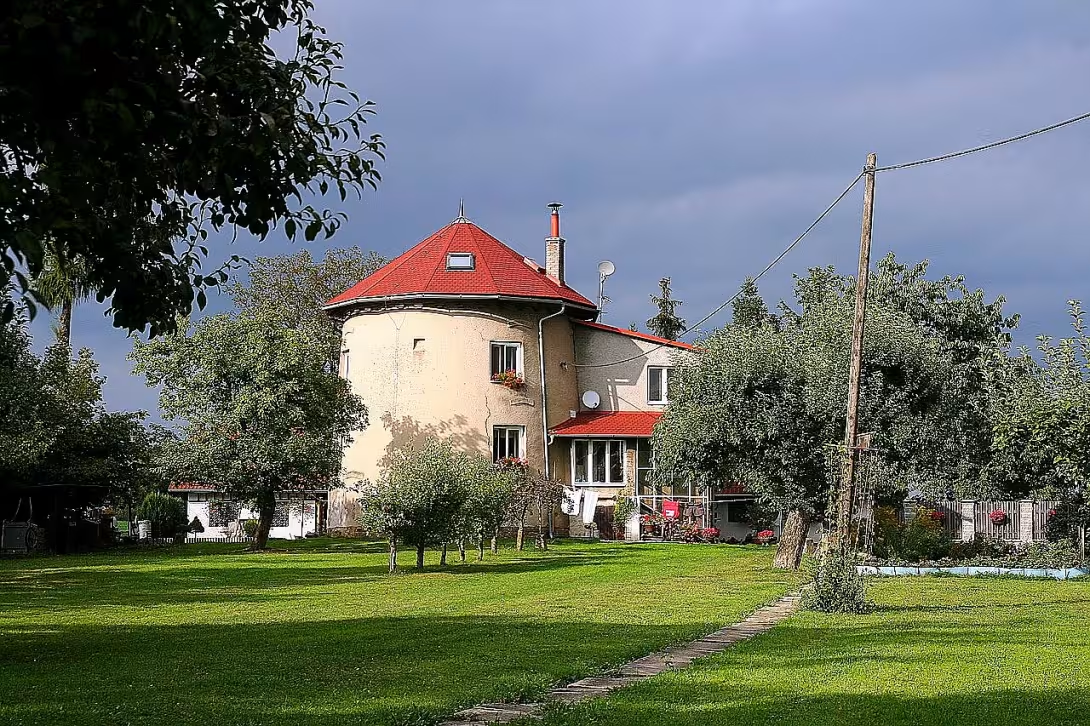
Větrný mlýn ve Studénce is a brick construction of the Dutch type in the Moravian-Silesian region. The building is probably from the beginning of the 19th century. Its importance lies in the fact that the original milling plant survived until the end of World War II.
There are few reports of the oldest history of the mill. Written sources from the time of creation are missing, therefore the exact year of construction is not documented. The Czech countries were then within the Austrian Empire, which recovered from the napoleonic wars and went through the initial phase of the industrial revolution.
Architecturally, it is a brick construction of the Dutch type. The original look included a shingles roof. In the 1950s, however, the mill underwent an insensitive reconstruction, which disrupted its authenticity. The original roof was replaced with metal, new rectangular windows were broken into the mantle and a brick porch was added. During these modifications, all internal grinding equipment and blades disappeared.
The mill was operational until the beginning of the 20th century. A fundamental break in his fate came at the end of World War II. Between April 30 and May 2, 1945, the object was severely damaged during the battle of the front. The building was subsequently repaired in 1947. Since 1958 the mill has been guided as a state-protected cultural monument.
Today the mill in Studenka is a reminder of the technical history of the region, although its original technological and architectural form has been significantly altered in the past. Visitors to the city can see the object near the natural reserve around the Odra River. The tour offers the opportunity to reflect on changes in rural architecture and the fate of buildings that have survived the war conflicts of the 20th century.
Historical milestones
- 1945
- The mill was badly damaged during the Soviet-German front.
- 1947
- The building's been repaired.
- 1958
- The building was declared to be protected.
Architectural development
It was originally a brick mill of the Dutch type with shingles roof. In the 1950s, it underwent an insensitive reconstruction in which internal grinding equipment and blades were removed. The original roof was replaced with tin, new windows were broken into the mantle and a brick porch was added.
Historical events
In 1945, the mill was badly damaged during World War II. The building was repaired in 1947. Since 1958, the mill has been protected historically.
Points of interest
- It's a walled-up construction of the Dutch type, which probably dates back to the early nineteenth century. - The original grinding plant was preserved in the building until the end of World War II. - In the 1950s, the mill went through an insensitive reconstruction, in which the internal grinding equipment and blades disappeared and the original shingle roof was replaced with tin. - Between April 30 and May 2 of the year one thousand nine hundred forty-five, the object was severely damaged during the battle of the front. - Since the year one thousand nine hundred fifty-eight, the mill has been held as a state-protected cultural monument.
Guide
Show guide text
This text was created by artificial intelligence and has not been editorially reviewed. It may contain inaccuracies.
Welcome to the Studenka. You are standing in front of just one of the most interesting historical objects in this area, which will immediately attract your attention with its presence. Before your eyes, there is a windmill whose massive walled figure is very dignified and peaceful in the landscape. Even though the world around us is constantly changing and time is flowing relentlessly forward, this building here stands as a firm point, as a silent witness to the many years it has borne behind. Feel the atmosphere, feel the calm that seems to be almost intact around this building, and try to imagine what this place looked like in times when life was much simpler and more dependent on the forces of nature.
Now let's move further into the past together and understand how this mill came to be. Although no old written records tell us the exact date of its construction, historical context allows us to get very close to its beginnings. We believe this object originated in the early nineteenth century. Imagine the time when agriculture became the foundation of all human endeavours and when the windmill was an absolute necessity for every community. This mill has served its people here for many decades. It was a place of work, a place of meeting, and a place where the wind force turned into an obezProcessing People's Food. It worked here in full operation until the beginning of the twentieth century, when the world began to change and when new technologies began to change the way people work with the earth.
Now pay attention to the architecture itself and to what you're seeing right now. Look at this massive structure. It's a walled building that carries very specific features that we call the Dutch type. This style of construction is rare in our area and gives the mill its unique character. The Dutch type means some strength and stability that was necessary for buildings to face constant wind pressure. Feel the strength of the wall, the massive material from which the building is built. Although time and elements tried to weaken this building, it still stands and reminds us of the quality of the craft at the time. Look at its walls and see the stability that this building carries inside it.
But the history of this place is not just a story of quiet work and agricultural rhythm. It is also a story of great suffering and stormy times that have struck this country. We must prepare ourselves for the fact that this quiet corner, too, has become part of major world conflicts. 1945 was very difficult for this mill. At a time when the lines of battle were constantly moving and when one army withdrew and the other, coming from eastern territories, moved forward, there was a bloody struggle here. The mill found itself in a fire of conflict and suffered considerable damage at that time. It was a time of chaos when everything that people have been building for centuries could be destroyed in an instant. Fortunately, however, the building was repaired in 1947, when people tried to return life to this place and repair what the war had so badly destroyed.
And it's here that we come to something that may be the greatest mystery and the greatest loss of this place. If you could look inside now, you might be looking for those huge machines, those complex mechanisms that previously powered the wind. And you know what? By the end of World War II, the original milling plant was actually preserved in this building. It was the machines, the parts that formed the very soul of this mill. It was the heart that beat in it. But in the 1950s, something happened that we see as very unfortunate today. There was a reconstruction that was carried out very insensitive. In this process, everything that made the mill the real mill was removed. The internal grinding machine has disappeared and we're left with this beautiful but empty box. What was once full of motion, sound and work was replaced by silence. That's why this mill is so interesting today - it's like a memory of something that no longer exists, but what we still feel in its walls.
This object was declared a monument in 1958, which means that its historical significance was recognised despite all the losses it suffered. It's our common treasure that teaches us about history, about human work and the destructive power of war. Even if you no longer hear the sound of grinding machines in it today, his presence still tells us the story of the people who lived and worked here.
Now that you know about his fate and what this place has experienced, I suggest you walk around and perceive the silence that exists here. Try in your mind to complete the missing parts that were once there, and imagine the movement, the wind and the work. Thank you for taking this short journey through time. We wish you a wonderful continuation in the tour of our beautiful countryside.
Tips for visitors
The best time to visit is during sunny days in spring or summer months, when the surrounding landscape is fully blooming and the construction of the mill stands out in contrast to the blue sky. Due to the open space, we recommend avoiding wind days.
The easiest way to remember is by car.
Take with you fixed shoes suitable for field movement and, in case of sunny weather, a headgear and plenty of liquids, because there are not many shady places around the mill.
We recommend the photographers to use the golden hour shortly before sunset, when soft light beautifully depicts the structure of the brick wall of the Dutch type. The best shots are taken from a slight distance to capture the entire mill silhouette in the landscape.
For families with children the trip is ideal as an easy walk.
Frequently asked questions
Can the monument be visited?
This is a technical monument. Some are open as exhibitions, others are out of use or on private land. We have not verified whether this one is accessible.
What are the opening hours and admission?
We have not verified the opening hours or admission. Current information is published by the operator.
Where is the monument?
Location: Studénka, Moravskoslezský kraj. The map on this page shows the exact spot.
Why is the monument protected?
It is listed in the Central List of Cultural Monuments of the Czech Republic as a cultural monument (register no. 1000147718).
Businesses nearby
Do you run a restaurant, accommodation, shop, museum, rental, wellness or other visitor service near this monument? Show yourself directly to the people heading to it — this is how they will see you in the app and on the web:
Events nearby
Zdroj akcí: otevřená data měst a obcí ČR (Národní katalog otevřených dat) a kalendář akcí Národního památkového ústavu.
Nearby
Město Studénka, přírodní rezervace v okolí řeky Odry.
Accommodation nearby
Themed route
1. City Studénka - village. Suitable starting point for meeting local environment. 2. Větrný mlýn ve Studénce - technical monument. The main destination of the trip, which represents a unique construction in the landscape. 3. Natural reservation in the vicinity of the river Odra - protected area. Ideal place for a quiet walk and water nature observation.
Seasonal recommendations
In spring the mill will surround the lush green and the first flowers, creating a feeling of a new beginning. The light is soft and pleasant for the observation of the building. We recommend to dress in more layers because the weather is variable. It's best to come in the morning before any spring showers start.
In the summer months the monument in the bright sun and surrounding landscape is densely wooded. The atmosphere is full of energy, but there are more visitors. It is advisable to choose light clothes and come first thing in the morning to avoid the biggest crowds and heat. Don't forget to bring enough water.
Autumn brings golden leaves and frequent mists to the studios that provide a mysterious touch. The air is getting colder and winder, which is symbolic for this building. Practical is to take a waterproof jacket and plan a visit to the late afternoon when the sun beautifully highlights the colors of nature.
In winter the mill may look very rough, especially if the landscape is covered with snow and the trees are without leaves. There's peace and quiet. It's essential to have warm shoes and gloves because of the cold.
Visualizations and artistic views


The visualisations are generated by artificial intelligence and serve as inspiration.
Photos from the area
Real photos taken near the monument

Zdroj a licence jsou uvedeny u každého snímku.
Tips from visitors
No tips yet. Be the first!
Log in and add your tip.
Sources and literature
Photos: Kankovaa / CC BY-SA 3.0 — Wikimedia Commons. The author and licence also appear when you hover over the image.
Faktickým podkladem tohoto textu byl článek na Wikipedii, jehož autory jsou přispěvatelé Wikipedie. Článek je dostupný pod licencí CC BY-SA 4.0.
Location on the map
Příběhy a pověsti
Legendy, pověsti a příběhy spjaté s touto památkou
Fotografie návštěvníků
Zatím žádné fotografie. Buďte první, kdo přidá fotografii z návštěvy!
Log in a přidejte svou fotografii nebo hodnoťte.
Za ověřenou návštěvu v aplikaci získáte víc bodů — poznáme podle GPS, že jste na místě.
Reviews and comments